Top | Home | Frequently Asked Questions | Guestbook
Disclaimer: This information is believed to be accurate, but is not guaranteed.
 Please send corrections or additions to

#5046
#5045
#5044
#5043
- GUIDE US, O THOU GREAT JEHOVAH Music: John Hughes Text: William Williams Arrangement: Mack Wilberg
- ALL THINGS BRIGHT AND BEAUTIFUL Music: John Rutter Text: Cecil Frances Alexander
- FLUTE SOLO (ORGAN SOLO) Music: Thomas Arne Arrangement: Diane Bish
- O SPLENDOR OF GOD’S GLORY BRIGHT Music: German hymn tune Text: St. Ambrose; transl. Louis F. Benson Arrangement: Mack Wilberg
- HIS EYE IS ON THE SPARROW Music: Charles H. Gabriel Text: Civilla D. Martin Arrangement: Mack Wilberg
- THE SPOKEN WORD: “Love’s Currency”
- LOVE WILL BLESS OUR HOME Music: Ryan Murphy Text: Marvin K. Gardner
- THE MORNING BREAKS Music: George Careless Text: Parley P. Pratt Arrangement: Mack Wilberg
#5042
- GREAT IS THY FAITHFULNESS Music: William M. Runyan Text: Thomas O. Chisholm Arrangement: Ryan Murphy
- IF THE SAVIOR STOOD BESIDE ME Music and Text: Sally DeFord Arrangement: Sam Cardon
- SING PRAISE TO HIM (ORGAN SOLO) Music: from Bohemian Brethren’s Songbook Arrangement: Richard Elliott
- AWAKE AND ARISE, ALL YE CHILDREN OF LIGHT Music: Welsh tune (The Ash Grove) Text: David Warner Arrangement: Mack Wilberg
- MAY WE BE MORE LIKE THEE Music: Mack Wilberg Text: Lloyd Newell
- THE SPOKEN WORD: “Sit and Eat”
- THINK A SACRED SONG Music and Text: Marlene Summers Merkling Arrangement: Mack Wilberg
- LET THE LIGHT OF CHRIST WITHIN ME Music: Mack Wilberg Text: David Warner
#5041
- THIS DAY IS A GOOD DAY, LORD Music and Text: J. Frederic Voros Jr. Arrangement: Mack Wilberg
- LIGHT UNTO LIFE Music: Mack Wilberg Text: David Warner
- THE KING OF LOVE MY SHEPHERD IS Music: Irish melody Text: Henry Baker Arrangement: Mack Wilberg
- CARILLON DE WESTMINSTER (ORGAN SOLO) Music: Louis Vierne
- SOFTLY AND TENDERLY Music and Text: Will L. Thompson Arrangement: Mack Wilberg
- THE SPOKEN WORD: “Inspiration from Heaven”
- CLOSE AS A QUIET PRAYER Music and Text: Sally DeFord Arrangement: Ryan Murphy
- TO GOD BE THE GLORY Music: William H. Doane Text: Fanny J. Crosby Arrangement: Ryan Murphy
An Africa Special
#5040
- ALLELUIA FANFARE AND PRAISE TO THE LORD, THE ALMIGHTY Music: from Stralsund Gesangbuch Text: Joachim Neander; transl. Catherine Winkworth Arrangement: Mack Wilberg
- JOIN WE NOW IN PRAISE AND SING Music: Spanish melody Text: William E. Hickson Arrangement: Mack Wilberg
- PRAISE! PRAISE! PRAISE THE LORD! Music: traditional Cameroon processional song Text: traditional; collected by Elaine Hanson Arrangement: Ralph Johnson
- COME, COME, YE SAINTS Music: American folk song Text: William Clayton Arrangement: Mack Wilberg
- THE SPOKEN WORD: “The Joy We Share”
- HOW FIRM A FOUNDATION Music: J. Ellis Text: attr. Robert Keen Arrangement: Mack Wilberg
- AMAZING GRACE Music: American folk hymn Text: John Newton Arrangement: Mack Wilberg
#5039
- LET ALL THE WORLD IN EVERY CORNER SING Music: Ryan Murphy Text: George Herbert
- HEAR HIM Music: Ryan Murphy Text: Wendy Randall
- HORNPIPE, FROM WATER MUSIC (ORGAN SOLO) Music: George Frideric Handel Arrangement: Carl McKinley
- OH, WHAT A BEAUTIFUL MORNIN’ from Oklahoma! Music: Richard Rodgers Text: Oscar Hammerstein II Arrangement: Arthur Harris
- THE SPOKEN WORD: “Remembering: An Antidote”
- ALABARÉ (I WILL PRAISE) Music and Text: José Pagán and Manuel José Alonso Arrangement: Mack Wilberg
- IT IS WELL WITH MY SOUL Music: Philip Paul Bliss Text: Horatio G. Spafford Arrangement: Mack Wilberg
Annual General Conference
#5038
- THAT EASTER DAY WITH JOY WAS BRIGHT Music: German hymn tune Text: from a Latin hymn; transl. John Mason Neale Arrangement: Mack Wilberg
- COME, ALL PEOPLE, LOOK AND WONDER Music: Henry Smart Text: Thomas Kelly Arrangement: Mack Wilberg
- I STAND ALL AMAZED (ORGAN SOLO) Music: Charles Hutchinson Gabriel Arrangement: Andrew Unsworth
- JESUS HAS RISEN Music and Text: Thelma Johnson Ryser Arrangement: Ryan Murphy
- I KNOW THAT MY REDEEMER LIVES Music: Lewis D. Edwards Text: Samuel Murray Arrangement: Mack Wilberg
- THE SPOKEN WORD: “Easter Is Hope”
- BECAUSE OF HIM Music: American folk hymn Text: David Warner Arrangement: Mack Wilberg
- HAIL THE DAY THAT SEES HIM RISE Music: Robert Williams Text: Charles Wesley Arrangement: Mack Wilberg
#5037
- HOSANNA, LOUD HOSANNA Music: German hymn tune Text: Jennette Threlfall Arrangement: Mack Wilberg
- HALLELUJAH from Christ on the Mount of Olives Music: Ludwig van Beethoven Text: based on scripture
- BEAUTIFUL SAVIOR (ORGAN SOLO) Music: Silesian folk tune Arrangement: Dale Wood
- CONSIDER THE LILIES Music and Text: Roger Hoffman Arrangement: A. Laurence Lyon
- THE SPOKEN WORD: “This Is Jesus”
- TELL ME THE STORIES OF JESUS Music: Frederic A. Challinor Text: W. H. Parker Arrangement: Ryan Murphy
- REJOICE, THE LORD IS KING! Music: Horatio Parker Text: Charles Wesley Arrangement: Ryan Murphy
Guests: BRIGHAM YOUNG UNIVERSITY SINGERS; ANDREW CRANE, Conductor
#5036
- I THINK THE WORLD IS GLORIOUS Music: Alexander Schreiner Text: Anna Johnson Arrangement: Mack Wilberg
- RISE! UP! ARISE! (EXCERPT) from Saint Paul Music: Felix Mendelssohn Text: based on scripture
- THERE IS SUNSHINE IN MY SOUL TODAY Music: John R. Sweney Text: Eliza E. Hewitt Arrangement: Mack Wilberg
- COME, THOU FOUNT OF EVERY BLESSING (ORGAN SOLO) Music: John Wyeth Arrangement: Dale Wood
- REJOICE, THE LORD IS KING Music: Malcolm Archer Text: Charles Wesley
- HAIL, GLADDENING LIGHT Brigham Young University Singers Music: Charles Wood Text: trans. John Keble
- THE SPOKEN WORD: “Becoming Brave”
- SALMO (PSALM) 150 Brigham Young University Singers Music: Ernesto Herrera Text: based on scripture
- REDEEMER OF ISRAEL Music: Freeman Lewis Text: Joseph Swain; adapted by William W. Phelps Arrangement: Mack Wilberg
#5035
- SCATTER SUNSHINE Music: Edwin O. Excell Text: Lanta Wilson Smith Arrangement: Ryan Murphy
- I KNOW THAT MY SAVIOR LOVES ME Music and Text: Tami Jeppson Creamer Arrangement: Ryan Murphy
- PRELUDE ON “PISGAH” (ORGAN SOLO) Music: American folk hymn Arrangement: Dale Wood
- WHEN YOU WISH UPON A STAR from Pinocchio Music: Leigh Harline Text: Ned Washington Arrangement: Michael Davis
- THE SPOKEN WORD: “Water the Roots”
- LET US ALL PRESS ON Music and Text: Evan Stephens Arrangement: Richard Elliott
- PRESS FORWARD, SAINTS Music: Vanja Y. Watkins Text: Marvin K. Gardner Arrangement: Mack Wilberg
#5034
- IN HYMNS OF PRAISE Music: Alfred Beirly Text: Ada Blenkhorn Arrangement: Mack Wilberg
- LOOK AT THE WORLD Music and Text: John Rutter
- RECESSIONAL (ORGAN SOLO) Music: Robert Cundick
- ALLELUIA Music: attr. Giulio Caccini Arrangement: Mack Wilberg
- Spoken word: "Learning From Living"
- FOR THE BEAUTY OF THE EARTH Music: Conrad Kocher Text: Folliott S. Pierpoint Arrangement: Mack Wilberg
- HOW FIRM A FOUNDATION Music: J. Ellis Text: attr. Robert Keen Arrangement: Mack Wilberg
Rebroadcast of episode #5015
#5033
- LET THERE BE LIGHT! Music: Gilbert M. Martin Text: John Marriott
- I SING THE MIGHTY POWER OF GOD Music: English melody Text: Isaac Watts Arrangement: Mack Wilberg
- PRELUDE ON “BROTHER JAMES’S AIR” (ORGAN SOLO) Music: Searle Wright
- AWAKE THE HARP from The Creation Music: Franz Joseph Haydn Text: Based on scripture
- COUNT YOUR BLESSINGS INSTEAD OF SHEEP Music and Text: Irving Berlin Arrangement: Michael Davis
- THE SPOKEN WORD: “Love Is Spelled T-I-M-E”
- LIGHT UNTO LIFE Music: Mack Wilberg Text: David Warner
- LOVE DIVINE, ALL LOVES EXCELLING Music: Rowland Hugh Prichard Text: Charles Wesley Arrangement: Mack Wilberg
Rebroadcast of episode #5014
#5032
- I THINK THE WORLD IS GLORIOUS Music: Alexander Schreiner Text: Anna Johnson Arrangement: Mack Wilberg
- WITH JOYFUL VOICES RINGING Music: William G. Tarrant Text: Irish folk song Arrangement: Mack Wilberg
- JESUS LOVES ME Music: William B. Bradbury Arrangement: Brian Mathias
- JESU, JOY OF MAN’S DESIRING Music: Johann Sebastian Bach Text: Martin Jahn Arrangement: Mack Wilberg
- THE SOUND OF MUSIC from The Sound of Music Music: Richard Rodgers Text: Oscar Hammerstein II Arrangement: Arthur Harris
- Spoken word: Fear Not
- LET US ALL PRESS ON Music and Text: Evan Stephens Arrangement: Richard Elliott
- O LOVE THAT WILL NOT LET ME GO Music: Albert L. Peace Text: George Matheson Arrangement: Ryan Murphy
#5031
- Allelujah Fanfare/PRAISE TO THE LORD, THE ALMIGHTY Music: from Stralsund Gesangbuch Text: Joachim Neander; trans. Catherine Winkworth Arrangement: Mack Wilberg
- PSALM 148 Music: Gustav Holst Text: based on scripture
- PRAISE THE LORD WITH DRUMS AND CYMBALS (ORGAN SOLO) Music: Sigfrid Karg-Elert
- WHAT A WONDERFUL WORLD Music and Text: George David Weiss and Bob Thiele Arrangement: Mack Wilberg
- THE SPOKEN WORD: “Love Is a Verb”
- LOVE ONE ANOTHER Music and Text: Luacine Clark Fox Arrangement: Mack Wilberg
- MY GOD IS SO HIGH Music and Text: African American spiritual Arrangement: Ryan Murphy
#5030
- On This Day of Joy and Gladness Music and Text: Leroy J. Robertson Arrangement: Mack Wilberg
- For The Beauty of The Earth Music: John Rutter Text: Folliott S. Pierpoint
- The Ash Grove [organ solo] Music: Welsh melody Arrangement: John Longhurst
- How Excellent Thy Name, from Saul Music: George Frideric Handel Text: Charles Jennens
- Spoken word: "His Eye Is On The Sparrow"
- His Eye Is On The Sparrow Music: Charles H. Gabriel Text: Civilla D. Martin Arrangement: Mack Wilberg
- I Believe In Christ Music: John Longhurst Text: Bruce R. McConkie Arrangement: Mack Wilberg
Guest director: Daniel Hyde, of Kings College, Cambridge
#5029
- Morning Has Broken Music: Gaelic melody Text: Eleanor Farjeon Arrangement: Mack Wilberg
- O Clap Your Hands [directed by Daniel Hyde, of Kings College, Cambridge]Music: John Rutter Text: based on Psalm 47
- SINFONIA, FROM CANTATA NO. 29 (“WE THANK THEE, GOD”) (ORGAN SOLO) Music: Johann Sebastian Bach Arrangement: Robert Hebble
- AWAKE THE HARP from The Creation Music: Franz Joseph Haydn Text: based on scripture
- BROTHER JAMES’S AIR Music: James Leith MacBeth Bain Text: based on Psalm 23 Arrangement: Mack Wilberg
- The Spoken Word: "The Accumulation of Our Decisions"
- Oh, Peter, Go Ring Them Bells Music and Text: African American spiritual Arrangement: Howard Helvey
- Guide Us, O Thou Great Jehovah Music: John Hughes Text: William Williams Arrangement: Mack Wilberg
#5028
- THIS DAY IS A GOOD DAY, LORD Music and Text: J. Frederic Voros Jr. Arrangement: Mack Wilberg
- JOIN WE NOW IN PRAISE AND SING Music: Spanish melody Text: William E. Hickson Arrangement: Mack Wilberg
- FINAL, FROM SYMPHONY NO.1 (ORGAN SOLO) Music: Louis Vierne
- MY SONG IN THE NIGHT Music and Text: American folk hymn Arrangement: Mack Wilberg
- HOLD ON from ThenSecret Garden Music: Lucy Simon Text: Marsha Norman Arrangement: Ryan Murphy
- THE SPOKEN WORD: “Moments That Matter”
- THIS LITTLE LIGHT OF MINE Music and Text: African American spiritual Arrangement: Mack Wilberg
- It Is Well With My Soul [live broadcast]
#5027
- WITH SONGS OF PRAISE Music: Newell Kay Brown Text: Penelope Moody Allen Arrangement: Mack Wilberg
- HARK, ALL YE NATIONS! Music: George F. Root Text: Louis F. Mönch Arrangement: Mack Wilberg
- FINALE, FROM SYMPHONY NO.6 (ORGAN SOLO) Music: Charles-Marie Widor
- WHO WILL BUY? from Oliver! Music and Text: Lionel Bart Arrangement: Michael Davis
- THE SPOKEN WORD: “My Brother’s Keeper”
- LORD, I WOULD FOLLOW THEE Music: K. Newell Dayley Text: Susan Evans McCloud Arrangement: Ryan Murphy
- STANDING ON THE PROMISES Music and Text: Russell K. Carter Arrangement: Ryan Murphy
#5026
- GUIDE US, O THO GREAT JEHOVAH Music: John Hughes Text: William Williams Arrangement: Mack Wilberg
- O SPLENDOR OF GOD’S GLORY BRIGHT Music: German hymn tune Text: St. Ambrose; transl. Louis F. Benson Arrangement: Mack Wilberg
- PRELUDE ON “PROSPECT OF HEAVEN” (ORGAN SOLO) Music: Andrew Gramling Arrangement: Andrew Unsworth
- GIVE GLORY TO HIS HONORED NAME from Athalia Music: George Frideric Handel Text: Samuel Humphreys
- DEAREST CHILDREN, GOD IS NEAR YOU Music: John Menzies Macfarlane Text: Charles L. Walker Arrangement: Mack Wilberg
- DOWN TO THE RIVER TO PRAY Music and Text: American folk hymn Arrangement: Mack Wilberg
- THE SPOKEN WORD: “True Wisdom”
- THE KING OF LOVE MY SHEPHERD IS Music: Ryan Murphy Text: Henry Baker
- TO GOD BE THE GLORY Music: William H. Doane Text: Fanny J. Crosby Arrangement: Ryan Murphy
#5025
- COME, YE CHILDREN OF THE LORD Music: Spanish melody Text: James H. Wallis Arrangement: Mack Wilberg
- IF THE SAVIOR STOOD BESIDE ME Music and Text: Sally DeFord Arrangement: Sam Cardon
- VENITE! (ORGAN SOLO) Music: John Leavitt
- GLORY TO GOD ON HIGH Music: Felice de Giardini Text: James Allen Arrangement: Mack Wilberg
- BE THOU MY VISION Music: traditional Irish hymn Text: versed by Eleanor H. Hull; trans. Mary E Byrne Arrangement: Mack Wilberg
- THE SPOKEN WORD: “Waging Peace”
- PEACE LIKE A RIVER Music and Text: African American spiritual Arrangement: Mack Wilberg
- THE MORNING BREAKS Music: George Careless Text: Parley P. Pratt Arrangement: Mack Wilberg
Rebroadcast of episode #4917
#5024
- JOY TO THE WORLD Music: Lowell Mason Lyrics: Isaac Watts Arrangement: Mack Wilberg
- HOW FAR IS IT TO BETHLEHEM? Music: English Carol Lyrics: Frances Chesterton Arrangement: Mack Wilberg
- OF THE FATHER’S LOVE BEGOTTEN (ORGAN SOLO) Music: 13th-Century Plainsong Arrangement: Andrew Unsworth
- THERE ARE ANGELS HOV’RING ROUND Music and Lyrics: Traditional Spiritual Arrangement: Ryan Murphy
- GO, TELL IT ON THE MOUNTAIN Music and Lyrics: African American Spiritual Arrangement: Ryan Murphy
- THE SPOKEN WORD: “Gathering for Christmas”
- HALLELUJAH from Messiah Music: George Frideric Handel Lyrics: from Scripture
#5023
- SING A CHRISTMAS CAROL from Scrooge Music and Text: Leslie Bricusse Arrangement: Michael Davis
- ’TIS JOY WHEN MOON AND STARS ABOVE Music: English melody Text: David Warner Arrangement: Mack Wilberg
- COME, ALL YE SHEPHERDS (ORGAN SOLO) Music: Czech carol Arrangement: Andrew Unsworth
- WHENCE IS THAT GOODLY FRAGRANCE FLOWING? Music: French carol Text: transl. A. B. Ramsay Arrangement: Mack Wilberg
- DO YOU HEAR WHAT I HEAR? (BELLS) Music: Gloria Shayne Baker Arrangement: Sandra Eithun
- WELCOME, CHRISTMAS MORNING! Music: Mack Wilberg Text: David Warner
- THE SPOKEN WORD “The Christmas Star”
- SILENT NIGHT Music: Franz Gruber Text: Joseph Mohr Arrangement: Mack Wilberg
- HALLELUJAH from Messiah Music: George Frideric Handel Text: Based on scripture
Featuring: Stephanie J. Block, Sebastian Arcelus, Julian Mansilla, Leandro Curaba
#5022
- CHRISTMAS JOY! (JOYFUL, JOYFUL WE ADORE THEE—JOY TO THE WORLD) Music: Ludwig van Beethoven and Lowell Mason Text: Henry van Dyke and Isaac Watts; alt. by William W. Phelps Arrangement: Mack Wilberg
- WHAT CHILD IS THIS? Music: English carol Text: William Chatterton Dix Arrangement: Wayne Haun
- IL EST NÉ, LE DIVIN ENFANT (ORGAN SOLO) Music: traditional French carol Arrangement: Brian Mathias
- EL NACIMIENTO Music: Ariel Ramírez Text: Félix Luna Arrangement: Mack Wilberg
- ALL THROUGH THE NIGHT Music: Welsh carol Text: Harold Boulton; additional lyrics by David Warner Arrangement: Mack Wilberg
- THE SPOKEN WORD “The Christmas Story: Luke 2”
- ANGELS FROM THE REALMS OF GLORY Music: French carol Text: James Montgomery Arrangement: Mack Wilberg
#5021
- SUSSEX CAROL Music: Traditional English carol Text: Traditional English carol; alt. Luke Wadding Arrangement: Mack Wilberg
- FOR UNTO US A CHILD IS BORN from Messiah Music and Text: George Frideric Handel
- POSTLUDE SUR UN NOËL (BRING A TORCH, JEANETTE, ISABELLA) (ORGAN SOLO) Music: French carol Arrangement: Denis Bédard
- THE FIRST NOEL Music and Text: English carol Arrangement: Mack Wilberg
- CHILDREN, GO WHERE I SEND THEE Music and Text: African American spiritual Arrangement: Ryan Murphy
- THE SPOKEN WORD “Finding Christ in Christmas”
- HARK! THE HERALD ANGELS SING Music: Felix Mendelssohn Text: Charles Wesley Arrangement: Mack Wilberg
#5020
- CAROL TO THE KING Music: French carol Text: Jim Christian Arrangement: Mack Wilberg
- RISE! UP! ARISE! (EXCERPT) from Saint Paul Music: Felix Mendelssohn Text: based on scripture
- IN DULCI JUBILO (ORGAN SOLO) Music: German carol Arrangement: Andrew Unsworth
- THERE ARE ANGELS HOV’RING ROUND Music and Text: Traditional spiritual Arrangement: Ryan Murphy
- THE SPOKEN WORD “Christmas Blessings Never to Be Forgotten”
- I’LL BE HOME FOR CHRISTMAS Music: Walter Kent Text: Kim Gannon and Buck Ram Arrangement: Michael Davis
- O COME, ALL YE FAITHFUL Music: attr. John F. Wade Text: attr. John F. Wade; trans. Frederick Oakeley Arrangement: Mack Wilberg
#5019
- PRAISE THE LORD! YE HEAV’NS, ADORE HIM Music: William Moore Text: Psalm 148 Arrangement: Mack Wilberg
- LOOK AT THE WORLD Music and Text: John Rutter
- EVERY TIME I FEEL THE SPIRIT (ORGAN SOLO) Music: African American spiritual Arrangement: Richard Elliott
- PEACE LIKE A RIVER Music and Text: African American spiritual Arrangement: Mack Wilberg
- NOW THANK WE ALL OUR GOD Music: Johann Crüger Text: Martin Rinkart; trans. Catherine Winkworth Arrangement: Mack Wilberg
- THE SPOKEN WORD: “Our Depth of Gratitude”
- COME, THOU FOUNT OF EVERY BLESSING Music: American folk hymn Text: Robert Robinson Arrangement: Mack Wilberg
#5018
- Antiphon, from Five Mystical Songs
- Awake and Arise, All Ye Children of Light
- Tocatta in Seven
- Look Up, from Lifesongs
- We Shall See and Walk in The Light
- Spoken word: "Find Someone to Serve"
- Have I Done Any Good?
- How Firm a Foundation
#5017
- SAINTS BOUND FOR HEAVEN Music and Text: American folk hymn Arrangement: Mack Wilberg
- HALLELUJAH CHORUS from Christ on the Mount of Olives Music: Ludwig van Beethoven Text: based on scripture
- PROCESSIONAL IN E-FLAT MAJOR (ORGAN SOLO) Music: David N. Johnson
- WHAT A WONDERFUL WORLD Music and Text: George David Weiss and Bob Thiele Arrangement: Mack Wilberg
- THE SPOKEN WORD: “Divine Orbits”
- MORNING HAS BROKEN Music: Gaelic melody Text: Eleanor Farjeon Arrangement: Mack Wilberg
- I SURRENDER ALL Music: Winfield S. Weeden Text: Judson W. Van DeVenter Arrangement: Mack Wilberg
#5016
- IN HYMNS OF PRAISE Music: Alfred Beirly Text: Ada Blenkhorn Arrangement: Mack Wilberg
- LOOK TO THE DAY Music and Text: John Rutter
- MARCH MILITAIRE (ORGAN SOLO) Music: Franz Schubert Arrangement: Harry L. Vibbard
- SOFTLY AND TENDERLY Music and Text: Will L. Thompson Arrangement: Mack Wilberg
- ALABARÉ (I WILL PRAISE) Music and Text: José Pagán and Manuel José Alonso Arrangement: Mack Wilberg
- THE SPOKEN WORD: “From Faith-Filled to Faithful”
- IT’S A LONG WAY Music: Ryan Murphy Text: William Stanley Braithwaite
- PRAISE TO THE LORD, THE ALMIGHTY Music: from Stralsund Gesangbuch Text: Joachim Neander; trans. Catherine Winkworth Arrangement: Mack Wilberg
#5015
- LET THERE BE LIGHT! Music: Gilbert M. Martin Text: John Marriott
- I SING THE MIGHTY POWER OF GOD Music: English melody Text: Isaac Watts Arrangement: Mack Wilberg
- PRELUDE ON “BROTHER JAMES’S AIR” (ORGAN SOLO) Music: Searle Wright
- AWAKE THE HARP from The Creation Music: Franz Joseph Haydn Text: Based on scripture
- COUNT YOUR BLESSINGS INSTEAD OF SHEEP Music and Text: Irving Berlin Arrangement: Michael Davis
- THE SPOKEN WORD “Love Is Spelled T-I-M-E”
- LIGHT UNTO LIFE Music: Mack Wilberg Text: David Warner
- LOVE DIVINE, ALL LOVES EXCELLING Music: Rowland Hugh Prichard Text: Charles Wesley Arrangement: Mack Wilberg
#5014
- I THINK THE WORLD IS GLORIOUS Music: Alexander Schreiner Text: Anna Johnson Arrangement: Mack Wilberg
- WITH JOYFUL VOICES RINGING Music: William G. Tarrant Text: Irish folk song Arrangement: Mack Wilberg
- JESUS LOVES ME Music: William B. Bradbury Arrangement: Brian Mathias
- JESU, JOY OF MAN’S DESIRING Music: Johann Sebastian Bach Text: Martin Jahn Arrangement: Mack Wilberg
- THE SOUND OF MUSIC from The Sound of Music Music: Richard Rodgers Text: Oscar Hammerstein II Arrangement: Arthur Harris
- THE SPOKEN WORD: “Fear Not”
- LET US ALL PRESS ON Music and Text: Evan Stephens Arrangement: Richard Elliott
- O LOVE THAT WILL NOT LET ME GO Music: Albert L. Peace Text: George Matheson Arrangement: Ryan Murphy
Guest: The Kings Singers
#5013
- ALL CREATURES OF OUR GOD AND KING Music: German hymn tune Text: Saint Francis of Assisi; transl. William H. Draper Arrangement: Mack Wilberg
- LORD, THROUGH CHANGING DAYS, UNCHANGING Music: Henry Smart Text: Walter Russell Bowie Arrangement: Mack Wilberg
- MY SHEPHERD WILL SUPPLY MY NEED Music: American folk hymn Arrangement: Dale Wood
- HOW EXCELLENT THY NAME from Saul Music: George Frideric Handel Text: Charles Jennens
- IF I CAN HELP SOMEBODY (The Kings Singers) Music and Text: Alma Androzzo Arrangement: Stacey V. Gibbs
- THE SPOKEN WORD: “The Intersections of Our Lives”
- STEAL AWAY (The Kings Singers) Music and Text: Wallace and Minerva Willis Arrangement: Bob Chilcott
- THOU GRACIOUS GOD, WHOSE MERCY LENDS Music: Old British Tune Text: Oliver Wendell Holmes Arrangement: Mack Wilberg
General Conference
#5012
- GUIDE US, O THOU GREAT JEHOVAH Music: John Hughes Text: William Williams Arrangement: Mack Wilberg
- I WILL FOLLOW GOD’S PLAN Music and Text: Vanja Y. Watkins Arrangement: Nathan L. Hofheins
- WHAT A FRIEND WE HAVE IN JESUS (ISRAEL, ISRAEL, GOD IS CALLING) Music: Charles C. Converse Arrangement: Richard Elliott
- A NEW COMMANDMENT I GIVE UNTO YOU Music: Crawford Gates Text: John 13:34–35
- BE THOU MY VISION Music: traditional Irish hymn Text: versed by Eleanor H. Hull; trans. Mary E. Byrne Arrangement: Mack Wilberg
- OUR PRAYER TO THEE Music: Joseph Parry Text: Russell M. Nelson Arrangement: Mack Wilberg
- THE SPOKEN WORD: “The Faith to Ask”
- WHEN FAITH ENDURES Music: Stephen M. Jones Text: Naomi W. Randall
- PRESS FORWARD, SAINTS Music: Vanja Y. Watkins Text: Marvin K. Gardner Arrangement: Mack Wilberg
#5011
- Simple Gifts
- For the Beauty of the Earth
- Annie Laurie
- When You Wish Upon A Star
- Spoken word: "His Eye Is on the Sparrow"
- Spoken word: Tribute to Russell M. Nelson
- God Be With You 'Till We Meet Again
#5010
- Praise, My Soul, the King of Heaven
- I Feel My Savior's Love
- Fanfare
- Homeward Bound
- Now Thank We All Our God
- Spoken word: "A House of Prayer, Praise and Thanksgiving"
- We Love Thy House, O God
- Hymn of Praise
#5009
- Glory To God On High
- Called to Serve
- Finale, from Symphony No. 6
- Alleluia, Amen (Air in G)
- Tuya es la gloria (To Thee Be the Glory)
- Spoken word: "The Aspen Grove"
- Oh Peter, Go Ring Them Bells
- Thou Gracious God, Whose Mercy Lends [brief applause follows]
#5008
- O Clap Your Hands
- This Little Light Of Mine
- Fountain Reverie
- Oh, What a Beautiful Mornin', from Oklahoma
- Spoken word: "Drop By Drop"
- Hear Him
- Rejoice, The Lord Is King
#5007
- Come Ye Children Of The Lord
- If The Savior Stood Beside Me
- All Things Bright and Beautiful [organ solo]
- Hark, All Ye Nations
- For the Beauty of the Earth
- Spoken word: "The Lens of God"
- Look at the World
- The Spirit of God
[replay of Episode #4991 with a new spoken word message, while the choir is on tour in Buenos Aires, Argentina]
#5006
- PRAISE TO THE LORD, THE ALMIGHTY Music: from Stralsund Gesangbuch Text: Joachim Neander Translation: Catherine Winkworth Arrangement: Mack Wilberg
- LOOK TO THE DAY Music and Text: John Rutter
- CARILLON DE WESTMINSTER (ORGAN SOLO) Music: Louis Vierne
- THIS IS MY FATHER’S WORLD Music: Franklin L. Sheppard Text: Maltbie D. Babcock Arrangement: Mack Wilberg
- THE SPOKEN WORD: “Mighty Prayer”
- THE KING OF LOVE MY SHEPHERD IS Music: Ryan Murphy Text: Henry Baker
- TO GOD BE THE GLORY Music: William H. Doane Text: Fanny J. Crosby Arrangement: Ryan Murphy
[replay of Episode #4992 with a new spoken word message, while the choir is on tour in Buenos Aires, Argentina]
#5005
- SIMPLE GIFTS Music and Text: Traditional Shaker Song Arrangement: Ryan Murphy
- I KNOW THAT MY SAVIOR LOVES ME Music: Tami Jeppson Creamer Text: Tami Jeppson Creamer and Derena A. Bell Arrangement: Ryan Murphy
- PRELUDE IN CLASSIC STYLE (ORGAN SOLO) Music: Gordon Young
- HOMEWARD BOUND Music and Text: Marta Keen Thompson Arrangement: Mack Wilberg
- THE SPOKEN WORD: "Listen Louder"
- LORD, THROUGH CHANGING DAYS, UNCHANGING Music: Henry Smart Text: Walter Russell Bowie Arrangement: Mack Wilberg
- IT IS WELL WITH MY SOUL Music: Philip Paul Bliss Text: Horatio G. Spafford Arrangement: Mack Wilberg
#5004
- My God Is So High
- I Will Follow God's Plan
- Praise the Lord with Drums and Cymbals
- O Splendor of God's Glory Bright
- Alleluia
- The Spoken Word: "Sharpen The Saw"
- There is Sunshine in My Soul Today
- Press Forward, Saints
#5003
- Alleluja Fanfare/Praise to The Lord
- Join We Now In Praise and Sing
- Toccata in G Major
- His Eye is on the Sparrow
- The Spoken Word: "A House Still Standing"
- Morning Has Broken
- Let Us All Press On
#5002
- Skatter Sunshine
- In The Garden
- Praise to the Lord, The Almighty
- I Sing the Mighty Power of God
- They, the Builders of the Nation
- The Spoken Word: "The Pioneer Spirit"
- Come, Come Ye Saints
#5001
- With Joyful Voices Ringing
- Awake and Arise, All Ye Children of Light
- Festive Trumpet Tune
- Sheep May Safely Graze
- Hold On, from "The Secret Garden"
- The Spoken Word: "Commandments and Boundaries"
- Teach Me to Walk in the Light
- I Believe In Christ
5000th Episode Celebration
#5000
- The Morning Breaks
- When in Our Music God Is Glorified
- Improvisation on "Hymn to Joy" based on "Ode to Joy"
- Pilgrim Song
- The Spoken Word: "5,000 Weeks of Inspiratin"
- Consider The Lillies [conducted by Craig Jessop]
- High on the Mountain Top
#4999
- God Of Our Fathers, Whose Almighty Hand
- How Bright Is The Day
- Prelude on "Pisgah"
- Canticle (featuring the Bells on Temple Square)
- The Spoken Word: "As Certain as the Dawn"
- God Bless America
- Battle Hymn of the Republic
#4998
- O WORSHIP THE KING Music: Johann Michael Haydn Text: Robert Grant Arrangement: Ryan Murphy
- BE THOU MY VISION Music: Traditional Irish Hymn Text: versed by Eleanor H. Hull; trans. Mary E. Byrne Arrangement: Mack Wilberg
- PRELUDE IN B MA JOR Music: Camille Saint-Saëns
- LET ALL THE ANGELS OF GOD WORSHIP HIM from Messiah Music and Text: George Frideric Handel
- WHAT A WONDERFUL WORLD Music and Text: George David Weiss and Bob Thiele Arrangement: Mack Wilberg
- THE SPOKEN WORD: “A Noble Pursuit”
- DEAREST CHILDREN, GOD IS NEAR YOU Music: John Menzies Macfarlane Text: Charles L. Walker Arrangement: Mack Wilberg
- ON GREAT LONE HILLS Music: Jean Sibelius Text: Amy Sherman Bridgman Arrangement: H. Alexander Matthews
#4997
- PRAISE THE LORD; YE HEAV’NS, ADORE HIM Music: William Moore Text: Psalm 148 Arrangement: Mack Wilberg
- IF THE SAVIOR STOOD BESIDE ME Music and Text: Sally DeFord Arrangement: Sam Cardon
- COME, WE THAT LOVE THE LORD (ORGAN SOLO) Music: Silesian melody Arrangement: James C. Kasen
- HOW EXCELLENT THY NAME from Saul Music: Charles Jennens Text: George Frideric Handel
- COME TO MY GARDEN from The Secret Garden Music: Lucy Simon Text: Marsha Norman Arrangement: Kurt Bestor
- THE SPOKEN WORD: “In the Shadow of His Hand”
- BE STILL, MY SOUL Music: Jean Sibelius Text: Katharina von Schlegel; trans. Jane Borthwick Arrangement: Mack Wilberg
- O COME, YE NATIONS OF THE EARTH Music: German hymn tune Text: David Warner Arrangement: Mack Wilberg
#4996
- GLORY TO GOD ON HIGH Music: Felice de Giardini Text: James Allen Arrangement: Mack Wilberg
- HALLELUJAH from Christ on the Mount of Olives Music: Ludwig van Beethoven Text: Based on scripture
- BE THOU MY VISION (ORGAN SOLO) Music: Irish folk melody Arrangement: Andrew Unsworth
- MORNING HAS BROKEN Music: Gaelic melody Text: Eleanor Farjeon Arrangement: Mack Wilberg
- O LIGHT OF LIFE! Music: Mack Wilberg Text: David Warner
- THE SPOKEN WORD: “I’ve Got This”
- THIS LITTLE LIGHT OF MINE African American spiritual Arrangement: Mack Wilberg
- ARISE, O GOD, AND SHINE Music: John Darwall Text: William Hurn Arrangement: Mack Wilberg
#4995
- LET ALL THE WORLD IN EVERY CORNER SING Music: Ryan Murphy Text: George Herbert
- “GIVE,” SAID THE LITTLE STREAM Music: William B. Bradbury Text: Fanny J. Crosby Arrangement: Ryan Murphy
- THE ASH GROVE (ORGAN SOLO) Music: Welsh Melody Arrangement: John Longhurst
- RISE! UP! ARISE! (EXCERPT) from Saint Paul Music: Felix Mendelssohn Text: Based on Scripture
- YOU’LL NEVER WALK ALONE from Carousel Music: Richard Rodgers Text: Oscar Hammerstein II Arrangement: Arthur Harris
- THE SPOKEN WORD: “Spiritually Stretching”
- JESUS, THE VERY THOUGHT OF THEE Music: John B. Dykes Text: attr. Bernard of Clairvaux; trans. Edward Caswall Arrangement: Mack Wilberg
- HIGH ON THE MOUNTAIN TOP Music: Ebenezer Beesley Text: Joel H. Johnson Arrangement: Mack Wilberg
#4994
- IN HYMNS OF PRAISE Music: Alfred Beirly Text: Ada Blenkhorn Arrangement: Mack Wilberg
- FOR THE BEAUTY OF THE EARTH (ORGAN SOLO) Music: John Rutter Text: Folliott S. Pierpoint
- MY SONG IN THE NIGHT American folk hymn Arrangement: Mack Wilberg
- ALABARÉ (I WILL PRAISE) Music: José Pagán and Manuel José Alonso Arrangement: Mack Wilberg
- Spoken Word: "Reach Outward"
- I WOULD BE TRUE Music: Traditional Irish tune Text: Howard Walter; additional lyrics by David Warner Arrangement: Mack Wilberg
- FILL THE WORLD WITH LOVE from Goodbye, Mr. Chips Music and Text: Leslie Bricusse Arrangement: Mack Wilberg
#4993
- AMERICA THE BEAUTIFUL Music: Samuel A. Ward Text: Katherine Lee Bates Arrangement: Mack Wilberg
- SHENANDOAH Music: American folk song Text: American folk song Arrangement: Mack Wilberg
- RALLY ’ROUND THE FLAG (THE BATTLE CRY OF FREEDOM) Music: George F. Root Arrangement: Richard Elliott
- ON THIS DAY Music: Charles Strouse Text: Charles Strouse Arrangement: Mac Huff
- THE SPOKEN WORD: “Our Epitaph”
- ONE PERSON, FROM DEAR WORLD Music: Jerry Herman Text: Jerry Herman Arrangement: Ryan Murphy
- GOD BLESS AMERICA Music: Irving Berlin Text: Irving Berlin Arrangement: Roy Ringwald
#4992
- SIMPLE GIFTS Music and Text: Traditional Shaker Song Arrangement: Ryan Murphy
- I KNOW THAT MY SAVIOR LOVES ME Music: Tami Jeppson Creamer Text: Tami Jeppson Creamer and Derena A. Bell Arrangement: Ryan Murphy
- PRELUDE IN CLASSIC STYLE (ORGAN SOLO) Music: Gordon Young
- HOMEWARD BOUND Music and Text: Marta Keen Thompson Arrangement: Mack Wilberg
- THE SPOKEN WORD: “Faith, Prayer, and Love”
- LORD, THROUGH CHANGING DAYS, UNCHANGING Music: Henry Smart Text: Walter Russell Bowie Arrangement: Mack Wilberg
- IT IS WELL WITH MY SOUL Music: Philip Paul Bliss Text: Horatio G. Spafford Arrangement: Mack Wilberg
#4991
- PRAISE TO THE LORD, THE ALMIGHTY Music: from Stralsund Gesangbuch Text: Joachim Neander Translation: Catherine Winkworth Arrangement: Mack Wilberg
- LOOK TO THE DAY Music and Text: John Rutter
- CARILLON DE WESTMINSTER (ORGAN SOLO) Music: Louis Vierne
- THIS IS MY FATHER’S WORLD Music: Franklin L. Sheppard Text: Maltbie D. Babcock Arrangement: Mack Wilberg
- THE SPOKEN WORD: “Love’s True Power”
- THE KING OF LOVE MY SHEPHERD IS Music: Ryan Murphy Text: Henry Baker
- TO GOD BE THE GLORY Music: William H. Doane Text: Fanny J. Crosby Arrangement: Ryan Murphy
#4990
- LET THERE BE LIGHT! Music: Gilbert M. Martin Text: John Marriott
- FOR THE BEAUTY OF THE EARTH Music: Conrad Kocher Text: Folliott S. Pierpoint Arrangement: Mack Wilberg
- THE GIFT TO BE SIMPLE Music: American Shaker Melody Arrangement: Dale Wood
- IF YE LOVE ME Music: Mack Wilberg Text: John 14:15
- THE SPOKEN WORD: “Inner Strength of the Soul”
- PEACE BE MINE Music: Mack Wilberg Text: David Warner
- DOWN TO THE RIVER TO PRAY Music and Text: American folk hymn Arrangement: Mack Wilberg
- O GOD BEYOND ALL PRAISING Music: Gustav Holst Text: Michael Perry Arrangement: Mack Wilberg
#4989
- Announcement about the 5,000th episode. mailto:5000@tabchoir.org
- ON THIS DAY OF JOY AND GLADNESS Music: Leroy J. Robertson Text: Leroy J. Robertson Arrangement: Mack Wilberg
- WE THANK THEE, LORD, FOR THIS NEW DAY Music: Mack Wilberg Text: David Warner
- LOOK AT THE WORLD Music: John Rutter Text: John Rutter
- FINALE, FROM SYMPHONY NO. 6 Music: Charles-Marie Widor
- SHALL WE GATHER AT THE RIVER? Music: Robert Lowry Text: Robert Lowry Arrangement: Ryan Murphy
- ORGAN INTERLUDE
- THE SPOKEN WORD: “God’s Timeless Principles”
- A NEW COMMANDMENT I GIVE UNTO YOU Music: Crawford Gates Text: Scripture
- HOW FIRM A FOUNDATION Music: J. Ellis Text: Robert Keen Arrangement: Mack Wilberg
Guests: Dallyn Vail Bayles and Gabriel Trumpet Ensemble
#4988
- ALLELUIA, ALLELUIA! HEARTS AND VOICES HEAVENWARD RAISE Music: Ludwig van Beethoven Text: Christopher Wordsworth Arrangement: Mack Wilberg
- THAT EASTER DAY WITH JOY WAS BRIGHT Music: German hymn tune Text: From a Latin hymn; transl. John Mason Neale Arrangement: Mack Wilberg
- FANFARE-TOCCATA ON “CHRIST THE LORD IS RISEN TODAY” (ORGAN SOLO) Music: Richard Elliott
- LIGHT UNTO LIFE Music: Mack Wilberg Text: David Warner
- I KNOW THAT MY REDEEMER LIVES Music: Lewis D. Edwards Text: Samuel Medley Arrangement: Mack Wilberg
- THE SPOKEN WORD: “Greater Love”
- BECAUSE OF HIM Music: American folk hymn Text: David Warner Arrangement: Mack Wilberg
- HE IS RISEN Music: Joachim Neander Text: Cecil Frances Alexander Arrangement: Mack Wilberg
#4987
- COME, YE CHILDREN OF THE LORD Music: Spanish melody Text: James H. Wallis Arrangement: Mack Wilberg
- MEDITATION Music: Johann Sebastian Bach and Charles Gounod Arrangement: Mack Wilberg
- AWAKE AND ARISE, ALL YE CHILDREN OF LIGHT Music: Welsh tune (The Ash Grove) Text: David Warner Arrangement: Mack Wilberg
- EARLY ONE MORNING (ORGAN SOLO) Music: English folk song Arrangement: Andrew Unsworth
- TELL ME THE STORIES OF JESUS Music: Frederic A. Challinor Text: W. H. Parker Arrangement: Ryan Murphy
- THE SPOKEN WORD: “Good Works”
- LOVE ONE ANOTHER Music and Text: Luacine Clark Fox Arrangement: Mack Wilberg
- MY GOD IS SO HIGH African American spiritual Arrangement: Ryan Murphy
- Announcement about the 5,000th episode. mailto:5000@tabchoir.org
Annual General Conference
#4986
- ALL CREATURES OF OUR GOD AND KING Music: German hymn tune Text: St. Francis of Assisi; transl. William H. Draper Arrangement: Mack Wilberg
- I WILL FOLLOW GOD’S PLAN Music and Text: Vanja Y. Watkins Arrangement: Nathan Hofheins
- WHAT WONDROUS LOVE IS THIS? (ORGAN SOLO) Music: American folk hymn Arrangement: Brian Mathias
- SOFTLY AND TENDERLY Music and Text: Will L. Thompson Arrangement: Mack Wilberg
- THE SPOKEN WORD: “Power in His Name”
- I FEEL MY SAVIOR’S LOVE Music: K. Newell Dayley Text: Ralph Rodgers Jr., K. Newell Dayley, and Laurie Huffman Arrangement: Sam Cardon
- I BELIEVE IN CHRIST Music: John Longhurst Text: Bruce R. McConkie Arrangement: Mack Wilberg
Guest: Wendy Bryn Harmer
#4985
- Saints Bound for Heaven
- Hark All Ye Nations
- The Rejoicing, from "The Royal Fireworks"
- Jesu, Joy of Man's Desiring
- O Splendor of God's Glory Bright
- Climb Ev'ry Mountain, from "The Sound of Music" (f/Wendy Bryn Harmer)
- Spoken Word: "The Force Of Kindness"
- Fill the World With Love, from "Goodbye, Mr. Chips"
- Announcement about the 5,000th episode. mailto:5000@tabchoir.org
Guests: BYU–Idaho Collegiate Singers; Dr. Randall Kempton, Conductor
#4984
- I THINK THE WORLD IS GLORIOUS Music: Alexander Schreiner Text: Anna Johnson Arrangement: Mack Wilberg
- IF THE SAVIOR STOOD BESIDE ME Music and Text: Sally DeFord Arrangement: Sam Cardon
- GIVE GLORY TO HIS HONORED NAME from Athalia Music: George Frideric Handel Text: Samuel Humphreys
- I SING THE MIGHTY POWER OF GOD Music: English melody Text: Isaac Watts Arrangement: Mack Wilberg
- MY SHEPHERD WILL SUPPLY MY NEED (ORGAN SOLO) Music: American folk hymn Arrangement: Dale Wood
- HOLD ON! Traditional spiritual Arrangement: Moses Hogan
- THE SPOKEN WORD: "The Evidence of Faith”
- I BELIEVE Music: Eriks Ešenvalds
- O COME YE NATIONS OF THE EARTH Music: German hymn tune Text: David Warner Arrangement: Mack Wilberg
#4983
- ANTIPHON from Five Mystical Songs Music: Ralph Vaughan Williams Text: George Herbert
- THERE IS SUNSHINE IN MY SOUL TODAY Music: John R. Sweney Text: Eliza E. Hewitt Arrangement: Mack Wilberg
- IN CHRIST THERE IS NO EAST OR WEST (ORGAN SOLO) Music: Spiritual hymn Arrangement: Gilbert M. Martin
- CONSIDER THE LILIES Music and Text: Roger Hoffman Arrangement: A. Laurence Lyon
- THE SPOKEN WORD: “In God We Trust”
- TO GOD BE THE GLORY Music: William H. Doane Text: Fanny J. Crosby Arrangement: Ryan Murphy
- COME, THOU FOUNT OF EVERY BLESSING Music: American folk hymn Text: Robert Robinson Arrangement: Mack Wilberg
#4982
- WITH SONGS OF PRAISE Music: Newel Kay Brown Text: Penelope Moody Allen Arrangement: Mack Wilberg
- LORD, THROUGH CHANGING DAYS, UNCHANGING Music: Henry Smart Text: Walter Russell Bowie Arrangement: Mack Wilberg
- SHALL WE GATHER AT THE RIVER? (ORGAN SOLO) Music: Robert Lowry Arrangement: Richard Elliott
- FOR THE BEAUTY OF THE EARTH Music: Conrad Kocher Lyrics: Folliott S. Pierpoint Arrangement: Mack Wilberg
- TUYA ES LA GLORIA (“TO THEE BE THE GLORY”) Traditional Latin American hymn Arrangement: Mack Wilberg
- THE SPOKEN WORD: “Choosing Faith”
- I KNOW THAT MY REDEEMER LIVES Music: Lewis D. Edwards Text: Samuel Medley Arrangement: Mack Wilberg
- ARISE, O GOD, AND SHINE Music: John Darwall Text: William Hurn Arrangement: Mack Wilberg
#4981
- SCATTER SUNSHINE Music: Edwin O. Excell Text: Lanta Wilson Smith Arrangement: Ryan Murphy
- HEAR HIM Music: Ryan Murphy Text: Wendy Randall
- JESU, JOY OF MAN’S DESIRING (ORGAN SOLO) Music: Johann Sebastian Bach Arrangement: Andrew Unsworth
- HOW BRIGHT IS THE DAY Music: American folk hymn Lyrics: S. B. Sawyer Arrangement: Mack Wilberg
- THE SPOKEN WORD: “Learning by Doing”
- THIS LITTLE LIGHT OF MINE African American spiritual Arrangement: Mack Wilberg
- PRESS FORWARD, SAINTS Music: Vanja Y. Watkins Text: Marvin K. Gardner Arrangement: Mack Wilberg
Rebroadcast of episode #4936 while the Choir is on tour in Lima, Peru.
#4980
- Let All the World in Every Corner Sing
- I Know That My Savior Loves Me
- All Things Bright and Beautiful [organ solo]
- Down to the River to Pray
- Spoken Word: "Matters of Faith" (Recorded in Mexico City, June 2023)
- This Is My Father’s World
- Come, Thou Fount of Every Blessing
Rebroadcast of episode #4966 while the Choir is on tour in Lima, Peru.
#4979
- All Creatures of Our God and King
- I Feel My Savior's Love
- PRELUDE ON “LITTLE DAVID, PLAY ON YOUR HARP” [ORGAN SOLO]
- COME TO MY GARDEN, from The Secret Garden
- Spoken Word: “The Ultimate Source for Inspiration”
- PILGRIM SONG
- STANDING ON THE PROMISES
#4978
- COME, YE CHILDREN OF THE LORD Music: Spanish melody Text: James H. Wallis Arrangement: Mack Wilberg
- LOOK AT THE WORLD Music and Text: John Rutter
- GLORY TO GOD ON HIGH Music: Felice de Giardini Text: James Allen Arrangement: Mack Wilberg
- MENUET GOTHIQUE (ORGAN SOLO) from Suite gothique Music: Léon Boëllmann
- ALLELUIA, AMEN (AIR IN G) Music: Johann Sebastian Bach Arrangement: Mack Wilberg
- WHEN IN OUR MUSIC GOD IS GLORIFIED Music: Charles Villiers Stanford Text: Fred Pratt Green Arrangement: Mack Wilberg
- THE SPOKEN WORD: “The Gift of Music”
- IT IS WELL WITH MY SOUL Music: Philip Paul Bliss Text: Horatio G. Spafford Arrangement: Mack Wilberg
#4977
- PRAISE, MY SOUL, THE KING OF HEAVEN Music: Ryan Murphy Text: Henry F. Lyte
- THE KING OF LOVE MY SHEPHERD IS Music: Ryan Murphy Text: Henry Baker
- VENITE! (ORGAN SOLO) Music: John Leavitt
- WHAT A WONDERFUL WORLD Music and Text: George David Weiss and Bob Thiele Arrangement: Mack Wilberg
- THE SPOKEN WORD: “The Value of Good Work”
- HAVE I DONE ANY GOOD? Music and Text: Will L. Thompson Arrangement: David A. Zabriskie
- I BELIEVE IN CHRIST Music: John Longhurst Text: Bruce R. McConkie Arrangement: Mack Wilberg
Guest: The Gabriel Trumpet Ensemble
#4976
- JOYFUL, JOYFUL WE ADORE THEE Music: Ludwig van Beethoven Text: Henry van Dyke Arrangement: Mack Wilberg
- LOOK TO THE DAY Music and Text: John Rutter
- SINFONIA (ORGAN SOLO) from Cantata no. 29 (“We Thank Thee, God”) Music: Johann Sebastian Bach Arrangement: Robert Hebble
- JESUS, THE VERY THOUGHT OF THEE Music: John B. Dykes Text: attr. Bernard of Clairvaux; trans. Edward Caswall Arrangement: Mack Wilberg
- Spoken Word: Mighty Prayer
- OUR PRAYER TO THEE Music: Joseph Parry Text: Russell M. Nelson Arrangement: Mack Wilberg
- REDEEMER OF ISRAEL Music: Freeman Lewis Text: Joseph Swain; adapted by William W. Phelps Arrangement: Mack Wilberg
#4975
- ALLELUIA FANFARE/PRAISE TO THE LORD, THE ALMIGHTY Music: from Stralsund Gesangbuch Text: Joachim Neander; trans. Catherine Winkworth Arrangement: Mack Wilberg
- MORNING HAS BROKEN Music: Gaelic melody Text: Eleanor Farjeon Arrangement: Mack Wilberg
- LET US ALL PRESS ON Music and Text: Evan Stephens Arrangement: Richard Elliott
- PRELUDE ON AN ENGLISH FOLK SONG (O WALY WALY) (ORGAN SOLO) Music: Andrew Unsworth
- WHO WILL BUY? from Oliver! Music and Text: Lionel Bart Arrangement: Michael Davis
- Spoken Word: God's Eternal Perspective
- LOVE DIVINE, ALL LOVES EXCELLING Music: Rowland Hugh Prichard Text: Charles Wesley Arrangement: Mack Wilberg
#4974
- GUIDE US, O THOU GREAT JEHOVAH Music: John Hughes Text: William Williams Arrangement: Mack Wilberg
- JOIN WE NOW IN PRAISE AND SING Music: Spanish melody Text: William E. Hickson Arrangement: Mack Wilberg
- ALLELUIA Music: attr. Giulio Caccini Arrangement: Mack Wilberg
- ROCK OF AGES (ORGAN SOLO) Music: Thomas Hastings Arrangement: Dale Wood
- “GIVE,” SAID THE LITTLE STREAM Music: William B. Bradbury Text: Fanny J. Crosby Arrangement: Ryan Murphy
- THE SPOKEN WORD “Start Where You Are”
- SIMPLE GIFTS Shaker song Arrangement: Ryan Murphy
- MUSIC EVERYWHERE Music: Ryan Murphy Text: adapted from S. W. Foster
#4973
- IN HYMNS OF PRAISE Music: Alfred Beirly Text: Ada Blenkhorn Arrangement: Mack Wilberg
- ALL THINGS BRIGHT AND BEAUTIFUL Music: John Rutter Text: Cecil Frances Alexander
- EVERY TIME I FEEL THE SPIRIT (ORGAN SOLO) Music: African American spiritual Arrangement: Richard Elliott
- HOMEWARD BOUND Music and Text: Marta Keen Thompson Arrangement: Mack Wilberg
- O SPLENDOR OF GOD’S GLORY BRIGHT Music: German hymn tune Text: St. Ambrose; trans. Louis F. Benson Arrangement: Mack Wilberg
- THE SPOKEN WORD “These Are Good Days”
- WE THANK THEE, LORD, FOR THIS NEW DAY Music: Mack Wilberg Text: David Warner
- HOW FIRM A FOUNDATION Music: J. Ellis Text: attr. Robert Keen Arrangement: Mack Wilberg
#4972
- ON THIS DAY OF JOY AND GLADNESS Music and Text: Leroy J. Robertson Arrangement: Mack Wilberg
- FOR THE BEAUTY OF THE EARTH Music: John Rutter Text: Folliott S. Pierpoint
- THIS IS MY FATHER’S WORLD Music: Franklin L. Sheppard Text: Maltbie D. Babcock Arrangement: Mack Wilberg
- TRUMPET TUNE IN A MAJOR (ORGAN SOLO) Music: James C. Kasen
- GIVE GLORY TO HIS HONORED NAME, from Athalia Music: George Frideric Handel Text: Samuel Humphreys
- WHEN YOU WISH UPON A STAR, from Pinocchio Music: Leigh Harline Text: Ned Washington Arrangement: Michael Davis
- THE SPOKEN WORD: “True Identity”
- AS A SHEPHERD Music: Mack Wilberg Text: David Warner
- HOW FIRM A FOUNDATION Music: J. Ellis Text: attr. Robert Keen Arrangement: Mack Wilberg
Guests: Ruthie Ann Miles, Dennis Haysbert, Bells on Temple Square, The Gabriel Trumpet Ensemble
#4971
- O COME, O COME EMMANUEL* Traditional Christmas hymn Arrangement: Mack Wilberg
- ’TWAS MIDNIGHT IN THE STABLE* Music: French carol Text: David Warner Arrangement: Mack Wilberg
- HARK! THE HERALD ANGELS SING Music: Felix Mendelssohn Text: Charles Wesley Arrangement: Michael Davis
- WELCOME CHRISTMAS MORNING! Music: Mack Wilberg Text: David Warner
- GOOD KING WENCESLAS (ORGAN SOLO) Music: Traditional Christmas carol Arrangement: Brian Mathias
- WHAT SHALL WE GIVE? Music: Catalonian carol Text: David Warner Arrangement: Mack Wilberg
- THE SPOKEN WORD: “The Christmas Story: Luke 2”
- ANGELS FROM THE REALMS OF GLORY* Music: French carol Text: James Montgomery Arrangement: Mack Wilberg
#4970
- Sussex Carol
- Infant Holy, Infant Lowly
- In dulci jublio [organ solo]
- Away in a Manger
- Children, Go Where I Send Thee
- Spoken Word: Christmas Eve 1818 in the Austrian village of Oberndorf; "Silent Night" first Performed
- Silent Night
#4969
- DING DONG! MERRILY ON HIGH Music: French carol Text: George R. Woodward Arrangement: Mack Wilberg
- HARK! THE HERALD ANGELS SING Music: Felix Mendelssohn Text: Charles Wesley Arrangement: Mack Wilberg
- PEACE BE MINE (CHRISTMAS VERSION) Music: Mack Wilberg Text: David Warner
- GESÙ BAMBINO (ORGAN SOLO) Music: Pietro A. Yon
- THE SPOKEN WORD: “Listen Louder”
- OH, COME, ALL YE FAITHFUL Music: attr. John F. Wade Text: attr. John F. Wade; trans. Frederick Oakeley Arrangement: Mack Wilberg
- HALLELUJAH, from Messiah Music: George Frideric Handel
#4968
- NOE! NOE! Music: French carol Text: David Warner Arrangement: Mack Wilberg
- AND THE GLORY OF THE LORD, from Messiah Music: George Frideric Handel Text: Based on scripture
- WHAT CHILD IS THIS? (ORGAN SOLO) Music: Traditional English carol Arrangement: Brian Mathias
- CHRISTMAS BELLS ARE RINGING Music and Text: Robert P. Manookin
- MASTERS IN THIS HALL Music: Traditional English carol Arrangement: Matthew Compton Featuring Bells at Temple Square
- GO TELL IT ON THE MOUNTAIN African American spiritual Arrangement: Ryan Murphy
- THE SPOKEN WORD: “Light the World”
- WELCOME CHRISTMAS MORNING Music: Mack Wilberg Text: David Warner
- JOY TO THE WORLD Music: Lowell Mason Text: Isaac Watts Arrangement: Mack Wilberg
#4967
- O CLAP YOUR HANDS Music: John Rutter Text: Based on Psalm 47
- HALLELUJAH CHORUS, from Christ on the Mount of Olives Music: Ludwig van Beethoven Text: Based on scripture
- GUIDE US, O THOU GREAT JEHOVAH (CWM RHONDDA) (ORGAN SOLO) Music: John Hughes Arrangement: Paul Manz
- ALLELUIA, AMEN (AIR IN G) Music: Johann Sebastian Bach Arrangement: Mack Wilberg
- NOW THANK WE ALL OUR GOD Music: Johann Crüger Text: Martin Rinkhart; trans. Catherine Winkworth Arrangement: Mack Wilberg
- THE SPOKEN WORD: “The Ordinary Blessings of Life”
- COUNT YOUR BLESSINGS INSTEAD OF SHEEP, from White Christmas Music and Text: Irving Berlin Arrangement: Michael Davis
- ON GREAT LONE HILLS Music: Jean Sibelius Text: Amy Sherman Bridgman Arrangement: H. Alexander Matthews
#4966
- ALL CREATURES OF OUR GOD AND KING Music: German hymn tune Text: St. Francis of Assisi; trans. William H. Draper Arrangement: Mack Wilberg
- I FEEL MY SAVIOR’S LOVE Music: K. Newell Dayley Text: Ralph Rodgers Jr., K. Newell Dayley, and Laurie Huffman Arrangement: Sam Cardon
- PRELUDE ON “LITTLE DAVID, PLAY ON YOUR HARP” (ORGAN SOLO) African American spiritual Arrangement: Andrew Unsworth
- COME TO MY GARDEN, from The Secret Garden Music: Lucy Simon Text: Marsha Norman Arrangement: Kurt Bestor
- Spoken Word: “The Ultimate Source for Inspiration”
- PILGRIM SONG American folk hymn Arrangement: Ryan Murphy
- STANDING ON THE PROMISES Music and Text: Russell K. Carter Arrangement: Ryan Murphy
#4965
- MY GOD IS SO HIGH African American spiritual Arrangement: Ryan Murphy
- TELL ME THE STORIES OF JESUS Music: Frederic A. Challinor Text: W. H. Parker Arrangement: Ryan Murphy
- PRELUDE ON “PISGAH” (ORGAN SOLO) American folk hymn Arrangement: Dale Wood
- AWAKE AND ARISE, ALL YE CHILDREN OF LIGHT Music: Welsh tune (The Ash Grove) Text: David Warner Arrangement: Mack Wilberg
- Spoken word: "The Power of Words"
- ONE PERSON, from Dear World Music and Text: Jerry Herman Arrangeent: Ryan Murphy
- THOU GRACIOUS GOD, WHOSE MERCY LENDS Music: English folk tune Text: Oliver Wendell Holmes Arrangement: Mack Wilberg
Special Guest: Erin Morley
#4964
- LET THERE BE LIGHT! Music: Gilbert M. Martin Text: John Marriott
- THERE IS SUNSHINE IN MY SOUL TODAY Music: John R. Sweney Text: Eliza E. Hewitt Arrangement: Mack Wilberg
- PRAISE THE LORD WITH DRUMS AND CYMBALS (ORGAN SOLO) Music: Sigfrid Karg-Elert
- RISE! UP! ARISE! (EXCERPT), from Saint Paul Music: Felix Mendelssohn Text: Based on scripture
- DEAREST CHILDREN, GOD IS NEAR YOU Music: John Menzies Macfarlane Text: Charles L. Walker Arrangement: Mack Wilberg
- Spoken word: "Peace in a Troubled World"
- YOU’LL NEVER WALK ALONE, from Carousel Music: Richard Rodgers Text: Oscar Hammerstein II Arrangement: Arthur Harris
- IT IS WELL WITH MY SOUL Music: Philip Paul Bliss Text: Horatio G. Spafford Arrangement: Mack Wilberg
#4963
- ON THIS DAY OF JOY AND GLADNESS Music and Text: Leroy J. Robertson Arrangement: Mack Wilberg
- FOR THE BEAUTY OF THE EARTH Music: John Rutter Text: Folliott S. Pierpoint
- THIS IS MY FATHER’S WORLD Music: Franklin L. Sheppard Text: Maltbie D. Babcock Arrangement: Mack Wilberg
- TRUMPET TUNE IN A MAJOR (ORGAN SOLO) Music: James C. Kasen
- GIVE GLORY TO HIS HONORED NAME, from Athalia Music: George Frideric Handel Text: Samuel Humphreys
- WHEN YOU WISH UPON A STAR, from Pinocchio Music: Leigh Harline Text: Ned Washington Arrangement: Michael Davis
- Spoken Word: "True Identity"
- AS A SHEPHERD Music: Mack Wilberg Text: David Warner
- HOW FIRM A FOUNDATION Music: J. Ellis Text: attr. Robert Keen Arrangement: Mack Wilberg
#4962
- SING PRAISE TO HIM Music: from Bohemian Brethren’s Songbook Text: Johann J. Schütz; trans. Frances Elizabeth Cox Arrangement: Ryan Murphy
- I WILL SING WITH THE SPIRIT Music: John Rutter Text: Based on 1 Corinthians 14:15
- MY SHEPHERD WILL SUPPLY MY NEED (ORGAN SOLO) Music: American folk hymn Arrangement: Dale Wood
- HEAR HIM Music: Ryan Murphy Text: Wendy Randall
- THE SPOKEN WORD: “We Need Everyone” (Originally presented by Lloyd D. Newell on the Music & the Spoken Word broadcast, Nov. 16, 2014.)
- SING!, from Sesame Street Music and Text: Joe Raposo Arrangement: Ryan Murphy
- FOR ALL THE SAINTS Music: Ralph Vaughan Williams Text: William Walsham How Arrangement: Mack Wilberg
#4961
- IN HYMNS OF PRAISE Music: Alfred Beirly Text: Ada Blenkhorn Arrangement: Mack Wilberg
- MORNING HAS BROKEN Music: Gaelic melody Text: Eleanor Farjeon Arrangement: Mack Wilberg
- SING PRAISE TO GOD (ORGAN SOLO) Music: Bohemian Brethren’s Songbook Arrangement: Paul Laubengayer
- JESU, JOY OF MAN’S DESIRING Music: Johann Sebastian Bach Text: Martin Jahn
- DOWN TO THE RIVER TO PRAY American folk hymn Arrangement: Mack Wilberg
- THE SPOKEN WORD: “In Wisdom and Order”
- I THINK THE WORLD IS GLORIOUS Music: Alexander Schreiner Text: Anna Johnson Arrangement: Mack Wilberg
- COME, THOU FOUNT OF EVERY BLESSING Music: American folk hymn Text: Robert Robinson Arrangement: Mack Wilberg
[General Conference]
#4960
- “With Songs of Praise” Music: Newell Kay Brown Lyrics: Penelope Moody Allen Arrangement: Mack Wilberg
- “For the Beauty of the Earth” Music: Conrad Kocher Lyrics: Folliott S. Pierpoint Arrangement: Mack Wilberg
- Hallelujah Chorus, from “Christ on the Mount of Olives” Music: Ludwig van Beethoven
- Organ Interlude
- “Sweet Is the Work” Music: John J. McClellan Arrangement: Andrew Unsworth
- “I Would Be True” Music: Traditional Lyrics: Howard Walter Arrangement: Mack Wilberg
- Spoken word: "Everyday Courage"
- “Let Us All Press On” Music: Evan Stephens Lyrics: Evan Stephens Arrangment: Richard Elliott
- “O Come Ye Nations of the Earth” Music: Traditional Lyrics: David Warner Arrangement: Mack Wilberg
#4959
- “Simple Gifts” Music: Shaker Song Arrangement: Ryan Murphy
- “The King of Love My Shepherd Is” Music: Ryan Murphy Lyrics: Henry Baker
- “Hornpipe,” from Water Music Music: George Frideric Handel Arrangement: Carl McKinley
- “O Splendor of God’s Glory Bright” Music: German Hymn Tune Arrangement: Mack Wilberg
- Organ Interlude
- Spoken word: "Turn to Heaven" (Originally presented by Lloyd D. Newell on Music & the Spoken Word broadcast, Oct. 27, 2013.)
- “The Prayer,” from Quest for Camelot Music: Carole Bayer Sager and David Foster Lyrics: Carole Bayer Sager and David Foster
- “Fill the World with Love,” from Goodbye, Mr. Chips Music: Leslie Bricusse Lyrics: Leslie Bricusse Arrangement: Mack Wilberg
#4958
- “Scatter Sunshine” Music: Edwin O. Excell Lyrics: Lanta Wilson Smith Arrangement: Ryan Murphy
- “I Will Follow God’s Plan” Music and Lyrics: Vanja Y. Watkins Arrangement: Nathan Hofheins
- “Caricature of a Sunday School Song (“Jesus Loves Me”)” Music: William B. Bradbury Arrangement: Dale Wood
- “How Bright Is the Day” Music and Lyrics: American Folk Hymn Arrangement: Mack Wilberg
- “I Know That My Redeemer Lives” Music: Lewis D. Edwards Arrangement: Mack Wilberg
- Organ Interlude
- Spoken word: "The Need to Be Appreciated" (Originally presented by Lloyd D. Newell on Music & the Spoken Word broadcast, September 10, 2017.)
- “Look to the Day” Music and Lyrics: John Rutter Arrangement: Arch Own
- “Redeemer of Israel” Music: Freeman Lewis Lyrics: William W. Phelps Arrngement: Mack Wilberg
#4957
- “Saints Bound for Heaven” Music & Lyrics: American Folk Hymn Arrangement: Mack Wilberg
- “This Little Light of Mine” Music & Lyrics: African American Spiritual Arrangement: Mack Wilberg
- “Carillon de Westminster” Music: Louis Vierne Organist: Andrew Unsworth
- “Jesus, the Very Thought of Thee” Music: John B. Dykes Lyrics: Bernard of Clairvaux Arrangement: Mack Wilberg
- “I Sing The Mighty Power of God” (missing from web site) Music: English melody Lyrics: Isaac Watts Arrangement: Mack Wilberg
- Spoken word: "What Is True Greatness?" (Originally presented by Lloyd D. Newell on the Music & the Spoken broadcast, 15 May 2016)
- “Look at the World” Music & Lyrics: John Rutter
- “Press Forward, Saints” Music: Vanja Y. Watkins Lyrics: Marvin K. Gardner Arrangement: Mack Wilberg
#4956
- “Let All The World In Every Corner Sing” Music: Ryan Murphy Lyrics: George Herbert
- “I Know That My Savior Loves Me” Music: Tami Jeppson Creamer Lyrics: Tami Jeppson Creamer and Derena Bell Arrangement: Ryan Murphy
- “Trumpet Voluntary” (Organ Solo) Music: John Stanley
- “Softly and Tenderly” Music and Lyrics: Will L. Thompson Arrangement: Mack Wilberg
- Spoken word: "Lift Up Our Eyes"
- “Lift Thine Eyes” from Elijah Music: Felix Mendelssohn Lyrics: Based on Psalm 121
- “He, Watching Over Israel” Music: Felix Mendelssohn Lyrics: Based on Psalm 121
- “O Come Ye Nations of the Earth” Music: Germany Hymn Tune Lyrics: David Warner Arrangement: Mack Wilberg
#4955
- “Alleluja Fanfare/Praise to the Lord, the Almighty” Music: Stralsund Gesangbuch Arrangement: Isaac Watts
- “Join We Now in Praise and Sing” Music: Spanish Melody Lyrics: William E. Hickson Arrangement: Mack Wilberg
- “Holy, Holy, Holy” Music: John B. Dykes Lyrics: Reginald Heber Arrangement: Arthur Harris
- “I Am Jesus’ Little Lamb” (organ solo) Music: German Melody Arrangement: Robert Cundick
- “How Excellent Thy Name” from Saul Music: George Frideric Handel
- “What a Wonderful World” Music and Lyrics: George David Weiss & Bob Thiele Arrangement: Mack Wilberg
- Spoken Word: "The Power of Music"
- “When in Our Music God Is Glorified” Music: Charles Villiers Stanford Lyrics: Fred Pratt Green Arrangement: Mack Wilberg
#4954
- “With Joyful Voices Ringing” Music: William Tarrant Arrangement: Mack Wilberg
- “Glory to God on High” Music: Felice de Giardini Lyrics: James Allen Arrangement: Mack Wilberg
- “Alleluia” Music: Attributed to Giulio Caccini Arrangement: Mack Wilberg
- “Lisa Lan” (organ solo) Music: Welsh Melody Arrangement: Andrew Unsworth
- “Come, Christinas, Join To Sing!” Featuring Bells at Temple Square Arrangement: Matthew Compton
- Spoken word: "Our Life Stories"
- “For the Beauty of the Earth” Music: Conrad Kocher Lyrics: Folliott S. Pierpoint Arrangement: Mack Wilberg
- “To God Be The Glory” Music: William Doane Lyrics: Fanny J. Crosby Arrangement: Ryan Murphy
#4953
- “Antiphon” from Five Mystical Songs Music: Ralph Vaughan Wiliams Lyrics: George Herbert
- “We Thank Thee, Lord, For This New Day” Music: Mach Wilberg Lyrics: David Warner
- “Arise, O God, and Shine” Music: John Darwall Lyrics: William Hurn Arrangement: Mack Wilberg
- Improvisation on “Hymn to Joy” Music: Ludwig van Beethoven Arrangement: Richard Elliott
- “Pilgrim Song” Music and Lyrics: American Folk Hymn Arrangement: Ryan Murphy
- “Music Everywhere” Music: Ryan Murphy Lyrics: S.W. Foster Arrangement: Ryan Murphy
- Spoken word: "Full of Faith and Hope"
- “Love Divine, All Loves Excelling” Music: R. H. Prichard Lyrics: Charles Wesley Arrangement: Mack Wilberg
#4952
- “Guide Us, O Thou Great Jehovah” Music: John Hughes Lyrics: William Williams Arrangement: Mack Wilberg
- “In the Garden” Music and Lyrics: C. Austin Miles Arrangement: Mack Wilberg
- “Psalm 19" (organ solo) Music: Benedetto Marcello Arrangement: Diane Bish
- “I Know That My Savior Loves Me” Music: Tami Jeppson Creamer Lyrics: Tami Jeppson Creamer and Derena A. Bell Arrangement: Ryan Murphy
- “My God Is So High” Music and Lyrics: African American Spiritual Arrangement: Ryan Murphy
- Spoken word: Strong, Positive, Hopeful
- “O Love That Will Not Let Me Go” Music: Albert L. Peace Lyrics: George Matheson Arrangement: Ryan Murphy
#4951
- “All Creatures of Our God and King” Music: German Hymn Tune Lyrics: St. Francis of Assisi Arrangement: Mack Wilberg
- “Let There Be Light” Music: Gilbert M. Martin Lyrics: John Marriott
- “Final,” from Symphony No. 1 (organ solo) Music: Louis Vierne
- “My Shepherd Will Supply My Need” Music: American Folk Melody Lyrics: Isaac Watts Arrangement: Mack Wilberg
- “Awake and Arise, All Ye Children of Light” Music: Welsh Tune (The Ash Grove) Lyrics: David Warner Arrangement: Mack Wilberg
- “It Is Well With My Soul” Music: Philip Paul Bliss Lyrics: Horatio Spafford Arrangement: Mack Wilberg
#4950
- “Joyful, Joyful, We Adore Thee” Music: Ludwig van Beethoven Lyrics: Henry Van Dyke Arrangement: Mack Wilberg
- “Consider the Lilies” Music and Lyrics: Roger Hoffman Arrangement: A. Laurence Lyon
- “The Ash Grove” (organ solo) Music: Welsh Melody Arrangement: John Longhurst
- “Dearest Children, God Is Near You” Music: John Menzies MacFarlane Lyrics: Charles L. Walker Arrangement: Mack Wilberg
- “Awake the Harp,” from The Creation Music: Franz Joseph Haydn
- Spoken word: "Make Someone Smile Today"
- “Smile” Music: Charles Chaplin Lyrics: John Turner and Geoffrey Parsons Arrangement: Sam Cardon
- “Fill the World with Love,” from Goodbye, Mr. Chips Music and Lyrics: Leslie Bricusse Arrangement: Mack Wilberg
#4949
- “Come, Ye Children of the Lord” Music: Spanish Melody Lyrics: James H. Wallis Arrangement: Mack Wilberg
- “Hallelujah Chorus” from Christ on the Mount of Olives Music: Ludwig van Beethoven
- “Be Thou My Vision” (organ solo) Music: Irish Melody Arrangement: Andrew Unsworth
- “Look to the Day” Music and Lyrics: John Rutter
- “Tuya es la gloria” (To Thee Be The Glory) Music: Latin American Melody Arrangement: Mack Wilberg
- Spoken word: "Time Well Spent"
- “Thou Gracious God, Whose Mercy Lends” from An Atlantic Bridge Music: English Melody Lyrics: Oliver Wendell Holmes, Sr. Arrangement: Mack Wilberg
#4948
- “O Clap Your Hands” Music: John Rutter Lyrics: Based on Psalm 47
- “If the Savior Stood Beside Me” Music and Lyrics: Sally DeFord Arrangement: Sam Cardon
- “I Sing the Mighty Power of God” Music: English Melody Lyrics: Isaac Watts Arrangement: Mack Wilberg
- “Fanfare” (organ solo) Music: Jacques Lemmens
- “Down By the Riverside” Music and Lyrics: African American Spiritual Arrangement: Ryan Murphy
- “Hold On” from “The Secret Garden” Music: Lucy Simon Lyrics: Marsha Norman Arrangement: Ryan Murphy
- Spoken word: "Winners and Champions"
- “Call of the Champions” Music: John Williams
#4947
- “Praise, My Soul, the King of Heaven” Music: Ryan Murphy Lyrics: Henry Francis Lyte
- “Give, Said the Little Stream” Music: William B. Bradbury Lyrics: Fanny J. Crosby Arrangement: Ryan Murphy
- “Jesus Loves Me” (organ solo) Music: William B. Bradbury Arrangement: Charles Callahan
- “Rejoice, the Lord is King” Music: Malcolm Archer Lyrics: Charles Wesley
- “Shenandoah” Music: American Folk Song Arrangement: Mack Wilberg
- Spoken word: "Small Gestures of Kindness"
- “This Little Light of Mine” Music: African American Spiritual Arrangement: Mack Wilberg
- “Press Forward, Saints” Music: Vanja Y. Watkins Lyrics: Marvin K. Gardner Arrangement: Mack Wilberg
Guest Artist: Amy Manford
#4946
- “In Hymns of Praise” Music: Alfred Beirly Lyrics: Ada Blenkhorn Arrangement: Mack Wilberg
- “I Feel My Savior’s Love” Music: K. Newell Dayley Lyrics: Ralph Rodgers, K. Newell Dayley, and Laurie Huffman Arrangement: Sam Cardon
- “Processional” (organ solo) Music: William Mathias
- “Morning Has Broken” Music: Gaelic Melody Lyrics: Eleanor Farjeon Arrangement: Mack Wilberg
- “Anyone Can Move a Mountain” Music: Johnny Marks Arrangement: Mack Wilberg
- Spoken word: "Mountains To Climb"
- “Climb Ev’ry Mountain,” from The Sound of Music Music: Richard Rodgers Lyrics: Oscar Hammstein II Arrangement: Mack Wilberg
- “On Great Lone Hills” Music: Jean Sibelius Lyrics: William W. Phelps Arrangement: Mack Wilberg
[first episode featuring Derrick Porter]
#4945
- “Praise the Lord, Ye Heav’ns Adore Him” Music: William Moore Lyrics: Psalm 148 Arrangement: Mack Wilberg
- “Lord, through Changing Days, Unchanging” Music: Henry Smart Lyrics: Walter Russell Bowie Arrangement: Mack Wilberg
- “Processional in E-flat Major” (organ solo) Music: David N. Johnson
- “Jesus, the Very Thought of Thee” Music: John B. Dykes Lyrics: Bernard of Clairvaux Arrangement: Mack Wilberg
- “Look at the World” Music and Lyrics: John Rutter
- Spoken word: "On This Day of Joy and Gladness"
- “On This Day of Joy and Gladness” Music and Lyrics: Leroy J. Robertson Arrangement: Mack Wilberg
- “Redeemer of Israel” Music: Freeman Lewis Lyrics: William W. Phelps Arrangement: Mack Wilberg
[final episode featuring Lloyd D. Newell]
#4944
- “For All the Saints” Music: Ralph Vaughan Williams Lyrics: William Walsham How Arrangement: Mack Wilberg
- “My Song in the Night” Music and Lyrics: American Folk Hymn Lyrics: Mack Wilberg
- “Standing on the Promises” Music and Lyrics: Russell K. Carter Arrangement: Ryan Murphy
- “It Is Well with My Soul” Music: Philip Paul Bliss Lyrics: Horatio Spafford Arrangement: Mack Wilberg
- Spoken word: "May Peace Be with You, This Day and Always"
- “May We Be More Like Thee” Music: Mack Wilberg Lyrics: Lloyd Newell
- “God Be with You Till We Meet Again” Music: William G. Tomer Lyrics: Jeremiah E. Rankin Arrangement: Mack Wilberg
#4943
- “Scatter Sunshine” Music: Edwin O. Excell Lyrics: Lanta Wilson Smith Arrangement: Ryan Murphy
- “The King of Love My Shepherd Is” Music: Ryan Murphy Lyrics: Henry Baker
- “Come, Thou Fount of Every Blessing” (Organ Solo) Music: John Wyeth Arrangement: Dale Wood
- “How Bright Is The Day” Traditional Hymn Arrangement: Mack Wilberg
- Spoken word: "Increase in Devotion to Him"
- “Because of Him” Traditional Hymn Lyrics: David Warner Arrangement: Mack Wilberg
- “Sing!” from “Toccata” Music: Charles-Marie Widor Lyrics: David Willcocks Arrangement: David Willcocks
#4942
- “Join We Now in Praise and Sing” Spanish Melody Lyrics: William E. Hickson Arrangement: Mack Wilberg
- “Arise, O God, and Shine” Music: John Darwall Lyrics: William Hurn Arrangement: Mack Wilberg
- “Flute Solo” (Organ Solo) Music: Thomas Arne Arrangement: Diane Bish
- “Antiphon” from “Five Mystical Songs” Music: Ralph Vaughan Williams Lyrics: George Herbert
- “For the Beauty of the Earth” Music: Conrad Kocher Lyrics: Folliot S. Pierpont Arrangement: Mack Wilberg
- Spoken word: "A Symbol of Peace and Friendship"
- “All Things Bright and Beautiful” Music: John Rutter Lyrics: Cecil Frances Alexander Arrangement: David A. Zabriskie
- “O God Beyond All Praising” Music: Gustav Holst Lyrics: Michael Perry Arrangement: Mack Wilberg
#4941
- “With Songs of Praise” Music: Newell Kay Brown Lyrics: Penelope Moody Allen Arrangement: Mack Wilberg
- “This Little Light of Mine” Spiritual Hymn Arrangement: Mack Wilberg
- Prelude on “Prospect of Heaven” (Organ Solo) Arrangement: Andrew Unsworth
- “Rise! Up! Arise!” from “Saint Paul” Music: Felix Mendelssohn Arrangement: Michael Davis
- “There Is Sunshine in My Soul Today” Music: John R. Sweney Lyrics: Eliza E. Hewitt Arrangement: Mack Wilberg
- Spoken word: "Remembering Good People, Doing Good Works" (José Rizal: Philippine National Hero -- Recorded in the Philippines February 2024)
- “Have I Done Any Good?” Music and Lyrics: Will L. Thompson Arrangement: David A. Zabriskie
- “Battle Hymn of the Republic” Music: William Steffe Lyrics: Julia Ward Howe Arrangement: Peter J. Wilhousky
#4940
- “Simple Gifts” Shaker song Arrangement: Ryan Murphy
- “Hear Him” Music: Ryan Murphy Lyrics: Wendy Randall
- “Fugue in C Major” (“Jig”)” (Organ solo) Music: Dietrich Buxtehude
- “Who Will Buy?” from Oliver Music and Lyrics: Lionel Bart Arrangement: Michael Davis
- Spoken word: "Education for Eternity" (Recorded in Manila, Philippines, February 2024)
- “O Splendor of God’s Glory Bright” German hymn tune Arrangement: Mack Wilberg
- “Let Us All Press On” Music and Lyrics: Evan Stephens Arrangement: Richard Elliott
#4939
- “On This Day of Joy and Gladness” Music and Lyrics: Leroy J. Robertson Arrangement: Mack Wilberg
- “For the Beauty of the Earth” Music: John Rutter Lyrics: Folliott S. Pierpont
- “Praise and Thanksgiving” (Organ solo) Traditional hymn Arrangement: Dale Wood
- “Softly and Tenderly” Music and Lyrics: Will L. Thompson Arrangement: Mack Wilberg
- “Outburst” Featuring The Bells at Temple Square Music: Karen Lackey Buckwalter
- Spoken word: "Family As the Foundation" (Recorded in Manila, Philippines, February 2024)
- “Home Is A Special Kind of Feeling " from The Wind in the Willows Music: John Rutter Lyrics: David Grant
- “Fill the World With Love” from Goodbye, Mr. Chips Music and Lyrics: Leslie Bricusse Arrangement: Mack Wilberg
#4938
- “All Creatures of Our God and King” German hymn tune Lyrics: St. Francis of Assisi Arrangement: Mack Wilberg
- “Lord, Through Changing Days, Unchanged” Music: Henry Smart Lyrics: Walter Russell Bowie Arrangement: Mack Wilberg
- “Finale from Symphony no. 6" (Organ solo) Music: Charles-Marie Widor
- “I Feel My Savior’s Love” Music: K. Newell Dayley Lyrics: Ralph Rodgers, K. Newell Dayley, and Laurie Huffman Arrangement: Sam Cardon
- “Give Glory to His Honored Name” Music: George Frideric Handel Lyrics: Samuel Humphreys
- Spoken word: "Choosing Good" (Recorded in Mexico City, June 2023)
- “My God Is So High” African American spiritual Arrangement: Ryan Murphy
- “To God Be The Glory” Music: William Doane Lyrics: Fanny J. Crosby Arrangement: Ryan Murphy
#4937
- “Saints Bound for Heaven” American folk hymn Arrangement: Mack Wilberg
- “Look at the World” Music and Lyrics: John Rutter
- “Sinfonia” (Organ solo) from Cantata no. 29 (“We Thank Thee, O God”) Music: Johann Sebastian Bach Arrangement: Robert Hebble
- “I Sing the Mighty Power of God” Music: English melody Lyrics: Isaac Watts Arrangement: Mack Wilberg
- “What a Wonderful World” Music and Lyrics: George David Weiss and Bob Thiele Arrangement: Mack Wilberg
- Spoken Word: "The World Is One Family"
- “He’s Got the Whole World in His Hands” African American spiritual Arrangement: Mack Wilberg
#4936
- “Let All The World in Every Corner Sing” Music: Ryan Murphy Lyrics: George Herbert
- “I Know That My Savior Loves Me” Music: Tami Jeppson Creamer Lyrics: Tami Jeppson Creamer and Derena A. Bell Arrangement: Ryan Murphy
- “All Things Bright and Beautiful” (Organ solo) Music: Thomas Hewitt Jones
- “Down to the River to Pray” Music: Spiritual hymn Lyrics: Mack Wilberg
- Spoken word: "Matters of Faith" (Recorded in Mexico City, June 2023)
- “This Is My Father’s World” Music: Franklin Sheppard Lyrics: Maltbie B. Babcock Arrangement: Mack Wilberg
- “Come, Thou Fount of Every Blessing” Music: American folk melody Lyrics: Robert Robinson Arrangement: Mack Wilberg
#4935
- “Guide Us, O Thou Great Jehovah” Music: John Hughes Lyrics: William Williams Arrangement: Mack Wilberg
- “All Things Bright and Beautiful” Music: John Rutter Lyrics: Cecil Frances Alexander
- “Venite!” (Organ solo) Music: John Leavitt
- “Jesu, Joy of Man’s Desiring” Music: Johann Sebastian Bach Lyrics: Martin Jahn
- “Tuya Es La Gloria” (To Thee Be The Glory) Music and Lyrics: Traditional Latin American hymn Arrangement: Mack Wilberg
- Spoken word: "Our Search for Soul-Satisfying Happiness"
- “I Would Be True” Music: Irish folk song Lyrics: Howard Walter; add’l. lyrics by David Warner Arrangement: Mack Wilberg
- “O Come Ye Nations of the Earth” Music: German hymn tune Lyrics: David Warner Arrangement: Mack Wilberg
General Conference
#4934
- “I Think The World Is Glorious” Music: Alexander Schreiner Lyrics: Anna Johnson Arrangement: Mack Wilberg
- “If The Savior Stood Beside Me” Music and Lyrics: Sally DeFord Arrangement: Sam Cardon
- Improvisation on “How Firm A Foundation” (organ solo) Music: J. Ellis Arrangement: Richard Elliott
- “Hark, All Ye Nations!” Music: George F. Root Lyrics: Louis F. Monch Arrangement: Mack Wilberg
- “Come, Follow Me” Music: Samuel McBurney Lyrics: John Nicholson
- Spoken word: "Follow Me"
- “May We Be More Like Thee” Music: Mack Wilberg Lyrics: Lloyd Newell
- “Love Divine, All Love Excelling” Music: R.H. Prichard Lyrics: Charles Wesley Arrangement: Mack Wilberg
Easter Special: "Because He Is Risen"
#4933
- “Hail the Day That Sees Him Rise” Music: Robert Williams Lyrics: Charles Wesley Arrangement: Mack Wilberg
- “In the Garden” Music and Lyrics: C. Austin Miles Arrangement: Ryan Murphy
- “Easter Hymn” (Christ the Lord Is Risen Today) (Organ Solo) Music: Traditional hymn tune Arrangement: Andrew Unsworth
- “I Know That My Redeemer Lives” Music: Lewis D. Edwards Lyrics: Samuel Medley Arrangement: Mack Wilberg
- Spoken word: "Because He Is Risen"
- “He Is Risen” Music: Joachim Neander Lyrics: Cecil Frances Alexander Arrangement: Mack Wilberg With the Gabriel Trumpet Ensemble
- “Hallelujah” from Messiah Music: George Frideric Handel Lyrics: based on scripture
Guest Artists: BYU Singers - Andrew Crane, Conductor
#4932
- “Glory to God on High” Music: Felice de Giardini Lyrics: James Allen Arrangement: Mack Wilberg
- “Hallelujah Chorus” from Christ on the Mount of Olives Music: Ludwig van Beethoven
- “Have I Done Any Good” Music and Lyrics: Will L. Thompson Arrangement: David A. Zabriskie
- “Toccata in Seven” (organ solo) Music: John Rutter
- “Sweet Is the Work” Music: John J. McClellan Arrangement: Michael Hicks Guest Artists: BYU Singers - Andrew Crane, Conductor
- Spoken word: "A Quiet Prompting to Do Something"
- “This Little Light of Mine” Arrangement: Stacey V. Gibbs Guest Artist: BYU Singers - Andrew Crane, Conductor
- “Thou Gracious God, Whose Mercy Lends” from An Atlantic Bridge Music: English Melody Lyrics: Oliver Wendell Holmes, Sr. Arrangement: Mack Wilberg Guest ArtistsL BYU Singers - Andrew Crane, Conductor
recorded in The Philippines, February, 2024
#4931
- “In Hymns of Praise “ Music: Alfred Beirly Lyrics: Ada Blenkhorn Arrangement: Mack Wilberg
- “Awake and Arise, All Ye Children of Light” Music: Welsh melody Lyrics: David Warner Arrangement: Mack Wilberg
- “Ah, El Novio No Quere Dinero” Sephardic wedding song Arrangement: Mack Wilberg
- “Pilgrim Song” American folk hymn Arrangement: Ryan Murphy
- Spoken word: A Tradition of Goodness and Faith
- “Bahay Kubo” Traditional hymn Arrangement: Mack Wilberg
- “I Believe in Christ” Music: John Longhurst Arrangement: Mack Wilberg
#4930
- “Come, Ye Children of the Lord” Music: Spanish Melody Lyrics: James H. Wallis Arrangement: Mack Wilberg
- “Meditation” Music: Johann Sebastian Bach/Charles Gounod Arrangement: Mack Wilberg
- “Woodland Flute Call” (organ solo) Music: Fannie Charles Dillon
- “Hold On” from The Secret Garden Music: Lucy Simon Lyrics: Marsha Norman Arrangement: Ryan Murphy
- “His Eye Is on the Sparrow” Music: Charles H. Gabriel Lyrics: Civilla Durfee Martin Arrangement: Mack Wilberg
- “The Spirit of God” Music: Anonymous Lyrics: William W. Phelps Arrangement: Mack Wilberg
[rebroadcast of episode #4912, November 5, 2023]
#4929
- “‘Give,’ Said the Little Stream” Music: William B. Bradbury Lyrics: Fanny J. Crosby Arrangement: Ryan Murphy
- “The Kind of Love My Shepherd Is” Music: Ryan Murphy Lyrics: Henry Baker
- “Come, Ye Children of the Lord” (organ solo) Music: Spanish melody Arrangement: James C. Kasen
- “My God Is So High” African American spiritual Arrangement: Ryan Murphy
- Spoken word: "Becoming Better Than When We Started"
- “May We Be More like Thee” Music: Mack Wilberg Lyrics: Lloyd D. Newell
- “For All the Saints” Music: Ralph Vaughan Williams Lyrics: William Walsham How Arrangement: Mack Wilberg
[rebroadcast of episode #4909, October 15, 2023]
#4928
- “Let All the World in Every Corner Sing” Music: Ryan Murphy Lyrics: George Herbert
- “Tell Me the Stories of Jesus” Music: F.A. Challinor Lyrics: W.H. Parker Arrangement: Ryan Murphy
- “Guide Us, O Thou Great Jehovah” (organ solo) Welsh Melody Arrangement: Paul Manz
- “Meditation” Music: Johann Sebastian Bach/Charles Gounod Arrangement: Mack Wilberg
- “Over the Rainbow,” from The Wizard of Oz Music: Harold Arlen Lyrics: E.Y. (Yip) Harburg Arrangement: Arthur Harris
- Spoken word: "To The Rescue"
- “Love One Another” Music and Lyrics: Luacine Clark Fox Arrangement: Mack Wilberg
- “O Come Ye Nations of the Earth” Traditional Hymn Lyrics: David Warner Arrangement: Mack Wilberg
[rebroadcast of episode #4908, October 8, 2023]
#4927
- “I Think the World Is Glorious” Music: Alexander Schreiner Lyrics: Anna Johnson Arrangement: Mack Wilberg
- “This Little Light of Mine” African American spiritual Arrangement: Mack Wilberg
- “Trumpet Tune in Seven” (organ solo) Music: James C. Kasen
- “Glory to God on High” Music: Felice de Giardini Lyrics: James Allen Arrangement: Mack Wilberg
- “Come to My Garden,” from The Secret Garden Music: Lucy Simon Lyrics: Marsha Norman Arrangement: Kurt Bestor
- Spoken word: "Each Day Is a Special Day"
- “Look at the World” Music and lyrics: John Rutter
- “Redeemer of Israel” Music: Freeman Lewis Lyrics: Joseph Swain; adapted by William W. Phelps Arrangement: Mack Wilberg
#4926
- “Alleluia Fanfare/Praise to the Lord, the Almighty” Music: from Stralsund Gesangbuch Lyrics: Joachim Neander; trans. Catherine Winkworth Arrangement: Mack Wilberg
- “Awake and Arise, All Ye Children of Light” Music: Welsh melody (The Ash Grove) Lyrics: David Warner Arrangement: Mack Wilberg
- Prelude on “Middlebury” (Organ Solo) Music: Dale Wood
- Alleluia Music: attr. Giulio Caccini Arrangement: Mack Wilberg
- Spoken word: "Success That Lasts Forever"
- The Prayer from Quest for Camelot Music and Lyrics: Carole Bayer Sager and David Foster
- I Believe in Christ Music: John Longhurst Lyrics: Bruce R. McConkie Arrangement: Mack Wilberg
#4925
- “My God Is So High” African American spiritual Arrangement: Ryan Murphy
- “There Is Sunshine in My Soul Today” Music: John R. Sweney Lyrics: Eliza E. Hewitt Arrangement: Mack Wilberg
- “Finale Jubilante” (Organ Solo) Music: Healey Willan Arrangement: Janet Linker
- “For I Am Called by Thy Name” Music: Crawford Gates Lyrics: from Jeremiah 15:16
- “Pilgrim Song” American folk hymn Arrangement: Ryan Murphy
- Spoken word: "Remembering the Day"
- “Music Everywhere” Music: Ryan Murphy Lyrics: adapted from S. W. Foster
- “O Love That Will Not Let Me Go” Music: Albert L. Peace Lyrics: George Matheson Arrangement: Ryan Murphy
Guest Conductor: Stephen Layton
#4924
- “O Clap Your Hands ” Music: John Rutter Lyrics: Scripture
- “He, Watching Over Israel,” from Elijah (featuring Stephen Layton) Music: Felix Mendelssohn
- “Sing Praise to Him” (organ solo) Music: Richard Elliott
- “Antiphon” from Five Mystical Songs Music: Ralph Vaughan Williams Lyrics: George Herbert
- Spoken word: "A Promise of Peace and Joy"
- “Peace Be Mine” Music: Mack Wilberg Lyrics: David Warner
- “Alabare (I Will Praise)” Music: Jose Pagan and Manuel Jose Alonso Arrangement: Mack Wilberg
- “O God Beyond All Praising” Music: Gustav Holst Arrangement: Mack Wilberg Lyrics: Marvin K. Gardner Arrangement: Mack Wilberg
#4923
- “Let There Be Light!” Music: Gilber M. Martin Lyrics: John Marriott
- “Be Thou My Vision” Music: Irish Melody Lyrics: Mary E. Byrne Arrangement: Mack Wilberg
- “Finale,” from Symphony no. 6 (organ solo) Music: Charles-Marie Widor
- “Homeward Bound” Music and Lyrics: Marta Keen Thompson Arrangement: Mack Wilberg
- Spoken Word: "Reason Not the Need" (Recorded in Mexico City, June 2023)
- “For the Beauty of the Earth” Music: John Rutter Lyrics: Folliott S. Pierpoint
- “Let Us All Press On” Music and Lyrics: Evan Stephens Arrangement: Richard Elliott
#4922
- “Standing on the Promises ” Music and Lyrics: Russell K. Carter Arrangement: Ryan Murphy
- “I Know That Savior Loves Me” Music: Tami Jeppson Creamer Lyrics: Tami Jeppson Creamer and Derena A. Bell Arrangement: Ryan Murphy
- “Fanfare” (organ solo) Music: Jacques Lemmens
- “Dearest Children, God Is Near You” Music: John Menzies MacFarlane Lyrics: Charles L. Walker Arrangement: Mack Wilberg
- “Down to the River to Pray” Music: Spiritual hymn Arrangement: Mack Wilberg
- Spoken word: "Of Motes and Beams"
- “Love One Another” Music and Lyrics: Luacine Clark Fox Arrangement: Mack Wilberg
- “Press Forward, Saints” Music: Vanja Y. Watkins Lyrics: Marvin K. Gardner Arrangement: Mack Wilberg
#4921
- “Join We Now In Praise and Sing” Music: Spanish melody Lyrics: William E. Hickson Arrangement: Mack Wilberg
- “If The Savior Stood Beside Me” Music and Lyrics: Sally DeFord Arrangement: Sam Cardon
- “I Sing The Mighty Power of God” Music: English melody Lyrics: Isaac Watts Arrangement: Mack Wilberg
- “Norwegian Rustic March” (organ solo) from Lyric Pieces, op. 54 Music: Edvard Grieg Arrangement: Richard Elliott
- “This Little Light of Mine” African American spiritual Arrangement: Mack Wilberg
- “We Thank Thee, Lord, For This New Day” Music: Mack Wilberg Lyrics: David Warner
- Spoken word: "Reflect and Anticipate"
- “I Will Follow God’s Plan” Music and Lyrics: Vaja Y. Watkins Arrangement: Nathan Hofheins
- “The Morning Breaks” Music: George Careless Lyrics: Parley P. Pratt Arrangement: Mack Wilberg
[re-broadcast of #4869 from January 8, 2023]
#4920
- “In Hymns of Praise” Music: Alfred Beirly Lyrics: Ada Blenkhorn Arrangement: Mack Wilberg
- “I Feel My Savior’s Love” Music: K. Newell Dayley Lyrics: Ralph Rodgers, K. Newell Dayley, and Laurie Huffman Arrangement: Sam Caron
- “Final” from Symphony no. 1 (organ solo) Music: Louis Vierne
- “Alleluia” Music: Giulio Caccini Arrangement: Mack Wilberg
- “I Would Be True” Music: Traditional hymn Lyrics: Howard Walter Arrangement: Mack Wilberg
- “How Firm a Foundation” Music: J. Ellis Lyrics: Robert Keen Arrangement: Mack Wilberg
[re-broadcast of #4865 from December 11, 2022]
#4919
- “O Come, All Ye Faithful” Music: John Francis Wade Lyrics: Frederick Oakeley Arrangement: Leroy J. Robertson
- “O Come, Little Children” Music: German carol Lyrics: Christian von Schmid Arrangement: Mack Wilberg
- “II est ne, le divin Enfant” (organ solo) Music: French carol Arrangement: Brian Mathias
- “Lo, How a Rose E’er Blooming” Music: Koelner Gesangbuch Lyrics: Theodore Baker Arrangement: Mack Wilberg
- “Ding Dong! Merrily on High” Music: French carol Lyrics: George Ratcliffe Woodward Arrangement: Mack Wilberg
- “Still, Still, Still” Music: Austrian carol Lyrics: David Warner Arrangement: Mack Wilberg
- “Here We Come A-Caroling” Music: Traditional hymn Arrangement: Mack Wilberg
Special Guests: Michael Maliakel, Lesley Nicol and the Gabriel Trumpet Ensemble
#4918
- “Sing We Now Of Christmas” (choir members sing while entering and taking their seats) Music: French carol Arrangement: Mack Wilberg
- “Joy To The World” Music: Lowell Mason Lyrics: Isaac Watts Arrangement: Michael Davis
- “To The Cradle Run (Bring a Torch, Jeannette, Isabells)” Music: French carol Arrangement: Richard Elliott
- “To The Cradle Run (Bring a Torch, Jeannette, Isabells)” (trumpet/organ solo) Arrangement: Richard Elliott
- “O Little One Sweet” Music: German carol Lyrics: transl. Percy Dearmer Arrangement: Mack Wilberg
- Spoken word: The Christmas Story: Luke 2 (read by Lesley Nicol)
- “Angels From The Realms Of Glory" Music: French carol Lyris: James Montgomery Arrangement: Mack Wilberg
#4917
- “Joy to the World” Music: Lowell Mason Lyrics: Isaac Watts Arrangement: Mack Wilberg
- “How Far Is It to Bethlehem?” Music: English carol Lyrics: Frances Chesterton Arrangement: Mack Wilberg
- “Of the Father’s Love Begotten” (organ solo) Music: 13th-century plainsong Arrangement: Andrew Unsworth
- “There Are Angels Hov’ring Round” Music: Spiritual hymn Arrangement: Ryan Murphy
- “Go, Tell It on the Mountain” Music: Traditional hymn Arrangement: Ryan Murphy
- Spoken word: "Gathering for Christmas"
- “Hallelujah” from Messiah Music: George Frideric Handel
#4916
- “Ding Dong! Merrily on High” Music: French carol Lyrics: George R. Woodward Arrangement: Mack Wilberg
- “O Come, Little Children” Music: Johann A. P. Schulz Lyrics: Christian von Schmid Arrangement: Mack Wilberg
- “II est ne, le divin Enfant” (organ solo) Music: French carol Arrangement: Brian Mathias
- “Peace Be Mine” (Christmas version) Music: Mack Wilberg Lyrics: David Warner
- “Von Himmel Hoch” Music: Felix Mendelssohn Lyrics: Martin Luther
- Spoken word: "Friendship at the Heart of Christmas"
- “The First Noel” Music: English carol Arrangement: Mack Wilberg
- “Hark! The Herald Angels Sing” Music: Felix Mendelssohn Lyrics: Charles Wesley Arrangement: Mack Wilberg
#4915
- “Sussex Carol” Music: English carol Lyrics: Luke Wadding Arrangement: Mack Wilberg
- “Whence Is That Goodly Fragrance Flowing?” Music: French carol Lyrics: trans. A.B. Ramsey Arrangement: Mack Wilberg
- “I Saw Three Ships” (organ solo) Music: English carol Arrangement: Richard Elliott
- “Still, Still, Still” Music: Austrian carol Lyrics: trans. David Warner Arrangement: Mack Wilberg
- “Carol of The Bells” Music: Ukrainian carol Arrangement: Kevin McChesney Featuring Bells at Temple Square
- Spoken word: "A Reason of the Hope"
- “Noe! Noe!” Music: French carol Lyrics: David Warner Arrangement: Mack Wilberg
- “O Come, All Ye Faithful” Music: attr. John F. Wade Lyrics: attr. John F. Wade; trans. Frederick Oakeley Arrangement: Mack Wilberg
Guest Conductor: Craig Jessop
#4914
- I Think The World Is Glorious Music: Alecander Schreiner Lyrics: Anna Johnson Arrangement: Mack Wilberg
- I Sing The Mighty Power of God English Melody Lyrics: Isaac Watts Arrangement: Mack Wilberg
- I'm Trying to Be Like Jesus (C. Jessop, conductor) Music and Lyrics: Janice Kapp Perry Arrangement: Barlow Bradford
- In Christ There Is No East or West (organ solo) Arrangement: Gilbert M. Martin
- Did You Think To Pray? (C. Jessop, conductor) Music: William O. Perkins Lyrics: Mary A. Pepper Kidder Arrangement: Mack Wilberg
- Spoken word: "There Is Joy in Gratitude" (by Don Staheli)
- Count Your Blessings Instead of Sheep (from "White Christmas") Music and Lyrics: Irving Berlin Arrangement: Michael Davis
- Praise to the Lord, The Almighty Music: Stralsund Gesangbuch Lyrics: Joachim Neander Arrangement: Mack Wilberg
#4913
- “On This Day of Joy and Gladness” Music and Lyrics: Leroy J. Robertson Arrangement: Mack Wilberg
- “How Bright Is the Day” American folk hymn Arrangement: Mack Wilber
- “Festive Trumpet Tune” (organ solo) Music: David German
- “My Song in the Night” American folk hymn Arrangement: Mack Wilberg
- “Oh, What a Beautiful Mornin’” from Oklahoma! Music: Richard Rodgers Lyrics: Oscar Hammerstein II Arrangement: Arthur Harris
- Spoken word: "Cheerful Givers"
- “I Would Be True” Music: Irish folk song (“Londonderry Air”) Lyrics: Howard A. Walter; addl. lyrics by David Warner Arrangement: Mack Wilberg
- “Battle Hymn of the Republic” Music: William Steffe Lyrics: Julia Ward Howe Arrangement: Peter J. Wilhousky
#4912
- “‘Give,’ Said the Little Stream” Music: William B. Bradbury Lyrics: Fanny J. Crosby Arrangement: Ryan Murphy
- “The Kind of Love My Shepherd Is” Music: Ryan Murphy Lyrics: Henry Baker
- “Come, Ye Children of the Lord” (organ solo) Music: Spanish melody Arrangement: James C. Kasen
- “My God Is So High” African American spiritual Arrangement: Ryan Murphy
- Spoken word: "Becoming Better Than When We Started"
- “May We Be More like Thee” Music: Mack Wilberg Lyrics: Lloyd D. Newell
- “For All the Saints” Music: Ralph Vaughan Williams Lyrics: William Walsham How Arrangement: Mack Wilberg
#4911
- “Saints Bound for Heaven” American folk hymn Arrangement: Mack Wilberg
- “For the Beauty of the Earth” Music: John Rutter Lyrics: Folliott S. Pierpoint
- “Prelude in G Major” (organ solo) Music: Johann Sebastian Bach
- “Let All the Angels of God Worship Him” from Messiah Music: George Frideric Handel
- “I Sing the Mighty Power of God” Music: English melody Lyrics: Isaac Watts Arrangement: Mack Wilberg
- “His Eye Is on the Sparrow” Music: Charles H. Gabriel Lyrics: Civilla D. Martin
- Spoken word: "Built Upon a Rock" (recorded in Scotland, June 11, 2022) Arrangement: Mack Wilberg
- “How Firm a Foundation” Music: attr. J. Ellis Lyrics: attr. Robert Keen Arrangement: Mack Wilberg
Music of Praise and Thanksgiving
#4910
- In Hymns of Praise Music: Alfred Beirly Lyrics: Ada Blenkhorn Arrangement: Mack Wilberg
- Holy, Holy, Holy Music: John B. Dykes Lyrics: Reginald Heber Arrangement: Arthur Harris
- John Was a Writer, African-American Spiritual Sung a cappella by Morehouse Glee Club
- My Soul's Been Anchored in the Lord, African-American Spiritual Sung a cappella by Spelman Glee Club
- What a Wonderful World Music and Lyrics: George David Weiss & Bob Thiele Arrangement: Mack Wilberg
- Spoken word: "Observing God’s Hand in His Handiwork"
- Come, Thou Fount of Every Blessing American Folk Melody Lyrics: Robert Robinson Arrangement: Mack Wilberg
#4909
- “Let All the World in Every Corner Sing” Music: Ryan Murphy Lyrics: George Herbert
- “Tell Me the Stories of Jesus” Music: F.A. Challinor Lyrics: W.H. Parker Arrangement: Ryan Murphy
- “Guide Us, O Thou Great Jehovah" (organ solo) Welsh Melody Arrangement: Paul Manz
- “Meditation” Music: Johann Sebastian Bach/Charles Gounod Arrangement: Mack Wilberg
- “Over the Rainbow,” from “The Wizard of Oz” Music: Harold Arlen Lyrics: E.Y. (Yip) Harburg Arrangement: Arthur Harris
- Spoken word: "To The Rescue"
- “Love One Another” Music and Lyrics: Luacine Clark Fox Arrangement: Mack Wilberg
- “O Come Ye Nations of the Earth” Traditional Hymn Lyrics: David Warner Arrangement: Mack Wilberg
#4908
- “I Think the World Is Glorious” Music: Alexander Schreiner Lyrics: Anna Johnson Arrangement: Mack Wilberg
- “This Little Light of Mine” African American spiritual Arrangement: Mack Wilberg
- “Trumpet Tune in Seven” (organ solo) Music: James C. Kasen
- “Glory to God on High” Music: Felice de Giardini Lyrics: James Allen Arrangement: Mack Wilberg
- “Come to My Garden,” from The Secret Garden Music: Lucy Simon Lyrics: Marsha Norman Arrangement: Kurt Bestor
- Spoken word: "Each Day Is a Special Day"
- “Look at the World” Music and lyrics: John Rutter
- “Redeemer of Israel” Music: Freeman Lewis Lyrics: Joseph Swain; adapted by William W. Phelps Arrangement: Mack Wilberg
General Conference
#4907
- “Press Forward, Saints” Music: Vanja Y. Watkins Lyrics: Marvin K. Gardner Arrangement: Mack Wilberg
- “Awake and Arise, All Ye Children of Light” Music: Welsh melody Lyrics: David Warner Arrangement: Mack Wilberg
- “Because of Him” Music: Traditional hymn tune Lyrics: David Warner Arrangement: Mack Wilberg
- “Jesus Loves Me” (organ solo) Music: William B. Bradbury Arrangement: Brian Mathias
- “Dearest Children, God Is near You” Music: John Menzies Macfarlane Lyrics: Charles L. Walker Arrangement: Mack Wilberg
- Spoken Word: "Steps Toward Him"
- “Jesus, the Very Thought of Thee” Music: John B. Dykes Lyrics: attr. Bernard of Clairvaux; trans. Edward Caswall Arrangement: Mack Wilberg
- “Let Us All Press On” Music and Lyrics: Evan Stephens Arrangement: Richard Elliott
#4906
- “Scatter Sunshine” Music: Edwin O. Excell Lyrics: Lanta Wilson Smith Arrangement: Ryan Murphy
- “I Will Follow God’s Plan” Music and lyrics: Vanja Y. Watkins Arrangement: Nathan Hofheins
- “Simple Gifts” (organ solo) Music: Shaker song Arrangement: Richard Elliott
- “Hear Him” Music: Ryan Muphy Lyrics: Wendy Randall
- Spoken word: "Daily Care and Keeping"
- “Be Thou My Vision” Music: Irish melody Lyrics: Mary E. Byrne Arrangement: Mack Wilberg
- “On Great Lone Hills” Music: Jean Sibelius Lyrics: Amy Sherman Bridgman Arrangement: H. Alexander Matthews
#4905
- “With Songs of Praise” Music: Newell Kay Brown Lyrics: Penelope Moody Allen Arrangement: Mack Wilberg
- “If the Savior Stood beside Me” Music and lyrics: Sally DeFord Arrangement: Sam Cardon
- “O Splendor of God’s Glory Bright” Music: German hymn tune Lyrics: St. Ambrose; trans. Louis F. Benson Arrangement: Mack Wilberg
- “Processional in E-flat Major” (organ solo) Music: David N. Johnson
- “Jesu, Joy of Man’s Desiring” Music: Johann Sebastian Bach Lyrics: Martin Jahn
- Spoken word: "A Good Apology"
- “One Person,” from Dear World Music and lyrics: Jerry Herman Arrangement: Ryan Murphy
- “O God Beyond All Praising” Music: Gustav Holst Lyrics: Michael Perry Arrangement: Mack Wilberg
#4904
- O Clap Your Hands” Music: John Rutter Lyrics: from Psalm 47
- “Hallelujah Chorus” from Christ on the Mount of Olives Music: Ludwig van Beethoven
- “The Ash Grove” (organ solo) Music: Welsh melody Arrangement: John Longhurst
- “I Feel My Savior’s Love” Music: K. Newell Dayley Lyrics: Ralph Rodgers Jr., K. Newell Dayley, and Laurie Huffman Arrangement: Sam Cardon
- “Tuya es la gloria” (“To Thee Be the Glory”) Traditional Latin American hymn Arrangement: Mack Wilberg
- Spoken word: "A Higher Perspective" (Recorded in Mexico City, June 2023)
- “Come, Thou Fount of Every Blessing Music: American folk hymn Lyrics: Robert Robinson Arrangement: Mack Wilberg
#4903
- “All Creatures of Our God and King” Music: German hymn tune Lyrics: St. Francis of Assisi; trans. William H. Draper Arrangement: Mack Wilberg
- “Hark, All Ye Nations!” Music: George F. Root Lyrics: Louis F. Mönch Arrangement: Mack Wilberg
- “Rejoice, the Lord Is King” Music: Malcolm Archer Lyrics: Charles Wesley
- “In Christ There Is No East or West” (organ solo) Music: Spiritual hymn Arrangement: Dale Wood
- “Consider the Lilies” Music and lyrics: Roger Hoffman Arrangement: A. Laurence Lyon
- Spoken Word: "The Joyful Work of Love and Service"
- “Have I Done Any Good?” Music and lyrics: Will L. Thompson Arrangement: David A. Zabriskie
- “Praise, My Soul, the King of Heaven” Music: Ryan Murphy Lyrics: Henry F. Lyte
#4902
- “Light Dawns on a Weary World” Music: Mack Wilberg Lyrics: Mary Louise Bringle
- “All Things Bright and Beautiful” Music: John Rutter Lyrics: Cecil Frances Alexander
- “Give Glory to His Honored Name” Music: George Frideric Handel Lyrics: Samuel Humphreys
- “For the Beauty of the Earth” Music: Conrad Kocher Lyrics: Folliott S. Pierpont Arrangement: Mack Wilberg
- “Fanfare” (organ solo) Music: William Mathias
- “How Great Thou Art” (Bells at Temple Square) Music: Swedish folk tune Arrangement: Joel Raney Featuring Bells at Temple Square
- Spoken word: "Constant Truths in a Changing World"
- “Lord, through Changing Days, Unchanged” Music: Henry Smart Lyrics: Walter Russell Bowie Arrangement: Mack Wilberg
- “Fill the World with Love,” from Goodbye, Mr. Chips Music and lyrics: Leslie Bricusse Arrangement: Mack Wilberg
#4901
- “Glory to God on High” Music: Felice de Giardini Lyrics: James Allen Arrangement: Mack Wilberg
- “Antiphon” from Five Mystical Songs Music: Ralph Vaughan Williams Lyrics: George Herbert
- “Dearest Children, God Is Near You” Music: John Menzies Macfarlane Lyrics: Charles L. Walker Arrangement: Mack Wilberg
- “Carillon de Westminster” (organ solo) Music: Louis Vierne
- Spoken word: "Our Own Silent Minute" Recorded at Big Ben, London, England, June 16, 2022)
- “Peace like a River” African American spiritual Arrangement: Mack Wilberg
- “Hold On,” from The Secret Garden Music: Lucy Simon Lyrics: Marsha Norman Arrangement: Ryan Murphy
- “When in Our Music God Is Glorified” Music: Charles Villiers Stanford Lyrics: Fred Pratt Green Arrangement: Mack Wilberg
#4900
- “Come, Ye Children of the Lord” Music: Spanish melody Lyrics: James H. Wallis Arrangement: Mack Wilberg
- “Look at the World” Music and lyrics: John Rutter
- Improvisation on “Hymn to Joy” (organ solo) Music: Ludwig van Beethoven Arrangement: Richard Elliott
- “I Sing the Mighty Power of God” Music: English melody Lyrics: Isaac Watts Arrangement: Mack Wilberg
- “On a Wonderful Day like Today,” from The Roar of Greasepaint—The Smell of the Crowd Music and lyrics: Leslie Bricusse and Anthony Newley Arrangement: Sam Cardon
- Spoken Word: "Our Center Core"
- “Peace Be Mine” Music: Mack Wilberg Lyrics: David Warner
- “I Believe in Christ” Music: John Longhurst Lyrics: Bruce R. McConkie Arrangement: Mack Wilberg
#4899
- “In Hymns of Praise” Music: Alfred Beirly Lyrics: Ada Blenkhorn Arrangement: Mack Wilberg
- “Awake and Arise, All Ye Children of Light” Music: Welsh melody Lyrics: David Warner Arrangement: Mack Wilberg
- “Early One Morning” (organ solo) Music: English folk song Arrangement: Andrew Unsworth
- “Let All the Angels of God Worship Him,” from Messiah Music: George Frideric Handel
- “Shenandoah” Music and lyrics: American folk song Arrangement: Mack Wilberg
- Spoken word: "His Mercy Endureth Forever"
- “The King of Love My Shepherd Is” Music: Ryan Murphy Lyrics: Henry Baker
- “Standing on the Promises” Music and lyrics: Russell K. Carter Arrangement: Ryan Murphy
#4898
- “On This Day of Joy and Gladness” Music and lyrics: Leroy J. Robertson Arrangement: Mack Wilberg
- “We Thank Thee, Lord, for This New Day” Music: Mack Wilberg Lyrics: David Warner
- “How Firm a Foundation” Music: Attr. J. Ellis Lyrics: Attr. Robert Keen Arrangement: Mack Wilberg
- Prelude on “Pisgah” (organ solo) Music: Dale Wood
- “He, Watching Over Israel,” from Elijah Music: Felix Mendelssohn Lyrics: words from Psalm 121:4; 138:7
- Spoken word: "On Good Days and Bad"
- “Be Thou My Vision” Music: Traditional Irish hymn Lyrics: versed by Eleanor H. Hull; trans. Mary E. Byrne Arrangement: Mack Wilberg
- “Press Forward, Saints” Music: Vanja Y. Watkins Lyrics: Marvin K. Gardner Arrangement: Mack Wilberg
#4897
- “Guide Us, O Thou Great Jehovah” Music: John Hughes Lyrics: William Williams Arrangement: Mack Wilber
- “All Things Bright and Beautiful” Music: John Rutter Lyrics: Cecil Frances Alexander
- “Hornpipe,” from Water Music (organ solo) Music: George Frideric Handel Arrangement: Carl McKinley
- "Love Is Spoken Here” Music and lyrics: Janice Kapp Perry Arrangement: Sam Cardon
- “The Handcart Song” Music: John Daniel Thompson McAllister Lyrics: John Daniel Thompson McAllister and Lucile Cardon Reading Arrangement: Sam Cardon
- Spoken word: "The Pioneering Spirit"
- “Faith in Every Footstep” Music and lyrics: K. Newell Dayley
- “Music in the Air” African American spiritual Arrangement: Ryan Murphy
#4896
- “Let There Be Light!” Music: Gilbert M. Martin Lyrics: John Marriott
- “There Is Sunshine in My Soul Today” Music: John R. Sweney Lyrics: Eliza E. Hewitt Arrangement: Mack Wilberg
- “Venite!” (organ solo) Music: John Leavitt
- "Join We Now in Praise and Sing” Music: Spanish melody Lyrics: William E. Hickson Arrangement: Mack Wilberg
- “For the Beauty of the Earth” Music: Conrad Kocher Lyrics: Folliott S. Pierpoint Arrangement: Mack Wilberg
- Spoken word: "This Wonderful World" (Recorded in Mexico City, June 2023)
- “What a Wonderful World” Music and lyrics: George David Weiss and Bob Thiele Arrangement: Mack Wilberg
- “Redeemer of Israel” Music: Freeman Lewis Lyrics: Joseph Swain; adapted by William W. Phelps| Arrangement: Mack Wilberg
#4895
- “Simple Gifts” Music: Shaker song Arrangement: Ryan Murphy
- “Morning Has Broken” Music: Gaelic melody Lyrics: Eleanor Farjeon Arrangement: Mack Wilberg
- “Final,” from Symphony No. 1 (organ solo) Music: Louis Vierne
- “Look Up,” from Lifesongs Music: Ryan Murphy Lyrics: Howard Walter
- Spoken Word: "The Glory of God Is Intelligence"
- “O Splendor of God’s Glory Bright” Music: German hymn tune Arrangement: Mack Wilberg
- “The Sound of Music,” from The Sound of Music Music: Richard Rodgers Lyrics: Oscar Hammerstein II Arrangement: Arthur Harris
- “The Morning Breaks” Music: George Careless Lyrics: Parley P. Pratt Arrangement: Mack Wilberg
"The Essentials of Freedom"
#4894
- “I Think the World Is Glorious” Music: Alexander Schreiner Lyrics: Anna Johnson Arrangement: Mack Wilberg
- “The Holy City” (with Emmet Cahill) Music: Stephen Adams Lyrics: Frederick E. Weatherly Arrangement: Mack Wilberg
- “Praise and Thanksgiving” (organ solo) Music: Gaelic melody Arrangement: Richard Elliott
- “For the Beauty of the Earth” Music: John Rutter Lyrics: Folliott S. Pierpoint
- “O Danny Boy” (with Emmet Cahill) Music and lyrics: Irish folk song Arrangement: Joshua O’Dell and Emmet Cahill Orchestration: Matt Riley
- “God of Our Fathers, Whose Almighty Hand” Music: George W. Warren Lyrics: Daniel C. Roberts Arrangement: Mack Wilberg
- Spoken Word: "The Essentials of Freedom"
- “Battle Hymn of the Republic” Music: William Steffe Lyrics: Julia Ward Howe Arrangement: Peter J. Wilhousky
[Recorded on tour in Mexico City]
#4893
- “Alleluia Fanfare/Praise to the Lord, the Almighty” Music: from Stralsund Gesangbuch Lyrics: Joachim Neander; trans. Catherine Winkworth Arrangement: Mack Wilberg
- “Alabaré (I Will Praise)” Music and lyrics: José Pagán and Manuel José Alonso Arrangement: Mack Wilberg
- “Folk Tune” (organ solo) Music: Percy Whitlock
- “Let Us All Press On” Music and lyrics: Evan Stephens Arrangement: Richard Elliott
- “Music Everywhere” Music: Ryan Murphy Lyrics: adapted from S. W. Foster
- Spoken Word: "Mi Casa Es Tu Casa"
- “Meditation” Music: Johann Sebastian Bach and Charles Gounod Arrangement: Mack Wilberg
- “Hijos del Senõr, venid” Music: Spanish melody Lyrics: James H. Wallis Arrangement: Mack Wilberg
[Rebroadcast of #4840, while Choir is on tour in Mexico]
#4892
- "On This Day of Joy and Gladness" Music and Lyrics: Leroy J. Robertson Arrangement: Mack Wilberg
- "For the Beauty of the Earth" Music: John Rutter Lyrics: Folliott S. Pierpoint
- "Sheep May Safely Graze" Music: Johann Sebastian Bach Lyrics: Salomon Franck Arrangement: Mack Wilberg
- "Sing Praise to Him" (organ solo) Music: Bohemian Brethren’s Songbook Arrangement: Richard Elliott
- "Home Is a Special Kind of Feeling," from The Wind in the Willows Music: John Rutter Lyrics: David Grant
- Spoken Word: "A Sacred, Holy Calling"
- "My Father’s Faith" Music and Lyrics: Janice Kapp Perry Arrangement: Nathan Hofheins
- "Standing on the Promises" Music and Lyrics: Russell K. Carter Arrangement: Ryan Murphy
#4891
- “Glory to God on High” Music: Felice de Giardini Lyrics: James Allen Arrangement: Mack Wilberg
- “Alleluia” Music: Attr. Giulio Caccini Arrangement: Mack Wilberg
- “Come, Thou Fount of Every Blessing" (organ solo) Music: Traditional American melody Arrangement: Dale Wood
- “Come to My Garden,” from The Secret Garden Music: Lucy Simon Lyrics: Marsha Norman Arrangement: Kurt Bestor
- Spoken Word: "Remember the Sabbath Day"
- “On This Day of Joy and Gladness” Music and lyrics: Leroy J. Robertson Arrangement: Mack Wilberg
- “The Spirit of God” Music: Anonymous Lyrics: William W. Phelps Arrangement: Mack Wilberg
#4890
- “Saints Bound for Heaven” Music: American folk hymn Arrangement: Mack Wilberg
- “Meditation” Music: Johann Sebastian Bach and Charles Gounod Arrangement: Mack Wilberg
- “Hark, All Ye Nations!” Music: George F. Root Lyrics: Louis F. Mönch Arrangement: Mack Wilberg
- “How Great Thou Art” (organ solo) Music: Swedish folk tune Arrangement: Dale Wood
- “Awake and Arise, All Ye Children of Light” Music: Welsh melody Lyrics: David Warner Arrangement: Mack Wilberg
- Spoken Word: "Advice to Your Younger Self"
- “Shall We Gather at the River?” Music and lyrics: Robert Lowry Arrangement: Ryan Murphy
- “Rejoice, the Lord Is King” Music: Horatio Parker Lyrics: Charles Wesley Arrangement: Ryan Murphy
#4889
- “God of Our Fathers, Whose Almighty Hand” Music: George W. Warren Lyrics: Daniel C. Roberts Arrangement: Mack Wilberg
- “Called to Serve” Music: Walter G. Tyler Lyrics: Grace Gordon Arrangement: Mack Wilberg
- “A Flower Remembered” Music and lyrics: John Rutter
- “Nearer, My God, to Thee” (organ solo) Music: Lowell Mason Arrangement: Brian Mathias
- “Fantasy on ‘Kingsfold’” Music: English folk melody Arrangement: H. Dean Wagner Featuring Bells at Temple Square
- Spoken Word: "The Morning Will Come" (Recorded in London at the Cabinet War Rooms, June 15, 2022) Heidi Swinton
- “O God, Our Help in Ages Past” Music: William Croft Lyrics: Isaac Watts Arrangement: Mack Wilberg
- “Battle Hymn of the Republic” Music: William Steffe Lyrics: Julia Ward Howe Arrangement: Peter J. Wilhousky
#4888
- “Join We Now in Praise and Sing” Music: Spanish melody Lyrics: William E. Hickson Arrangement: Mack Wilberg
- “If the Savior Stood beside Me” Music and lyrics: Sally DeFord Arrangement: Sam Cardon
- “I Sing the Mighty Power of God” Music: English melody Lyrics: Isaac Watts Arrangement: Mack Wilberg
- “I Am Jesus’ Little Lamb” (organ solo) Music: German melody Arrangement: Robert Cundick
- “Give Glory to His Honored Name” Music: George Frideric Handel Lyrics: Samuel Humphreys
- “This Is the Christ” Music: Michael F. Moody Lyrics: James E. Faust; Jan Pinborough Arrangement: Barlow Bradford
- “Fight the Good Fight with All Thy Might” Music: John Gardner Lyrics: John S. B. Monsell
- Spoken Word: "The Good Fight"
- “Redeemer of Israel” Music: Freeman Lewis Lyrics: Joseph Swain; adapted by William W. Phelps Arrangement: Mack Wilberg
Sacred Love of a Mother
#4887
- “When in Our Music God Is Glorified” Music: English melody Lyrics: Fred Pratt Green Arrangement: Emily Crocker
- “Oh, What a Beautiful Mornin,’” from Oklahoma! Music: Richard Rodgers Lyrics: Oscar Hammerstein II Arrangement: Arthur Harris
- “Carillon de Westminster” (organ solo) Music: Louis Vierne
- “A Lullaby” Music: Ryan Murphy Lyrics: Eugene Field
- Spoken Word: "Mother, Home, and Heaven"
- “A Mother’s Eyes Reflect the Love of Heaven” Music and lyrics: Stephen Jones
- “Music in the Air” African American spiritual Arrangement: Ryan Murphy
#4886
- “Let There Be Light!” Music: Gilbert M. Martin Lyrics: John Marriott
- “There Is Sunshine in My Soul Today” Music: John R. Sweney Lyrics: Eliza E. Hewitt Arrangement: Mack Wilberg
- “Finale, from Symphony no. 6” (organ solo) Music: Charles-Marie Widor
- “How Bright Is the Day” American folk hymn Arrangement: Mack Wilberg
- “You’ll Never Walk Alone,” from Carousel Music: Richard Rodgers Lyrics: Oscar Hammerstein II Arrangement: Arthur Harris
- Spoken Word: "The Sheepfold of God" (Recorded in Wales, June 12, 2022)
- “As a Shepherd” Music: Mack Wilberg Lyrics: David Warner
- “I Believe in Christ” Music: John Longhurst Lyrics: Bruce R. McConkie Arrangement: Mack Wilberg
#4885
- “Scatter Sunshine” Music: Edwin O. Excell Lyrics: Lanta Wilson Smith Arrangement: Ryan Murphy
- “All Things Bright and Beautiful” Music: John Rutter Lyrics: Cecil Frances Alexander
- “Toccata, from Symphony no. 5” (organ solo) Music: Charles-Marie Widor
- “Tell Me the Stories of Jesus” Music: Frederic A. Challinor Lyrics: W. H. Parker Arrangement: Ryan Murphy
- Spoken Word: "An Open Heart to Receiving Correction"
- “Over the Rainbow," from The Wizard of Oz Music: Harold Arlen Lyrics: E. Y. Harburg Arrangement: Arthur Harris
- “Arise, O God, and Shine” Music: John Darwall Lyrics: William Hurn Arrangement: Mack Wilberg
Poor sound on the BYU-TV live broadcast caused Episode #4781 to be aired instead
#4884
- “Come, Ye Children of the Lord” Music: Spanish melody Lyrics: James H. Wallis Arrangement: Mack Wilberg
- “If the Savior Stood Beside Me” Music and lyrics: Sally DeFord Arrangement: Sam Cardon
- Prelude on “Little David, Play on Your Harp” (organ solo) Music: African American spiritual Arrangement: Andrew Unsworth
- “Give Glory to His Honored Name” Music: George Frideric Handel Lyrics: Samuel Humphreys
- “Come to My Garden,” from The Secret Garden Music: Lucy Simon Lyrics: Marsha Norman Arrangement: Kurt Bestor
- “On This Day of Joy and Gladness” Music and lyrics: Leroy J. Robertson Arrangement: Mack Wilberg
- “Redeemer of Israel” Music: Freeman Lewis Lyrics: Joseph Swain; adapted by William W. Phelps Arrangement: Mack Wilberg
#4883
- “‘Give,’ Said the Little Stream” Music: William B. Bradbury Lyrics: Fanny J. Crosby Arrangement: Ryan Murphy
- “Hear Him” Music: Ryan Murphy Lyrics: Wendy Randall
- “All Things Bright and Beautiful” (organ solo) Music: English folk tune Arrangement: Brian Mathias
- Spoken Word: "True Friendship"
- “I Would Be True” Music: Irish folk song (“Londonderry Air”) Lyrics: Howard A. Walter; addl. lyrics by David Warner Arrangement: Mack Wilberg
- “This Little Light of Mine” Music and lyrics: African American spiritual Arrangement: Mack Wilberg
- “On Great Lone Hills” Music: Jean Sibelius Lyrics: Amy Sherman Bridgman Arrangement: H. Alexander Matthews
"Because of Him"
#4882
- “Christ the Lord Is Risen Today” Music: traditional hymn tune Lyrics: Charles Wesley Arrangement: Mack Wilberg
- “Come, All People, Look and Wonder” Music: Henry Smart Lyrics: Thomas Kelly Arrangement: Mack Wilberg
- Fanfare-Toccata on “Christ the Lord Is Risen Today” (organ solo) Music: Richard Elliott
- “That Easter Day with Joy Was Bright” Music: German hymn tune Lyrics: from a Latin hymn; transl. John Mason Neale Arrangement: Mack Wilberg
- “Softly and Tenderly” Music and lyrics: Will L. Thompson Arrangement: Mack Wilberg Featuring: Madison Leonard, soprano
- Spoken word: "Because of Him"
- “Because of Him” Music: traditional hymn tune Lyrics: David Warner Arrangement: Mack Wilberg
- “He Is Risen” Music: Joachim Neander Lyrics: Cecil Frances Alexander Arrangement: Mack Wilberg
General Conference in the Conference Center
#4881
- “All Creatures of Our God and King” Music: German hymn tune Lyrics: St. Francis of Assisi; transl. William H. Draper Arrangement: Mack Wilberg
- “I Feel My Savior’s Love” Music: K. Newell Dayley Lyrics: Ralph Rodgers Jr., K. Newell Dayley, and Laurie Huffman Arrangement: Sam Cardon
- “Jesu, Joy of Man’s Desiring” (organ solo) Music: Johann Sebastian Bach Arrangement: Andrew Unsworth
- “Hark, All Ye Nations!” Music: George F. Root Lyrics: Louis F. Mönch Arrangement: Mack Wilberg
- “Lord, I Would Follow Thee” Music: K. Newell Dayley Lyrics: Susan Evans McCloud
- Spoken Word: "The Highest, Holiest, Happiest Way"
- “May We Be More like Thee” Music: Mack Wilberg Lyrics: Lloyd D. Newell
- “Press Forward, Saints” Music: Vanja Y. Watkins Lyrics: Marvin K. Gardner Arrangement: Mack Wilberg
Guests: BYU-Idaho Collegiate Singers, Randall Kempton, Conductor
#4880
- “I Think the World Is Glorious” [BYU singers + choir] Music: Alexander Schreiner Lyrics: Anna Johnson Arrangement: Mack Wilberg
- “I Will Follow God’s Plan” [BYU singers] Music and lyrics: Vanja Y. Watkins Arrangement: Nathan Hofheins
- Festive Trumpet Tune (organ solo) Music: David German
- “Sheep May Safely Graze” Music: Johann Sebastian Bach Lyrics: Salomon Franck Arrangement: Mack Wilberg
- “When We Love” Music: Elaine Hagenberg Lyrics: Charles Anthony Silvestri
- Spoken word: "Cultivating Happiness"
- “Unclouded Day” [BYU singers] Music and lyrics: J. K. Alwood Arrangement: Shawn Kirchner
- “He’s Got the Whole World in His Hands” [BYU singers + choir] African American spiritual Arrangement: Mack Wilberg
#4879
- In Hymns of Praise” Music: Alfred Beirly Lyrics: Ada Blenkhorn Arrangement: Mack Wilberg
- “All Things Bright and Beautiful” Music: John Rutter Lyrics: Cecil Frances Alexander
- “Guide Us, O Thou Great Jehovah” (organ solo) (Cwm Rhondda) Music: Welsh hymn tune Arrangement: Paul Manz
- “If Ye Love Me” Music: Mack Wilberg Lyrics: from the Gospel of John
- “For I Am Called by Thy Name” Music: Crawford Gates Lyrics: from Jeremiah 15:16
- Spoken Word: "Let Us All Press On"
- “Let Us All Press On” Music and lyrics: Evan Stephens Arrangement: Richard Elliott
- “Come, Thou Fount of Every Blessing” Music: American folk hymn Lyrics: Robert Robinson Arrangement: Mack Wilberg
#4878
- “Praise, My Soul, the King of Heaven” Music: Ryan Murphy Lyrics: Henry F. Lyte
- “Look Up” from Life Songs Music: Ryan Murphy Lyrics: Howard A. Walter
- Prelude on “Pisgah” (organ solo) Music: Dale Wood
- “This Is My Father’s World” Music: Franklin L. Sheppard Lyrics: Maltbie D. Babcock Arrangement: Mack Wilberg
- Spoken Word: "A Spiritual Awakening"
- “The Prayer” from Quest for Camelot Music and lyrics: Carole Bayer Sager and David Foster Italian lyrics by Alberto Testa and Tony Renis
- “Press Forward, Saints” Music: Vanja Y. Watkins Lyrics: Marvin K. Gardner Arrangement: Mack Wilberg
#4877
- “Saints Bound for Heaven” American folk hymn Arrangement: Mack Wilberg
- “Be Thou My Vision” Music: traditional Irish hymn Lyrics: Eleanor H. Hull; transl. Mary E. Byrne Arrangement: Mack Wilberg
- “The King of Love My Shepherd Is” (organ solo) Music: Irish melody Arrangement: Brian Mathias
- “Hallelujah Chorus,” from Christ on the Mount of Olives Music: Ludwig van Beethoven
- “For the Beauty of the Earth” Music: Conrad Kocher Lyrics: Folliott S. Pierpoint Arrangement: Mack Wilberg
- Spoken Word: "The Bitter and the Sweet"
- “What a Wonderful World” Music and lyrics: George David Weiss and Bob Thiele Arrangement: Mack Wilberg
- “High on the Mountain Top” Music: Ebenezer Beesley Lyrics: Joel H. Johnson Arrangement: Mack Wilberg
#4876
- “Light Dawns on a Weary World” Music: Mack Wilberg Lyrics: Mary Louise Bringle
- “Hark, All Ye Nations!” Music: George F. Root Lyrics: Louis F. Mönch Arrangement: Mack Wilberg
- “Prelude in Classic Style” (organ solo) Music: Gordon Young
- “I Know That My Redeemer Lives” Music: Lewis D. Edwards Lyrics: Samuel Medley Arrangement: Mack Wilberg
- “Tuya es la Gloria (‘To Thee Be the Glory’)” Traditional Latin American hymn Arrangement: Mack Wilberg
- Spoken Word: "Unity, Liberty, Charity"
- “Where Love Is” Music: Joanne Bushman Doxey and Marjorie Castleton Kjar Lyrics: Joanne Bushman Doxey and Norma B. Smith Arrangement: Sam Cardon
- “O Come Ye Nations of the Earth” Music: German hymn tune Lyrics: David Warner Arrangement: Mack Wilberg
#4875
- “My God Is So High” African American spiritual Arrangement: Ryan Murphy
- “For the Beauty of the Earth” Music: John Rutter Lyrics: Folliott S. Pierpoint
- “Sweet Is the Work” (organ solo) Music: John J. McClellan Arrangement: Andrew Unsworth
- “Simple Gifts” Traditional Shaker hymn Arrangement: Ryan Murphy
- “We Thank Thee, Lord, for This New Day” Music: Mack Wilberg Lyrics: David Warner
- Spoken Word: "Don’t Ever Give Up"
- “Have I Done Any Good?” Music and lyrics: Will L. Thompson Arrangement: David A. Zabriskie
- “Fill the World with Love,” from Goodbye, Mr. Chips Music and lyrics: Leslie Bricusse Arrangement: Mack Wilberg
#4874
- “Guide Us, O Thou Great Jehovah” Music: John Hughes Lyrics: William Williams Arrangement: Mack Wilberg
- “Look to the Day” Music and lyrics: John Rutter
- “Toccata in Seven” (organ solo) Music: John Rutter
- “Peace Like a River” Music and lyrics: African American spiritual Arrangement: Mack Wilberg
- “Hold On,” from The Secret Garden Music: Lucy Simon Lyrics: Marsha Norman Arrangement: Ryan Murphy
- Spoken Word: "Love: As Relevant and Reliable as Ever" (Recorded at the University of Oxford with Rev. Andrew Teal, June 14, 2022)
- “Love One Another” Music and lyrics: Luacine Clark Fox Arrangement: Mack Wilberg
- “And Then Shall Your Light Break Forth,” from Elijah Music: Felix Mendelssohn Lyrics: words from Isaiah 58:8
#4873
- “Glory to God on High” Music: Felice de Giardini Lyrics: James Allen Arrangement: Mack Wilberg
- “If the Savior Stood beside Me” Music and lyrics: Sally DeFord Arrangement: Sam Cardon
- “I Sing the Mighty Power of God” Music: English melody Lyrics: Isaac Watts Arrangement: Mack Wilberg
- Sinfonia, from Cantata no. 29 (“We Thank Thee, God”) (organ solo) Music: Johann Sebastian Bach Arrangement: Robert Hebble
- “Thanks Be to God,” from Elijah Music: Felix Mendelssohn Lyrics: words from Psalm 93:3–4
- Spoken Word: "Thinking Ahead", Written by Joni Hilton
- “I Will Follow God’s Plan” Music and lyrics: Vanja Y. Watkins Arrangement: Nathan Hofheins
- “Music Everywhere” Music: Ryan Murphy Lyrics: adapted from S. W. Foster
- “Climb Ev’ry Mountain,” from The Sound of Music Music: Richard Rodgers Lyrics: Oscar Hammerstein II Arrangement: Arthur Harris
#4872
- “Let All the World in Every Corner Sing” Music: Ryan Murphy Lyrics: George Herbert
- “Brightly Beams Our Father’s Mercy” Music and lyrics: Philip Paul Bliss Arrangement: Ryan Murphy
- Prelude on “Middlebury” (organ solo) Music: Dale Wood
- “O Splendor of God’s Glory Bright” Music: German hymn tune Lyrics: St. Ambrose Arrangement: Mack Wilberg
- “The Sound of Music” from The Sound of Music Music: Richard Rodgers Lyrics: Oscar Hammerstein II Arrangement: Arthur Harris
- Spoken Word: "The Precious Gift of Books" (Recorded at Trinity College, Dublin, Ireland)
- “Awake and Arise, All Ye Children of Light” Music: Welsh melody Lyrics: David Warner Arrangement: Mack Wilberg
- “Redeemer of Israel” Music: Freeman Lewis Lyrics: William W. Phelps Arrangement: Mack Wilberg
#4871
- “Come, Ye Children of the Lord” Music: Spanish melody Lyrics: James H. Wallis Arrangement: Mack Wilberg
- “Look at the World” Music and lyrics: John Rutter
- “Fanfare” (organ solo) Music: Jacques-Nicolas Lemmens
- “Jesu, Joy of Man’s Desiring” Music: Johann Sebastian Bach Lyrics: Martin Jahn
- “Alabaré (I Will Praise)” Music and lyrics: Jose Pagan and Manuel Jose Alonso Arrangement: Mack Wilberg
- Spoken Word: History: “A Larger Way of Looking at Life”, Written by Heidi Swinton
- “Morning Has Broken” Music: Gaelic melody Lyrics: Eleanor Farjeon Arrangement: Mack Wilberg
- “Let Us All Press On” Music and lyrics: Evan Stephens Arrangement: Richard Elliott
"Working in Harmony"
#4870
- “Scatter Sunshine” Music: Edwin O. Excell Lyrics: Lanta Wilson Smith Arrangement: Ryan Murphy
- “Hear Him” Music: Ryan Murphy Lyrics: Wendy Randall
- The Rejoicing, from Music for the Royal Fireworks (organ solo) Music: George Frideric Handel Arrangement: Richard Elliott
- “There Is Sunshine in My Soul Today” Music: John R. Sweney Lyrics: Eliza E. Hewitt Arrangement: Mack Wilberg
- Spoken Word: “The Same Care One for Another”
- “This Little Light of Mine” Music and Lyrics: African American spiritual Arrangement: Mack Wilberg
- “Arise, O God, and Shine” Music: John Darwall Lyrics: William Hurn Arrangement: Mack Wilberg
#4869
- “In Hymns of Praise” Music: Alfred Beirly Lyrics: Ada Blenkhorn Arrangement: Mack Wilberg
- “I Feel My Savior’s Love” Music: K. Newell Dayley Lyrics: Ralph Rodgers Jr., K. Newell Dayley, and Laurie Huffman Arrangement: Sam Cardon
- Final, from Symphony no. 1 (organ solo) Music: Louis Vierne
- “Alleluia” Music: attr. Giulio Caccini Arrangement: Mack Wilberg
- Spoken Word: "Seeing God’s Hand"
- “I Would Be True” Music: Irish folk song (“Londonderry Air”) Lyrics: Howard A. Walter; addl. lyrics: David Warner Arrangement: Mack Wilberg
- “How Firm a Foundation” Music: attr. J. Ellis Lyrics: attr. Robert Keen Arrangement: Mack Wilberg
[Pre-recorded, from more than one broadcast session]
#4868
- “I Think the World Is Glorious” Music: Alexander Schreiner Lyricist: Anna Johnson Arrangement: Mack Wilberg
- “The Lord My Pasture Will Prepare” Music: Dmitri Bortniansky Lyricist: Joseph Addison Arrangement: Mack Wilberg
- Improvisation on “Hymn to Joy” (organ solo) Music: Ludwig van Beethoven Arrangement: Richard Elliott
- “Down to the River to Pray” Composer and Lyricist: American folk hymn Arrangement: Mack Wilberg
- “Tree of Life” Music: Mack Wilberg Lyricist: David Warner With Bells at Temple Square
- Spoken Word: Auld Lang Syne
- “Auld Lang Syne” Music and Lyrics: Traditional song Arrangement: Mack Wilberg
- “Standing on the Promises” Music and Lyricist: Russell K. Carter Arrangement: Ryan Murphy
[Pre-recorded]
#4867
- “Sussex Carol” Music and Lyrics: English carol Arrangement: Mack Wilberg Featuring: Bells at Temple Square
- “The Holly and the Ivy” Music and Lyrics: English carol Arrangement: Mack Wilberg Featuring: Megan Hilty
- “Il est né le divin Enfant” (organ solo) Music: French carol Arrangement: Brian Mathias
- “Three Symbols of Christmas” Music: Irish folk song Lyrics: David Warner Arrangement: Mack Wilberg Featuring: Neal McDonough and Megan Hilty
- “O Holy Night” Music: Adolphe-Charles Adam Lyrics: Placide Cappeau de Roquemaure; trans. by John Sullivan Dwight Arrangement: Mack Wilberg
- “Angels from the Realms of Glory” Music: French carol Lyrics: James Montgomery Arrangement: Mack Wilberg Featuring: Megan Hilty, Bells at Temple Square, and Gabriel Trumpet Ensemble
Guests: Bells on Temple Square, Lea Salonga, Sir David Suchet, the Gabriel Trumpet Ensemble
#4866
- “When the Shepherds Saw the Light” Music: French Carol Lyrics: David Warner Arrangement: Mack Wilberg With Bells at Temple Square, Gabriel Trumpet Ensemble
- “Payapang Daigdig” Music: Felipe de Leon Lyrics: Brigido Batungbakal Arrangement: Mack Wilberg Featuring: Lea Salonga
- “Hosanna in excelsis (based on Canon in D)” Music: Johann Pachelbel Lyrics: from Matthew 21:9 Arrangement: Mack Wilberg
- “O Holy Night” Music: Adolphe Adam Lyrics: translated by John Sullivan Dwight Arrangement: Ryan Murphy Featuring: Lea Salonga
- “Rocking Carol” Music: Traditional Czech carol Lyrics: Traditional Arrangement: Mack Wilberg
- Spoken Word: The Christmas Story: Luke 2, Read by Sir David Suchet
- “Angels from Realms of Glory” Music: French carol Lyrics: James Montgomery Arrangement: Mack Wilberg With: Bells at Temple Square and Gabriel Trumpets Featuring: Lea Salonga
#4865
- “O Come, All Ye Faithful” Music: Attributed to John F. Wade Lyrics: Attributed to John F. Wade; trans. Frederick Oakeley Arrangement: Leroy J. Robertson
- “O Come, Little Children” Music: Johann A. P. Schulz Lyrics: Christoph von Schmid Arrangement: Mack Wilberg
- “”Il est né, le divin Enfant” (organ solo) Music: French carol Arrangement: Brian Mathias
- “Lo, How a Rose E’er Blooming” Music: Michael Praetorious Lyrics: Traditional, trans. Theodore Baker Arrangement: Mack Wilberg
- “Ding Dong! Merrily On High” Music: French carol Lyrics: trans. George R. Woodward Arrangement: Mack Wilberg
- Spoken Word: "Charles Dickens and His Christmas Carol" (Recorded in London, England, Dickens House)
- “Still, Still, Still” Music: Austrian carol Lyrics: Traditional, additional lyrics by David Warner Arrangement: Mack Wilberg
- “Here We Come A-Caroling” Music and Lyrics: Traditional English Carol Arrangement: Mack Wilberg
#4864
- “I Saw Three Ships” Music and Lyrics : Traditional English carol Arrangement: Mack Wilberg
- “Carol to the King” Music: French carol Lyrics: Jim Christian Arrangement: Mack Wilberg
- “Postlude sur un Noël (Bring a Torch, Jeanette, Isabella)” (organ solo) Music: French carol Arrangement: Denis Bédard
- “How Far Is It to Bethlehem?” Music: English Carol Lyrics: Frances Chesterton Arrangement: Mack Wilberg
- Spoken Word: "A Heart Full of Christmas" (Written by Don Staheli)
- “There Are Angels Hov’ring Round” Music and Lyrics: Traditional American spiritual Arrangement: Ryan Murphy
- “Hark! The Herald Angels Sing” Music: Felix Mendelssohn Lyrics: Charles Wesley Arrangement: Mack Wilberg
#4863
- “Sussex Carol” Music: Traditional English carol Lyrics: Luke Wadding Arrangement: Mack Wilberg
- “Christmas Bells Are Ringing” Music and Lyrics: Robert P. Manookin Arrangement: Arthur Harris
- “Hark! The Herald Angels Sing” (organ solo) Music: Felix Mendelssohn Arrangement: Neil Harmon
- “Dance and Sing (Il est né)” Music and Lyrics: Traditional French carol Arrangement: Ryan Murphy
- “The First Noel” Music and Lyrics: Traditional English carol Arrangement: Mack Wilberg
- The Spoken Word: "What Can We Give Him?"
- “In the Bleak Midwinter” Music: Gustav Holst Lyrics: Christina Rossetti Arrangement: Mack Wilberg
- “And Then Shall Your Light Break Forth,” from Elijah Music: Felix Mendelssohn Lyrics: From Isaiah 58:8
"A Joyous Thanksgiving"
#4862
- “Alleluia Fanfare/Praise to the Lord, the Almighty” Music: German hymn tune Lyrics: Joachim Neander; translation by Catherine Winkworth Arrangement: Mack Wilberg With Bells at Temple Square
- “Prayer of Thanksgiving” Music: Edward Kremser (based on a Dutch melody) Lyrics: Translation by Theodore Baker Arrangement: Mack Wilberg
- “Come, Ye Thankful People Come” (organ solo) [some extraneous talk during live broadcast] Music: George J Elvey Arrangement: Brian Mathias
- “For the Beauty of the Earth” Music: Conrad Kocher Lyrics: Folliott S. Pierpoint Arrangement: Mack Wilberg
- “Simple Gifts” Music: Shaker tune Arrangement: D. Linda McKechnie Featuring: Bells at Temple Square and Orchestra at Temple Square, with LeAnna Willmore conducting
- “Now Thank We All Our God” Music: Johann Crüger Lyrics: Martin Rinkhart, translation by Catherine Winkworth Arrangement: Mack Wilberg
- The Spoken Word: "Our First Noble Deed of the Morning"
- “Come, Thou Fount of Every Blessing” Music: American folk hymn Lyrics: Robert Robinson Arrangement: Mack Wilberg With Bells at Temple Square
"Countless Bravery"
#4861
- “America the Beautiful” Music: Samuel A. Ward Lyrics: Katharine Lee Bates Arrangement: Mack Wilberg
- “Because of the Brave” Music and Lyrics: Lowell Alexander and Steve Amerson Arrangement: Bob Krogstad
- “Columbia, the Gem of the Ocean” (organ solo) Music: Thomas A’Becket and David Shaw Arrangement: Richard Elliott
- “Mansions of the Lord,” from We Were Soldiers Music: Nick Glennie-Smith Lyrics: Randall Wallace Featuring the West Point Glee Club, and The Tabernacle Choir and Orchestra at Temple Square, with Constance Chase, conducting
- The Spoken Word: "Timely and Timeless Values"
- “God Is Nigh” Music: General Daniel Butterfield Lyrics: Horace Lorenzo Trim Arrangement: Nicholas McKaig Featuring the West Point Glee Club with Constance Chase, conducting
- “Battle Hymn of the Republic” Music: William Steffe Lyrics: Julie Ward Howe Arrangement: Peter J. Wilhousky Featuring the West Point Glee Club, and The Tabernacle Choir and Orchestra at Temple Square
#4860
- “Antiphon,” from Five Mystical Songs Music: Ralph Vaughan Williams Lyrics: George Herbert
- “How Bright Is the Day” Music and Lyrics: American folk hymn Arrangement: Mack Wilberg
- “The Ash Grove” (organ solo) Music: Welsh melody Arrangement: John Longhurst
- “I Think the World Is Glorious” Music: Alexander Schreiner Lyrics: Anna Johnson Arrangement: Mack Wilberg
- “Hosanna in excelsis” Music: Johann Pachelbel Lyrics: Words from Matthew 21:9 Arrangement: Mack Wilberg
- The Spoken Word: "Striving to Become Like Him"
- “May We Be More Like Thee” Music: Mack Wilberg Lyrics: Lloyd Newell
- “Press Forward, Saints” Music: Vanja Y. Watkins Lyrics: Marvin K. Gardner Arrangement: Mack Wilberg
#4859
- “Redeemer of Israel” Music: Freeman Lewis Lyrics: William W. Phelps; adapted from Jose Swain Arrangement: Mack Wilberg
- “Let There Be Light!” Music: Gilbert M. Martin Lyrics: John Marriott
- “There Is Sunshine in My Soul Today” Music: John R. Sweney Lyrics: Eliza E. Hewitt Arrangement: Mack Wilberg
- “Trumpet Tune in A Major” (organ solo) Music: James C. Kasen
- “Down to the River to Pray” Music and Lyrics: American folk hymn Arrangement: Mack Wilberg
- The Spoken Word: "With Faith"
- “Faith” Music: Michael Finlinson Moody Lyrics: Beatrice Goff Jackson Arrangement: Richard Elliott
- “Music Everywhere” Music: Ryan Murphy Lyrics: Adapted from S. W. Foster
#4858
- “With Songs of Praise” Music: Newel Kay Brown Lyrics: Penelope Moody Allen Arrangement: Mack Wilberg
- “Hallelujah Chorus” from Christ on the Mount of Olives Music and Lyrics: Ludwig van Beethoven
- “Norwegian Rustic March” from Lyric Pieces, op. 54 Music: Evard Grieg Arrangement: Richard Elliott
- “I Know That My Redeemer Lives” Music: Lewis D. Edwards Lyrics: Samuel Medley Arrangement: Mack Wilberg
- The Spoken Word: "Repairing What Is Broken"
- “Peace Be Mine” Music: Mack Wilberg Lyrics: David Warner
- “Praise the Lord! His Glories Show” Music: Robert Williams Lyrics: Henry Francis Lyte Arrangement: Mack Wilberg
#4857
- “When in Our Music God Is Glorified” Music: Traditional English melody Lyrics: Fred Pratt Green Arrangement: Emily Crocker
- “For the Beauty of the Earth” Music: John Rutter Lyrics: Folliott S. Pierpoint
- Menuet gothique, from Suite gothique (organ solo) Music: Léon Boëllmann
- “I Sing the Mighty Power of God” Music: English melody Lyrics: Isaac Watts Arrangement: Mack Wilberg
- “What a Wonderful World” Music and Lyrics: George David Weiss and Bob Thiele Arrangement: Mack Wilberg
- The Spoken Word: “Patches of Godlight” (Recorded with Lloyd Newell at The Kilns, outside Oxford, England)
- “Morning Has Broken” Music: Gaelic melody Lyrics: Eleanor Farjeon Arrangement: Mack Wilberg
- “Let Us All Press On” Music and Lyrics: Evan Stephens Arrangement: Richard Elliott
#4856
- “On This Day of Joy and Gladness” Music and Lyrics: Leroy J. Robertson Arrangement: Mack Wilberg
- “Look at the World” Music and Lyrics: John Rutter
- Finale, from Symphony no. 6 (organ solo) Music: Charles-Marie Widor
- “Softly and Tenderly” Music and Lyrics: Will L. Thompson Arrangement: Mack Wilberg
- “Each Life That Touches Ours for Good” Music: A. Laurence Lyon Lyrics: Karen Lynn Davidson
- Spoken Word: "Moments and Memories of Kindness"
- “Love One Another” Music and Lyrics: Luacine Clark Fox Arrangement: Mack Wilberg
- “Standing on the Promises” Music and Lyrics: Russell K. Carter Arrangement: Ryan Murphy
General Conference
#4855
- “Come, Ye Children of the Lord” Music: Spanish melody Lyrics: James H. Wallis Arrangement: Mack Wilberg
- “If the Savior Stood Beside Me” Music and Lyrics: Sally DeFord Arrangement: Sam Cardon
- “Shine On” (organ solo) Music: Joseph Ballantyne Arrangement: Richard Elliott
- “The King of Love My Shepherd Is” Music: Irish melody Lyrics: Henry Baker Arrangement: Mack Wilberg
- “His Voice as the Sound” Music and Lyrics: American folk song Arrangement: Mack Wilberg
- Spoken Word: Daily Devotion
- “More Holiness Give Me” Music and Lyrics: Phillip P. Bliss Arrangement: Ronald Staheli
- “O Come Ye Nations of the Earth” Music: German hymn tune Lyrics: David Warner Arrangement: Mack Wilberg
#4854
- “Sing Praise to Him” Music: From Bohemian Brethren’s Songbook Lyrics: Johann J. Schütz; trans. Frances Elizabeth Cox Arrangement: Mack Wilberg
- “Awake and Arise, All Ye Children of Light” Music: Welsh melody Lyrics: David Warner Arrangement: Mack Wilberg
- “All Things Bright and Beautiful” (organ solo) Music: Thomas Hewitt Jones
- “The Ground” from Sunrise Mass Music: Ola Gjeilo Lyrics: Liturgical text
- “Home Is a Special Kind of Feeling” from The Wind in the Willows Music: John Rutter Lyrics: David Grant
- Spoken Word: Better Families, Better People
- “Love Is Spoken Here” Music and Lyrics: Janice Kapp Perry Arrangement: Sam Cardon
- “How Firm a Foundation” Music: Attributed to J. Ellis Lyrics: Attributed to Robert Keen Arrangement: Mack Wilberg
#4853
- “Guide Us, O Thou Great Jehovah” Music: John Hughes Lyrics: William Williams Arrangement: Mack Wilberg
- “Hark, All Ye Nations!” Music: George F. Root Lyrics: Louis F. Mönch
- “Venite” (organ solo) Music: John Leavitt
- “Have I Done Any Good?” Music and Lyrics: Will L.Thompson Arrangement: David A. Zabriskie
- “My God Is So High” Music and Lyrics: African-American spiritual Arrangement: Ryan Murphy
- Spoken Word: "Running with Faith" (Recorded outside Belfast, Northern Ireland with Jason Smyth)
- “Climb Ev’ry Mountain” from The Sound of Music Music: Richard Rogers Lyrics: Oscar Hammerstein II Arrangement: Arthur Harris
- “All Creatures of Our God and King” Music: German hymn tune Lyrics: St. Francis of Assisi; trans. William H. Draper Arrangement: Mack Wilberg
#4852
- “O God, Our Help in Ages Past” Music: William Croft Lyrics: Isaac Watts Arrangement: Mack Wilberg
- “The Lord My Pasture Will Prepare” Music: Dimitri Bortniansky Lyrics: Joseph Addison Arrangement: Mack Wilberg
- “Nearer, My God, to Thee” (organ solo) Music: Lowell Mason Arrangement: Richard Elliott
- “Alleluia” Music: attr. to Giulio Caccini Arrangement: Mack Wilberg
- “Peace Like a River” Music and Lyrics: African-American spiritual Arrangement: Mack Wilberg
- Spoken Word: There Is No Fear in Love, Written by Don Staheli
- “It Is Well with My Soul” Music: Philip P. Bliss Lyrics: Horatio G. Spafford Arrangement: Mack Wilberg
#4851
- “Saints Bound for Heaven” Music and Lyrics: American folk hymn Arrangement: Mack Wilberg
- “We Thank Thee, Lord, for This New Day” Music: Mack Wilberg Lyrics: David Warner
- “O Come Ye Nations of the Earth” Music: German hymn tune Lyrics: David Warner Arrangement: Mack Wilberg
- Processional in E-flat Major (organ solo) Music: David N. Johnson
- “My Song in the Night” Music and Lyrics: American folk hymn Arrangement: Mack Wilberg
- “Hold On” from The Secret Garden Music: Lucy Simon Lyrics: Marsha Norman Arrangement: Ryan Murphy
- Spoken Word: Love of Work Is Success
- “Come, Labor On” Music: T. Tertius Noble Lyrics: Jane L. Bothwick Arrangement: Ryan Murphy
Guests: The Piano Guys
#4850
- “In Hymns of Praise” Music: Alfred Beirly Lyrics: Ada Blenkhorn Arranger: Mack Wilberg
- “The Mission” / ”How Great Thou Art” Music: Ennion Morricone/Swedish folk melody Lyrics: Stuart K. Hine Arrangement: Jon Schmidt, Al van der Beek, and Steven Sharp Nelson Featuring: The Piano Guys
- “I Feel My Savior’s Love” Music: K. Newell Dayley Lyrics: Ralph Rodgers Jr., K. Newell Dayley, and Laurie Huffman Arrangement: Sam Cardon
- Improvisation on “Hymn to Joy” (organ solo) Music: Ludwig van Beethoven Arrangement: Richard Elliott
- “Wayfaring Stranger” Music and Lyrics: traditional American folk hymn Arrangement: Mack Wilberg Featuring: The Piano Guys
- Spoken Word: "The Music of Faith and Hope"
- “Tuya es la gloria (To Thee Be the Glory)” Music and Lyrics: traditional Latin American hymn Arrangement: Mack Wilberg Featuring: The Piano Guys
- “Alleluia Fanfare/Praise to the Lord, The Almighty” Music: German hymn tune Lyrics: Joachim Neander; trans.: Catherine Winkworth Arrangement: Mack Wilberg
#4849
- “Scatter Sunshine” Music: Edwin O. Excell Lyrics: Lanta Wilson Smith Arrangement: Ryan Murphy
- “I Know That My Savior Loves Me” Music: Tami Jeppson Creamer Lyrics: Tami Jeppson Creamer and Derena Bell Arrangement: Ryan Murphy
- Prelude on “Pisgah” (organ solo) Music: Dale Woods
- “Morning Has Broken” Music: Gaelic melody Lyrics: Eleanor Farjeon Arrangement: Mack Wilberg
- “The Sound of Music” from The Sound of Music Music: Richard Rogers Lyrics: Oscar Hammerstein II Arrangement: Arthur Harris
- The Spoken Word: "Quieting the Noise"
- “Meditation” Music: Johann Sebastiann Bach/Charles Gounod Arrangement: Mack Wilberg
- “When in Our Music God Is Glorified” Music: Charles Villiers Stanford Lyrics: Fred Pratt Green Arrangement: Mack Wilberg
#4848
- “Come, Ye Children of the Lord” Music: Spanish melody Lyrics: James H. Wallis Arrangement: Mack Wilberg
- “Look at the World” Music and Lyrics: John Rutter
- “Praise to the Lord, the Almighty” (organ solo) Music: German hymn tune Arrangement: James C. Kasen
- “Be Still, My Soul” Music: Jean Sibelius Lyrics: Katharina von Schlegel, trans. Jane Borthwick Arrangement: Mack Wilberg
- Spoken Word: "Share Your Talents" Written by Joni Hilton
- “This Little Light of Mine” Music and Lyrics: African-American spiritual Arrangement: Mack Wilberg
- “Press Forward, Saints” Music: Vanja Y. Watkins Lyrics: Marvin K. Gardner Arrangement: Mack Wilberg
#4847
- “Glory to God on High” Music: Felice de Giardini Lyrics: James Allen Arrangement: Mack Wilberg With Bells at Temple Square
- “I Think the World is Glorious” Music: Alexander Schreiner Lyrics: Anna Johnson Arrangement: Mack Wilberg
- “Early One Morning” (organ solo) Music: English folk song Arrangement: Andrew Unsworth
- “A Child’s Prayer” Music and Lyrics: Janice Kapp Perry
- “Hymn to Joy” Music: from Symphony no. 9 by Beethoven Arrangement: Edward Hodges Handbell Arrangement: Michael R. Keller Featuring Bells at Temple Square
- Spoken Word: "The Capacity to Grow and Change"
- “Tree of Life” Music: Mack Wilberg Lyrics: David Warner With Bells at Temple Square
- “High on the Mountain Top” Music: Ebenezer Beesley Lyrics: Joel H. Johnson Arrangement: Mack Wilberg With Bells at Temple Square
#4846
- “Simple Gifts” Music: Shaker song Lyrics: Joseph Brackett Arrangement: Ryan Murphy
- “Tell Me the Stories of Jesus” Music: Frederic A. Challinor Lyrics: W. H. Parker Arrangement: Ryan Murphy
- “My Shepherd Will Supply My Need” (organ solo) Music: American folk hymn Arrangement: Dale Wood
- “Give Glory to His Honored Name” from Athalio Music: George Frederic Handel Lyrics: Samuel Humphreys
- “Homeward Bound” Music and Lyrics: Marta Keen Thompson Arrangement: Mack Wilberg
- Spoken Word: "Guide Us, O Thou Great Jehovah" (Filmed on location in Wales)
- “Guide Us, O Thou Great Jehovah” Music: John Hughes Lyrics: William Williams Arrangement: Mack Wilberg
#4845
- “They, The Builders of the Nation” Music: Alfred M. Durham Lyrics: Ida R Alldredge Arrangement: Mack Wilberg
- “I Sing the Mighty Power of God” Music: English melody Lyrics: Isaac Watts Arrangement: Mack Wilberg
- “Trumpet Tune in Seven” (organ solo) Music: James C. Kasen
- “Come, Come, Ye Saints” Music: American folk song Lyrics: William Clayton Arrangement: Mack Wilberg
- Spoken word: Neighbors in Our Own Households
- “Where Love Is” Music: Joanne Bushman Doxey and Marjorie Castleton Kjar Lyrics: Joanne Bushman Doxey and Norma B. Smith Arrangement: Sam Cardon
- “For I Am Called by Thy Name” Music: Crawford Gates Lyricis: Scripture
- “Praise, My Soul, the King of Heaven” Music: John Goss Lyrics: Henry Francis Lyte Arrangement: Ryan Murphy
Featuring Guest Soloist: Shea Owens
#4844
- “Light Dawns on a Weary World” Music: Mack Wilberg Lyrics: Mary Louise Bringle
- “I Feel My Savior’s Love” Music: K. Newell Dayley Lyrics: Ralph Rodgers, K. Newell Dayley, and Laurie Huffman
- “Jesus Loves Me” (organ solo) Music: William B. Bradbury Arrangement: Brian Mathias
- “There But for You Go I” from Brigadoon Music: Frederick Loewe Lyrics: Alan J. Lerner Arrangement: Arthur Harris Featuring Shea Owens
- “As the Dew from Heaven Distilling” (1st verse) Music: Joseph J. Daynes Lyrics: Thomas Kelly
- Spoken word: “As the Dew from Heaven Distilling” (2nd verse follows)
- “Thankful” Music and Lyrics: Carole Bayer Sager, David Foster, and Richard Page Arrangement: Mark Hayes Featuring Shea Owens
- “The Morning Breaks” Music: George Careless Lyricist: Parley P. Pratt Arrangement: Mack Wilberg
with the Bells on Temple Square
#4843
- “Let All the World in Every Corner Sing” Music: Ryan Murphy Lyrics: George Herbert
- “Consider the Lilies” Music and Lyrics: Roger Hoffman Arrangement: A. Laurence Lyon
- “Suo Gân” (organ solo) Music: Welsh melody Arrangement: Joseph Peeples
- “How Bright Is the Day” Music and Lyrics: Traditional Arrangement: Mack Wilberg
- Spoken Word: "Who Is My Neighbor?"
- “I Would Be True” Music: Irish folk song (“Londonderry Air”) Lyrics: Howard A. Walter, addl. lyrics: David Warner Arrangement: Mack Wilberg
- “Praise the Lord! His Glories Show” Music: Robert Williams Lyrics: Henry Francis Lyte Arrangement: Mack Wilberg
Self-Control, Liberty, and Law
#4842
- “O God, Our Help in Ages Past” Music: Wiliam Croft Lyrics: Isaac Watts Arrangement: Mack Wilberg
- “My Country, ‘Tis of Thee” Music: Traditional Lyrics: Samuel F. Smith Arrangement: Mack Wilberg
- “National Emblem March” (organ duet) Music: Edwin Eugene Bagley Arrangement: Robert Cundick
- “America, the Dream Goes On” Music: John Williams Lyrics: Alan and Marilyn Bergman Arrangement: Michael Davis
- Spoken Word
- “America the Beautiful” Music: Samuel A. Ward Lyrics: Katherine Lee Bates Arrangement: Mack Wilberg
- “Battle Hymn of the Republic” Music: Willaim Steffe Lyrics: Julia Ward Howe Arrangement: Peter J. Wilhousky
#4841
- “Awake and Arise” Music: Carolee Curtis Green Lyrics: Theodore E. Curtis Arrangement: Mack Wilberg
- “I Will Follow God’s Plan” Music and Lyrics: Vanja Y. Watkins Arrangement: Nathan Hofheins
- “Festive Trumpet Tune” (organ solo) Music: David German
- “Softly and Tenderly” Music and Lyrics: Will L. Thompson Arrangement: Mack Wilberg
- “Alabaré (I Will Praise)” Music and Lyrics: Jose Pagan and Manuel Jose Alonso Arrangement: Mack Wilberg
- Spoken Word: "A Life-Changing Lesson"
- “This Little Light of Mine” Music: African-American spiritual Lyrics: Traditional Arragement: Mack Wilberg
- “On Great Lone Hills” Music: Jean Sibelius Lyrics: Amy Sherman Bridgman Arrangement: H. Alexander Matthews
"A Sacred, Holy Calling"
#4840
- "On This Day of Joy and Gladness" Music and Lyrics: Leroy J. Robertson Arrangement: Mack Wilberg
- "For the Beauty of the Earth" Music: John Rutter Lyrics: Folliott S. Pierpoint
- "Sheep May Safely Graze" Music: Johann Sebastian Bach Lyrics: Salomon Franck Arrangement: Mack Wilberg
- "Sing Praise to God, Who Reigns Above" (organ solo) Music: Bohemian Brethren’s Songbook Arrangement: Richard Elliott
- "Home Is a Special Kind of Feeling," from The Wind in the Willows Music: John Rutter Lyrics: David Grant
- Spoken Word: "A Sacred, Holy Calling"
- "My Father’s Faith" Music and Lyrics: Janice Kapp Perry Arrangement: Nathan Hofheins
- "Standing on the Promises" Music and Lyrics: Russell K. Carter Arrangement: Ryan Murphy
#4839
- “Give,” Said the Little Stream Music: William B. Bradbury Lyrics: Fanny J. Crosby Arrangement: Ryan Murphy
- Hear Him Music: Ryan Murphy Lyrics: Wendy Randall
- Lisa Lan Music: Welsh melody Arrangement: Andrew Unsworth
- O Splendor of God’s Glory Bright Music: German hymn tune Lyrics: St. Ambrose, trans. Louis F. Benson Arrangement: Mack Wilberg
- Where Is Love?, from Oliver Music and Lyrics: Lionel Bart Arrangement: Michael Davis
- Spoken Word: The Greatest Commandments
- Love One Another Music and Lyrics: Luacine Clark Fox Arrangement: Mack Wilberg
- And Then Shall Your Light Break Forth, from Elijah Music: Felix Mendelssohn Lyrics: Scripture
#4838
- Antiphon, from Five Mystical Songs Music: Ralph Vaughan Williams Lyrics: George Herbert
- Look to the Day Music and Lyrics: John Rutter
- Toccata in Seven (organ solo) Music: John Rutter
- Jesus, the Very Thought of Thee Music: John B. Dykes Lyrics: Bernard of Clairvaux Arrangement: Mack Wilberg
- Awake and Arise, All Ye Children of Light Music: Welsh melody Lyrics: David Warner Arrangement: Mack Wilberg
- Spoken Word: "Peace Like a River", Written by Don H. Staheli
- Peace Like a River Music and Lyrics: African-American spiritual Arrangement: Mack Wilberg
- When in Our Music God Is Glorified Music: Charles Villiers Stanford Lyrics: Fred Pratt Green Arrangement: Mack Wilberg
Featuring the Wasatch & District Pipe Band
#4837
- “God of Our Fathers, Whose Almighty Hand” Music: George W. Warren Lyrics: Daniel C. Roberts Arrangement: Mack Wilberg
- “Blades of Grass and Pure White Stones” Music and Lyrics: Orrin Hatch, Lowell Alexander, and Phil Naish Arrangement: Keith Christopher
- “Irish Tune from County Derry” (organ solo) Music: Percy Grainger Arrangement: Richard Elliott
- “Brother James’s Air” Music: James Leith Macbeth Lyrics: Scripture Arrangement: Mack Wilberg
- Spoken Word: "To Remember and Be Remembered"
- “A Flower Remembered” Music and Lyrics: John Rutter
- “Amazing Grace” Music: Traditional Lyrics: John Newton Arrangement: Mack Wilberg Featuring the Utah Pipe Band
#4836
- “Saints Bound for Heaven” Music and Lyrics: American folk song Arrangement: Mack Wilberg
- “If the Savior Stood Beside Me” Music and Lyrics: Sally DeFord Arrangement: Sam Cardon
- Finale, from Symphony No. 1 (organ solo) Music: Louis Vierne
- “Morning Has Broken” Arrangement: Mack Wilberg Music: Gaelic Melody Lyrics: Eleanor Farjeon
- “Look Up” from Lifesongs Music: Ryan Murphy Lyrics: Howard Walter
- Spoken Word: "Indebtedness and Gratitude"
- “What a Wonderful World” Music and Lyrics: George David Weiss and Bob Thiele Arrangement: Mack Wilberg
- “Redeemer of Israel” Music: Freeman Lewis Lyrics: William W. Phelps Arrangement: Mack Wilberg
#4835
- “Sing Praise to Him” Music: Bohemian Brethren’s Songbook Lyrics: Johann J. Schutz Arrangement: Mack Wilberg
- “All Things Bright and Beautiful” Music: John Rutter Lyrics: Cecil Frances Alexander
- “Recessional” (organ solo) Music: Robert Cundick
- “If Ye Love Me” Music: Mack Wilberg Lyrics: Scripture
- “I Feel My Savior’s Love” Music: K. Newell Dayley Lyrics: Ralph Rodgers, K. Newell Dayley, and Laurie Huffman Arrangement: Sam Cardon
- Spoken Word: "Of Enemies and Friends"
- “Come to My Garden” from The Secret Garden Music: Lucy Simon Lyrics: Marsha Norman Arrangement: Kurt Bestor
- “High on the Mountain Top” Music: Ebenezer Beesley Lyrics: Joel H. Johnson Arrangement: Mack Wilberg
#4834
- “I Think the World Is Glorious” Music: Alexander Schreiner Lyrics: Anna Johnson Arrangement: Mack Wilberg
- “Mother, Tell Me the Story” Music and Lyrics: Janice Kapp Perry Arrangement: Mack Wilberg
- “Songs My Mother Taught Me” (organ solo) Music: Antonin Dvorák
- “Spiritfire” Music: Benjamin Tucker Featuring: Bells at Temple Square with LeAnna Willmore, conducting
- “My God Is So High” Music and Lyrics: African American spiritual Arrangement: Ryan Murphy
- “Be Thou My Vision” Music: Irish melody Lyrics: Ancient Irish hymn; trans. Mary E. Byrne Arrangement: Mack Wilberg
- Spoken Word: "Motherhood Matters"
- “A Mother’s Love” Music and Lyrics: David Len Allen
- “Fill the World with Love” from Goodbye, Mr. Chips Music and Lyrics: Leslie Bricusse Arrangement: Mack Wilberg Featuring: Bells at Temple Square
Featuring: St. Olaf Choir, Anton Armstrong, conductor
#4833
- “How Firm a Foundation” Music: Attributed to J. Ellis Lyrics: Attributed to Robert Kean Arrangement: Mack Wilberg
- “Light Dawns on a Weary World” Music: Mack Wilberg Lyrics: Mary Louise Bringle St. Olaf Choir joins The Tabernacle Choir and Orchestra at Temple Square with Anton Armstrong conducting the combined ensembles
- “Processional” (organ solo) Music: William Mathias
- “Praise to the Lord, the Almighty” Music: German chorale Lyrics: Joachim Neander; trans. Catherine Winkworth Arrangement: F. Melius Christiansen Featuring: St. Olaf Choir with Anton Armstrong, conducting
- Spoken Word: Tender Mercies
- “Jesus Loves Me” Music: William B. Bradbury Lyrics: Anna B. Warner Arrangement: John A. Ferguson Featuring: St. Olaf Choir with Anton Armstrong, conducting
- “Thou Gracious God, Whose Mercy Lends” Music: English folk tune Lyrics: Oliver W. Holmes, Sr. Arrangement: Mack Wilberg St. Olaf Choir joins The Tabernacle Choir and Orchestra at Temple Square with Mack Wilberg conducting the combined ensembles
Featuring Sissel
#4832
- “Glory to God on High” Music: Felice de Giardini Lyrics: James Allen Arrangement: Mack Wilberg
- “For the Beauty of the Earth” Music: John Rutter Lyrics: Cecil Frances Alexander
- “This Is My Father's World” Music: English melody adapted by Franklin L. Sheppard Lyrics: Maltbie D. Babcock Arrangement: Mack Wilberg
- “Flute Solo” (organ solo) Music: Thomas Arne
- “Slow Down” Music and Lyrics: Chuck Girard Arrangement: Sam Cardon Featuring: Sissel
- “Deilig Er Jorden (Beautiful Savior)” Music: Silesian folk melody Lyrics: Anonymous 12th century Arrangement: Per Kolstad/Mack Wilberg Featuring: Sissel
- “From All That Dwell Below the Skies” Music: John Hatton Lyrics: Isaac Watts Arrangement: Mack Wilberg
with Bells at Temple Square and Gabriel Trumpet Ensemble
#4831
- “Hail the Day That Sees Him Rise” Music: Robert Williams Lyrics: Charles Wesley Arrangement: Mack Wilberg Featuring Bells at Temple Square and Gabriel Trumpet Ensemble
- “Consider the Lilies” Music and Lyrics: Roger Hoffman Arrangement: A. Laurence Lyon
- “Fanfare-Toccata on ‘Christ the Lord Is Risen Today’” (organ solo) Arrangement: Richard Elliott
- “Jesus Has Risen” Music and Lyrics : Thelma Johnson Ryser Arrangement: Ryan Murphy
- "I Know That My Redeemer Lives" Music: Lewis D. Edwards Lyrics: Samuel Murray Arrangement: Mack Wilberg
- Spoken Word: "Come And See"
- "Hallelujah," from Messiah Music: George Frideric Handel Lyrics: Scripture Featuring: Bells at Temple Square and Gabriel Trumpet Ensemble
#4830
- “Praise to the Lord, the Almighty” Music: Stralsund Gesangbuch Lyrics: Isaac Watts Arrangement: Mack Wilberg
- “I Know That My Savior Loves Me” Music: Tami Jeppson Creamer Lyrics: Tami Jeppson Creamer and Derena A. Bell Arrangement: Ryan Murphy
- “Prelude on an English Folk Song (O Waly, Waly)” (organ solo) Music: Andrew Unsworth
- “Jesu, Joy of Man’s Desiring” Music: Johann Sebastian Bach Lyrics: Martin Jahn Arrangement: Mack Wilberg
- Spoken word: All Around Us
- “I Think the World Is Glorious” Music: Alexander Schreiner Lyrics: Anna Johnson Arrangement: Mack Wilberg
- “It Is Well with My Soul” Music: Philip Paul Bliss Lyrics: Horatio Spafford Arrangement: Mack Wilberg
General Conference in Conference Center
#4829
- “Awake and Arise, All Ye Children of Light” Music: Welsh melody Lyrics: David Warner Arrangement: Mack Wilberg
- “A Child’s Prayer” Music and Lyrics: Janice Kapp Perry
- “The King of Love My Shepherd Is” (organ solo) Music: Irish melody Arrangement: Brian Mathias
- “I Sing the Mighty Power of God” Music: English melody Lyrics: Isaac Watts Arrangement: Mack Wilberg
- “For I Am Called by Thy Name” Music: Crawford Gates Lyrics: Scripture
- Spoken word: "Ask, Seek, and Knock"
- “Lead, Kindly Light” Music: John B. Dykes Lyrics: John Henry Newman Arrangement: Mack Wilberg
- “Arise, O God, and Shine” Music: John Darwall Lyrics: William Hurn Arrangement: Mack Wilberg
#4828
- “When in Our Music God Is Glorified” Music: English melody Lyrics: Fred P. Green Arrangement: Emily Crocker
- “There Is Sunshine in My Soul Today” Music: John R. Sweney Lyrics: Eliza E. Hewitt Arrangement: Mack Wilberg
- “How Great Thou Art (Great Is Our God)” (organ solo) Music: Swedish folk melody Arrangement: Dale Wood
- “Their Sound Is Gone Out into All Lands” from Messiah Music: George Frideric Handel Lyrics: Scripture
- “My Song in the Night” Music: American folk hymn Lyrics: adpt. Joseph Swain Arrangement: Mack Wilberg
- Spoken Word: "Just Let the Fire Warm You"
- “In the Garden” Music and Lyrics: C. Austin Miles Arrangement: Ryan Murphy
- “Rejoice, the Lord Is King!” Music: Horatio Parker Lyrics: Charles Wesley Arrangement: Ryan Murphy
#4827
- “All Creatures of Our God and King” Music: German hymn tune Lyrics: St. Francis of Assisi Arrangement: Mack Wilberg
- Spoken Word: "Showing Our Love" [people speaking over the following three hymns]
- “Look at the World” Music and Lyrics: John Rutter
- “Jesu, Joy of Man's Desiring” (organ solo) Music: Johann Sebastian Bach Arrangement: Andrew Unsworth
- “The Lord My Pasture Will Prepare” Music: Dimitri Bortniansky Lyrics: Joseph Addison Arrangement: Mack Wilberg
- “Where Love Is” Music: Joanne Bushman Doxey and Marjorie Castleton Lyrics: Joanne Bushman Doxey and Norma B. Smith Arrangement: Sam Cardon
- “Lift Up Your Hearts” Music: Old 124th Lyrics: Henry Montagu Butler; alt. Howard Helvey Arrangement: Mack Wilberg
#4826
- “Guide Us, O Thou Great Jehovah” Music: John Hughes Lyrics: William Williams Arrangement: Mack Wilberg
- “He Shall Feed His Flock” Music: John Ness Beck Lyrics: Scripture
- “Fanfare” (organ solo) Music: Jacques Lemmens
- “Meditation” Music: Johann Sebastian Bach/Charles Gounod Arrangement: Mack Wilberg
- “Love Is Spoken Here” Music and Lyrics: Janice Kapp Perry Arrangement: Sam Cardon
- “Brightly Beams Our Father's Mercy” Music and Lyrics: Philip Paul Bliss Arrangement: Ryan Murphy
- “Standing on the Promises” Music and Lyrics: Russell K. Carter Arrangement: Ryan Murphy
[live broadcast resumes in the Tabernacle]
#4825
- “Come, Ye Children of the Lord” Music: Spanish melody Lyrics: James H. Wallis Arrangement: Mack Wilberg
- “If the Savior Stood Beside Me” Music and Lyrics: Sally DeFord Arrangement: Sam Cardon
- “The Ash Grove” (organ solo) Music: Welsh melody Arrangement: John Longhurst
- “Give Glory to His Honored Name” from Athalia Music: George Frideric Handel Lyrics: Samuel Humphreys
- “For the Beauty of the Earth” Music: Conrad Kocher Lyrics: Folliott S. Pierpont Arrangement: Mack Wilberg
- Spoken Word: "The Focus of Our Lives"
- “Look to the Day” Music and Lyrics: John Rutter
- “Press Forward, Saints” Music: Vanja Y. Watkins Lyrics: Marvin Gardner Arrangement: Mack Wilberg
[pastiche of previously recorded songs, with new spoken word, because of COVID-19 restrictions]
#4824
- “O Clap Your Hands” Music: John Rutter Lyrics: Scripture
- “The Lord My Pasture Will Prepare”1 Music: Dmitri Bortniansky Lyrics: Joseph Addison Arrangement: Mack Wilberg
- “Prelude on ‘Pisgah’” (organ solo) Music: Dale Wood
- “Sing Praise to Him” Music: Bohemian Brethren’s Songbook Lyrics: Johann J. Schutz Arrangement: Mack Wilberg
- “Softly and Tenderly” Music and Lyrics: Will L. Thompson Arrangement: Mack Wilberg
- Spoken Word: "In the Direction of Hope"
- “Come, Labor On” Music: T. Tertius Noble Lyrics: Jane L. Bothwick Arrangement: Ryan Murphy
[pastiche of previously recorded songs, with new spoken word, because of COVID-19 restrictions]
#4823
- “Let All the World in Every Corner Sing” Music: Ryan Murphy Lyrics: George Herbert
- “Tell Me the Stories of Jesus” Music: F. A. Challinor Lyrics: W. H. Parker Arrangement: Ryan Murphy
- “In Christ There Is No East or West” (organ solo) Music: Spiritual Arrangement: Dale Wood
- “Gloria" from Mass in D Music and Lyrics: Antonín Dvorák
- “Lead, Kindly Light” Music: John B. Dykes Lyrics: John Henry Newman Arrangement: Mack Wilberg
- Spoken Word: "Those Who Make Us Better"
- “Climb Ev’ry Mountain” from The Sound of Music” Music: Richard Rogers Lyrics: Oscar Hammerstein II Arrangement: Arthur Harris
- “When in Our Music God Is Glorified" Music: Charles Villiers Stanford Lyrics: Fred Pratt Green Arrangement: Mack Wilberg
[pastiche of previously recorded songs, with new spoken word, because of COVID-19 restrictions]
#4822
- “Saints Bound for Heaven” Music and Lyrics: American folk song Arrangement: Mack Wilberg
- “Look at the World” Music and Lyrics: John Rutter
- “All Things Bright and Beautiful” organ solo Music: English melody Arrangement: Dale Wood
- “Lift Up Your Heads” from Messiah Music: George Frideric Handel Lyrics: Psalm 24:7-10
- “His Voice as the Sound” Music and Lyrics: American folk song Arrangement: Mack Wilberg
- Spoken Word: No Tinge of Regret
- “Love One Another” Music and Lyrics: Luacine Clark Fox Arrangement: Mack Wilberg
- “On Great Lone Hills” Music: Jean Sibelius Lyrics: Amy Sherman Bridgman Arrangement: H. Alexander Matthews
[pastiche of previously recorded songs, with new spoken word, because of COVID-19 restrictions]]
#4821
- “Glory to God on High” Music: Felice de Giardini Lyrics: James Allen Arrangement: Mack Wilberg
- “Simple Gifts” Music and Lyrics: Shaker song Arrangement: Ryan Murphy
- “Prelude on ‘Middlebury’” organ solo Music: Dale Wood
- “Consider the Lilies” Music and Lyrics: Roger Hoffman Arrangement: A. Laurence Lyon
- “Now Thank We All Our God” Music: Johann Crüger Lyrics: Martin Rinkhart Arrangement: Mack Wilberg
- Spoken word: Timeless Tales [of Hans Christian Andersen]
- “Pilgrim Song” Music and Lyrics: American folk song Arrangement: Ryan Murphy
- “Guide Us, O Thou Great Jehovah” Music: John Hughes Lyrics: William Williams Arrangement: Mack Wilberg
[rebroadcast of #4806 (except Norwegian Rustic March and Home Is a Special Kind of Feeling), with new spoken word, because of COVID-19 restrictions]
#4820
- “Praise, My Soul, the King of Heaven” Music: Ryan Murphy Lyrics: Henry F. Lyte
- “Be Thou My Vision” Music: Irish melody Lyrics: Irish hymn; translated by Mary E. Byrne Arrangement: Mack Wilberg
- “Norwegian Rustic March” (organ solo) Music: Edvard Grieg
- “Home Is a Special Kind of Feeling” from The Wind in the Willows Music: John Rutter Lyrics: David Grant
- Spoken Word: Of Miracles and Examples
- “May We Be More Like Thee” Music: Mack Wilberg Lyrics: Lloyd Newell
- “Fill the World with Love” from Goodbye, Mr. Chips Music and Lyrics: Leslie Bricusse Arrangement: Mack Wilberg
[rebroadcast of #4806 (except For the Beauty, Carillon, and I will follow) with new spoken word, because of COVID-19 restrictions]
#4819
- “How Firm a Foundation” Music: J. Ellis Lyrics: Robert Keen Arrangement: Mack Wilberg
- “For the Beauty of the Earth” Music: John Rutter Lyrics: Folliott S. Pierpoint
- “Carillon de Westminster” organ solo Music: Louis Vierne
- “Tuya es la gloria (To Thee Be the Glory)” Music and Lyrics: Traditional Latin American Arrangement: Mack Wilberg
- “I Will Follow God’s Plan” Music and Lyrics: Vanja Y. Watkins Arrangement: Nathan L. Hofheins
- “Come, Thou Fount of Every Blessing” Music: American folk hymn Lyrics: Robert Robinson Arrangement: Mack Wilberg Featuring Bells at Temple Square
[rebroadcast of #4807 (except "My God Is So High") with new spoken word, because of COVID-19 restrictions]
#4818
- “Scatter Sunshine” Music: Edwin O. Excell Lyrics: Lanta Wilson Smith Arrangement: Ryan Murphy
- “Hear Him” Music: Ryan Murphy Lyrics: Wendy Randall
- “Prelude on ‘Prospect of Heaven’” organ solo Music: Andrew Unsworth
- “How Bright Is the Day” Music and Lyrics: American folk hymn Arrangement: Mack Wilberg
- “My God Is So High” Music and Lyrics: African-American spiritual Arrangement: Ryan Murphy
- “Praise to the Lord, the Almighty” Music: German hymn tune Lyrics: Joachim Neander; translated by Catherine Winkworth Arrangement: Mack Wilberg
[rebroadcast of #4769, while choir is on vacation]
#4817
- “How Excellent Thy Name” from Saul Music: George Frideric Handel Lyrics: 1 Samuel
- “Be Thou My Vision” Music: Irish melody Lyrics: Irish hymn; translated by Mary E. Byrne Arrangement: Mack Wilberg
- “Sing Praise to Him” (organ solo) Music: Bohemian Brethren’s Songbook, 1566 Arrangement: Richard Elliott
- “Alleluia” Music: Attributed to Giulio Caccini Arrangement: Mack Wilberg
- “Down to the River to Pray” Music and Lyrics: American folk hymn Arrangement: Mack Wilberg
- “We Love Thy House, O God" Music: Leroy J. Robertson Lyrics: William Bullock
- “High on the Mountain Top” Music: Ebenezer Beesley Lyrics: Joel H. Johnson Arrangement: Mack Wilberg
"Traditions and Resolutions"
#4816
- “I Think the World Is Glorious” Music: Alexander Schreiner Lyrics: Anna Johnson Arrangement: Mack Wilberg
- “For the Beauty of the Earth” Music: Conrad Kocher Lyrics: Folliott S. Pierpoint Arrangement: Mack Wilberg
- “Look to the Day” Music and Lyrics:: John Rutter Arrangement: Mack Wilberg
- “Simple Gifts” organ solo Music: Shaker song Arrangement: Richard Elliott
- “New Year” Music and Lyrics: John Rutter
- “I’ll Begin Again” from Scrooge Music and Lyrics: Leslie Bricusse Arrangement: Richard Elliott
- “Sing!” from Toccata Music: Charles-Marie Widor Lyrics: David Willcocks Arrangement: David Willcocks
[rebroadcast of #4710, while choir is on vacation]
#4815
- “Joy to the World” Music: Lowell Mason Lyrics: Isaac Watts Arrangement: Mack Wilberg
- “Away in a Manger” Music: William J. Kirkpatrick Arrangement: Mack Wilberg
- “Noe! Noe!” Music: French carol David Warner Arrangement: Mack Wilberg
- “Good King Wenceslas” (Choir interlude) Music and Lyrics: Traditional
- “Good King Wenceslas” Organ solo Music: Traditional
- “Christmas Bells Are Ringing” Music and Lyrics: Robert P. Manookin
- “A Christmas Carol” from Scrooge Music and Lyrics: Leslie Bricusse
- “Hallelujah” from Messiah Music: George Frideric Handel Featuring the Gabriel Trumpet Ensemble
With the Bells at Temple Square and Gabriel Trumpet Ensemble
#4814
- “Sussex Carol” Music: English carol Arrangement: Mack Wilberg Featuring: Bells at Temple Square
- “The Holly and the Ivy” Music: English carol Arrangement: Mack Wilberg Featuring: Megan Hilty
- “Il est né le divin Enfant” organ solo Music: French carol Arrangement: Brian Mathias
- “Three Symbols of Christmas” Music: Irish folk song Lyrics: David Warner Arrangement: Mack Wilberg Featuring: Neal McDonough and Megan Hilty
- “O Holy Night” Music: Adolphe-Charles Adam Lyrics: Cappeau de Roquemaure; translated by John Sullivan Dwight Arrangement: Mack Wilberg
- “Angels from the Realms of Glory” Music: French carol Lyrics: James Montgomery Arrangement: Mack Wilberg Featuring: Megan Hilty, Bells at Temple Square, and Gabriel Trumpet Ensemble
#4813
- “On This Day Earth Shall Ring” (Personent Hodie) Music and Lyrics: Medieval carol Arrangement: Mack Wilberg
- “O Little Town of Bethlehem” Music: Lewis H. Redner Lyrics: Phillips Brooks Arrangement: Leroy Robertson
- “Shepherd’s Dance” organ solo Music: Richard Elliott
- “Masters in This Hall” Music: French Carol Lyrics: William Morris Arrangement: Mack Wilberg
- “In the Bleak Midwinter” Music: Gustav Holst Lyrics: Christina G. Rossetti Arrangement: Mack Wilberg
- “O Come, All Ye Faithful” Music: John F. Wade Lyrics: Frederick Oakeley Arrangement: Leroy Robertson
#4812
- “Ding! Dong! Merrily on High” Music: French carol Lyrics: G. R. Woodward Arrangement: Mack Wilberg
- “There Are Angels Hov’ring Round” Music and Lyrics: African-America spiritual Arrangement: Ryan Murphy
- “In dulci jubilo” (organ solo) Music: German carol Arrangement: Andrew Unsworth
- “How Far Is It to Bethlehem?” Music: English carol Lyrics: Frances Chesterton Arrangement: Mack Wilberg
- “Still, Still, Still” Music: Austrian carol Lyrics: English text by David Warner Arrangement: Mack Wilberg
- “Carol to the King” Music: French carol Lyrics: Jim Christian Arrangement: Mack Wilberg
#4811
- “O Come, O Come, Emmanuel” Music: Thirteenth Century Plain Song Arrangement: Arthur Harris
- “And the Glory of the Lord” from Messiah Music: George Frideric Handel Text: Scripture
- “Gesu Bambino” organ solo Music: Pietro A. Yon
- “Christmas Bells Are Ringing” Music and Lyrics: Robert P. Manookin
- “O Holy Night” Music: Adolphe Charles Adam Lyrics: Placide Cappeau Arrangement: Mack Wilberg
- “Hark! The Herald Angels Sing” Music: Felix Mendelssohn Lyrics: Charles Wesley Arrangement: Mack Wilberg
"A Virtue for Every Season of Life"
#4810
- “Prayer of Thanksgiving” Music: Edward Kremser Lyrics: Theodore Baker Arrangement: Nathan Hofheins
- “For the Beauty of the Earth” Music: John Rutter Lyrics: Folliott S. Pierpoint
- “Prelude on 'Simple Gifts'” organ solo Music: Shaker tune Arrangement: Franklin Ashdown
- “I Think the World Is Glorious” Music: Alexander Schreiner Lyrics: Anna Johnson Arrangement: Mack Wilberg
- “Home is a Special Kind of Feeling” from The Wind in the Willows Music: John Rutter Lyrics: David Grant
- “Now Thank We All Our God” Music: Johann Crüger Lyrics: Martin Rinkhart; translated by Catherine Winkworth Arrangement: Mack Wilberg
- “Come, Ye Thankful People, Come” Music: George J. Elvey Lyrics: Henry Alford Arrangement: Mack Wilberg
#4809
- “Praise, My Soul, the King of Heaven” Music: Ryan Murphy Lyrics: Henry F. Lyte
- “Be Thou My Vision” Music: Irish melody Lyrics: Irish hymn; translated by Mary E. Byrne Arrangement: Mack Wilberg
- “Meditation on ‘He Lives’” (organ solo) Music: Lewis D. Edwards Arrangement: Linda Margetts
- “Give Glory to His Honored Name” Music: George Friderich Handel Lyrics: Samuel Humphreys
- “I Will Follow God’s Plan” Music and Lyrics: Vanja Y. Watkins Arrangement: Nathen L. Hofheins
- “May We Be More Like Thee” Music: Mack Wilberg Lyrics: Lloyd Newell
- “Fill the World with Love” from Goodbye, Mr. Chips Music and Lyrics: Leslie Bricusse Arrangement: Mack Wilberg
"The Dream of a Nation"
#4808
- “Because of the Brave” Music and Lyrics: Lowell Alexander and Steve Amerson Arrangement: Bob Krogstad
- “Our God Is Marching On” Music and Lyrics: A Medley of the Official Hymns of the U.S. Armed Forces Arrangement: Michael Davis
- “The Liberty Bell” (organ solo) Music: John Philip Sousa Arrangement: Joseph Linger
- “America the Beautiful” Music: Samuel A. Ward Lyrics: Katherine Lee Bates Arrangement: Michael Davis
- “American Anthem” Music and Lyrics: Gene Scheer Arrangement: Michael Davis
- “Battle Hymn of the Republic” Music: William Steffe Lyrics: Julia Ward Howe Arrangement: Peter J. Wilhousky
#4807
- “Scatter Sunshine” Music: Edwin O. Excell Lyrics: Lanta Wilson Smith Arrangement: Ryan Murphy
- “Hear Him” Music: Ryan Murphy Lyrics: Wendy Randall
- “Prelude on ‘Prospect of Heaven’” organ solo Music: Andrew Unsworth
- “How Bright Is the Day” Music and Lyrics: American folk hymn Arrangement: Mack Wilberg
- “Anyone Can Move a Mountain” Music and Lyrics: Johnny Marks Arrangement: Mack Wilberg
- “Praise to the Lord, the Almighty” Music: German hymn tune Lyrics: Joachim Neander; translated by Catherine Winkworth Arrangement: Mack Wilberg
Choir's first live performance in 19 months!
#4806
- “Glory to God on High” Music: Felice de Giardini Lyrics: James Allen Arrangement: Mack Wilberg
- “We Thank Thee, Lord, for This New Day” Music: Mack Wilberg Lyrics: David Warner
- “How Firm a Foundation” Music: J. Ellis Lyrics: Robert Keen Arrangement: Mack Wilberg
- “Praise and Thanksgiving” (“Morning Has Broken”) organ solo Music: Richard Elliott
- “Tuya es la gloria (To Thee Be the Glory)” Music and Lyrics: Traditional Latin American Arrangement: Mack Wilberg
- “Now Thank We All Our God” Music: Johann Crüger Lyrics: Martin Rinkhart; translated by Catherine Winkworth Arrangement: Mack Wilberg With Bells at Temple Square
- “Come Thou Fount of Every Blessing” Music: American folk hymn Lyrics: Robert Robinson Arrangement: Mack Wilberg With Bells at Temple Square
[rebroadcast of #4717 with new spoken word, because of COVID-19 restrictions]
#4805
- “Morning Has Broken” Music: Gaelic melody Lyrics: Eleanor Farjeon Arrangement: Mack Wilberg
- “Press Forward, Saints” Music: Vanja Y. Watkins Lyrics: Marvin Gardner Arrangement: Mack Wilberg
- “Awake the Harp” from The Creation Music: Franz Josef Haydn
- “For the Beauty of the Earth” (organ solo) Music: Conrad Kocher; setting by Michael Burkhardt
- “There Is Sunshine in My Soul Today” Music: John R. Sweney Lyrics: Eliza E. Hewitt Arrangement: Mack Wilberg
- “It’s a Grand Night for Singing” from State Fair Music: Richard Rodgers Lyrics: Oscar Hammerstein II Arrangement: Arthur Harris
- “It Is Well with My Soul” Music: Philip P. Bliss Lyrics: Horatio G. Spafford Arrangement: Mack Wilberg
[rebroadcast of #4675 with new spoken word, because of COVID-19 restrictions]
#4804
- “Rejoice, the Lord Is King!” Music: Horatio Parker Lyrics: Charles Wesley Arrangement: Ryan Murphy
- “I Will Follow God’s Plan” Music and Lyrics: Vanja Y. Watkins Arrangement: Nathan L. Hofheins
- “Fugue in G Major (“Gigue”) (organ solo) Music: Johann Sebastian Bach
- “When You Wish upon a Star,” from Pinocchio Music: Leigh Harline Lyrics: Ned Washington Arrangement: Michael Davis
- “Hallelujah,” from Christ on the Mount of Olives Music: Ludwig van Beethoven Lyrics: (original German lyrics) Franz Xaver Huber
- “He’s Got the Whole World in His Hands” Music and Lyrics: African-American spiritual Arrangement: Mack Wilberg
[rebroadcast of #4673 with new spoken word, because of COVID-19 restrictions]
#4803
- “Let Zion in Her Beauty Rise” Music: Anonymous Lyrics: Edward Partridge Arrangement: James C. Kasen
- “My Shepherd Will Supply My Need” Music: American folk hymn Lyrics: Psalm 23; paraphrased by Isaac Watts Arrangement: Mack Wilberg
- “Be Thou My Vision” (organ solo) Music and Lyrics: Irish melody Arrangement: Andrew Unsworth
- “Called to Serve” Music: Walter G. Tyler Lyrics: Grace Gordon Arrangement: Mack Wilberg
- “Love Is Spoken Here” Music and Lyrics: Janice Kapp Perry Arrangement: Sam Cardon
- The Spoken Word: "Called By His Name"
- “For I Am Called by Thy Name” Music: Crawford Gates Lyrics: Jeremiah 15:16
- “Arise, O God, and Shine” Music: John Darwell Lyrics: William Hurn Arrangement: Mack Wilberg
[rebroadcast of #4681 with new spoken word, because of COVID-19 restrictions]
#4802
- “When in Our Music God Is Glorified” Music: English melody Lyrics: Fred Pratt Green Arrangement: Emily Crocker
- “Consider the Lilies of the Field” Music and Lyrics: Roger Hoffman Arrangement: A. Laurence Lyon
- “Finale Jubilante” (organ solo) Music: Healey Willan
- “Down to the River to Pray” Music and Lyrics: American folk hymn Arrangement: Mack Wilberg
- “On a Clear Day” from On a Clear Day, You Can See Forever Music: Burton Lane Lyrics: Alan Jay Lerner Arrangement: Arthur Harris
- “On Great Lone Hills” Music: Jean Sibelius Lyrics: Amy Sherman Bridgman Arrangement: H. Alexander Mathews
[rebroadcast of #4674 with new spoken word, because of COVID-19 restrictions]
#4801
- “Redeemer of Israel” Music: Freeman Lewis Lyrics: Joseph Swain; adapted by William W. Phelps Arrangement: Mack Wilberg
- “I Know That My Savior Loves Me” Music and Lyrics: Tami Jeppson Creamer and Derena Bell Arrangement: Ryan Murphy
- “Praise and Thanksgiving” (organ solo) Music: Dale Wood
- “Oh, What a Beautiful Mornin’” from Oklahoma Music: Richard Rodgers Lyrics: Oscar Hammerstein II Arrangement: Arthur Harris
- “Tree of Life” Music: Mack Wilberg Lyrics: David Warner
- “The Morning Breaks” Music: George Careless Lyrics: Parley P. Pratt Arrangement: Mack Wilberg
Special: 9/11 | Coming Together
#4800
- “Count Your Blessings Instead of Sheep” from White Christmas Music and Text: Irving Berlin Arrangement: Michael Davis
- “Angels Among Us” Music and Text: Becky Hobbs and Don Goodman Arrangement: Sam Cardon Guest Artist: Kristin Chenoweth
- “You Raise Me Up” Music: Rolf Løvland Text: Brendon Graham Arrangement: Nathan Hofheins
- “One Person” from Dear World Music and Text: Jerry Herman Arrangement: Ryan Murphy
- “Peace Like a River” Music and Text: African-American spiritual Arrangement: Mack Wilberg
- “He’s Got the Whole World in His Hands” Music and Text: African-American spiritual Arrangement: Mack Wilberg
[rebroadcast of #4694 with new spoken word, because of COVID-19 restrictions]
#4799
- “Let All the World in Every Corner Sing” Music: Ryan Murphy Lyrics: George Herbert
- “Tell Me the Stories of Jesus” Music: F. A. Challinor Lyrics: W. H. Parker Arrangement: Ryan Murphy
- “Achieved Is the Glorious Work” from The Creation Music: Franz Joseph Haydn Text: adptd. from scripture and Milton’s “Paradise Lost”
- “Prelude on “Middlebury” (organ solo) Music: Dale Wood
- “I Whistle a Happy Tune” from The King and I Music: Richard Rodgers Lyrics: Oscar Hammerstein II Arrangement: Sam Cardon
- “I’m Runnin’ On” Music and Lyrics: African-American spiritual Arrangement: Mack Wilberg
- “Thou Gracious God, Whose Mercy Lends” Music: English melody Lyrics: Oliver Wendell Holmes, Sr. Arrangement: Mack Wilberg
[rebroadcast of #4663 with new spoken word, because of COVID-19 restrictions]
#4798
- “All Creatures of Our God and King” German hymn tune Lyrics: St. Francis of Assisi; translated by William H. Draper Arrangement: Mack Wilberg
- “Look at the World” Music and Lyrics: John Rutter
- “Fanfare” (organ solo) Music: William Mathias
- “Who Will Buy?” from Oliver Music and Lyrics: Lionel Bart Arrangement: Michael Davis
- “Where Can I Turn for Peace?” Music: Joleen G. Meredith Lyrics: Emma Lou Thayne Arrangement: Mack Wilberg
- “Thou Lovely Source of True Delight” Music: Mack Wilberg Lyrics: Anne Steele; additional text by David Warner
[rebroadcast of #4692 with new spoken word, because of COVID-19 restrictions]
#4797
- “Simple Gifts” Music and Lyrics: Shaker song Arrangement: Ryan Murphy
- “Pilgrim Song” Music and Lyrics: American folk hymn Arrangement: Ryan Murphy
- “Scherzo” from Dix Pièces pour Orgue, no. 8 (organ solo) Music: Eugène Gigout
- “His Voice as the Sound” Music and Lyrics: American folk hymn Arrangement: Mack Wilberg
- “What a Wonderful World” Music and Lyrics: George David Weiss and Bob Thiele Arrangement: Mack Wilberg
- “I Think the World Is Glorious” Music: Alexander Schreiner Lyrics: Anna Johnson Arrangement: Mack Wilberg
[rebroadcast of #4696 with new spoken word, because of COVID-19 restrictions]
#4796
- “Arise, O God, and Shine” Music: John Darwell Lyrics: William Hurn Arrangement: Mack Wilberg
- “I Sing the Mighty Power of God” Music: English melody Lyrics: Isaac Watts Arrangement: Mack Wilberg
- “Venite!” (organ solo) Music: John Leavitt
- “Let All the Angels of God Worship Him” from Messiah Music: George Frideric Handel
- “Come to My Garden” from The Secret Garden Music Lucy Simon Lyrics: Marsha Norman Arrangement: Kurt Bestor
- “Love Divine, All Loves Excelling” Music: Rowland Hugh Prichard Lyrics: Charles Wesley Arrangement: Mack Wilberg
[rebroadcast of #4700 with new spoken word, because of COVID-19 restrictions]
#4795
- “Praise to the Lord, the Almighty” Music: German hymn tune Lyrics: Joachim Neander; trans. by Catherine Winkworth Arrangement: Mack Wilberg
- “All Things Bright and Beautiful” Music: John Rutter Lyrics: Cecil Frances Alexander
- “Salvation” (organ solo) Music: Gilbert M. Martin
- “Climb to the Top of the Highest Mountain” Music: Carolyn Jennings Lyrics: Adapted from Isaiah 40 Guest Conductor: Anton Armstrong
- “Antiphon” from Five Mystical Songs Music: Ralph Vaughan Williams Lyrics: George Herbert Guest Conductor: Anton Armstrong
- “Love One Another” Music and Lyrics: Luacine Clark Fox Arrangement: Mack Wilberg
- “How Firm a Foundation” Music: Attributed to J. Ellis Lyrics: Attributed to Robert Keen Arrangement: Mack Wilberg
[rebroadcast of #4705 with new spoken word, because of COVID-19 restrictions]
#4794
- “Hallelujah Chorus” from Christ on the Mount of Olives Music: Ludwig van Beethoven Lyrics: Scripture
- “The Lord My Pasture Will Prepare” Music: Dmitri Bortniansky Lyrics: Joseph Addison Arrangement: Mack Wilberg
- “Toccata in Seven” organ solo Music: John Rutter
- “Peace Like a River” Music and Lyrics: African-American spiritual Arrangement: Mack Wilberg
- “Over the Rainbow” from The Wizard of Oz Music: Harold Arlen Lyrics: E. Y. Harburg Arrangement: Arthur Harris
- “Standing on the Promises” Music and Lyrics: Russell K. Carter Arrangement: Ryan Murphy
[rebroadcast of #4688 with new spoken word, because of COVID-19 restrictions]
#4793
- “The Handcart Song” Music and Lyrics: John Daniel Thompson McAllister; new verse by Lucile Cardon Reading Arrangement: Sam Cardon
- “Panis angelicus” Music: César Franck Arrangement: Mack Wilberg Featuring Sissel
- “Improvisation on ‘Hymn to Joy’” (organ solo) Music: Ludwig van Beethoven Arrangement: Richard Elliott
- “How Great Thou Art” Music: Swedish folk melody Lyrics: Stuart K. Hine Arrangement: Håkon Iversen Featuring Sissel
- “Faith in Every Footstep” Music and Lyrics: K. Newell Dayley
- “Thou Gracious God, Whose Mercy Lends” Music: English folk tune Lyrics: Oliver Wendell Holmes, Sr. Arrangement: Mack Wilberg Featuring Sissel
[rebroadcast of #4693 with new spoken word, because of COVID-19 restrictions] With Bells at Temple Square, Leanna Wilmore conducting
#4792
- “High on the Mountain Top” Music: Ebenezer Beesley Lyrics: Joel H. Johnson Arrangement: Mack Wilberg
- “He Shall Feed His Flock” Music: John Ness Beck Lyrics: Scripture
- “For the Beauty of the Earth” Music: John Rutter Lyrics: Folliott S. Pierpoint
- “The King of Love My Shepherd Is” (organ solo) Music: Irish melody Arrangement: Brian Mathias
- “Allegro” from Concerto in A minor Music: Antonio Vivaldi/Johan Sebastian Bach Arrangement: Fred Gramman Featuring Bells at Temple Square
- “Climb Ev’ry Mountain” from The Sound of Music Music: Richard Rodgers Lyrics: Oscar Hammerstein II Arrangement: Arthur Harris
- “Fill the World with Love” from Goodbye, Mr. Chips Music and Lyrics: Leslie Bricusse Arrangement: Mack Wilberg
[rebroadcast of #4679 with new spoken word, because of COVID-19 restrictions]
#4791
- “Antiphon” from Five Mystical Songs Music: Ralph Vaughan Williams Lyrics: George Herbert
- “I Sing the Mighty Power of God” Music: English melody Lyrics: Isaac Watts Arrangement: Mack Wilberg
- “Menuet Gothique” from Suite Gothique (organ solo) Music: Léon Bo?llmann
- “Come to My Garden” from The Secret Garden Music: Lucy Simon Lyrics: Marsha Norman Arrangement: Kurt Bestor
- “Where Love Is” Music: Joanne Bushman Doxey and Marjorie Castleton Kjar Lyrics: Joanne Bushman Doxey and Norma B. Smith Arrangement: Sam Cardon
- “How Firm a Foundation” Music: J. Ellis Lyrics: Robert Keen Arrangement: Mack Wilberg
"The Price of Liberty"
#4790
- “This Is a Great Country” from Mr. President Music and Lyrics: Irving Berlin Arrangement: Michael Davis
- “God Bless America” Music and Lyrics: Irving Berlin Arrangement: Roy Ringwald
- “Columbia, the Gem of the Ocean” (organ solo) Music: Thomas á Becket and David Shaw Arrangement: Richard Elliott
- “This Land Is Your Land” Music and Lyrics: Woody Guthrie Arrangement: Percy Faith; adapted by Michael Davis
- “God Bless the USA” Music and Lyrics: Lee Greenwood Arrangement: Michael Davis
- “My Country, ‘Tis of Thee” Music: Traditional hymn tune Lyrics: Samuel F. Smith Arrangement: Mack Wilberg
- “Grand Old Flag” Music and Lyrics: George M. Cohan Arrangement: Arthur Harris
[rebroadcast of #4722 with new spoken word, because of COVID-19 restrictions]
#4789
- “Let There Be Light!” Music: Gilbert M. Martin Lyrics: John Marriott
- “For the Beauty of the Earth” Music: John Rutter Lyrics: Folliott S. Pierpoint
- “Finale” from Symphony no. 6 (organ solo) Music: Charles-Marie Widor
- “The Sound of Music” from The Sound of Music Music: Richard Rodgers Lyrics: Oscar Hammerstein II Arrangement: Arthur Harris
- “Awake and Arise, All Ye Children of Light” Music: Welsh tune Lyrics: David Warner Arrangement: Mack Wilberg
- “It Is Well with My Soul” Music: Philip P. Bliss Lyrics: Horatio G. Spafford Arrangement: Mack Wilberg
[rebroadcast of #4683 with new spoken word, because of COVID-19 restrictions]
#4788
- “O Clap Your Hands” Music: John Rutter Lyrics: Psalm 47
- “The Lord My Pasture Will Prepare” Music: Dmitri Bortniansky Lyrics: Joseph Addison Arrangement: Mack Wilberg
- “Simple Gifts” (organ solo) Music: Shaker melody Arrangement: Richard Elliott
- “Turn Around” Music: Harry Belafonte, Alan Greene, and Malvina Reynolds Lyrics: Harry Belafonte and Malvina Reynolds Arrangement: Michael Davis
- “Father” Music and Lyrics: R. Ross Boothe
- “Sing!” Music: David Wilcocks, based on Toccata, from Symphony no. 5 by Charles-Marie Vidor Lyrics: David Wilcocks
[rebroadcast of #4735 with new spoken word, because of COVID-19 restrictions]
#4787
- “Let All the World in Every Corner Sing” Music: Ryan Murphy Lyrics: George Herbert
- “Morning Has Broken” Music: Gaelic melody Lyrics: Eleanor Farjeon Arrangement: Mack Wilberg
- “In the Garden” Music and Lyrics: C. Austin Miles Arrangement: Ryan Murphy
- “Marche Militaire” (organ solo) Music: Franz Schubert
- “Over the Rainbow” from The Wizard of Oz Music: Harold Arlen Lyrics: E. Y. Harburg Arrangement: Arthur Harris
- “How Firm a Foundation” Music: Attributed to J. Ellis Lyrics: Attributed to Robert Keen Arrangement: Mack Wilberg
[rebroadcast of #4682 with new spoken word, because of COVID-19 restrictions]
#4786
- “Saints Bound For Heaven” Music and Lyrics: American folk song Arrangement: Mack Wilberg
- “If the Savior Stood Beside Me” Music and Lyrics: Sally DeFord Arrangement: Sam Cardon
- “Trumpet Tune in Seven” (organ solo) Music: James C. Kasen
- “Their Sound Is Gone Out into All Lands” from Messiah Music: George Frideric Handel Lyrics: Scripture
- “How Can I Keep from Singing?” Music and Lyrics: Robert Lowry Arrangement: Mack Wilberg
- “Morning Has Broken" [live episode 4682 featured “Tonight,” from West Side Story] Music: Gaelic melody Lyrics: Eleanor Farjeon Arrangement: Mack Wilberg
- “All People That on Earth Do Dwell” Music: attributed to Louis Bourgeois Lyrics: William Kethe Arrangement: Mack Wilberg
[rebroadcast of #4680, because of COVID-19 restrictions]
#4785
- “The Star-Spangled Banner” Music: John Stafford Smith Lyrics: Francis Scott Key Arrangement: Frank Asper
- “Because of the Brave” Music and Lyrics: Lowell Alexander and Steve Amerson Arrangement: Bob Krogstad
- “America the Beautiful” Music: Samuel A. Ward Lyrics: Katherine Lee Bates Arrangement: Michael Davis
- “The Washington Post” (organ solo) Music: John Philip Sousa Arrangement: Joseph Linger
- “This Is My Country” Music: Al Jacobs Lyrics: Don Raye Arrangement: Michael Davis
- “The Pledge of Allegiance” Music: Charles Osgood Lyrics: Francis Bellamy Arrangement: Michael Davis
- “On This Day” Music and Lyrics: Charles Strouse Arrangement: Mac Huff
- “A Tribute to the Armed Services” Music and Lyrics: Various from the 5 armed forces music Arranged: Lloyd Larson
[rebroadcast of #4702 with new spoken word, because of COVID-19 restrictions]
#4784
- “From All That Dwell below the Skies” Music: John Hatton Lyrics: Isaac Watts Arrangement: Mack Wilberg
- “The King of Love My Shepherd Is” Music: Irish tune Lyrics: Henry Baker Arrangement: Mack Wilberg
- “In Thee Is Gladness” Music: Giovanni G. Gastoldi; setting by Daniel Kallman Lyrics: Johann Lindemann; translated by Catherine Winkworth
- “Psalm 19” (organ solo) Music: Benedetto Marcello
- “More Holiness Give Me” Music and Lyrics: Philip Paul Bliss Arrangement: Ronald Staheli
- “Simple Gifts” Music: Shaker song Lyrics: traditional; additional lyrics by David Warner Arrangement: Mack Wilberg
- “Rejoice, the Lord Is King!” Music: Horatio Parker Lyrics: Charles Wesley Arrangement: Ryan Murphy
[rebroadcast of #4721 with new spoken word, because of COVID-19 restrictions]
#4783
- “My God Is So High” Music and Lyrics: African-American spiritual Arrangement: Ryan Murphy
- “Deep River” Music and Lyrics: African-American spiritual Arrangement: Mack Wilberg
- “Toccata” (organ solo) Music: Théodore Dubois
- “The Lord My Pasture Will Prepare” Music: Dmitri Bortniansky Lyrics: Joseph Addison Arrangement: Mack Wilberg
- “One Person” from Dear World Music and Lyrics: Jerry Herman Arrangement: Ryan Murphy
- “Come, Thou Fount of Every Blessing” Music: American folk hymn Lyrics: Robert Robinson Arrangement: Mack Wilberg
Mother's Day
#4782
- “All Things Bright and Beautiful” Music: John Rutter Lyrics: Cecil Frances Alexander
- “My Mother’s Love” Music and Lyrics: Janice Kapp Perry Arrangement: Nathan Hofheins
- “Jesus Loves Me” (organ solo) Music: William B. Bradbury Arrangement: Brian Mathias
- “Canticle” Music: Matthew Compton Featuring Bells at Temple Square
- “Home Is a Special Kind of Feeling” from Wind in the Willows Music: John Rutter Lyrics: David Grant
- “Fill the World with Love” from Goodbye, Mr. Chips Music and Lyrics: Leslie Bricusse Arrangement: Mack Wilberg
[rebroadcast of #4718 with new spoken word, because of COVID-19 restrictions]
#4781
- “Praise to the Lord, the Almighty” Music: German hymn tune Lyrics: Joachim Neander; translated by Catherine Winkworth Arrangement: Mack Wilberg With Bells at Temple Square
- “Brother James’s Air” Music: James Leith Macbeth Bain Lyrics: Psalm 23 Arrangement: Mack Wilberg
- Fanfare on the Tune “Song of Agincourt” (organ solo) Music: Percy Whitlock Arrangement: Malcolm Riley
- “Ring His Glorious Praise” Music: Patrick W. Meyer Featuring Bells at Temple Square
- Spoken Word: "Prayer and Work"
- “Music in the Air” Music and Lyrics: African-American spiritual Arrangement: Ryan Murphy
- “O Love That Will Not Let Me Go” Music: Albert L. Peace Lyrics: George Matheson Arrangement: Ryan Murphy With Bells at Temple Square
[rebroadcast of #4720 with new spoken word, because of COVID-19 restrictions]
#4780
- “The Morning Breaks” Music: George Careless Lyrics: Parley P. Pratt Arrangement: Mack Wilberg
- “A Child’s Prayer” Music and Lyrics: Janice Kapp Perry
- “Recessional” (organ solo) Music: Robert Cundick
- “Oh, Watch the Stars” Music: Spiritual Lyrics: Additional verses by David Warner Arrangement: Mack Wilberg
- “And God Said: The Day Shall Dawn” from King David Music: Arthur Honegger Lyrics: René Morax; trans. Edward Agate
- “When in Our Music God Is Glorified” Music: Charles Villiers Stanford Lyrics: Fred Pratt Green Arrangement: Mack Wilberg
[rebroadcast of #4715 with new spoken word, because of COVID-19 restrictions]
#4779
- “‘Give,’ Said the Little Stream” Music: William B. Bradbury Lyrics: Fanny J. Crosby Arrangement: Ryan Murphy
- “Called to Serve” Music: Walter G. Tyler Lyrics: Grace Gordon Arrangement: Mack Wilberg
- “Final from Symphony no. 1” (organ solo) Music: Louis Vierne
- “I Know That My Savior Loves Me” Music and Lyrics: Tami Jeppson Creamer and Derena Bell Arrangement: Ryan Murphy
- “On a Clear Day” from On a Clear Day You Can See Forever Music: Burton Lane Lyrics: Alan Jay Lerner Arrangement: Arthur Harris
- "And Then Shall Your Light Break Forth" from "Elijah", by Felix Mendelssohn
[rebroadcast of #4716 with new spoken word, because of COVID-19 restrictions]
#4778
- “Guide Us, O Thou Great Jehovah” Music: John Hughes Lyrics: William Williams Arrangement: Mack Wilberg
- “If the Savior Stood Beside Me” Music and Lyrics: Sally DeFord Arrangement: Sam Cardon
- “How Great Thou Art” (organ solo) Music: Swedish folk tune Arrangement: Dale Wood
- “Happy and Blessed Are They” from St. Paul Music: Felix Mendelssohn Lyrics: Based on Scripture
- “On a Wonderful Day like Today” Music and Lyrics: Leslie Bricusse and Anthony Newley Arrangement: Sam Cardon
- “All People That on Earth Do Dwell” Music: Attributed to Louis Bourgeois Lyrics: William Kethe Arrangement: Mack Wilberg
[rebroadcast of #4620 with new spoken word, because of COVID-19 restrictions]
#4777
- “Hallelujah Chorus” from Christ on the Mount of Olives Music: Ludwig van Beethoven Lyrics: Franz Xaver Huber; trans. Rev. John Troutbeck
- “Jesus Has Risen” Music: Thelma Johnson Ryser Lyrics: Thelma Johnson Ryser; additional lyrics by Ryan Murphy Arrangement: Ryan Murphy
- “Morning Mood” from Peer Gynt Suite (organ solo) Music: Edvard Grieg; transcribed by Clay Christiansen
- “Since by Man Came Death” from Messiah Music: George Frideric Handel Lyrics: I Corinthians 15:21-22
- “Consider the Lilies of the Field” Music and Lyrics: Roger Hoffman Arrangement: A. Laurence Lyon
- “Hail the Day That Sees Him Rise” Music: Robert Williams Lyrics: Charles Wesley Arrangement: Mack Wilberg
[rebroadcast of #4701 with new spoken word, because of COVID-19 restrictions]
#4776
- “Unfold, Ye Portals” from The Redemption Music: Charles Gounod Lyrics: English translation by Reverend John Troutbeck
- “The Ground” from Sunrise Mass Music: Ola Gjeilo Lyrics: Anonymous
- “Praise the Lord with Drums and Cymbals” (organ solo) Music: Sigfrid Karg-Elert
- “When You Wish upon a Star” from Pinocchio Music: Leigh Harline Lyrics: Ned Washington Arrangement: Michael Davis
- “Have I Done Any Good” Music and Lyrics: Will L. Thompson Arrangement: David A. Zabriskie
- “When the Saints Go Marching In” Music and Lyrics: Spiritual Arrangement: John Rutter
[rebroadcast of #4668 with new spoken word, because of COVID-19 restrictions]
#4775
- “I Think the World Is Glorious” Music: Alexander Schreiner Lyrics: Anna Johnson Arrangement: Mack Wilberg
- “If the Savior Stood Beside Me” Music and Lyrics: Sally DeFord Arrangement: Sam Cardon
- “Hornpipe,” from Water Music (organ solo) Music: George Frideric Handel Arrangement: Carl McKinley
- “O Light of Life” Music: Mack Wilberg Lyrics: David Warner
- New spoken word: "Those Who Are Prepared"
- “No Man Is an Island” Music and Lyrics: Joan Whitney and Alex Kramer Arrangement: Michael Davis
- “On a Wonderful Day Like Today” Music and Lyrics: Leslie Bricusse and Anthony Newley Arrangement: Sam Cardon
- “Guide Us, O Thou Great Jehovah” Music: John Hughes Lyrics: William Williams Arrangement: Mack Wilberg
[rebroadcast of #4670 with new spoken word, because of COVID-19 restrictions]
#4774
- “Look to the Day” Music and Lyrics: John Rutter
- “Rise! Up! Arise!” from Saint Paul Music: Felix Mendelssohn Lyrics: Scripture
- “For the Beauty of the Earth” Music: Conrad Kocher Lyrics: Folliott S. Pierpont Arrangement: Mack Wilberg
- “Prelude on Middlebury” organ solo Music: Dale Wood
- “He Shall Feed His Flock”
Music: John Ness Beck
Lyrics: Scripture
- New spoken word: Love and Loneliness
- “One Person” from Dear World Music and Lyrics: Jerry Herman Arrangement: Ryan Murphy
- “O Love That Will Not Let Me Go” Music: Albert L. Peace Lyrics: George Matheson Arrangement: Ryan Murphy
- New spoken word: Love and Loneliness
[rebroadcast of #4689, because of COVID-19 restrictions]
#4773
- “The Gospel Train” Music and Lyrics: African-American spiritual Arrangement: Nathan Hofheins
- “This Little Light of Mine” Music and Lyrics: African-American spiritual Arrangement: Mack Wilberg
- “Come, Ye Children of the Lord” (organ solo) Music: Spanish melody Arrangement: James C. Kasen
- “Lift Up Your Heads, O Ye Gates” from Messiah Music: George Frideric Handel Text: Scripture
- “Homeward Bound” Music and Lyrics: Marta Keen Arrangement: Mack Wilberg
- “I Will Follow God’s Plan” Music and Lyrics: Vanja Y. Watkins Arrangement: Nathan Hofheins
- “O Come Ye Nations of the Earth” Music: German hymn tune Lyrics: David Warner Arrangement: Mack Wilberg
Previously recorded
#4772
- “Standing on the Promises” Music and Lyrics: Russell K. Carter Arrangement: Ryan Murphy
- “The Lord My Pasture Will Prepare” Music: Dmitri Bortniansky Lyrics: Joseph Addison Arrangement: Mack Wilberg
- “Final” from Symphony no.1 (organ solo) Music: Louis Vierne
- “Where Is Love?” from Oliver Music and Lyrics: Lionel Bart Arrangement: Michael Davis
- “Love One Another” Music and Lyrics: Luacine Clark Fox Arrangement: Mack Wilberg
- “Glory” Music: Nikolai Rimsky-Korsakoff; ed. Gregory Stone Lyrics (English): Milton Pascal
- “Benediction” Music: Mack Wilberg Lyrics: David Warner
[rebroadcast of #4684 with new spoken word, because of COVID-19 restrictions]
#4771
- “My God Is So High” Music and Lyrics: African-American spiritual Arrangement: Ryan Murphy
- “Look at the World” Music and Lyrics: John Rutter
- “Largo in G” (organ solo) Music: George Frideric Handel Arrangement: Brian Mathias
- “Gloria,” from Mass in D, op. 86 Music: Antonin Dvo?ák Lyrics: Traditional
- “My Favorite Things” from The Sound of Music Music: Richard Rodgers Lyrics: Oscar Hammerstein II Arrangement: Arthur Harris
- “There Is a Balm in Gilead” Music and Lyrics: African-American spiritual Arrangement: Mack Wilberg
- “Hymn of Praise” Music: Mack Wilberg Lyrics: David Warner
[rebroadcast of #4666, because of COVID-19 restrictions]
#4770
- “America the Beautiful” Music: Samuel A. Ward Lyrics: Katherine Lee Bates Arrangement: Mack Wilberg
- “The House I Live In” Music: Earl Robinson Lyrics: Lewis Allan Arrangement: Michael Davis
- “National Emblem March” (organ duet) Music: Edwin E. Bagley Arrangement: Robert Cundick
- “America, the Dream Goes On” Music: John Williams Lyrics: Alan and Marilyn Bergman Arrangement: Michael Davis
- “O God, Our Help in Ages Past” Music: William Croft Lyrics: Isaac Watts Arrangement: Mack Wilberg
- “Battle Hymn of the Republic” Music: William Steffe Lyrics: Julia Ward Howe Arrangement: Peter J. Wilhousky
[rebroadcast of #4719 with new spoken word, because of COVID-19 restrictions]
#4769
- “How Excellent Thy Name” from Saul Music: George Frideric Handel Lyrics: 1 Samuel
- “Be Thou My Vision” Music: Irish melody Lyrics: Irish hymn; translated by Mary E. Byrne Arrangement: Mack Wilberg
- “Sing Praise to Him” (organ solo) Music: Bohemian Brethren’s Songbook, 1566 Arrangement: Richard Elliott
- “Alleluia” Music: Attributed to Giulio Caccini Arrangement: Mack Wilberg
- “Down to the River to Pray” Music and Lyrics: American folk hymn Arrangement: Mack Wilberg
- “We Love Thy House, O God" Music: Leroy J. Robertson Lyrics: William Bullock
- “High on the Mountain Top” Music: Ebenezer Beesley Lyrics: Joel H. Johnson Arrangement: Mack Wilberg
[rebroadcast of #4664 with new spoken word, because of COVID-19 restrictions]
#4768
- “Simple Gifts” Shaker song Arrangement: Ryan Murphy
- “Psalm 150” Music: César Franck Lyrics: Scripture
- “There Is Sunshine in My Soul Today” Music: John R. Sweney Lyrics: Eliza E. Hewitt Arrangement: Mack Wilberg
- “Little David, Play on Your Harp” (organ solo) African-American Spiritual Arrangement: Andrew Unsworth
- “I Whistle a Happy Tune” from The King and I Music: Richard Rodgers Lyrics: Oscar Hammerstein II Arrangement: Sam Cardon
- “All People That on Earth Do Dwell” Music: Attributed to Louis Bourgeois Lyrics: William Kethe Arrangement: Mack Wilberg
[rebroadcast of #4717 with new spoken word, because of COVID-19 restrictions]
#4767
- “Morning Has Broken” Music: Gaelic melody Lyrics: Eleanor Farjeon Arrangement: Mack Wilberg
- “Press Forward, Saints” Music: Vanja Y. Watkins Lyrics: Marvin Gardner Arrangement: Mack Wilberg
- “Awake the Harp” from The Creation Music: Franz Josef Haydn Lyrics: Scripture
- “For the Beauty of the Earth” (organ solo) Music: Conrad Kocher; setting by Michael Burkhardt
- “There Is Sunshine in My Soul Today” Music: John R. Sweney Lyrics: Eliza E. Hewitt Arrangement: Mack Wilberg
- “It’s a Grand Night for Singing” from State Fair Music: Richard Rodgers Lyrics: Oscar Hammerstein II Arrangement: Arthur Harris
- “It Is Well with My Soul” Music: Philip P. Bliss Lyrics: Horatio G. Spafford Arrangement: Mack Wilberg
[rebroadcast of #4662 with new spoken word, because of COVID-19 restrictions]
#4766
- “Oh, Peter, Go Ring Them Bells” Music and Lyrics: Spiritual Arrangement: Howard Helvey Featuring Bells at Temple Square
- “My Good Lord Done Been Here” Music and Lyrics: Spiritual Arrangement: Jacqueline Harrison; orchd. Paul Hamilton Featuring Robert Sims
- “This Little Light of Mine” Music: Spiritual Arrangement: Mack Wilberg Featuring Bells at Temple Square
- “Ride On, King Jesus” (organ solo) Music: Spiritual Arrangement: David Kidwell
- “Deep River” Music and Lyrics: Spiritual Arrangement: Hart Morris Featuring Bells at Temple Square
- “Don’t You Let Nobody Turn You ‘Round” Music and Lyrics: Spiritual Arrangement: Lena J. McLin Featuring Robert Sims
- “Lift Every Voice and Sing” Music: J. Rosamond Johnson Lyrics: James Weldon Johnson Arrangement: Roland Carter
[rebroadcast of #4713 with new spoken word, because of COVID-19 restrictions]
#4765
- “Let All the World in Every Corner Sing” Music: Ryan Murphy Lyrics: George Herbert
- “The King of Love My Shepherd Is” Music: Ryan Murphy Lyrics: Henry W. Baker
- “Sinfonia to Cantata XXIX” (organ solo) Music: Johann Sebastian Bach Arrangement: Robert Hebbel
- “All Things Bright and Beautiful” Music: English melody Lyrics: Cecil Frances Alexander Arrangement: Mack Wilberg
- “What a Wonderful World” Music and Lyrics: George David Weiss and Bob Thiele Arrangement: Mack Wilberg
- “How Firm a Foundation” Music: Attributed to J. Ellis Lyrics: Attributed to Robert Keen Arrangement: Mack Wilberg
[rebroadcast of #4712 with new spoken word, because of COVID-19 restrictions]
#4764
- “All Creatures of Our God and King” Music: German hymn tune Lyrics: St. Francis of Assisi; translated by William H. Draper Arrangement: Mack Wilberg
- “Awake and Arise, All Ye Children of Light” Music: Welsh tune Lyrics: David Warner Arrangement: Mack Wilberg
- “Be Thou My Vision” (organ solo) Music: Irish folk melody Arrangement: Andrew Unsworth
- “Lovely Appear” from The Redemption Music and Lyrics: Charles Gounod
- “Who Will Buy?” from Oliver! Music and Lyrics: Lionel Bart Arrangement: Michael Davis
- “Thou Lovely Source of True Delight” Music: Mack Wilberg Lyrics: Anne Steele with additional lyrics by David Warner
[rebroadcast of #4711 with new spoken word, because of COVID-19 restrictions]
#4763
- “This Little Light of Mine” Music: African-American Spiritual Arrangement: Mack Wilberg Featuring Bells at Temple Square
- “Arise, O God, and Shine” Music: John Darwell Lyrics: William Hurn Arrangement: Mack Wilberg
- “The Ash Grove” organ solo Music: Welsh melody Arrangement: John Longhurst
- “Vivace con Spirito” Music: Jason W. Krug Featuring Bells at Temple Square
- “I’ll Begin Again” from Scrooge Music and Lyrics: Leslie Bricusse Arrangement: Richard Elliott
- “Hold On” from The Secret Garden Music: Lucy Simon Lyrics: Marsha Norman Arrangement: Ryan Murphy
- “Let There Be Peace on Earth” Music and Lyrics: Sy Miller and Jill Jackson Arrangement: Michael Davis Featuring Dallyn Vail Bayles
[rebroadcast of #4710, because of COVID-19 restrictions]
#4762
- “Joy to the World” Music: Lowell Mason Lyrics: Isaac Watts Arrangement: Mack Wilberg
- “Away in a Manger” Music: William J. Kirkpatrick Lyrics: Anonymous Arrangement: Mack Wilberg
- “Noe! Noe!” Music: French carol Lyrics: David Warner Arrangement: Mack Wilberg
- “Good King Wenceslas” (Choir interlude) Music and Lyrics: Traditional
- “Good King Wenceslas” organ solo Music: Traditional Arrangement: Virgil Fox
- “Christmas Bells Are Ringing” Music and Lyrics: Robert P. Manookin Arrangement: Arthur Harris
- “A Christmas Carol” from Scrooge Music and Lyrics: Leslie Bricusse Arrangement: Michael Davis
- “Hallelujah Chorus” from Messiah Music: George Frideric Handel Lyrics: Scripture Featuring Gabriel Trumpet Ensemble
[rebroadcast of #4657, because of COVID-19 restrictions]
#4761
- “Hark, the Herald Angels Sing” Music: Felix Mendelssohn Lyrics: Charles Wesley Arrangement: Mack Wilberg
- “O Holy Night” Music: Adolphe Adam Lyrics: Placide Cappeau Arrangement: David T. Clydesdale Featuring Kristin Chenoweth
- “Bring a Torch, Jeanette Isabella” (organ solo) Music: French carol Arrangement: Keith Chapman
- “Somewhere in My Memory” from Home Alone Music: John Williams Lyrics: Leslie Bricusse
- “Silent Night” Music: Franz Grüber Lyrics: Joseph Mohr Arrangement: Mack Wilberg
- “Hymn of Praise” Music: Mack Wilberg Lyrics: David Warner
[rebroadcast of #4708, because of COVID-19 restrictions]
#4760
- “Dance and Sing” Music: French carol Arrangement: Ryan Murphy
- “Do You Hear What I Hear?” Music and Lyrics: Noel Regney & Gloria Shayne Baker Arrangement: Arthur Harris
- “Adeste Fideles” Organ solo Music: John Francis Wade Arrangement: Franklin D. Ashdown
- “The First Noel” Music: English carol Arrangement: Mack Wilberg
- “How Far Is It to Bethlehem?” Music: English carol Lyrics: Frances Chesterton Arrangement: Mack Wilberg
- “Carol to the King” Music: French carol Lyrics: Jim Christian Arrangement: Mack Wilberg
[rebroadcast of #4707, because of COVID-19 restrictions]
#4759
- “Joy to the World!” Music: Lowell Mason Lyrics: Isaac Watts Arrangement: Leroy Robertson
- “For unto Us a Child Is Born” from Messiah Music: George Frideric Handel Lyrics: Isaiah 9:6
- “Variations on an Old Carol Tune” organ solo Music: Geoffrey Shaw
- “Ding Dong! Merrily on High” Music: French carol Lyrics: George Ratcliffe Woodward Arrangement: Mack Wilberg
- “In the Bleak Midwinter” Music: Gustav Holst Lyrics: Christina G. Rossetti
- “The Holly and the Ivy” Music: English carol Lyrics: Traditional
- “Christmas Is Coming” Music: English carol Lyrics: Traditional; additional lyrics by David Warner Arrangement: Mack Wilberg
[rebroadcast of #4706, because of COVID-19 restrictions]
#4758
- “Now Thank We All Our God” Music: Johann Crüger Lyrics: Martin Rinkart; translated by Catherine Winkworth
- “For the Beauty of the Earth” Music: John Rutter Lyrics: Folliott S. Pierpont
- “I Think the World Is Glorious” Music: Alexander Schreiner Lyrics: Anna Johnson Arrangement: Mack Wilberg
- “The Gift to Be Simple” (organ solo) Music: American Shaker melody Arrangement: Dale Wood
- “Come Ye Thankful, Gather Together” Music: Sondra K. Tucker Featuring Bells at Temple Square
- “Home Is a Special Kind of Feeling”, from The Wind in the Willows Music: John Rutter Lyrics: David Grant
- “Come, Ye Thankful People, Come” Music: George J. Elvey Lyrics: Henry Alford Arrangement: Mack Wilberg
[rebroadcast of #4671, because of COVID-19 restrictions]
#4757
- “Praise, My Soul, the King of Heaven” Music: Ryan Murphy Lyrics: Henry F. Lyte
- “Lead, Kindly Light” Music: John B. Dykes Lyrics: John Henry Newman Arrangement: Mack Wilberg
- “Praise to the Lord, the Almighty” (organ solo) Music: German hymn tune Arrangement: James C. Kasen
- “Gloria in Excelsis” from Mass in C Minor Music: Wolfgang Amedeus Mozart
- “Brazzle Dazzle Day” from Pete’s Dragon Music and Lyrics: Al Kasha and Joel Hirschhorn Arrangement: Ryan Murphy
- “My God, My Portion, and My Love” Music: American folk hymn Lyrics: Isaac Watts Arrangement: Mack Wilberg
[rebroadcast of #4704, because of COVID-19 restrictions]
#4756
- “America the Beautiful” Music: Samuel A. Ward Lyrics: Katherine Lee Bates Arrangement: Mack Wilberg
- “Who Are the Brave?” Music: Joseph M. Martin Lyrics: J. Paul Williams
- “The Washington Post” (organ solo) Music: John Philip Sousa Arrangement: Joseph Linger
- “God Bless America” Music and Lyrics: Irving Berlin Arrangement: Roy Ringwald
- “Because of the Brave” Music and Lyrics: Lowell Alexander and Steve Amerson
- “America, the Dream Goes On” Music: John Williams Lyrics: Alan and Marilyn Bergman
[rebroadcast of #4681, because of COVID-19 restrictions]
#4755
- “When in Our Music God Is Glorified” Music: English melody Lyrics: Fred Pratt Green Arrangement: Emily Crocker
- “Consider the Lilies of the Field” Music and Lyrics: Roger Hoffman Arrangement: A. Laurence Lyon
- “Finale Jubilante” (organ solo) Music: Healey Willan
- “Down to the River to Pray” Music and Lyrics: American folk hymn Arrangement: Mack Wilberg
- “On a Clear Day” from On a Clear Day, You Can See Forever Music: Burton Lane Lyrics: Alan Jay Lerner Arrangement: Arthur Harris
- “On Great Lone Hills” Music: Jean Sibelius Lyrics: Amy Sherman Bridgman Arrangement: H. Alexander Matthews
[rebroadcast of #4695, because of COVID-19 restrictions]
#4754
- “Rejoice, the Lord Is King” Music: Malcolm Archer Lyrics: Charles Wesley
- “Alleluia” Music: Guilio Caccini Arrangement: Mack Wilberg
- “The Rejoicing” from The Royal Fireworks (organ solo) Music: George Frederic Handel Arrangement: Richard Elliott
- “Love Is a Song” Music: Frank Churchill Lyrics: Larry Morey Arrangement: Arthur Harris
- “No Man Is an Island” Music and Lyrics: Joan Whitney and Alex Kramer Arrangement: Michael Davis
- “Great Is Thy Faithfulness” Music: William M. Runyan Lyrics: Thomas O. Chisolm Arrangement: Ryan Murphy
[rebroadcast of #4679, because of COVID-19 restrictions]
#4753
- “Antiphon” from Five Mystical Songs Music: Ralph Vaughan Williams Lyrics: George Herbert
- “I Sing the Mighty Power of God” Music: English melody Lyrics: Isaac Watts Arrangement: Mack Wilberg
- “Menuet Gothique” from Suite Gothique (organ solo) Music: Léon Bo?llmann
- “Come to My Garden” from The Secret Garden Music: Lucy Simon Lyrics: Marsha Norman Arrangement: Kurt Bestor
- “Where Love Is” by Joanne Bushman Doxey and Marjorie Castleton Kjar Arrangement: Sam Cardon
- “How Firm a Foundation” Music: J. Ellis Lyrics: Robert Keen Arrangement: Mack Wilberg
[rebroadcast of #4674, because of COVID-19 restrictions]
#4752
- “Redeemer of Israel” Music: Freeman Lewis Lyrics: Joseph Swain; adapted by William W. Phelps Arrangement: Mack Wilberg
- “I Know That My Savior Loves Me” by Tami Jeppson Creamer and Derena Bell Arrangement: Ryan Murphy
- “Praise and Thanksgiving” (organ solo) Music: Dale Wood
- “Oh, What a Beautiful Mornin’” from Oklahoma Music: Richard Rodgers Lyrics: Oscar Hammerstein II Arrangement: Arthur Harris
- “Tree of Life” Music: Mack Wilberg Lyrics: David Warner
- “The Morning Breaks” Music: George Careless Lyrics: Parley P. Pratt Arrangement: Mack Wilberg
[rebroadcast of #4594, because of COVID-19 restrictions]
#4751
- “I Think the World Is Glorious” Music: Alexander Schreiner Lyrics: Anna Johnson Arrangement: Mack Wilberg
- “The Lord My Pasture Will Prepare” Music: Dmitri Bortniansky Lyrics: Joseph Addison Arrangement: Mack Wilberg
- “Jesu, Joy of Man’s Desiring” (organ solo) Music: Johann Sebastian Bach Arrangement: Andrew Unsworth
- “A New Commandment I Give unto You” Music: Crawford Gates Lyrics: Scripture
- “Oh, May My Soul Commune with Thee” Music and Lyrics: Lorin F. Wheelwright
- “O Divine Redeemer” Music: Charles Gounod Lyrics: Alfred Phillips
- “How Firm A Foundation” Music: Attributed to J. Ellis Lyrics: Attributed to Robert Keen Arrangement: Mack Wilberg
[rebroadcast of #4703, because of COVID-19 restrictions]
#4750
- “When in Our Music God Is Glorified” Music: English melody Lyrics: Fred Pratt Green Arrangement: Emily Crocker
- “Look to the Day” Music and Lyrics: John Rutter
- “Presto” from Concerto in F, op. 4, no. 5 (Organ solo) Music: George Frideric Handel
- “Consider the Lilies of the Field” Music and Lyrics: Roger Hoffman Arrangement: A. Laurence Lyon
- “I’ll Fly Away” from O Brother, Where Art Thou? Music and Lyrics: Albert Brumley Arrangement: Sam Cardon
- “He’s Got the Whole World in His Hands” Music: African-American spiritual Arrangement: Mack Wilberg
[rebroadcast of #4690 announced, but #4692 aired]
#4749
- “Morning Has Broken” Music: Gaelic melody Lyrics: Eleanor Farjeon Arrangement: Mack Wilberg
- “Lead, Kindly Light” Music: John B. Dykes Lyrics: John Henry Newman Arrangement: Mack Wilberg
- “Trumpet Tune” (organ solo) Music: David German
- “Happy and Blest Are They” from St. Paul Music: Felix Mendelssohn
- “Who Will Buy?” from Oliver Music and Lyrics: Lionel Bart Arrangement: Michael Davis
- “My God, My Portion, and My Love” Music: American folk hymn Lyrics: Isaac Watts Arrangement: Mack Wilberg
[rebroadcast of #4692, because of COVID-19 restrictions]
#4748
- “Simple Gifts” Music and Lyrics: Shaker song Arrangement: Ryan Murphy
- “Pilgrim Song” Music and Lyrics: American folk hymn
- “Scherzo” from Dix Pièces pour Orgue, no. 8 (Organ solo) Music: Eugène Gigout
- “His Voice As the Sound” Music and Lyrics: American folk hymn Arrangement: Mack Wilberg
- “What a Wonderful World” Music and Lyrics: George David Weiss and Bob Thiele Arrangement: Mack Wilberg
- “I Think the World Is Glorious” Music: Alexander Schreiner Lyrics: Anna Johnson Arrangement: Mack Wilberg
[rebroadcast of #4694, because of COVID-19 restrictions]
#4747
- “Let All the World in Every Corner Sing” Music: Ryan Murphy Lyrics: George Herbert
- “Tell Me the Stories of Jesus” Music: F. A. Challinor Lyrics: W. H. Parker Arrangement: Ryan Murphy
- “Achieved Is the Glorious Work” from The Creation Music: Franz Joseph Haydn
- “Prelude on ‘Middlebury’” (organ solo) Music: Dale Wood
- “I Whistle a Happy Tune” from The King and I Music: Richard Rodgers Lyrics: Oscar Hammerstein II Arrangement: Sam Cardon
- “I’m Runnin’ On” Music and Lyrics: African-American spiritual Arrangement: Mack Wilberg
- “Thou Gracious God, Whose Mercy Lends” Music: English melody Lyrics: Oliver Wendell Holmes, Sr. Arrangement: Mack Wilberg
[rebroadcast of #4697, because of COVID-19 restrictions]
#4746
- “Praise, My Soul, the King of Heaven” Music: Ryan Murphy Lyrics: Henry F. Lyte
- “Be Thou My Vision” Music: Irish melody Lyrics: Ancient Irish hymn; translated by Mary E. Byrne; versed by Eleanor H. Hull Arrangement: Mack Wilberg
- “Finale” from Symphony no. 6 (organ solo) Music: Charles-Marie Widor
- “My Song in the Night” Music: American folk hymn Arrangement: Mack Wilberg
- “Brazzle Dazzle Day” from Pete’s Dragon Music and Lyrics: Al Kasha and Joel Hirschhorn Arrangement: Ryan Murphy
- "Let Us All Press On" Music and Lyrics: Evan Stephens Arrangement: Richard Elliott
[rebroadcast of #4530, because of COVID-19 restrictions]
#4745
- “This Land Is Your Land” Music and Lyrics: Woody Guthrie Arrangement: Percy Faith; adapted by Michael Davis
- “All Things Bright and Beautiful” Music: John Rutter Lyrics: Cecil Frances Alexander
- “Shenandoah” Music and Lyrics: American folk song Arrangement: Mack Wilberg
- “America the Beautiful” (organ solo) Music: Samuel A. Ward Arrangement: Andrew Unsworth
- “Oh, What a Beautiful Morning” from Oklahoma Music: Richard Rodgers Lyrics: Oscar Hammerstein II Arrangement: Arthur Harris
- “What a Wonderful World” Music and Lyrics: George David Weiss and Bob Thiele Arrangement: Mack Wilberg
- “I Think the World is Glorious” Music: Alexander Schreiner Lyrics: Anna Johnson Arrangement: Mack Wilberg
[rebroadcast of #4693, because of COVID-19 restrictions]
#4744
- “High on the Mountain Top” Music: Ebenezer Beesley Lyrics: Joel H. Johnson Arrangement: Mack Wilberg
- “He Shall Feed His Flock” Music: John Ness Beck Lyrics: Scripture
- “For the Beauty of the Earth” Music: John Rutter Lyrics: Folliott S. Pierpoint
- “The King of Love My Shepherd Is” (organ solo) Music: Irish melody Arrangement: Brian Mathias
- “Allegro” from Concerto in A minor Music: Antonio Vivaldi/Johan Sebastian Bach Arrangement: Fred Gramman Featuring Bells at Temple Square
- “Climb Ev’ry Mountain” from The Sound of Music Music: Richard Rodgers Lyrics: Oscar Hammerstein II Arrangement: Arthur Harris
- “Fill the World with Love” from Goodbye, Mr. Chips Music and Lyrics: Leslie Bricusse Arrangement: Mack Wilberg
[rebroadcast of #4676, because of COVID-19 restrictions]
#4743
- “Rejoice, the Lord Is King!” Music: Horatio Parker Lyrics: Charles Wesley Arrangement: Ryan Murphy
- “I Will Follow God’s Plan” Music and Lyrics: Vanja Y. Watkins Arrangement: Nathan L. Hofheins
- “Fugue in G Major (“Gigue”)” (organ solo) Music: Johann Sebastian Bach
- “When You Wish Upon a Star” from Pinocchio Music: Leigh Harline Lyrics: Ned Washington Arrangement: Michael Davis
- “Hallelujah” from Christ on the Mount of Olives Music: Ludwig van Beethoven Lyrics: Franz Xaver Huber; trans. anonymous
- “He’s Got the Whole World in His Hands” Music and Lyrics: African-American spiritual Arrangement: Mack Wilberg
[rebroadcast of #4691, because of COVID-19 restrictions]
#4742
- “Press Forward, Saints” Music: Vanja Y. Watkins Lyrics: Marvin Gardner Arrangement: Mack Wilberg
- “Sing Praise to Him” Music: Bohemian Brethren’s Songbook, 1566 Lyrics: Johann J. Schütz; translated by Frances Elizabeth Cox Arrangement: Mack Wilberg
- “Softly and Tenderly” Music and Lyrics: Will L. Thompson Arrangement: Mack Wilberg
- “Spitfire Prelude” (organ solo) Music: William Walton Arrangement: Dennis Morrell
- “One Person” from Dear World Music and Lyrics: Jerry Herman Arrangement: Ryan Murphy
- “Guide Us, O Thou Great Jehovah” Music: John Hughes Lyrics: William Williams Arrangement: Mack Wilberg
[rebroadcast of #4688, because of COVID-19 restrictions]
#4741
- “The Handcart Song” Music and Lyrics: John Daniel Thompson McAllister; new verse by Lucile Cardon Reading Arrangement: Sam Cardon
- “Panis Angelicus” Music: César Franck Arrangement: Mack Wilberg Featuring Sissel
- “Improvisation on ‘Hymn to Joy’” (organ solo) Music: Ludwig van Beethoven Arrangement: Richard Elliott
- “How Great Thou Art” Music: Swedish folk melody Lyrics: Stuart K. Hine Arrangement: Håkon Iversen Featuring Sissel
- “Faith in Every Footstep” Music and Lyrics: K. Newell Dayley
- “Thou Gracious God, Whose Mercy Lends” Music: English folk tune Lyrics: Oliver Wendell Holmes, Sr. Arrangement: Mack Wilberg Featuring Sissel
"This Day and Always" (start of 92nd year)
#4740
- “I Think the World Is Glorious” Music: Alexander Schreiner Lyrics: Anna Johnson Arrangement: Mack Wilberg
- Sissel speaks
- “Morning Has Broken” Music: Gaelic melody Lyrics: Eleanor Farjeon Arrangement: Mack Wilberg
- Lloyd Newell speaking
- “Softly and Tenderly" Music and Lyrics: Will L. Thompson Arrangement: Mack Wilberg
- Kristin Chenowith speaks
- “Standing on the Promises” Music and Lyrics: Russell K. Carter Arrangement: Ryan Murphy
- Andrew Elliott speaks
- “Norwegian Rustic March” (organ solo) Music: Edvard Grieg Arrangement: Richard Elliott
- “Come, Thou Fount of Every Blessing” [from #4721?] Music: American folk melody Lyrics: Robert Robinson Arrangement: Mack Wilberg
- “Morning Has Broken” Music: Gaelic melody Lyrics: Eleanor Farjeon Arrangement: Mack Wilberg
[rebroadcast of #4687, because of COVID-19 restrictions]
#4739
- “The Morning Breaks” Music: George Careless Lyrics: Parley P. Pratt Arrangement: Mack Wilberg
- “When in Our Music God Is Glorified” Music: Charles Villiers Stanford Lyrics: Fred Pratt Green Arrangement: Mack Wilberg
- “Prelude on ‘Pisgah’” (organ solo) Music: Dale Wood
- “Love One Another” Music and Lyrics: Luacine Clark Fox Arrangement: Mack Wilberg
- “Oh, What a Beautiful Mornin’” from Oklahoma Music: Richard Rodgers Lyrics: Oscar Hammerstein II Arrangement: Arthur Harris
- “Oh, Peter, Go Ring Them Bells” Music and Lyrics: African-American spiritual Arrangement: Howard Helvey
- “Come, Labor On” Music: T. Tertius Noble Lyrics: Jane L. Bothwick Arrangement: Ryan Murphy
[rebroadcast of #4677, because of COVID-19 restrictions]
#4738
- “Praise Ye the Lord” Music: Kirby Shaw Lyrics: Psalm 150
- “Tell Me the Stories of Jesus” Music: Frederic A. Challinor Lyrics: W. H. Parker Arrangement: Ryan Murphy
- “How Great Thou Art” (organ solo) Music: Swedish folk tune Arrangement: Dale Wood
- “This Is My Father’s World” Music: Franklin L. Sheppard Lyrics: Maltbie D. Babcock Arrangement: Mack Wilberg
- “Bound for the Promised Land” Music and Lyrics: American folk hymn Arrangement: Mack Wilberg
- “America, the Dream Goes On” Music: John Williams Lyrics: Alan and Marilyn Bergman
- “Climb Ev’ry Mountain” from The Sound of Music Music: Richard Rodgers Lyrics: Oscar Hammerstein II Arrangement: Arthur Harris
[rebroadcast of #4685, because of COVID-19 restrictions]
#4737
- “This Is a Great Country” from Mr. President Music and Lyrics: Irving Berlin Arrangement: Michael Davis
- “God Bless America” Music and Lyrics: Irving Berlin Arrangement: Roy Ringwald
- “Columbia, the Gem of the Ocean” (organ solo) Music: Thomas á Becket and David Shaw Arrangement: Richard Elliott
- “This Land Is Your Land” Music and Lyrics: Woody Guthrie Arrangement: Percy Faith; adapted by Michael Davis
- “God Bless the USA” Music and Lyrics: Lee Greenwood Arrangement: Michael Davis
- “My Country, ‘Tis of Thee” Music: Traditional hymn tune Lyrics: Samuel F. Smith Arrangement: Mack Wilberg
- “Grand Old Flag” Music and Lyrics: George M. Cohan Arrangement: Arthur Harris
[rebroadcast of #4683, because of COVID-19 restrictions]
#4736
- “O Clap Your Hands” Music: John Rutter Lyrics: Psalm 47
- “The Lord My Pasture Will Prepare” Music: Dmitri Bortniansky Lyrics: Joseph Addison Arrangement: Mack Wilberg
- “Simple Gifts” (organ solo) Music: Shaker melody Arrangement: Richard Elliott
- “Turn Around” Music: Harry Belafonte, Alan Greene, and Malvina Reynolds Lyrics: Harry Belafonte and Malvina Reynolds Arrangement: Michael Davis
- “Father” Music and Lyrics: R. Ross Boothe
- "Sing!” Music and Lyrics: David Wilcocks, based on Toccata, from Symphony no. 5 by Charles-Marie Vidor
[previously recorded; appears to be from a single session]
#4735
- “Let All the World in Every Corner Sing” Music: Ryan Murphy Lyrics: George Herbert
- “Morning Has Broken” Music: Gaelic melody Lyrics: Eleanor Farjeon Arrangement: Mack Wilberg
- “In the Garden” Music and lyrics: C. Austin Miles Arrangement: Ryan Murphy
- “Marche Militaire” (organ solo) Music: Franz Schubert
- “Over the Rainbow” from The Wizard of Oz Music: Harold Arlen Lyrics: E. Y. Harburg Arrangement: Arthur Harris
- “How Firm a Foundation” Music: Attributed to J. Ellis Lyrics: Attributed to Robert Keen Arrangement: Mack Wilberg
[rebroadcast of #4667, because of COVID-19 restrictions]
#4734
- “‘Give,’ Said the Little Stream” Music: William B. Bradbury Lyrics: Fanny J. Crosby Arrangement: Ryan Murphy
- “Brother James’s Air” Music: James Leith Macbeth Bain Lyrics: Psalm 23 Arrangement: Mack Wilberg
- “Prelude on ‘Prospect of Heaven’” (organ solo) Music: Anonymous, Southern Harmony, 1835 Arrangement: Andrew Unsworth
- “Awake the Harp” from The Creation Music: Franz Josef Haydn
- “My Favorite Things” from The Sound of Music Music: Richard Rodgers Lyrics: Oscar Hammerstein II Arrangement: Arthur Harris
- “The Prayer” from The Quest for Camelot Music: Carole Bayer Sager and David Foster Lyrics: Alberto Testa and Tony Renis; English lyrics by Carole Bayer Sager and David Foster
- “From All That Dwell Below the Skies” Music: John Hatton Lyrics: Isaac Watts Arrangement: Mack Wilberg
[rebroadcast of #4665, because of COVID-19 restrictions]
#4733
- “Praise to the Lord, the Almighty” Music: Stralsund Gesangbuch, 1665 Lyrics: Joachim Neander; translated by Catherine Winkworth Arrangement: Mack Wilberg
- “Be Thou My Vision” Irish melody Lyrics: Ancient Irish hymn; translated by Mary E. Byrne; versed by Eleanor H. Hull Arrangement: Mack Wilberg
- “This Is My Father’s World” (Organ solo) English folk melody Arrangement: Dale Wood
- “Lovely Appear” from The Redemption Music: Charles Gounod
- “Love Is a Song” Music: Frank Churchill Lyrics: Larry Morey Arrangement: Arthur Harris
- “Hold On” from The Secret Garden Music: Lucy Simon Lyrics: Marsha Norman Arrangement: Ryan Murphy
- “A Gaelic Blessing” Music: John Rutter Lyrics: Old Gaelic tune
[rebroadcast of #4680, because of COVID-19 restrictions]
#4732
- “The Star-Spangled Banner” Music: John Stafford Smith Lyrics: Francis Scott Key Arrangement: Frank Asper
- “Because of the Brave” by Lowell Alexander and Steve Amerson Arrangement: Bob Krogstad
- “America the Beautiful” Music: Samuel A. Ward Lyrics: Katherine Lee Bates Arrangement: Michael Davis
- “The Washington Post” (organ solo) Music: John Philip Sousa Arrangement: Joseph Linger
- “This Is My Country” Music: Al Jacobs Lyrics: Don Raye Arrangement: Michael Davis
- “The Pledge of Allegiance” Music: Charles Osgood Lyrics: Francis Bellamy Arrangement: Michael Davis
- “On This Day” by Charles Strouse Arrangement: Mac Huff
- “A Tribute to the Armed Services” Medley arranged by Lloyd Larson
[rebroadcast of #4623, because of COVID-19 restrictions]
#4731
- “All Creatures of Our God and King” German hymn tune Lyrics: St. Francis of Assisi; translated by William H. Draper Arrangement: Mack Wilberg
- “Rejoice, the Lord Is King” Music: Malcolm Archer Lyrics: Charles Wesley
- “Venite!” (organ solo) Music: John Leavitt
- “O Thou, the True and Only Light” from St. Paul Music: Felix Mendelssohn
- “There But for You Go I” from Brigadoon Music: Frederick Loewe Lyrics: Alan Jay Lerner Arrangement: Arthur Harris Featuring Christian Pursell
- “Down by the Riverside” Music and lyrics: African-American spiritual Arrangement: John Rutter
[rebroadcast of #4678, because of COVID-19 restrictions]
#4730
- “All Things Bright and Beautiful” Music: John Rutter Lyrics: Cecil Frances Alexander
- “My Mother’s Love” by Janice Kapp Perry Arrangement: Nathan Hofheins
- “Jesus Loves Me” (Organ solo) Music: William B. Bradbury Arrangement: Brian Mathias
- “Canticle” Music: Matthew Compton Featuring Bells at Temple Square
- “Home Is a Special Kind of Feeling” from Wind in the Willows Music: John Rutter Arrangement: David Grant
- “Fill the World with Love” from Goodbye, Mr. Chips by Leslie Bricusse Arrangement: Mack Wilberg With Bells at Temple Square
[rebroadcast of #4696, because of COVID-19 restrictions]
#4729
- “Arise, O God, and Shine” Music: John Darwell Arrangement: Mack Wilberg
- “I Sing the Mighty Power of God” Music: English melody Lyrics: Isaac Watts Arrangement: Mack Wilberg
- “Venite!” (organ solo) Music: John Leavitt
- “Let All the Angels of God Worship Him” from Messiah Music: George Frideric Handel
- “Come to My Garden” from The Secret Garden Music: Lucy Simon Lyrics: Marsha Norman Arrangement: Kurt Bestor
- “Love Divine, All Loves Excelling” Music: Rowland Hugh Prichard Lyrics: Charles Wesley Arrangement: Mack Wilberg
[rebroadcast of #4705, because of COVID-19 restrictions]
#4728
- “Hallelujah Chorus” from Christ on the Mount of Olives Music: Ludwig van Beethoven
- “The Lord My Pasture Will Prepare” Music: Dmitri Bortniansky Lyrics: Joseph Addison Arrangement: Mack Wilberg
- “Toccata in Seven” (organ solo) Music: John Rutter
- “Peace Like a River” Music: African-American spiritual Arrangement: Mack Wilberg
- “Over the Rainbow” from The Wizard of Oz Music: Harold Arlen Lyrics: E. Y. Harburg Arrangement: Arthur Harris
- “Standing on the Promises” Music and Lyrics: Russell K. Carter Arrangement: Ryan Murphy
[rebroadcast of #4567, because of COVID-19 restrictions]
#4727
- “Hymn of Praise” Music: Mack Wilberg Lyrics: David Warner
- “I Will Follow God’s Plan” Music and Lyrics: Vanja Y. Watkins Arrangement: Nathan Hofheins
- “Prelude on an English Folk Song” (organ solo) Music: Andrew Unsworth
- “The Ground” from Sunrise Mass Music: Ola Gjeilo
- “Standing on the Promises” Music and Lyrics: Russell K. Carter Arrangement: Ryan Murphy
- “May the Good Lord Bless and Keep You” Music and Lyrics: Meredith Willson Arrangement: Mack Wilberg
[rebroadcast of #4570, because of COVID-19 restrictions]
#4726
- “Christ the Lord Is Risen Today” Music: Anonymous Lyrics: Charles Wesley Arrangement: Mack Wilberg With Bells on Temple Square
- “Rejoice, the Lord Is King” Music: Malcolm Archer Lyrics: Charles Wesley
- “That Easter Day with Joy Was Bright” German hymn tune Lyrics: John Mason Neale Arrangement: Mack Wilberg
- “All Hail the Power of Jesus’ Name” (organ solo) Music: Oliver Holden Arrangement: John Longhurst
- “When I Survey the Wondrous Cross” Music: Lowell Mason Arrangement: Joel Raney; adapted by Arnold B. Sherman Featuring Bells on Temple Square
- “Hail the Day That Sees Him Rise” Music: Robert Williams Lyrics: Charles Wesley Arrangement: Mack Wilberg With Bells on Temple Square
- “Hallelujah” from Messiah Music: George Frideric Handel
[rebroadcast of #4568, because of COVID-19 restrictions]
#4725
- “Arise, O God, and Shine” Music: John Darwell Lyrics: William Hurn Arrangement: Mack Wilberg
- “I Feel My Savior’s Love” Music: K. Newell Dayley Lyrics: Ralph Rodgers, K. Newell Dayley and Laurie Huffman Arrangement: Sam Cardon
- “Lift Up Your Heads, O Ye Gates” from Messiah Music: George Frideric Handel
- “I Am Jesus’ Little Lamb” (organ solo) Music: German melody Arrangement: Robert Cundick
- “His Voice as the Sound” Music: American folk hymn Arrangement: Mack Wilberg
- “There Is Sunshine in My Soul Today” Music: John R. Sweney Lyrics: Eliza E. Hewitt Arrangement: Mack Wilberg
- “Praise, My Soul, the King of Heaven” Music: John Goss Lyrics: Henry F. Lyte Arrangement: Mack Wilberg
[rebroadcast of #4643, because of COVID-19 restrictions]
#4724
- “Sing Praise to Him” Bohemian’s Brethren’s Songbook, 1566 Lyrics: Johann J. Schütz; Translated by Frances Elizabeth Cox Arrangement: Mack Wilberg
- “Softly and Tenderly” by Will L. Thompson Arrangement: Mack Wilberg
- “Brother James’s Air” (Organ solo) Music: James Leith Macbeth Bain Arrangement: Dale Wood
- “Let All the Angels of God Worship Him” from Messiah Music: George Fridric Handel
- “I Will Follow God’s Plan” by Vanja Y. Watkins Arrangement: Nathen Hofheins
- “Brazzle Dazzle Day” from Pete’s Dragon by Al Kasha & Joel Hirschhorn Arrangement: Ryan Murphy
- “O Love That Will Not Let Me Go” Music: Albert L. Peace Lyrics: George Matheson Arrangement: Ryan Murphy
[rebroadcast of #4663, because of COVID-19 restrictions]
#4723
- “All Creatures of Our God and King” German hymn tune Lyrics: St. Francis of Assisi; translated by William H. Draper Arrangement: Mack Wilberg
- “Look at the World” by John Rutter
- “Fanfare” (Organ Solo) Music: William Mathias
- “Who Will Buy?” from Oliver by Lionel Bart Arrangement: Michael Davis
- “Where Can I Turn for Peace?” Music: Joleen G. Meredith Lyrics: Emma Lou Thayne Arrangement: Mack Wilberg
- “Thou Lovely Source of True Delight” Music: Mack Wilberg Lyrics: Anne Steele; additional text by David Warner
[rebroadcast of #4672, because of COVID-19 restrictions]
#4722
- “Let There Be Light!” Music: Gilbert M. Martin Lyrics: John Marriott
- “For the Beauty of the Earth” Music: John Rutter Lyrics: Folliott S. Pierpoint
- “Finale” from Symphony no. 6 (Organ solo) by Charles-Marie Widor
- “The Sound of Music” from The Sound of Music Music: Richard Rodgers Lyrics: Oscar Hammerstein II Arrangement: Arthur Harris
- “Awake and Arise, All Ye Children of Light” Music: Welsh tune Lyrics: David Warner Arrangement: Mack Wilberg
- “It Is Well with My Soul” Music: Philip P. Bliss Lyrics: Horatio G. Spafford Arrangement: Mack Wilberg
#4721
- “My God Is So High” Music: African-American Spiritual Arrangement: Ryan Murphy
- “Deep River” Music: African-American Spiritual Arrangement: Mack Wilberg
- “Toccata” (organ solo) Music: Théodore Dubois
- “The Lord My Pasture Will Prepare” Music: Dmitri Bortniansky Lyrics: Joseph Addison
- “One Person” from Dear World Music and lyrics: Jerry Herman Arrangement: Ryan Murphy
- “Come, Thou Fount of Every Blessing” Music: American folk hymn Lyrics: Robert Robinson Arrangement: Mack Wilberg
#4720
- “The Morning Breaks” Music: George Careless Lyrics: Parley P. Pratt Arrangement: Mack Wilberg
- “A Child’s Prayer” Music and Lyrics: Janice Kapp Perry
- “Recessional” (organ solo) Music: Robert Cundick
- “Oh, Watch the Stars” Music: Spiritual Lyrics: Traditional, additional verses by David Warner Arrangement: Mack Wilberg
- “And God Said: The Day Shall Dawn” from King David Music: Arthur Honegger
- “When in Our Music God Is Glorified” Music: Charles Villiers Stanford Lyrics: Fred Pratt Green Arrangement: Mack Wilberg
#4719
- “How Excellent Thy Name” from Saul Music: George Frideric Handel
- “Be Thou My Vision” Music: Irish melody Lyrics: Irish hymn; translated by Mary E. Byrne Arrangement: Mack Wilberg
- “Sing Praise to Him” (organ solo) Music: Bohemian Brothren’s Songbook, 1566 Arrangement: Richard Elliott
- “Alleluia” Music: Attributed to Giulio Caccini Arrangement: Mack Wilberg
- “Down to the River to Pray” Music: American folk hymn Arrangement: Mack Wilberg
- “We Love Thy House, O God" Music: Leroy J. Robertson Lyrics: William Bullock
- “High on the Mountain Top” Music: Ebenezer Beesley Lyrics: Joel H. Johnson Arrangement: Mack Wilberg
#4718
- “Praise to the Lord, the Almighty” Music: German hymn tune Lyrics: Joachim Neander; translated by Catherine Winkworth Arrangement: Mack Wilberg With Bells on Temple Square
- “Brother James’s Air” Music: James Leith Macbeth Bain Lyrics: Psalm 23 Arrangement: Mack Wilberg
- Fanfare on the Tune “Song of Agincourt” (organ solo) Music: Percy Whitlock Arrangement: Malcolm Riley
- “Ring His Glorious Praise” Music: Patrick W. Meyer Featuring Bells on Temple Square
- “Music in the Air” Music: African-American spiritual Arrangement: Ryan Murphy
- “O Love That Will Not Let Me Go” Music: Albert L. Peace Lyrics: George Matheson Arrangement: Ryan Murphy With Bells on Temple Square
#4717
- “Morning Has Broken” Music: Gaelic melody Lyrics: Eleanor Farjeon Arrangement: Mack Wilberg
- “Press Forward, Saints” Music: Vanja Y. Watkins Lyrics: Marvin Gardner Arrangement: Mack Wilberg
- “Awake the Harp” from The Creation Music: Franz Josef Haydn
- “For the Beauty of the Earth” (organ solo) Music: Conrad Kocher; setting by Michael Burkhardt
- “There Is Sunshine in My Soul Today” Music: John R. Sweney Lyrics: Eliza E. Hewitt Arrangement: Mack Wilberg
- “It’s a Grand Night for Singing” from State Fair Music: Richard Rodgers Lyrics: Oscar Hammerstein II Arrangement: Arthur Harris
- “It Is Well with My Soul” Music: Philip P. Bliss Lyrics: Horatio G. Spafford Arrangement: Mack Wilberg
#4716
- “Guide Us, O Thou Great Jehovah” Music: John Hughes Lyrics: William Williams Arrangement: Mack Wilberg
- “If the Savior Stood Beside Me” Music and Lyrics: Sally DeFord Arrangement: Sam Cardon
- “How Great Thou Art” organ solo Music: Swedish folk tune Arrangement: Dale Wood
- “Happy and Blessed Are They” from St. Paul Music: Felix Mendelssohn
- “On a Wonderful Day Like Today” Music and Lyrics: Leslie Bricusse and Anthony Newley Arrangement: Sam Cardon
- “All People That on Earth Do Dwell” Music: Attributed to Louis Bourgeois Lyrics: William Kethe Arrangement: Mack Wilberg
#4715
- “‘Give,’ Said the Little Stream” Music: William B. Bradbury Lyrics: Fanny J. Crosby Arrangement: Ryan Murphy
- “Called to Serve” Music: Walter G. Tyler Lyrics: Grace Gordon Arrangement: Mack Wilberg
- “Final from Symphony no. 1” organ solo Music: Louis Vierne
- “I Know That My Savior Loves Me” Music and Lyrics: Tami Jeppson Creamer and Derena Bell Arrangement: Ryan Murphy
- “On a Clear Day” from On a Clear Day You Can See Forever Music: Burton Lane Lyrics: Alan Jay Lerner Arrangement: Arthur Harris
- "And Then Shall Your Light Break Forth" from "Elijah", by Felix Mendelssohn
"Building On Our Roots"
#4714
- “Down by the Riverside” Music: African-American spiritual Arrangement: John Rutter
- “Peace Like a River” Music: African-American spiritual Arrangement: Mack Wilberg
- “Variation on ‘Kum Ba Yah’” organ solo Music: African-American spiritual Arrangement: John A. Behnke
- “Fill the World with Love” from Goodbye Mr. Chips Music and Lyrics: Leslie Bricusse Arrangement: Mack Wilberg
- “I’m Runnin’ On” Music: African-American spiritual Arrangement: Mack Wilberg
- “Battle Hymn of the Republic” Music: William Steffe Lyrics: Julia Ward Howe Arrangement: Peter J. Wilhousky
#4713
- “Let All the World in Every Corner Sing” Music: Ryan Murphy Lyrics: George Herbert
- “The King of Love My Shepherd Is” Music: Ryan Murphy Lyrics: Henry W. Baker
- “Sinfonia to Cantata XXIX” Organ solo Music: Johann Sebastian Bach Arrangement: Robert Hebbel
- “All Things Bright and Beautiful” Music: English melody Lytics: Cecil Frances Alexander Arrangement: Mack Wilberg
- “What a Wonderful World” Music and lyrics: George David Weiss and Bob Thiele Arrangement: Mack Wilberg
- “How Firm a Foundation” Music: Attributed to J. Ellis Lyrics: Attributed to Robert Keen Arrangement: Mack Wilberg
#4712
- “All Creatures of Our God and King” Music: German hymn tune Lyrics: St. Francis of Assisi; translated by William H. Draper Arrangement: Mack Wilberg
- “Awake and Arise, All Ye Children of Light” Music: Welsh tune Lyrics: David Warner Arrangement: Mack Wilberg
- “Be Thou My Vision” Organ solo Music: Irish folk melody Arrangement: Andrew Unsworth
- “Lovely Appear” from The Redemption Music: Charles Gounod
- “Who Will Buy?” from Oliver! Music and lyrics: Lionel Bart Arrangement: Michael Davis
- “Thou Lovely Source of True Delight” Music: Mack Wilberg Lyrics: Anne Steele with additional lyrics by David Warner
New Year Wishes
#4711
- “This Little Light of Mine” Music: African-American spiritual Lyrics: Traditional Arrangement: Mack Wilberg With Bells on Temple Square
- “Arise, O God, and Shine” Music: John Darwell Lyrics: William Hurn Arrangement: Mack Wilberg
- “The Ash Grove” organ solo Music: Welsh melody Arrangement: John Longhurst
- “Vivace con Spirito” Music: Jason W. Krug Featuring Bells on Temple Square
- “I’ll Begin Again” from Scrooge Music and Lyrics: Leslie Bricusse Arrangement: Richard Elliott
- “Hold On” from The Secret Garden Music: Lucy Simon Lyrics: Marsha Norman Arrangement: Ryan Murphy
- “Let There Be Peace on Earth” Music and Lyrics: Sy Miller and Jill Jackson Arrangement: Michael Davis Featuring Dallyn Vail Bayles
Guest: Gabriel Trumpet Ensemble
#4710
- “Joy to the World” Music: Lowell Mason Lyrics: Isaac Watts Arrangement: Mack Wilberg
- “Away in a Manger” Music: William J. Kirkpatrick Lyrics: Traditional Arrangement: Mack Wilberg
- “Noe! Noe!” Music: French carol Lyrics: David Warner Arrangement: Mack Wilberg
- “Good King Wenceslas” Organ solo Music: Traditional Arrangement: Virgil Fox (with introduction by Richard Elliott)
- “Christmas Bells Are Ringing” Music and Lyrics: Robert P. Manookin
- “A Christmas Carol” from Scrooge Music and Lyrics: Leslie Bricusse
- “Hallelujah Chorus” from Messiah Music: George Frideric Handel Featuring Gabriel Trumpet Ensemble
Guests: Kelli O’Hara, Richard Thomas and Gabriel Trumpet Ensemble
#4709
- “In Dulci Jubilo” Music: German carol Lyrics: Translation by R.L. Pearsall Arrangement: Mack Wilberg Featuring Gabriel Trumpet Ensemble
- “O Come, All Ye Faithful” Music and Lyrics: John F. Wade; translated by Frederic Oakeley Arrangement: Leroy Robertson
- “The Birthday of a King” Music and Lyrics: William Harold Neidlinger Arrangement: Mack Wilberg Featuring Kelli O’Hara
- “We Wish You a Merry Christmas” Organ solo Music: English carol Arrangement: Andrew Unsworth
- “Hallelujah” from Cantata BWV 143 Music: Johann Sebastian Bach
- “Baby of Bethlehem” Music and Lyrics: American folk carol Arrangement: Mack Wilberg Featuring Kelli O’Hara
- The Christmas Story: Luke 2 Narration: Richard Thomas
- “Angels from the Realms of Glory” French carol Lyrics: James Montgomery Arrangement: Mack Wilberg Featuring Kelli O’Hara and Gabriel Trumpet Ensemble
#4708
- “Dance and Sing” Music: French carol Lyrics: Traditional Arrangement: Ryan Murphy
- “Do You Hear What I Hear?” Music and Lyrics: Noel Regney and Gloria Shayne Baker Arrangement: Arthur Harris
- “Adeste Fideles” Organ solo Music: John Francis Wade Arrangement: Franklin D. Ashdown
- “The First Noel” Music: English carol Lyrics: Traditional Arrangement: Mack Wilberg
- “How Far Is It to Bethlehem?” Music: English carol Lyrics: Frances Chesterton Arrangement: Mack Wilberg
- “Carol to the King” Music: French carol Lyrics: Jim Christian Arrangement: Mack Wilberg
#4707
- “Joy to the World!” Music: Lowell Mason Lyrics: Isaac Watts Arrangement: Leroy Robertson
- “For unto Us a Child Is Born” from Messiah Music: George Frideric Handel
- “Variations on an Old Carol Tune” Organ solo Music: Geoffrey Shaw
- “Ding Dong! Merrily on High” Music: French carol Lyrics: George Ratcliffe Woodward Arrangement: Mack Wilberg
- “In the Bleak Midwinter” Music: Gustav Holst Lyrics: Christina G. Rossetti
- “The Holly and the Ivy” Music: English carol Lyrics: Traditional
- “Christmas Is Coming” Music: English carol Lyrics: Additional lyrics by David Warner Arrangement: Mack Wilberg
"The Gift of Gratitude"
#4706
- “Now Thank We All Our God” Music: Johann Crüger Lyrics: Martin Rinkart; translated by Catherine Winkworth
- “For the Beauty of the Earth” Music: John Rutter Lyrics: Folliott S. Pierpont
- “I Think the World Is Glorious” Music: Alexander Schreiner Lyrics: Anna Johnson Arrangement: Mack Wilberg
- “The Gift to Be Simple” Organ solo Music: American Shaker melody Arrangement: Dale Wood
- “Come Ye Thankful, Gather Together" Music: Sondra K. Tucker Featuring Bells on Temple Square
- “Home Is a Special Kind of Feeling,” from The Wind in the Willows Music: John Rutter Lyrics: David Grant
- “Come, Ye Thankful People, Come” Music: George J. Elvey Lyrics: Henry Alford Arrangement: Mack Wilberg With Bells on Temple Square
#4705
- “Hallelujah Chorus” from Christ on the Mount of Olives Music: Ludwig van Beethoven
- “The Lord My Pasture Will Prepare” Music: Dmitri Bortniansky Lyrics: Joseph Addison Arrangement: Mack Wilberg
- “Toccata in Seven” organ solo Music: John Rutter
- “Peace Like a River” Music: African-American spiritual Arrangement: Mack Wilberg
- “Over the Rainbow” from The Wizard of Oz Music: Harold Arlen Lyrics: E. Y. Harburg Arrangement: Arthur Harris
- “Standing on the Promises” Music and Lyrics: Russell K. Carter Arrangement: Ryan Murphy
"Worth A Sacrifice"
#4704
- “America the Beautiful” Music: Samuel A. Ward Lyrics: Katherine Lee Bates Arrangement: Mack Wilberg
- “Who Are the Brave” Music: Joseph M. Martin Lyrics: J. Paul Williams
- “The Washington Post” Music: John Philip Sousa Arrangement: Joseph Linger
- "God Bless America" Music and lyrics: Irving Berlin Arrangement: Roy Ringwald
- “Because of the Brave” Music and Lyrics: Lowell Alexander and Steve Amerson
- “America, the Dream Goes On” Music: John Williams Lyrics: Alan and Marilyn Bergman
#4703
- “When in Our Music God Is Glorified” Music: English melody Lyrics: Fred Pratt Green Arrangement: Emily Crocker
- “Look to the Day” Music and Lyrics: John Rutter
- “Presto” from Concerto in F, op. 4, no. 5 (Organ solo) Music: George Frideric Handel With the Orchestra at Temple Square
- “Consider the Lilies of the Field” Music and Lyrics: Roger Hoffman Arrangement: A. Laurence Lyon
- “I’ll Fly Away” Music and Lyrics: Albert Brumley Arrangement: Sam Cardon
- “He’s Got the Whole World in His Hands” Music: African-American spiritual Arrangement: Mack Wilberg
#4702
- “From All That Dwell below the Skies” Music: John Hatton Lyrics: Isaac Watts Arrangement: Mack Wilberg
- “The King of Love My Shepherd Is” Music: Irish tune Lyrics: Henry Baker Arrangement: Mack Wilberg
- “In Thee Is Gladness” Music: Giovanni G. Gastoldi; setting by Daniel Kallman Lyrics: Johann Lindemann; translated by Catherine Winkworth
- “Psalm 19” (organ solo) Music: Benedetto Marcello
- “More Holiness Give Me” Music and Lyrics: Philip Paul Bliss Arrangement: Ronald Staheli
- “Simple Gifts” Music: Shaker song Additional lyrics: David Warner Arrangement: Mack Wilberg
- “Rejoice, the Lord Is King!” Music: Horatio Parker Lyrics: Charles Wesley Arrangement: Ryan Murphy
#4701
- “Unfold, Ye Portals” from The Redemption Music: Charles Gounod Lyrics: English translation by Reverend John Troutbeck
- “The Ground” from Sunrise Mass Music: Ola Gjeilo
- “Praise the Lord with Drums and Cymbals” (organ solo) Music: Sigfrid Karg-Elert
- “When You Wish upon a Star” from Pinocchio Music: Leigh Harline Lyrics: Ned Washington Arrangement: Michael Davis
- “Have I Done Any Good?” Music and Lyrics: Will L. Thompson Arrangement: David A. Zabriskie
- “When the Saints Go Marching In” Music: Spiritual Arrangement: John Rutter
Anton Armstrong, guest conductor
#4700
- “Praise to the Lord, the Almighty” Music: German hymn tune Lyrics: Joachim Neander; translated by Catherine Winkworth Arrangement: Mack Wilberg
- “All Things Bright and Beautiful” Music: John Rutter Lyrics: Cecil Frances Alexander
- “Salvation” (Organ solo) Music: American folk hymn Arrangement: Gilbert M. Martin
- “Climb to the Top of the Highest Mountain” Music: Carolyn Jennings Lyrics: Adapted from Isaiah 40 Anton Armstrong, guest conductor
- “Antiphon” from Five Mystical Songs Music: Ralph Vaughan Williams Lyrics: George Herbert Anton Armstrong, guest conductor
- “Love One Another” Music and lyrics: Luacine Clark Fox Arrangement: Mack Wilberg
- “How Firm a Foundation” Music: Attributed to J. Ellis Lyrics: Attributed to Robert Keen Arrangement: Mack Wilberg
General Conference
#4699
- “I Think the World Is Glorious” Music: Alexander Schreiner Lyrics: Anna Johnson Arrangement: Mack Wilberg
- “If the Savior Stood Beside Me” Music and Lyrics: Sally DeFord Arrangement: Sam Cardon
- “The Ash Grove” (Organ solo) Music: Welsh melody Arrangement: John Longhurst
- “Where Love Is” Music: Joanne Bushman Doxey and Marjorie Castleton Kjar Lyrics: Joanne Bushman Doxey and Norma B. Smith Arrangement: Sam Cardon
- “May We Be More Like Thee” Music: Mack Wilberg Lyrics: Lloyd Newell
- “Guide Us, O Thou Great Jehovah” Music: John Hughes Lyrics: William Williams Arrangement: Mack Wilberg
Guest: Nancy Peery Marriott
#4698
- “Let There Be Light” Music: Gilbert M. Martin Lyrics: John Marriott
- “There Is Sunshine in My Soul Today” Music: John R. Sweeney Lyrics: Eliza E. Hewett Arrangement: Mack Wilberg
- “How Excellent Thy Name” from Saul Music: George Frideric Handel
- “Norwegian Rustice March” from Lyric Pieces, op. 54 (Organ solo) Music: Edvard Grieg Arrangement: Richard Elliott
- “Over the Rainbow” from The Wizard of Oz Music: Harold Arlen Lyrics: E. Y. Harburg Arrangement: Michael Davis Featuring Nancy Peery Marriott
- “Let There Be Peace on Earth” Music and Lyrics: Sy Miller & Jill Jackson Arrangement: Michael Davis Featuring Nancy Peery Marriott
- “Redeemer of Israel” Music: Freeman Lewis Lyrics: William W. Phelps; adapted from Joseph Swain Arrangement: Mack Wilberg
#4697
- “Praise, My Soul, the King of Heaven” Music: Ryan Murphy Lyrics: Henry F. Lyte
- “Be Thou My Vision” Music: Irish melody Lyrics: Ancient Irish hymn; translated by Mary E. Byrne; versed by Eleanor H. Hull Arrangement: Mack Wilberg
- “Finale” from Symphony no. 6 (Organ solo) Music: Charles-Marie Widor
- “My Song in the Night” Music: American folk hymn Arrangement: Mack Wilberg
- “Brazzle Dazzle Day” from Pete’s Dragon Music and Lyrics: Al Kasha and Joel Hirschhorn Arrangement: Ryan Murphy
- “Let Us All Press On” Music and Lyrics: Evan Stephens Arrangement: Richard Elliott
#4696
- “Arise, O God, and Shine” Music: John Darwell Lyrics: William Hurn Arrangement: Mack Wilberg
- “I Sing the Mighty Power of God” Music: English melody Lyrics: Isaac Watts Arrangement: Mack Wilberg
- “Venite!” (Organ solo) Music: John Leavitt
- “Let All the Angels of God Worship Him” from Messiah Music: George Frideric Handel
- “Come to My Garden” from The Secret Garden Music: Lucy Simon Lyrics: Marsha Norman Arrangement: Kurt Bestor
- “Love Divine, All Loves Excelling” Music: Rowland Hugh Prichard Lyrics: Charles Wesley Arrangement: Mack Wilberg
#4695
- “Rejoice, the Lord Is King” Music: Malcolm Archer Lyrics: Charles Wesley
- “Alleluia” Music: Guilio Caccini Arrangement: Mack Wilberg
- “The Rejoicing” from The Royal Fireworks (Organ solo) Music: George Frederic Handel Arrangement: Richard Elliott
- “Love Is a Song” Music: Frank Churchill Lyrics: Larry Morey Arrangement: Arthur Harris
- “No Man Is an Island” Music and Lyrics: Joan Whitney and Alex Kramer Arrangement: Michael Davis
- “Great Is Thy Faithfulness” Music: William M. Runyan Lyrics: Thomas O. Chisolm Arrangement: Ryan Murphy
"Measure of Life"
#4694
- “Let All the World in Every Corner Sing” Music: Ryan Murphy Lyrics: George Herbert
- “Tell Me the Stories of Jesus” Music: Frederic. A. Challinor Lyrics: W. H. Parker Arrangement: Ryan Murphy
- “Achieved Is the Glorious Work” from The Creation Music: Franz Joseph Haydn
- Prelude on “Middlebury” (organ solo) Music: Dale Wood
- “I Whistle a Happy Tune” from The King and I Music: Richard Rodgers Lyrics: Oscar Hammerstein II Arrangement: Sam Cardon
- “I’m Runnin’ On” Music: African American spiritual Arrangement: Mack Wilberg
- “Thou Gracious God, Whose Mercy Lends” Music: English melody Lyrics: Oliver Wendell Holmes Sr. Arrangement: Mack Wilberg
With Bells at Temple Square, Leanna Wilmore conducting
#4693
- “High on the Mountain Top” Music: Ebenezer Beesley Lyrics: Joel H. Johnson Arrangement: Mack Wilberg
- “He Shall Feed His Flock” Music: John Ness Beck Lyrics: Scripture
- “For the Beauty of the Earth” Music: John Rutter Lyrics: Folliott S. Pierpoint
- “The King of Love My Shepherd Is” (organ solo) Music: Irish melody Arrangement: Brian Mathias
- “Allegro” from Concerto in A Minor Music: Antonio Vivaldi/Johann Sebastian Bach Arrangement: Fred Gramann Featuring Bells on Temple Square
- “Climb Ev’ry Mountain” from The Sound of Music Music: Richard Rodgers Lyrics: Oscar Hammerstein II Arrangement: Arthur Harris
- “Fill the World with Love” from Goodbye, Mr. Chips Music and Lyrics: Leslie Bricusse Arrangement: Mack Wilberg
#4692
- “Simple Gifts” Music and lyrics: Shaker song Arrangement: Ryan Murphy
- “Pilgrim Song” Music and lyrics: American folk hymn
- “Scherzo” from Dix Pièces pour Orgue, no. 8 (Organ solo) Music: Eugène Gigout
- “His Voice as the Sound” Music and lyrics: American folk hymn Arrangement: Mack Wilberg
- “What a Wonderful World” Music and lyrics: George David Weiss and Bob Thiele Arrangement: Mack Wilberg
- “I Think the World Is Glorious” Music: Alexander Schreiner Lyrics: Anna Johnson Arrangement: Mack Wilberg
#4691
- “Press Forward, Saints” Music: Vanja Y. Watkins Lyrics: Marvin Gardner Arrangement: Mack Wilberg
- “Sing Praise to Him” Music: Bohemian Brethren’s Songbook, 1566 Lyrics: Johann J. Schütz; translated by Frances Elizabeth Cox Arrangement: Mack Wilberg
- “Softly and Tenderly” Music and Lyrics: Will L. Thompson Arrangement: Mack Wilberg
- “Spitfire Prelude” (Organ solo) Music: William Walton Arrangement: Dennis Morrell
- “One Person” from Dear World Music and lyrics: Jerry Herman Arrangement: Ryan Murphy
- “Guide Us, O Thou Great Jehovah” Music: John Hughes Lyrics: William Williams Arrangement: Mack Wilberg
#4690
- “Morning Has Broken” Music: Gaelic melody Lyrics: Eleanor Farjeon Arrangement: Mack Wilberg
- “Lead, Kindly Light” Music: John B. Dykes Lyrics: John Henry Newman Arrangement: Mack Wilberg
- “Trumpet Tune” (Organ solo) Music: David German
- “Happy and Blest Are They” from St. Paul Music: Felix Mendelssohn
- “Who Will Buy?” from Oliver Music and lyrics: Lionel Bart Arrangement: Michael Davis
- “My God, My Portion, and My Love” Music: American folk hymn Lyrics: Isaac Watts Arrangement: Mack Wilberg
#4689
- “The Gospel Train” Music and Lyrics: African-American spiritual Arrangement: Nathan Hofheins
- “This Little Light of Mine” Music: African-American spiritual Arrangement: Mack Wilberg
- “Come, Ye Children of the Lord” (Organ solo) Music: Spanish melody Arrangement: James C. Kasen
- “Lift Up Your Heads, O Ye Gates” from Messiah Music: George Frideric Handel
- “Homeward Bound” Music and Lyrics: Marta Keen Arrangement: Mack Wilberg
- “I Will Follow God’s Plan” Music and Lyrics: Vanja Y. Watkins Arrangement: Nathan Hofheins
- “O Come Ye Nations of the Earth” Music: German hymn tune Lyrics: David Warner Arrangement: Mack Wilberg
With special guest Sissel
#4688
- “The Handcart Song” Music and Lyrics: John Daniel Thompson McAllister; new verse by Lucile Cardon Reading Arrangement: Sam Cardon
- “Panis angelicus” Music: César Franck Arrangement: Mack Wilberg Featuring Sissel
- “Improvisation on ‘Hymn to Joy’” (Organ solo) Music: Ludwig van Beethoven Arrangement: Richard Elliott
- “How Great Thou Art” Music: Swedish folk melody Lyrics: Stuart K. Hine Arrangement: Håkon Iversen Featuring Sissel
- “Faith in Every Footstep” Music and lyrics: K. Newell Dayley
- “Thou Gracious God, Whose Mercy Lends” Music: English folk tune Lyrics: Oliver Wendell Holmes, Sr. Arrangement: Mack Wilberg Featuring Sissel
90th Anniversary of Broadcast
#4687
- “The Morning Breaks” Music: George Careless Lyrics: Parley P. Pratt Arrangement: Mack Wilberg
- “When in Our Music God Is Glorified” Music: Charles Villiers Stanford Lyrics: Fred Pratt Green Arrangement: Mack Wilberg
- “Prelude on ‘Pisgah’” (Organ solo) Music: Dale Wood
- “Love One Another” Music and Lyrics: Luacine Clark Fox Arrangement: Mack Wilberg
- “Oh, What a Beautiful Mornin’” from Oklahoma Music: Richard Rodgers Lyrics: Oscar Hammerstein II Arrangement: Arthur Harris
- “Oh, Peter, Go Ring Them Bells” Music: Spiritual Arrangement: Howard Helvey
- “Come, Labor On” Music: T. Tertius Noble Lyrics: Jane L. Bothwick Arrangement: Ryan Murphy
Guest: Vocal Majority, Greg Clancy, Jim Clancy, Conductors
#4686
- “Praise to the Lord, the Almighty” Music: German hymn tune Lyrics: Joachim Neander; translated by Catherine Winkworth Arrangement: Mack Wilberg
- “Holy, Holy, Holy” Music: John B. Dykes Lyrics: Reginald Heber Arrangement: Arthur Harris
- “Little David, Play on Your Harp” (organ solo) Music: African American spiritual Arrangement: Andrew Unsworth
- “How Great Thou Art” Music: Swedish folk melody Lyrics: Carl Gustav Boberg; translated by Stuart K. Hine Arrangement: Stuart K. Hine; adapted by Jim Clancy Featuring Vocal Majority
- “I’ll Walk with God” from The Student Prince Music: Nicholas Brodszky Lyrics: Paul Francis Webster Arrangement: Pete Rupay Featuring Vocal Majority
- “All Creatures of Our God and King” Music: German hymn tune Lyrics: St. Francis of Assisi; translated by William H. Draper Arrangement: Mack Wilberg
"The Privilege of Freedom"
#4685
- “This Is a Great Country” from Mr. President Music and Lyrics: Irving Berlin Arrangement: Michael Davis
- “God Bless America” Music and lyrics: Irving Berlin Arrangement: Roy Ringwald
- “Columbia, the Gem of the Ocean” (Organ solo) Music: Thomas á Becket and David Shaw Arrangement: Richard Elliott
- “This Land Is Your Land” Music and Lyrics: Woody Guthrie Arrangement: Percy Faith; adapted by Michael Davis
- “God Bless the USA” Music and Lyrics: Lee Greenwood Arrangement: Michael Davis
- “My Country, ‘Tis of Thee” Traditional hymn tune Lyrics: Samuel F. Smith Arrangement: Mack Wilberg
- “Grand Old Flag” Music and Lyrics: George M. Cohan Arrangement: Arthur Harris
#4684
- “My God Is So High” Music and Lyrics: African American spiritual Arrangement: Ryan Murphy
- “Look at the World” Music and Lyrics: John Rutter
- “Largo in G” (Organ solo) Music: George Frideric Handel Arrangement: Brian Mathias
- “Gloria,” from Mass in D, op. 86 Music: Antonin Dvo?ák
- “My Favorite Things” from The Sound of Music Music: Richard Rodgers Lyrics: Oscar Hammerstein II Arrangement: Arthur Harris
- “There Is a Balm in Gilead” Music and Lyrics: African American spiritual Arrangement: Mack Wilberg
- “Hymn of Praise” Music: Mack Wilberg Lyrics: David Warner
"Lessons From My Dad"
#4683
- “O Clap Your Hands” Music: John Rutter Lyrics: Psalm 47
- “The Lord My Pasture Will Prepare” Music: Dmitri Bortniansky Lyrics: Joseph Addison Arrangement: Mack Wilberg
- “Simple Gifts” (Organ solo) Music: Shaker melody Arrangement: Richard Elliott
- “Turn Around” Music and Lyrics: Harry Belafonte, Alan Greene, and Malvina Reynolds Arrangement: Michael Davis
- “Father” Music and Lyrics: R. Ross Boothe
- “Sing!” Music and Lyrics: David Wilcocks, based on “Toccata,” from Symphony no. 5 by Charles-Marie Widor
#4682
- “Saints Bound for Heaven” Music and Lyrics: American folk song Arrangement: Mack Wilberg
- “If the Savior Stood Beside Me” Music and Lyrics: Sally DeFord Arrangement: Sam Cardon
- “Trumpet Tune in Seven” (Organ solo) Music: James C. Kasen
- “Their Sound Is Gone Out into All Lands,” from Messiah Music: George Frideric Handel Text: Scripture
- “How Can I Keep from Singing?” Music and Lyrics: attributed to Robert Lowry Arrangement: Mack Wilberg
- “Tonight,” from West Side Story Music: Leonard Bernstein Lyrics: Stephen Sondheim Arrangement: Sam Cardon
- “All People That on Earth Do Dwell” Music: attributed to Louis Bourgeois Lyrics: William Kethe Arrangement: Mack Wilberg
#4681
- “When in Our Music God Is Glorified” Music: English melody Lyrics: Fred Pratt Green Arrangement: Emily Crocker
- “Consider the Lilies” Music and Lyrics: Roger Hoffman Arrangement: A. Laurence Lyon
- “Finale Jubilante” (Organ solo) Music: Healey Willan
- “Down to the River to Pray” Music and Lyrics: American folk hymn Arrangement: Mack Wilberg
- “On a Clear Day,” from On a Clear Day You Can See Forever Music: Burton Lane Lyrics: Alan Jay Lerner Arrangement: Arthur Harris
- “On Great Lone Hills” Music: Jean Sibelius Lyrics: Amy Sherman Bridgman Arrangement: H. Alexander Matthews
"The Promise of Liberty"
#4680
- “The Star-Spangled Banner” Music: John Stafford Smith Lyrics: Francis Scott Key Arrangement: Frank Asper
- “Because of the Brave” Music and Lyrics: Lowell Alexander and Steve Amerson Arrangement: Bob Krogstad
- “America the Beautiful” Music: Samuel A. Ward Lyrics: Katherine Lee Bates Arrangement: Michael Davis
- “The Washington Post March” (Organ solo) Music: John Philip Sousa Arrangement: Joseph Linger
- “This Is My Country” Music: Al Jacobs Lyrics: Don Raye Arrangement: Michael Davis
- “The Pledge of Allegiance” Music: Charles Osgood Lyrics: Francis Bellamy Arrangement: Michael Davis
- “On This Day” Music and Lyrics: Charles Strouse Arrangement: Mac Huff
- “A Tribute to the Armed Services” Medley arranged by Lloyd Larson
#4679
- “Antiphon,” from Five Mystical Songs Music: Ralph Vaughan Williams Lyrics: George Herbert
- “I Sing the Mighty Power of God” Music: English melody Lyrics: Isaac Watts Arrangement: Mack Wilberg
- “Menuet Gothique,” from Suite Gothique (Organ solo) Music: Léon Boëllmann
- “Come to My Garden,” from The Secret Garden Music: Lucy Simon Lyrics: Marsha Norman Arrangement: Kurt Bestor
- “Where Love Is” Music: Joanne Bushman Doxey and Marjorie Castleton Kjar Lyrics: Joanne Bushman Doxey and Norma B. Smith Arrangement: Sam Cardon
- "How Firm a Foundation” Music: J. Ellis Lyrics: Robert Keen Arrangement: Mack Wilberg
"The Gift of Charity"
#4678
- “All Things Bright and Beautiful” Music: John Rutter Lyrics: Cecil Frances Alexander
- “My Mother’s Love” by Janice Kapp Perry Arrangement: Nathan Hofheins
- “Jesus Loves Me” (Organ solo) Music: William B. Bradbury Arrangement: Brian Mathias
- “Canticle” Music: Matthew Compton Featuring Bells on Temple Square
- “Home Is a Special Kind of Feeling” from The Wind in the Willows Music: John Rutter Arrangement: David Grant
- “Fill the World with Love” from Goodbye, Mr. Chips by Leslie Bricusse Arrangement: Mack Wilberg
#4677
- “Praise Ye the Lord” Music: Kirby Shaw Lyrics: Psalm 150
- “Tell Me the Stories of Jesus” Music: Frederic A. Challinor Lyrics: W. H. Parker Arrangement: Ryan Murphy
- “How Great Thou Art” (Organ solo) Swedish folk tune Arrangement: Dale Wood
- “This Is My Father’s World” Music: Franklin L. Sheppard Lyrics: Maltbie D. Babcock Arrangement: Mack Wilberg
- “Bound for the Promised Land” American folk hymn Arrangement: Mack Wilberg
- “America, the Dream Goes On” Music: John Williams Lyrics: Alan and Marilyn Bergman
- “Climb Ev’ry Mountain” from The Sound of Music Music: Richard Rodgers Lyrics: Oscar Hammerstein II Arrangement: Arthur Harris
#4676
- “Rejoice, the Lord Is King!” Music: Horatio Parker Lyrics: Charles Wesley Arrangement: Ryan Murphy
- “I Will Follow God’s Plan” Music and lyrics by Vanja Y. Watkins Arrangement: Nathan L. Hofheins
- “Fugue in G Major (“Gigue”) (Organ solo) Music: Johann Sebastian Bach
- “When You Wish upon a Star,” from Pinocchio Music: Leigh Harline Lyrics: Ned Washington Arrangement: Michael Davis
- “Hallelujah,” from Christ on the Mount of Olives Music: Ludwig van Beethoven Lyrics: (original German lyrics) Franz Xaver Huber
- “He’s Got the Whole World in His Hands” African-American Spiritual Arrangement: Mack Wilberg
"The Greatest Miracle"
#4675
- “Christ the Lord Is Risen Today” Music: Anonymous Lyrics: Charles Wesley Arrangement: Mack Wilberg
- “That Easter Day with Joy Was Bright” Music: German hymn tune Lyrics: Latin hymn; translated by John Mason Neale Arrangement: Mack Wilberg
- “In the Garden” by C. Austin Miles Arrangement: Ryan Murphy
- “This Joyful Easter Tide” (Organ solo) Dutch tune Arrangement: John Ferguson
- “He Is Risen” Music: Joachim Neander Lyrics: Cecil Frances Alexander Arrangement: Mack Wilberg
- “Worthy Is the Lamb That Was Slain” from Messiah by George Frideric Handel
#4674
- “Redeemer of Israel” Music: Freeman Lewis Lyrics: Joseph Swain; adapted by William W. Phelps Arrangement: Mack Wilberg
- “I Know That My Savior Loves Me” Music and lyrics: Tami Jeppson Creamer and Derena Bell Arrangement: Ryan Murphy
- “Praise and Thanksgiving” (Organ solo) Music: Dale Wood
- “Oh, What a Beautiful Mornin’” from Oklahoma! Music: Richard Rodgers Lyrics: Oscar Hammerstein II Arrangement: Arthur Harris
- “Tree of Life” Music: Mack Wilberg Lyrics: David Warner
- “The Morning Breaks” Music: George Careless Lyrics: Parley P. Pratt Arrangement: Mack Wilberg
April Conference
#4673
- “Let Zion in Her Beauty Rise” Music: Anonymous Lyrics: Edward Partridge Arrangement: James C. Kasen
- “My Shepherd Will Supply My Need” Music: American folk hymn Lyrics: Psalm 23; paraphrased by Isaac Watts Arrangement: Mack Wilberg
- “Be Thou My Vision” (Organ solo) Music: Irish melody Arrangement: Andrew Unsworth
- “Called to Serve” Music: Walter G. Tyler Lyrics: Grace Gordon Arrangement: Mack Wilberg
- “Love Is Spoken Here” Music and Lyrics: Janice Kapp Perry Arrangement: Sam Cardon
- “For I Am Called by Thy Name” Music: Crawford Gates Lyrics: Jeremiah 15:16
- “Arise, O God, and Shine” Music: John Darwell Lyrics: William Hurn Arrangement: Mack Wilberg
#4672
- “Let There Be Light!” Music: Gilbert M. Martin Lyrics: John Marriott
- “For the Beauty of the Earth” Music: John Rutter Lyrics: Folliott S. Pierpoint
- “Finale” from Symphony no. 6 (Organ solo) by Charles-Marie Widor
- “The Sound of Music” from The Sound of Music Music: Richard Rodgers Lyrics: Oscar Hammerstein II Arrangement: Arthur Harris
- “Awake and Arise, All Ye Children of Light” Music: Welsh tune Lyrics: David Warner Arrangement: Mack Wilberg
- “It Is Well with My Soul” Music: Philip P. Bliss Lyrics: Horatio G. Spafford Arrangement: Mack Wilberg
#4671
- “Praise, My Soul, the King of Heaven” Music: Ryan Murphy Lyrics: Henry F. Lyte
- “Lead, Kindly Light” Music: John B. Dykes Lyrics: John Henry Newman Arrangement: Mack Wilberg
- “Praise to the Lord, the Almighty” Organ solo German hymn tune Arrangement: James C. Kasen
- “Gloria in Excelsis” from Mass in C Minor Music: Wolfgang Amadeus Mozart
- “Brazzle Dazzle Day” from Pete’s Dragon by Al Kasha and Joel Hirschhorn Arrangement: Ryan Murphy
- “My God, My Portion, and My Love” American folk hymn Lyrics: Isaac Watts Arrangement: Mack Wilberg
#4670
- “Look to the Day” by John Rutter
- “Rise! Up! Arise!” from Saint Paul by Felix Mendelssohn
- “For the Beauty of the Earth” Music: Conrad Kocher Lyrics: Folliott S. Pierpont Arrangement: Mack Wilberg
- “Prelude on Middlebury” Organ solo by Dale Wood
- “He Shall Feed His Flock”
Music: John Ness Beck
Lyrics: Scripture
- Spoken Word: A Life in Crescendo
- “One Person” from Dear World by Jerry Herman Arrangement: Ryan Murphy
- “O Love That Will Not Let Me Go” Music: Albert L. Peace Lyrics: George Matheson Arrangement: Ryan Murphy
- Spoken Word: A Life in Crescendo
#4669
- “Press Forward, Saints” Music: Vanja Y. Watkins Lyrics: Marvin Gardner Arrangement: Mack Wilberg
- “Rejoice, the Lord Is King” Music: Malcolm Archer Lyrics: Charles Wesley With BYU Singers
- “The King of Love My Shepherd Is” (Organ solo) Irish Melody Arrangement: Brian Mathias
- “Thy Will Be Done” Music: Peter Anglea Lyrics: Scripture Featured Guests: BYU Singers
- “As a Shepherd” Music: Mack Wilberg Lyrics: David Warner
- “Amen! Jesus Han Skal Råde” Music: Norwegian folk tune Arrangement: Henning Sommerro Featured Guests: BYU Singers
- “Come, Thou Fount of Every Blessing” American folk hymn Arrangement: Mack Wilberg With BYU Singers
#4668
- “I Think the World Is Glorious” Music: Alexander Schreiner Lyrics: Anna Johnson Arrangement: Mack Wilberg
- “If the Savior Stood Beside Me” Music and Lyrics: Sally DeFord Arrangement: Sam Cardon
- “Hornpipe,” from Water Music (Organ solo) by George Frideric Handel Arrangement: Carl McKinley
- “O Light of Life” Music: Mack Wilberg Lyrics: David Warner
- Spoken word: "The Best Ships Are Friendships"
- “No Man Is an Island” Music and Words: Joan Whitney and Alex Kramer Arrangement: Michael Davis
- “On a Wonderful Day like Today” Music and Lyrics: Leslie Bricusse and Anthony Newley Arrangement: Sam Cardon
- “Guide Us, O Thou Great Jehovah” Music: John Hughes Lyrics: William Williams Arrangement: Mack Wilberg
#4667
- “‘Give,’ Said the Little Stream” Music: William B. Bradbury Lyrics: Fanny J. Crosby Arrangement: Ryan Murphy
- “Brother James’s Air” Music: James Leith Macbeth Bain Lyrics: Psalm 23 Arrangement: Mack Wilberg
- “Prelude on ‘Prospect of Heaven’” (Organ solo) Anonymous, Southern Harmony, 1835 Arrangement: Andrew Unsworth
- “Awake the Harp” from The Creation Music: Franz Josef Haydn
- “My Favorite Things” from The Sound of Music Music: Richard Rodgers Lyrics: Oscar Hammerstein II Arrangement: Arthur Harris
- “The Prayer” from The Quest for Camelot Music: Carole Bayer Sager and David Foster Lyrics: Alberto Testa and Tony Renis; English lyrics by Carole Bayer Sager and David Foster
- “From All That Dwell Below the Skies” Music: John Hatton Lyrics: Isaac Watts Arrangement: Mack Wilberg
"Builder Of Bridges"
#4666
- “America the Beautiful” Music: Samuel A. Ward Lyrics: Katharine Lee Bates Arrangement: Mack Wilberg
- “The House I Live In” Music: Earl Robinson Lyrics: Lewis Allan Arrangement: Michael Davis
- “National Emblem March” (Organ duet) Edwin E. Bagley Arrangement: Robert Cundick
- “America, the Dream Goes On” Music: John Williams Lyrics: Alan and Marilyn Bergman Arrangement: Michael Davis
- “O God, Our Help in Ages Past” Music: William Croft Lyrics: Isaac Watts Arrangement: Mack Wilberg
- “Battle Hymn of the Republic” Music: William Steffe Lyrics: Julia Ward Howe Arrangement: Peter J. Wilhousky
#4665
- “Praise to the Lord, the Almighty” Music: Stralsund Gesangbuch, 1665 Lyrics: Joachim Neander; translated by Catherine Winkworth Arrangement: Mack Wilberg
- “Be Thou My Vision” Irish melody Lyrics: Ancient Irish hymn; translated by Mary E. Byrne; versed by Eleanor H. Hull Arrangement: Mack Wilberg
- “This Is My Father’s World” (Organ solo) English folk melody Arrangement: Dale Wood
- “Lovely Appear” from The Redemption Music: Charles Gounod
- “Love Is a Song” Music: Frank Churchill Lyrics: Larry Morey Arrangement: Arthur Harris
- “Hold On” from The Secret Garden Music: Lucy Simon Lyrics: Marsha Norman Arrangement: Ryan Murphy
- “A Gaelic Blessing” Music: John Rutter Lyrics: Old Gaelic tune
#4664
- “Simple Gifts” Shaker song Arrangement: Ryan Murphy
- “Psalm 150” Music: César Franck Lyrics: Scripture
- “There is Sunshine in My Soul Today” Music: John R. Sweney Lyrics: Eliza E Hewitt Arrangement: Mack Wilberg
- “Little David, Play on Your Harp” (Organ Solo) African-American Spiritual Arrangement: Andrew Unsworth
- “I Whistle a Happy Tune” from The King and I Music: Richard Rodgers Lyrics: Oscar Hammerstein II Arrangement: Sam Cardon
- “All People That on Earth Do Dwell” Music: Attributed to Louis Bourgeois Lyrics: William Kethe Arrangement: Mack Wilberg
#4663
- “All Creatures of Our God and King” German hymn tune Lyrics: St. Francis of Assisi; translated by William H. Draper Arrangement: Mack Wilberg
- “Look at the World” by John Rutter
- “Fanfare” (Organ Solo) Music: William Mathias
- “Who will Buy?” from Oliver by Lionel Bart Arrangement: Michael Davis
- “Where Can I turn for Peace?” Music: Joleen G. Meredith Lyrics: Emma Lou Thayne Arrangement: Mack Wilberg
- “Thou Lovely Source of True Delight” Music: Mack Wilberg Lyrics: Anne Steele; additional text by David Warner
"Never Stop Trying"
#4662
- “Oh, Peter, Go Ring Them Bells” Spiritual; arr. Howard Helvey Featuring Bells on Temple Square
- “My Good Lord Done Been Here” Spiritual; arr. Jacqueline B. Hairston; orchd. Paul Hamilton
- “This Little Light of Mine” Spiritual; arr. Mack Wilberg Featuring Bells on Temple Square
- “Ride On, King Jesus” (Organ Solo) Spiritual Arrangement: David Kidwell
- “Deep River” Spiritual; arr. Hart Morris Featuring Bells on Temple Square
- “Don’t You Let Nobody Turn You ’Round” Spiritual; arr. Lena McLin Featuring Robert Sims
- “Lift Every Voice and Sing” Music: J. Rosamond Johnson Lyrics: James Weldon Johnson Arrangement: Roland Carter
#4661
- “‘Give,’ Said the Little Stream” Music: William B. Bradbury Lyrics: Fanny J. Crosby Arrangement: Ryan Murphy
- “Brother James’s Air” Music: James Leith Macbeth Bain Lyrics: Psalm 23 Arrangement: Mack Wilberg
- “Prelude on ‘Prospect of Heaven’” (Organ solo) Anonymous, Southern Harmony, 1835 Arrangement: Andrew Unsworth
- “Awake the Harp” from The Creation Music: Franz Josef Haydn
- “My Favorite Things” from The Sound of Music Music: Richard Rodgers Lyrics: Oscar Hammerstein II Arrangement: Arthur Harris
- “The Prayer” from The Quest for Camelot Music: Carole Bayer Sager and David Foster Lyrics: Alberto Testa and Tony Renis; English lyrics by Carole Bayer Sager and David Foster
- “From All That Dwell Below the Skies” Music: John Hatton Lyrics: Isaac Watts Arrangement: Mack Wilberg
#4660
- “Oh, What a Beautiful Mornin’” from Oklahoma Music: Richard Rodgers Lyrics: Oscar Hammerstein II Arrangement: Arthur Harris
- “Let There Be Light” Music: Gilbert M. Martin Lyrics: John Marriott
- “I Will Follow God’s Plan” by Vanja Y. Watkins Arrangement: Nathan Hofheins
- “Carrillon de Westminster” (Organ solo) by Louis Vierne
- “When You Wish upon a Star” from Pinocchio Music: Leigh Harline Lyrics: Ned Washington Arrangement: Michael Davis
- “New Year” by John Rutter
- “O Come Ye Nations of the Earth” German hymn tune Lyrics: David Warner Arrangement: Mack Wilberg
"Anticipations of a New Year"
#4659
- "O Splendor of God's Glory Bright" Music: German hymn tune Arrangement: Mack Wilberg
- “Let There Be Light” Music: Gilbert M. Martin Lyrics: John Marriott
- “I Will Follow God’s Plan” by Vanja Y. Watkins Arrangement: Nathan Hofheins
- “Carrillon de Westminster” (Organ solo) by Louis Vierne
- “When You Wish upon a Star” from Pinocchio Music: Leigh Harline Lyrics: Ned Washington Arrangement: Michael Davis
- “New Year” by John Rutter
- "Ring Out Wild Bells" [brief organ interlude]
- “O Come Ye Nations of the Earth” German hymn tune Lyrics: David Warner Arrangement: Mack Wilberg
#4658
- “Joy to the World” Music: Lowell Mason Lyrics: Isaac Watts Arrangement: Leroy J. Robertson
- “Child of Light” Music: Mack Wilberg Lyrics: David Warner
- “Christmas Bells Are Ringing” by Robert P. Manookin
- “Carol of the Drum” by Katherine K. Davis Arrangement: Mack Wilberg
- “Come, All Ye Shepherds” (Organ solo) Bohemian carol Arrangement: Andrew Unsworth
- “Patapan” Music: Bernard de La Monnoye Arrangement: Cathy Moklebust Featuring Bells on Temple Square
- “Still, Still, Still” Austrian carol Arrangement: Mack Wilberg
- “Hallelujah” from Messiah by George Frideric Handel
Guest: Kristin Chenoweth
#4657
- “Hark! The Herald Angels Sing” Music: Felix Mendelssohn Lyrics: Charles Wesley Arrangement: Mack Wilberg
- “O Holy Night” Music: Adolphe Adam Lyrics: Placide Cappeau Arrangement: David T. Clydesdale
- “Bring a Torch, Jeanette, Isabella” (organ solo) French carol Arrangement: Keith Chapman
- “Somewhere in My Memory” from Home Alone Music: John Williams Lyrics: Leslie Bricusse
- “Silent Night” Music: Franz Grüber Lyrics: Joseph Mohr
- “Hymn of Praise” Music: Mack Wilberg Lyrics: David Warner
#4656
- “Joy to the Word” Music: Lowell Mason Lyrics: Isaac Watts Arrangement: Mack Wilberg
- “Noe! Noe!” French carol Lyrics: David Warner Arrangement: Mack Wilberg
- “How Far Is It to Bethlehem?” English carol Lyrics: Frances Chesterton Arrangement: Mack Wilberg
- Festival Prelude on “Hark! The Herald Angels Sing” (Organ solo) Music: Neil Harmon
- “And the Glory of the Lord” from Messiah Music: George Frideric Handel
- “The First Noel” English carol Arrangement: Mack Wilberg
- “Oh, Come, All Ye Faithful” Music: attributed to John F. Wade Lyrics: attributed to John F. Wade; translated by Frederick Oakeley Arrangement: Mack Wilberg
#4655
- “Hark! the Herald Angels Sing” Music: Felix Mendelssohn Lyrics: Charles Wesley Arrangement: Mack Wilberg
- “Ding Dong! Merrily on High” French carol Lyrics: George W. Woodward Arrangement: Mack Wilberg
- “For Unto Us a Child Is Born” from Messiah Music: George Frideric Handel
- “Gesu Bambino” (Organ solo) Music: Pietro Yon
- “Dance and Sing” French carol Arrangement: Ryan Murphy
- “Away in a Manger” Music: William J. Kirkpatrick Arrangement: Mack Wilberg
- “Carol to the King” French carol Lyrics: Jim Christian Arrangement: Mack Wilberg
#4654
- “Come, Ye Thankful People, Come” Music: George J. Elvey Lyrics: Henry Alford Arrangement: Mack Wilberg
- “All Things Bright and Beautiful” Music: John Rutter Lyrics: Cecil Francis Alexander
- “Lift Up Your Heads, O Ye Gates” from Messiah Music: George Frideric Handel
- “Menuet gothique” from Suite gothique (Organ solo) Music: Leon Boellman
- “Jesu, the Very Thought Is Sweet” Music: Mack Wilberg Lyrics: Bernard of Clairvaux
- “Sing a Christmas Carol” from Scrooge by Leslie Bricusse Arrangement: Michael Davis
"Praise of Thanksgiving"
#4653
- “Saints Bound for Heaven” American folk hymn Arrangement: Mack Wilberg
- “For the Beauty of the Earth” Music: Conrad Kocher Lyrics: Folliott S. Pierpoint Arrangement: Mack Wilberg
- “Now Thank We All Our God” (Organ solo) Music: Johann Crüger Arrangement: Michael Burkhardt
- “Over the River and through the Wood” Traditional Lyrics: adapted by Lydia Maria Child Arrangement: Ryan Murphy
- “Count Your Blessings Instead of Sheep” from White Christmas by Irving Berlin Arrangement: Michael Davis
- “Prayer of Thanksgiving” Music: Edward Kremser, based on a Dutch melody Lyrics: Theodore Baker and Julia Bulkley Cady Cory Arrangement: Nathan Hofeins
- “Thou Gracious God, Whose Mercy Lends” English folk tune Lyrics: Oliver Wendell Holmes Sr. Arrangement: Mack Wilberg
"Celebrating Veterans"
#4652
- “This Land Is Your Land” by Woody Guthrie Arrangement: Percy Faith; adapted by Michael Davis
- “Song for the Unsung Hero” Music: Joseph M. Martin Lyrics: Pamela Martin
- “The Battle Cry of Freedom” (Organ solo) Music: George F. Root Arrangement: Richard Elliott
- “Semper Fidelis March” Music: John Philip Sousa Arrangement: Carol Lynn Mizell With Bells on Temple Square
- “God of Our Fathers, Whose Almighty Hand” Music: George F. Warren Lyrics: Daniel C. Roberts Arrangement: Mack Wilberg
- “A Tribute to the Armed Services” Arranged by Lloyd Larson
- “Fill the World with Love” from Goodbye, Mr. Chips by Leslie Bricusse Arrangement: Mack Wilberg
#4651
- “Praise Ye the Lord” Music: John Rutter Lyrics: Scripture
- “Hark, All Ye Nations!” Music: George F. Root Lyrics: Louis F. Mönch Arrangement: Mack Wilberg
- “I Feel My Savior’s Love” Music: K. Newell Dayley Lyrics: Ralph Rodgers, K. Newell Dayley, and Laurie Huffman Arrangement: Sam Cardon
- “Beautiful Savior” (Organ solo) Silesian folk tune Arrangement: Dale Wood
- “The Impossible Dream” from Man of La Mancha Music: Mitch Leigh Lyrics: Joe Darion Arrangement: Arthur Harris
- “As a Shepherd” Music: Mack Wilberg Lyrics: David Warner
- “Fill the World with Love” from Goodbye, Mr. Chips by Leslie Bricusse Arrangement: Mack Wilberg
#4650
- “Canticle of Faithfulness” Music: Daniel Bird (based on Great Is Thy Faithfulness by William M. Runyan) Lyrics: Thomas O. Chisholm
- “My Shepherd Will Supply My Need” American folk hymn Lyrics: Psalm 23 paraphrased by Isaac Watts Arrangement: Mack Wilberg
- “Come, Thou Fount of Every Blessing” (Organ solo) Melody from Wyeth’s Repository of Sacred Music, 1813 Arrangement: Dale Wood
- “Ubi caritas” Music: Maurice Duruflé
- “Praise to God, Immortal Praise” Music: Stanley Vann Lyrics: Anna Laetitia Barbauld
- “Have I Done Any Good?” Music and Lyrics: Will L. Thompson
- “Praise, My Soul, the King of Heaven” Music: Ryan Murphy Lyrics: Henry F. Lyte
#4649
- “When in Our Music God Is Glorified” Music: Emily Crocker Lyrics: Fred Pratt Green
- “For the Beauty of the Earth” Music: John Rutter Lyrics: Folliott S. Pierpoint
- “Prelude on ‘Pisgah’” (Organ solo) Music: Dale Wood
- “Happy and Blest Are They” from St. Paul Music: Felix Mendelssohn
- “Oh, Peter, Go Ring Them Bells” Spiritual Arrangement: Howard Helvey
- “May the Good Lord Bless and Keep You” by Meredith Willson Arrangement: Mack Wilberg
#4648
- "Rejoice, the Lord Is King!" Music: Horatio Parker Lyrics: Charles Wesley Arrangement: Ryan Murphy
- "I Will Sing with the Spirit" Music: John Rutter Lyrics: Scripture
- "Fanfare" (Organ solo) Music: Jacques Lemens
- "The Ground" from Sunrise Mass by Ola Gjeilo
- "Love Is a Song" Music: Frank Churchill Lyrics: Larry Morey Arrangement: Arthur Harris
- "Praise the Lord! His Glories Show" Music: Robert Williams Lyrics: Henry Francis Lyte Arrangement: Mack Wilberg
#4647
- "Praise to the Lord, the Almighty" from Stalsund Gesangbuch, 1665 Lyrics: Joachim Neander; translated by Catherine Winkworth Arrangement: Mack Wilberg
- "If the Savior Stood Beside Me" by Sally DeFord Arrangement: Sam Cardon
- "Fountain Reverie" (Organ solo) by Percy E. Fletcher
- "Truth Eternal" Music: Alexander Schreiner Lyrics: Parley P. Pratt
- "My Song in the Night" American folk hymn Arrangement: Mack Wilberg
- "Love Divine, All Loves Excelling" Music: Rowland Hugh Prichard Lyrics: Charles Wesley Arrangement: Mack Wilberg
#4646
- “Look at the World” by John Rutter
- “I Think the World Is Glorious” Music: Alexander Schreiner Lyrics: Anna Johnson Arrangement: Mack Wilberg
- “Final” from Symphony no. 1(Organ solo) by Louis Vierne
- “The Call” Music: Mack Wilberg Lyrics: George Herbert, from The Temple
- “Over the Rainbow” from The Wizard of Oz Music: Harold Arlen Lyrics: E.Y. (Yip) Harburg Arrangement: Arthur Harris
- “On Great Lone Hills” Music: Jean Sibelius based on Finlandia Lyrics: Amy Sherman Bridgman Arrangement: H. Alexander Matthews
#4645
- “Hymn of Praise” Music: Mack Wilberg Lyrics: David Warner
- “Consider the Lilies of the Field” by Roger Hoffman Arrangement: A. Laurence Lyon
- “The Ash Grove” (Organ solo) Welsh melody Arrangement: John Longhurst
- “Pilgrim Song”1 American folk hymn Arrangement: Ryan Murphy
- “Come, Thou Fount of Every Blessing” American folk hymn Lyrics: Robert Robinson Arrangement: Mack Wilberg
#4644
- “How Excellent Thy Name” from Saul by George Frideric Handel
- “Psalm 148” Music: Gustav Holst Lyrics: Scripture
- “Earth Carol” (Organ solo) Music: Richard Purvis
- “The Lord My Pasture Will Prepare” Music: Dmitri Bortniansky Lyrics: Joseph Addison Arrangement: Mack Wilberg
- “Come to My Garden” from The Secret Garden Music: Lucy Simon Lyrics: Marsha Norman Arrangement: Kurt Bestor
- “Arise, O God, and Shine” Music: John Darwell Lyrics: William Hurn Arrangement: Mack Wilberg
#4643
- “Sing Praise to Him” Bohemian’s Brethren’s Songbook, 1566 Lyrics: Johann J. Schütz; translated by Frances Elizabeth Cox Arrangement: Mack Wilberg
- “Softly and Tenderly” by Will L. Thompson Arrangement: Mack Wilberg
- “Brother James’s Air” (Organ solo) Music: James Leith Macbeth Bain Arrangement: Dale Wood
- “Let All the Angels of God Worship Him”1 from Messiah Music: George Fridric Handel
- “I Will Follow God’s Plan” by Vanja Y. Watkins Arrangement: Nathan Hofheins
- “Brazzle Dazzle Day” from Pete’s Dragon by Al Kasha and Joel Hirschhorn Arrangement: Ryan Murphy
- “O Love That Will Not Let Me Go” Music: Albert L. Peace Lyrics: George Matheson Arrangement: Ryan Murphy
#4642
- “How Firm a Foundation” Music: J. Ellis Lyrics: Robert Keen Arrangement: Mack Wilberg
- “He Shall Feed His Flock” Music: John Ness Beck Lyrics: Scripture
- “Trumpet Tune in C” (Organ solo) by Alice Jordan
- “Prelude” from Holberg Time Music: Edvard Grieg Arrangement: Douglas J. Benton
- “Tree of Life” Music: Mack Wilberg Lyrics: David Warner
- “He’s Got the Whole World in His Hands” African-American Spiritual Arrangement: Mack Wilberg
Guest Soloist: Patrice Tipoki
#4641
- “Morning Has Broken” Gaelic melody Lyrics: Eleanor Farjeon Arrangement: Mack Wilberg
- “Alleluia” Music: Giulio Caccini Arrangement: Mack Wilberg
- “Amazing Grace, How Sweet the Sound” (Organ solo) Walker’s Southern Harmony, 1835 Arrangement: Robert Hebble
- “Put Your Shoulder to the Wheel” by Will L. Thompson Arrangement: Mack Wilberg
- “When You Wish upon a Star” from Pinocchio Music: Leigh Harline Lyrics: Ned Washington Arrangement: Michael Davis
- “The Lord Bless You and Keep You” Music: John Rutter Lyrics: Scripture Guest Soloist: Patrice Tipoki
- “Press Forward, Saints” Music: Vanja Y. Watkins Lyrics: Marvin Gardner Arrangement: Mack Wilberg
#4640
- “Hallelujah Chorus” from Christ on the Mount of Olives by Ludwig van Beethoven
- “Lead, Kindly Light” Music: John B. Dykes Lyrics: John Henry Newman Arrangement: Mack Wilberg
- “Joyous Day!” (Organ solo) by John Leavitt
- “Count Your Blessings Instead of Sheep” from White Christmas Music and Lyrics: Irving Berlin Arrangement: Michael Davis
- “Tonight” from West Side Story Music: Leonard Bernstein Lyrics: Stephen Sondheim Arrangement: Sam Cardon
- “Come, Come, Ye Saints” English fok song Lyrics: William Clayton Arrangement: Mack Wilberg
#4639
- “‘Give,” Said the Little Stream” Music: William B. Bradbury Lyrics: Fanny J. Crosby Arrangement: Ryan Murphy
- “The King of Love My Shepherd Is” Music: Ryan Murphy Lyrics: Henry W. Baker
- “Improvisation on ‘How Firm a Foundation’” (Organ solo) by Richard Elliott
- “Oh, What a Beautiful Mornin” from Oklahoma! Music: Richard Rodgers Lyrics: Oscar Hammerstein II Arrangement: Arthur Harris
- “Homeward Bound” by Marta Keen Arrangement: Mack Wilberg
- “And Then Shall Your Light Break Forth” Music: Felix Mendelssohn
#4638
- “Down to the River to Pray” American folk hymn Arrangement: Mack Wilberg
- “In the Garden” by C. Austin Miles Arrangement: Ryan Murphy
- “Processional in E-flat Major” (Organ solo) Music: David N. Johnson
- “Gloria in Excelsis” from Mass in C Minor, K427 by Wolgang Amadeus Mozart
- “On a Clear Day” from On a Clear Day You Can See Forever Music: Burton Lang Lyrics: Alan J. Lerner Arrangement: Arthur Harris
- “High on the Mountain Top” Music: Ebenezer Beesley Lyrics: Joel H. Johnson Arrangement: Mack Wilberg
Guest: Leticia Oaks Strong, viola soloist
#4637
- “Antiphon” Music: Ralph Vaughan Williams Lyrics: George Herbert
- “Look to the Day” Music and lyrics: John Rutter
- “Sing Praise to God” (Organ solo) Music: Paul Laubengayer
- “Be Thou My Vision” Irish melody Ancient Irish text; versed by Elenor H. Hull Arrangement: Cameron Joel Rose Featuring Leticia Oaks Strong
- “Who Will Buy?” from Oliver! by Lionel Bart Arrangement: Michael Davis
- “It Is Well with My Soul” Music: Philip P. Bliss Lyrics: Horatio G. Spafford Arrangement: Mack Wilberg
Special Guests: Matthew Morrison and Laura Michelle Kelly
#4636
- “My Favorite Things” from The Sound of Music Music: Richard Rodgers Lyrics: Oscar Hammerstein II Arrangement: Arthur Harris
- “It’s a Grand Night for Singing” from State Fair Music: Richard Rodgers Lyrics: Oscar Hammerstein II Arrangement: Arthur Harris
- “I Whistle a Happy Tune” from The King and I Music: Richard Rodgers Lyrics: Oscar Hammerstein II Arrangement: Sam Cardon
- “I Have Dreamed” from The King and I Music: Richard Rodgers Lyrics: Oscar Hammerstein II Guests: Matthew Morrison and Laura Michelle Kelly
- “Wedding Processional” from The Sound of Music (Organ solo) Music: Richard Rodgers Lyrics: Oscar Hammerstein II Arrangement: Richard Elliott and Garrett Breeze
- “They, the Builders of the Nation” Music: Alfred M. Durham Lyrics: Ida R. Alldredge Arrangement: Mack Wilberg
- “You’ll Never Walk Alone” from Carousel Music: Richard Rodgers Lyrics: Oscar Hammerstein II Arrangement: Arthur Harris Guests: Matthew Morrison and Laura Michelle Kelly
#4635
- “Let All the World in Every Corner Sing” Music: Ryan Murphy Lyrics: George Herbert
- ”This Is My Father’s World” Music: Franklin L. Sheppard Lyrics: Maltbie B. Babcock Arrangement: Mack Wilberg
- “Psalm 19” (Organ solo) Music: Benedetto Marcello Arrangement: Diane Bish
- “Cum Sancto Spiritu” from Petite messe solennelle Music: Gioacchino Rossini
- “The Sound of Music” from The Sound of Music Music: Richard Rodgers Lyrics: Oscar Hammerstein II Arrangement: Arthur Harris
- ”The Morning Breaks” Music: George Careless Lyrics: Parley P. Pratt Arrangement: Mack Wilberg
#4634
- “Saints Bound for Heaven” American folk hymn Arrangement: Mack Wilberg
- “I Feel My Savior’s Love” Music: K. Newell Dayley Lyrics: Ralph Rodgers, K. Newell Dayley, Laurie Huffman Arrangement: Sam Cardon
- “Carillon de Westminster” (Organ solo) Music: Louis Vierne
- “Shenandoah” American folk song Arrangement: Mack Wilberg
- “Climb Ev’ry Mountain” from The Sound of Music Music: Richard Rodgers Lyrics: Oscar Hammerstein II Arrangement: Arthur Harris
- “Redeemer of Israel” Music: Freeman Lewis Lyrics: Joseph Swain; adapted by William W. Phelps Arrangement: Mack Wilberg
"Defending Independence"
#4633
- “America, the Dream Goes On” Music: John Williams Lyrics: Alan and Marilyn Bergman Arrangement: Michael Davis Featuring West Point Band
- “Cohan’s Big Three” by George M. Cohan Arrangement: Floyd E. Werle Featuring West Point Band
- “The Stars and Stripes Forever” Music: John Philip Sousa Featuring West Point Band
- “America the Beautiful” Music: Samuel A. Ward Lyrics: Katharine Lee Bates Arrangement: Carmen Dragon Featuring West Point Band
- “Armed Forces Medlely” Featuring West Point Band
- “Battle Hymn of the Republic” Music: William Steffe Lyrics: Julie Ward Howe Arrangement: Peter J. Wilhousky Featuring West Point Band
Guest: Bryn Terfel
#4632
- “This Land Is Your Land” by Woody Guthrie Arrangement: Percy Faith; adapted by Michael Davis
- “All Things Bright and Beautiful” English melody Lyrics: Cecil Frances Alexander Arrangement: Mack Wilberg
- “America the Beautiful” (Organ solo) Music: Samuel A. Ward Arrangement: Andrew Unsworth
- “Oh, What a Beautiful Mornin’” from Oklahoma Music: Richard Rodgers Lyrics: Oscar Hammerstein Arrangement: Arthur Harris
- “What a Wonderful World” by George David Weiss and Bob Thiele Arrangement: Mack Wilberg
- “I Think the World Is Glorious” Music: Alexander Schreiner Lyrics: Anna Johnson Arrangement: Mack Wilberg
"Joys of Fatherhood"
#4631
- “Praise Ye the Lord” Music: Kirby Shaw Lyrics: Psalm 150
- “Pilgrim Song” American folk hymn Arrangement: Ryan Murphy
- “All Things Bright and Beautiful” (Organ solo) English folk tune Arrangement: Dale Wood
- “How Excellent Thy Name” from Saul Music: George Frideric Handel
- “Sunrise, Sunset” from Fiddler on the Roof Music: Jerry Bock Lyrics: Sheldon Harnick Arrangement: Arthur Harris
- “Home Is a Special Kind of Feeling” from The Wind in the Willows Music: John Rutter Lyrics: David Grant
- “Hymn of Praise” Music: Mack Wilberg Lyrics: David Warner
#4630
- “Guide Us, O Thou Great Jehovah” Music: John Hughes Lyrics: William Williams Arrangement: Mack Wilberg
- “Psalm 148” Music: Gustav Holst Lyrics: Scripture
- “Trumpet Tune in Seven” (Organ solo) Music: James C. Kasen
- “Deep River” African-American spiritual Arrangement: Mack Wilberg
- “Battle of Jericho” African-American spiritual Arrangement: Moses Hogan
- “This Little Light of Mine” by TBD Arrangement: Mack Wilberg
#4629
- “Let There Be Light!” Music: Gilbert M. Martin Lyrics: John Marriott
- “Awake and Arise, All Ye Children of Light” Welsh tune Lyrics: David Warner Arrangement: Mack Wilberg
- “My Shepherd Will Supply My Need” (Organ solo) American hymn tune Arrangement: Dale Wood
- “Unfold, Ye Portals” from The Redemption Music: Charles Gounod Lyrics: English translation by Reverend John Troutbeck
- “Hold On” from The Secret Garden Music: Lucy Simon Lyrics: Marsha Norman Arrangement: Ryan Murphy
- “Come, Thou Fount of Every Blessing” American folk hymn Lyrics: Robert Robinson Arrangement: Mack Wilberg
"Remember and Give Thanks"
#4628
- “America the Beautiful” Music: Samuel A. Ward Lyrics: Katharine Lee Bates Arrangement: Mack Wilberg
- “Who Are the Brave?” Music: Joseph M. Martin Lyrics: J. Paul Williams
- “The Liberty Bell March” (Organ solo) Music: John Philip Sousa Arrangement: Joseph Linger
- “Our God Is Marching On” (A Medley of the Official Hymns of the United States Armed Forces) Arrangement: Michael Davis
- “The Mansions of the Lord” from We Were Soldiers Music: Nick Glennie-Smith Lyrics: Randall Wallace Arrangement: Michael Davis
- “Flag of the Free” Arrangement: Michael Davis
#4627
- “Press Forward, Saints” Music: Vanya Y. Watkins Lyrics: Marvin K. Gardner Arrangement: Mack Wilberg
- “For the Beauty of the Earth” Music: John Rutter Lyrics: Folliott S. Pierpoint
- “Prelude on ‘Pisgah’” (Organ solo) Music: Dale Wood
- “Over the Rainbow” from The Wizard of Oz Music: Harold Arlen Lyrics: E. Y. Harburg Arrangement: Arthur Harris
- “Peace Like a River” Spiritual Arrangement: Mack Wilberg
- “My God Is So High” Spiritual Arrangement: Ryan Murphy
"A Mother's Influence"
#4626
- “On This Day of Joy and Gladness” by Leroy J. Robertson Arrangement: Mack Wilberg
- “Mother, Tell Me the Story” by Janice Kapp Perry Arrangement: Mack Wilberg
- “Songs My Mother Taught Me” (Organ solo) Music: Antonin Dvo?ák Arrangement: Richard Elliott
- “All Things Bright and Beautiful” English melody Arrangement: Jane McFadden Featuring Bells on Temple Square
- “A Mother’s Eyes Reflect the Love of Heaven” by Stephen Jones
- “Have I Done Any Good?” by Will L. Thompson Arrangement: David A. Zabriskie
- “Standing on the Promises” by Russell K. Carter Arrangement: Ryan Murphy
Guest: Stanford Olsen
#4625
- “Rejoice, the Lord Is King!” Music: Horatio Parker Lyrics: Charles Wesley Arrangement: Ryan Murphy
- “More Holiness Give Me” by Philip Paul Bliss Arrangement: Ronald Staheli
- “The Lord My Pasture Will Prepare” (Organ Solo) Music: Dimitri Bortniansky Arrangement: Bonnie Goodliffe
- “I Sing the Mighty Power of God” English melody Lyrics: Isaac Watts Arrangement: Mack Wilberg
- “Nella Fantasia” from The Mission Music: Ennio Morricone Lyrics: Ciara Ferrau Arrangement: Mack Wilberg Featuring Stanford Olsen
- “Love Divine, All Loves Excelling” Music: Rowland Hugh Prichard Lyrics: Charles Wesley Arrangement: Mack Wilberg
#4624
- “Let Zion in Her Beauty Rise” Anonymous Lyrics: Edward Partridge Arrangement: Mack Wilberg
- “I Will Follow God’s Plan” by Vanja Y. Watkins Arrangement: Nathan L. Hofheins
- “Prelude on an English Folk Song” (Organ solo) Music: Andrew Unsworth
- “Gloria” from Mass in D, op. 86 Music: Antonin Dvo?ák
- “Love One Another” by Luacine Clark Fox Arrangement: Mack Wilberg
- “When the Saints Go Marching In” Spiritual Arrangement: John Rutter
- “Guide Us, O Thou Great Jehovah” Music: John Hughes Lyrics: William Williams
Guest: Christian Pursell
#4623
- “All Creatures of Our God and King” German hymn tune Lyrics: St. Francis of Assisi; translated by William H. Draper Arrangement: Mack Wilberg
- “Rejoice, the Lord Is King” Music: Malcolm Archer Lyrics: Charles Wesley
- “Venite!” (Organ solo) Music: John Leavitt
- “O Thou, the True and Only Light” from St. Paul Music: Felix Mendelssohn
- “There But for You Go I” from Brigadoon Music: Frederick Loewe Lyrics: Alan Jay Lerner Arrangement: Arthur Harris Featuring Christian Pursell
- “Down by the Riverside” Spiritual Arrangement: John Rutter
#4622
- “Praise, My Soul, the King of Heaven” Music: Ryan Murphy Lyrics: Henry F. Lyte
- “Morning Has Broken” Gaelic melody Lyrics: Eleanor Farjeon Arrangement: Mack Wilberg
- “Prelude in Classic Style” (Organ solo) Music: Gordon Young
- “Brightly Beams Our Father’s Mercy” by Philip Paul Bliss Arrangement: Ryan Murphy
- “Count Your Blessings Instead of Sheep” from White Christmas by Irving Berlin Arrangement: Michael Davis
- “On Great Lone Hills” Music: Jean Sibelius (based on Finlandia) Lyrics: Amy Sherman Bridgman Arrangement: H. Alexander Matthews
#4621
- “When in Our Music God Is Glorified” Traditional hymn tune Lyrics: Fred Pratt Green Arrangement: Emily Crocker
- “Psalm 150” Music: César Franck Lyrics: Scripture
- “Jesu, Joy of Man’s Desiring” (Organ solo) Music: Johann Sebastian Bach Arrangement: Andrew Unsworth
- “This Is My Father’s World” Music: Franklin L. Sheppard Lyrics: Maltbie D. Babcock Arrangement: Mack Wilberg
- “Fill the World with Love” from Goodbye, Mr. Chips by Leslie Bricusse Arrangement: Mack Wilberg
- “Come, Labor On” Music: T. Terius Noble Lyrics: Jane L. Bothwick Arrangement: Ryan Murphy
"Easter Miracles"
#4620
- “Hallelujah Chorus” from Christ on the Mount of Olives Music: Ludwig van Beethoven
- “Jesus Has Risen” Music: Thelma Johnson Ryer Lyrics: Thelma Johnson Ryer; additional lyrics by Ryan Murphy Arrangement: Ryan Murphy
- “Morning Mood” from Peer Gynt (Organ solo) Music: Edvard Grieg; transcribed by Clay Christiansen
- “Since by Man Came Death” from Messiah Music: George Frideric Handel
- “Consider the Lilies of the Field” by Roger Hoffman Arrangement: A. Laurence Lyon
- “Hail the Day That Sees Him Rise” Music: Robert Williams Lyrics: Charles Wesley Arrangement: Mack Wilberg
Guest: Tyler Nelson
#4619
- “Praise to the Lord, the Almighty” Music: Stralsund Gesangbuch, 1665 Lyrics: Joachim Neander; translated by Catherine Winkworth Arrangement: Mack Wilberg
- “Be Thou My Vision” Irish melody Lyrics: Ancient Irish hymn; translated by Mary E. Byrne; versed by Eleanor H. Hull Arrangement: Mack Wilberg
- “Prelude on ‘Brother James’s Air’” (Organ solo) Music: Searle Wright
- “Look to the Rainbow” from Finian’s Rainbow Music: Burton Lane Lyrics: E. Y. Harburg Arrangement: Arthur Harris Featuring Tyler Nelson
- “Worthy Is the Lamb That Was Slain” from Messiah Music: George Frideric Handel
With special guest: BYU–Idaho Collegiate Singers, Randall Kempton, conductor
#4618
- “Saints Bound for Heaven” American folk hymn Arrangement: Mack Wilberg
- “I Feel My Savior’s Love” Music: K. Newell Dayley Lyrics: Ralph Rodgers, K. Newell Dayley, and Laurie Huffman Arrangement: Sam Cardon
- “A Highland Ayre” (Organ solo) Music: Richard Purvis
- “Prayer” Music: René Clausen Lyrics: Mother Teresa of Calcutta Featuring BYU–Idaho Collegiate Singers
- “My Favorite Things” from The Sound of Music Music: Richard Rodgers Lyrics: Oscar Hammerstein II Arrangement: Arthur Harris
- “I Got a Key” Spiritual Arrangement: Joni Jensen Featuring BYU–Idaho Collegiate Singers
- “O Clap Your Hands” Music: Ralph Vaughan Williams Lyrics: Psalm 47
#4617
- “Simple Gifts” Shaker song Arrangement: Ryan Murphy
- “For I Am Called by Thy Name” Music: Crawford Gates Lyrics: Scripture
- “Tell Me the Stories of Jesus” Music: Frederic A. Challinor Lyrics: W. H. Parker Arrangement: Ryan Murphy
- “Finale, from Symphony no. 6” (Organ solo) Music: Charles-Marie Widor
- “His Yoke Is Easy, and His Burthen Is Light” from Messiah Music: George Frideric Handel
- “Somewhere” from West Side Story Music: Leonard Bernstein Lyrics: Stephen Sondheim Arrangement: Arthur Harris
- “O Come Ye Nations of the Earth” German hymn tune Lyrics: David Warner Arrangement: Mack Wilberg
#4616
- “O Clap Your Hands” Music: John Rutter Lyrics: Psalm 47
- “The Lord My Pasture Will Prepare” Music: Dimitri Bortniansky Lyrics: Joseph Addison Arrangement: Mack Wilberg
- “Norwegian Rustic March” from Lyric Pieces (Organ solo) Music: Edvard Grieg Arrangement: Richard Elliott
- “Their Sound Is Gone Out” from Messiah Music: George Frideric Handel
- “Consider the Lilies of the Field” Music and Lyrics: Roger Hoffman Arrangement: A. Laurence Lyon
- “The Sound of Music” from The Sound of Music Music: Richard Rodgers Lyrics: Oscar Hammerstein II Arrangement: Arthur Harris
- “The Morning Breaks” Music: George Careless Lyrics: Parley P. Pratt Arrangement: Mack Wilberg
#4615
- “‘Give,’ Said the Little Stream” Music: William B. Bradbury Lyrics: Fanny J. Crosby Arrangement: Ryan Murphy
- “The King of Love My Shepherd Is” Music: Ryan Murphy Lyrics: Henry W. Baker
- “How Great Thou Art” (Organ solo) Swedish folk tune Arrangement: Dale Wood
- “But Thanks Be to God” from Messiah Music: George Frideric Handel
- “Sunrise, Sunset” from Fiddler on the Roof Music: Jerry Bock Lyrics: Sheldon Harnick Arrangement: Arthur Harris
- “Thou Lovely Source of True Delight” Music: Mack Wilberg Lyrics: Anne Steele; additional text by David Warner
"Leading A Nation"
#4614
- “God of Our Fathers, Whose Almighty Hand”1 Music: George W. Warren Lyrics: Daniel C. Roberts Arrangement: Mack Wilberg With Bells on Temple Square
- “This Is a Great Country” by Irving Berlin Arrangement: Michael Davis
- “The Pledge of Allegiance” Music: Charles Osgood Lyrics: Francis Bellamy Arrangement: Michael Davis
- “O Columbia, the Gem of the Ocean” (Organ solo) Music: Thomas a’Becket and David T. Shaw Arrangement: Alexander Schreiner; transcribed by Clay Christiansen
- “Semper Fidelis” Music: John Philip Sousa Arrangement: Carol Lynn Mizell Featuring Bells on Temple Square
- “My Country, ’Tis of Thee” Tune from Thesaurus Musicus, 1744 Lyrics: Samuel F. Smith Arrangement: Mack Wilberg With Bells on Temple Square
- “Flag of the Free” Medley by Michael Davis
#4613
- “Praise Ye the Lord” Music: John Rutter Lyrics: Psalm 150
- “If the Savior Stood Beside Me” by Sally DeFord Arrangement: Sam Cardon
- “The Rejoicing” from Music for the Royal Fireworks (Organ solo) Music: George Frideric Handel Arrangement: Richard Elliott
- “Let All the Angels of God Worship Him” from Messiah Music: George Frideric Handel
- “In Heavenly Love Abiding” Finnish melody Lyrics: Psalm 23; with additional lyrics by Anna L. Waring Arrangement: Mack Wilberg
- “Love Is a Song”by Frank Churchill Arrangement: Arthur Harris
- “Call of the Champions” (The Official Theme of the 2002 Olympic Winter Games) Music: John Williams
#4612
- “Standing on the Promises” by Russell K. Carter Arrangement: Ryan Murphy
- “The Lord Is My Shepherd” Music: Howard Goodall Lyrics: Psalm 23
- “My Shepherd Will Supply My Need” (Organ solo) American folk hymn Arrangement: Dale Wood
- “Lift Up Your Heads, O Ye Gates” from Messiah Music: George Frideric Handel
- “Be Still My Soul” Music: Jean Sibelius Lyrics: Katharina von Schlegel; translated by Jane Borthwick Arrangement: Mack Wilberg
- “Oh, What a Beautiful Mornin’” from Oklahoma Music: Richard Rodgers Lyrics: Oscar Hammerstein II Arrangement: Arthur Harris
- “O Praise Ye the Lord” Music: C. Hubert H. Parry Lyrics: Henry W. Baker Arrangement: Mack Wilberg
#4611
- “All Things Bright and Beautiful” Music: John Rutter Lyrics: Cecil Frances Alexander
- “Hymn of Praise” Music: Mack Wilberg Lyrics: David Warner
- “Final, from Symphony no. 1” (Organ solo) Music: Louis Vierne
- “Alleluia” Music: Giulio Caccini Arrangement: Mack Wilberg
- “Love One Another” by Luacine Clark Fox Arrangement: Mack Wilberg
- “One Person” from Dear World by Jerry Herman Arrangement: Ryan Murphy
#4610
- “Praise Ye the Lord” Music: Kirby Shaw Lyrics: Psalm 150
- “In the Garden” by C. Austin Miles Arrangement: Ryan Murphy
- “Guide Us, O Thou Great Jehovah” (Organ solo) Welsh hymn tune Arrangement: Paul Manz
- “How Lovely Is Thy Dwelling Place” from A German Requiem Music: Johannes Brahms
- “I’ll Begin Again” from Scrooge by Leslie Bricusse Arrangement: Richard Elliott
- “How Firm a Foundation” Music: Attributed to J. Ellis Lyrics: Attributed to Robert Keen Arrangement: Mack Wilberg
"Light and Love of Freedom"
#4609
- “My God Is So High” African-American spiritual Arrangement: Ryan Murphy
- “Wayfarin’ Stranger” American folk hymn Arrangement: Mack Wilberg
- “Little David, Play on Your Harp” (Organ solo) African-American spiritual Arrangement: Andrew Unsworth
- “Deep River” African-American spiritual Arrangement: Mack Wilberg
- “America, the Dream Goes On” Music: John Williams Lyrics: Alan and Marilyn Bergman Arrangement: Michael Davis
- “If the Way Be Full of Trial, Weary Not” Music: John R. Sweney Lyrics: W. H. Flaville Arrangement: Mack Wilberg
#4608
- “Let There Be Light!” Music: Gilbert M. Martin Lyrics: John Marriott
- “There Is Sunshine in My Soul Today” Music: John R. Sweney Lyrics: Eliza E. Hewitt Arrangement: Mack Wilberg
- “How Excellent Thy Name” from Saul Music: George Frideric Handel
- “Prelude on ‘All Things Bright and Beautiful’” (Organ solo) English hymn tune Arrangement: Neil Harmon
- “Over the Rainbow” from The Wizard of Oz Music: Harold Arlen Lyrics: E.Y. Harburg Arrangement: Arthur Harris
- Spoken Word: Tribute to President Monson [died 1/2]
- “You’ll Never Walk Alone” from Carousel Music: Richard Rodgers Lyrics: Oscar Hammerstein II Arrangement: Arthur Harris
- “Redeemer of Israel” Music: Freeman Lewis Lyrics: Joseph Swain; adapted by William W. Phelps| Arrangement: Mack Wilberg
"Happiness for a New Year"
#4607
- “I Think the World Is Glorious” Music: Alexander Schreiner Lyrics: Anna Johnson Arrangement: Mack Wilberg
- “Look to the Day” by John Rutter
- “The Impossible Dream” from Man of La Mancha Music: Mitch Leigh Lyrics: Joe Darion Arrangement: Arthur Harris
- “Morning Has Broken” (Organ solo) Music: Dale Wood
- “Toccata Ritmica” Music: Michael Joy Featuring Bells on Temple Square, LeAnna Willmore conducting
- “Song for a New Year” by R. Ross Boothe
- “Fill the World with Love” from Goodbye, Mr. Chips by Leslie Bricusse Arrangement: Mack Wilberg
#4606
- “A Christmas Carol” from Scrooge by Leslie Bricusse Arrangement: Michael Davis
- “Ding Dong! Merrily on High” French carol Lyrics: G. R. Woodward Arrangement: Mack Wilberg
- “We Wish You a Merry Christmas” (Organ solo) English carol Arrangement: Andrew Unsworth
- “Wexford Carol” Irish carol Arrangement: Mack Wilberg
- “O Come, All Ye Faithful” Music: Attributed to John F. Wade Lyrics: Attributed to John F. Wade; translated by Frederick Oakeley Arrangement: Mack Wilberg
- “Hallelujah”5 from Messiah Music: George Frideric Handel
Blessings Of Christmas
#4605
- “Joy to the World” Music: Lowell Mason Lyrics: Isaac Watts Arrangement: Mack Wilberg With Gabriel Trumpet Ensemble, Brad Omer director and Bells on Temple Square
- “Christmas Time Is Here” from A Charlie Brown Christmas Music: Vince Guaraldi Lyrics: Lee Mendelson Arrangement: Sam Cardon Featuring Sutton Foster
- “Unfold, Ye Portals” from The Redemption Music: Charles Gounod With Gabriel Trumpet Ensemble, Brad Omer director
- “Prelude on ‘O Little Town of Bethlehem’” (Organ solo) Music: Clay Christiansen
- “Silent Night” Music: Franz Gruber Lyrics: Joseph Mohr Arrangement: Mack Wilberg
- “Angels from the Realms of Glory” French carol Lyrics: James Montgomery Arrangement: Mack Wilberg With Sutton Foster, Gabriel Trumpet Ensemble and Bells on Temple Square
"A Merry Little Christmas"
#4605a
- “Joy to the World” Music: Lowell Mason Lyrics: Isaac Watts Arrangement: Mack Wilberg With Gabriel Trumpet Ensemble, Brad Omer director and Bells on Temple Square
- “Christmas Time Is Here” from A Charlie Brown Christmas Music: Vince Guaraldi Lyrics: Lee Mendelson Arrangement: Sam Cardon Featuring Sutton Foster
- “Unfold, Ye Portals” from The Redemption Music: Charles Gounod With Gabriel Trumpet Ensemble, Brad Omer director
- Sing!” from Toccata Music: Charles-Marie Widor; Choir parts by David Willcocks Lyrics: David Willcocks
- "Pure Imagination", from Willy Wonka and the Chocolate Factory
- “Silent Night” Music: Franz Gruber Lyrics: Joseph Mohr Arrangement: Mack Wilberg
- Luke 2
- “Angels from the Realms of Glory” French carol Lyrics: James Montgomery Arrangement: Mack Wilberg With Sutton Foster, Gabriel Trumpet Ensemble and Bells on Temple Square
#4604
- “Christmas Is Coming” English carol Additional lyrics by David Warner Arrangement: Mack Wilberg
- “How Far Is It to Bethlehem?” English carol Lyrics: Frances Chesterton Arrangement: Mack Wilberg
- “Let Earth Receive Her King!” (Organ solo) Music: Richard Elliott
- “One December, Bright and Clear” Catalonian carol Lyrics: English paraphrase by David Warner Arrangement: Mack Wilberg
- “O Little Town of Bethlehem” Music: Lewis H. Redner Lyrics: Phillips Brooks Arrangement: Leroy Robertson
- “What Shall We Give?” Catalonian carol Lyrics: English paraphrase by David Warner Arrangement: Mack Wilberg
- “Hark! The Herald Angels Sing” Music: Felix Mendelssohn Lyrics: Charles Wesley Arrangement: Mack Wilberg
#4603
- “O Come, All Ye Faithful” Music: Attributed to John F. Wade Lyrics: Attributed to Frederick Oakeley Arrangement: Leroy Robertson
- “Dance and Sing” French carol Arrangement: Ryan Murphy
- “Infant Holy, Infant Lowly” (Organ solo) Polish carol Arrangement: Dale Wood
- “And the Glory of the Lord” from Messiah by George Frideric Handel
- “Noe! Noe!” French carol Lyrics: David Warner Arrangement: Mack Wilberg
- “The First Nowell” English carol Arrangement: Mack Wilberg
- “Carol to the King” French carol Lyrics: Jim Christian Arrangement: Mack Wilberg
#4602
- “Guide Us, O Thou Great Jehovah” Music: John Hughes Lyrics: William Williams Arrangement: Mack Wilberg
- “I Feel My Savior’s Love” Music: K. Newell Dayley Lyrics: Ralph Rodgers, K. Newell Dayley, Laurie Huffman Arrangement: Sam Cardon
- “Rise Up, Arise” from St. Paul by Felix Mendelssohn
- “The Ash Grove” (Organ solo) Welsh folk song Arrangement: John Longhurst
- “Hold On” from The Secret Garden Music: Lucy Simon Lyrics: Marsha Norman Arrangement: Ryan Murphy
- “Come, Thou Fount of Every Blessing” American folk hymn Lyrics: Robert Robinson Arrangement: Mack Wilberg
"Basket of Blessings"
#4601
- “Prayer of Thanksgiving” Music: Edward Kremser Lyrics: Dutch hymn translated by Theodore Baker Additional lyrics by Julia Bulkley Cady Cory Arrangement: Nathan Hofheins
- “Homeward Bound” by Marta Keen Arrangement: Mack Wilberg
- “All Things Bright and Beautiful” (Organ solo) English folk tune Arrangement: Dale Wood
- “Fantasy on Kingsfold” English folk tune Arrangement: H. Dean Wagner Featuring Bells on Temple Square, LeAnna Willmore conducting
- “Simple Gifts” Shaker song Arrangement: Ryan Murphy
- “He’s Got the Whole World in His Hands” African-American Spiritual Arrangement: Mack Wilberg
"Valiant Veterans"
#4600
- “America, the Dream Goes On” Music: John Williams Lyrics: Alan and Marilyn Bergman
- “Our God Is Marching On” A Medley of the Official Hymns of the U.S. Armed Forces Arrangement: Michael Davis
- “Semper Fidelis March” (Organ solo) Music: John Philip Sousa; transcribed by Andrew Unsworth
- “This Is My Country” Music: Al Jacobs Lyrics: Don Raye Arrangement: Michael Davis
- “Because of the Brave” by Lowell Alexander and Steve Amerson Arrangement: Bob Krogstad
- “Battle Hymn of the Republic” Music: William Steffe Lyrics: Julia Ward Howe Arrangement: Peter J. Wilhousky
#4599
- “When in Our Music God Is Glorified” Traditional hymn tune Lyrics: Fred Pratt Green Arrangement: Emily Crocker
- “I Sing the Mighty Power of God” English melody Lyrics: Isaac Watts Arrangement: Mack Wilberg
- “Festival Toccata on ‘St. Anne’” (Organ solo) Music: William Croft Arrangement: Frederick Swann
- “Softly and Tenderly” by Will L. Thompson Arrangement: Mack Wilberg
- “On a Clear Day” from On a Clear Day You Can See Forever Music: Burton Lane Lyrics: Alan Jay Lerner Arrangement: Arthur Harris
- “Hail to the Lord’s Anointed” Music: Samuel Sebastian Wesley Lyrics: James Montgomery Arrangement: Ryan Murphy
#4598
- “Praise, My Soul, the King of Heaven” Music: Ryan Murphy Lyrics: Henry F. Lyte
- “My Shepherd Will Supply My Need” American folk hymn Lyrics: Psalm 23; paraphrased by Isaac Watts Arrangement: Mack Wilberg
- “Improvisation on ‘How Firm a Foundation’” (Organ solo) Music: J. Ellis; setting by Richard Elliott
- “The Battle of Jericho” Spiritual Arrangement: Moses Hogan
- “Climb Ev’ry Mountain” from The Sound of Music Music: Richard Rodgers Lyrics: Oscar Hammerstein II Arrangement: Arthur Harris
- “Come, Labor On” Music: T. Tertius Noble Lyrics: Jane L. Bothwick Arrangement: Ryan Murphy
#4597
- “Let All the World in Every Corner Sing” Music: Ryan Murphy Lyrics: George Herbert
- “Morning Has Broken” Gaelic melody Lyrics: Eleanor Farjeon Arrangement: Mack Wilberg
- “How Wondrous and Great” (Organ solo) Music: Johann Michael Haydn Arrangement: Neil Harmon
- “A Lullaby” Music: Ryan Murphy Lyrics: Eugene Field
- “Lead, Kindly Light” Music: John B. Dykes Lyrics: John Henry Newman Arrangement: Mack Wilberg
- “Praise to the Lord, the Almighty” from Stralsund Gesangbuch, 1665 Lyrics: Joachim Neander; translated by Catherine Winkworth Arrangement: Mack Wilberg
#4596
- “Rejoice, the Lord Is King” Music: Malcolm Archer Lyrics: Charles Wesley
- “O Come Ye Nations of the Earth” German hymn tune Lyrics: David Warner Arrangement: Mack Wilberg
- “Come, Ye Children of the Lord” (Organ solo) Spanish melody Arrangement: James C. Kasen
- “Brother James's Air” Music: James Leith Macbeth Bain Arrangement: Mack Wilberg
- “Come to My Garden,” from The Secret Garden Music: Lucy Simon Lyrics: Marsha Norman Arrangement: Kurt Bestor
- “And Then Shall Your Light Break Forth,” from Elijah Music: Felix Mendelssohn
#4595
- “Canticle of Faithfulness” Music: Daniel Bird; based on “Great Is Thy Faithfulness” by William M. Runyan Lyrics: Thomas O. Chisholm
- “Simple Gifts” Shaker song Lyrics: Traditional; additional lyrics by David Warner Arrangement: Mack Wilberg
- “Prelude on All Things Bright and Beautiful” (Organ solo) Music: Clay Christiansen
- “The Lord Is My Strength and My Shield” Music: Paul Leddington Wright Lyrics: John Wesley
- “Where Love Is” Music: Joanne Bushman Doxey and Marjorie Castleton Kjar Lyrics: Joanne Bushman Doxey and Norma B. Smith Arrangement: Sam Cardon
- “The Whole Armor of God” Music: K. Lee Scott Lyrics: Henry Child Carter
#4594
- “I Think the World Is Glorious” Music: Alexander Schreiner Lyrics: Anna Johnson Arrangement: Mack Wilberg
- “The Lord My Pasture Will Prepare” Music: Dmitri Bortniansky Lyrics: Joseph Addison Arrangement: Mack Wilberg
- “Jesu, Joy of Man’s Desiring” (Organ solo) Music: Johann Sebastian Bach Arrangement: Andrew Unsworth
- “A New Commandment I Give unto You” Music: Crawford Gates Lyrics: Scripture
- “Oh, May My Soul Commune with Thee” By Lorin F. Wheelwright
- “O Divine Redeemer” Music: Charles Gounod Lyrics: Alfred Phillips
- “How Firm a Foundation” Music: Attributed to J. Ellis Lyrics: Attributed to Robert Keen Arrangement: Mack Wilberg
#4593
- “Saints Bound for Heaven” American folk hymn Arrangement: Mack Wilberg
- “The Morning Breaks” Music: George Careless Lyrics: Parley P. Pratt Arrangement: Mack Wilberg
- “Lyric Interlude” (Organ solo) Music: Alexander Schreiner
- “They, the Builders of the Nation” Music: Alfred M. Durham Lyrics: Ida R. Alldredge Arrangement: Mack Wilberg
- “We Love Thy House, O God” Music: Leroy J. Robertson Lyrics: William Bullock
- “Bless This House” Music: Mary H. Brahe Lyrics: Helen Taylor Arrangement: Nathan Hofheins
- “The Spirit of God” Music: Anonymous Lyrics: William W. Phelps Arrangement: Mack Wilberg
#4592
- “Let There Be Light!” Music: Gilbert M. Martin Lyrics: John Marriott
- “Peace Like a River” African-American Spiritual Arrangment: Mack Wilberg
- “Praise the Lord with the Drums and Cymbals” (Organ solo) Music: Sigfrid Karg-Elert
- “The Sound of Music” from The Sound of Music Music: Richard Rodgers Lyrics: Oscar Hammerstein Arrangement: Arthur Harris
- “Look at the World” by John Rutter
- “All Creatures of Our God and King” German hymn tune Lyrics: St. Francis of Assisi; transcribed by William H. Draper Arrangement: Mack Wilberg
#4591
- “Antiphon” Music: Ralph Vaughan Williams Lyrics: George Herbert
- “Child of Light” Music: Mack Wilberg Lyrics: David Warner
- “I Will Sing with the Spirit” Music: John Rutter Lyrics: Scripture
- “Pastorale” (Organ solo) Music: Percy Whitlock
- “As a Shepherd” Music: Mack Wilberg Lyrics: David Warner
- “It’s a Grand Night for Singing” from State Fair Music: Richard Rodgers Lyrics: Oscar Hammerstein II Arrangement: Arthur Harris
- “It Is Well with My Soul” Music: Philip P. Bliss Lyrics: Horatio G. Safford Arrangement: Mack Wilberg
#4590
- “Hallelujah Chorus” from Christ on the Mount of Olives Music: Ludwig van Beethoven
- "Awake and Arise, All Ye Childreen of L Welsh tune Lyrics: David Warner Arrangement: Mack Wilberg
- “In Joyful Praise” (Organ solo) Music: A. Laurence Lyon
- “My Song in the Night” American folk hymn Arrangement: Mack Wilberg
- “One Person” from Dear World by Jerry Herman Arrangement: Ryan Murphy
- “Arise, O God, and Shine” Music: John Darwell Lyrics: William Hurn Arrangement: Mack Wilberg
#4589
- “‘Give,’ Said the Little Stream” Music: William B. Bradbury Lyrics: Fanny J. Crosby Arrangement: Ryan Murphy
- “Called to Serve” Music: Adam Geibel Lyrics: Grace Gordon Arrangement: Mack Wilberg
- “Come, Thou Fount of Every Blessing” (Organ solo) Music: John Wyeth’s Repository of Sacred Music, 1813 Arrangement: Dale Wood
- “I’ll Walk with God” from The Student Prince Music: Nicholas Bradzsky Lyrics: Paul Francis Webster Arrangement: Ryan Murphy
- “Down by the Riverside” African-American Spiritual Arrangement: John Rutter
- “Sing!” by David Willcocks based on Toccata from Organ Symphony no. 5 by Charles-Marie Widor
#4588
- “O Clap Your Hands” Music: John Rutter Lyrics: Psalm 47
- “If the Savior Stood beside Me” by Sally DeFord Arrangement: Sam Cardon
- “Jesus Loves Me” (Organ solo) Music: William B. Bradbury Arrangement: Charles Callahan
- “He, Watching Over Israel” from Elijah Music: Felix Mendelssohn
- “Who Will Buy?” from Oliver! by Lionel Bart Arrangement: Michael Davis
- “He’s Got the Whole World in His Hands” African-American Spiritual Arrangement: Mack Wilberg
#4587
- “Down to the River to Pray” American folk hymn Arrangement: Mack Wilberg
- “He Shall Feed His Flock” Music: John Ness Beck Lyrics: Scripture
- “Improvisation on ‘Hymn to Joy’” (Organ solo) Music: Richard Elliott; based on “Ode to Joy” from Symphony no. 9 by Ludwig van Beethoven
- “Abide with Me” Music: William H. Monk Arrangement: Ron Mallory Featuring Bells on Temple Square, LeAnna Willmore conducting
- “Tree of Life” Music: Mack Wilberg Lyrics: David Warner
- “High on the Mountain Top” Music: Ebenezer Beesley Lyrics: Joel H. Johnson Arrangement: Mack Wilberg
#4586
- “My God Is So High” African-American Spiritual Arrangement: Ryan Murphy
- “The Lord My Pasture Will Prepare” Music: Dmitri Bortniansky Lyrics: Joseph Addison Arrangement: Mack Wilberg
- “Menuet gothique” from Suite Gothique (Organ solo) Music: Léon Boëllmann
- “Consider the Lilies of the Field” by Roger Hoffman Arrangement: A. Laurence Lyon
- “Love Is a Song” Music: Frank Churchill Lyrics: Larry Morey Arrangement: Arthur Harris
- “On Great Lone Hills” Music: Based on Finlandia by Jean Sibelius Lyrics: Amy Sherman Bridgman Arrangement: H. Alexander Matthews
#4585
- “Sing Praise to Him” Music: from Bohemian Brethren’s Songbook, 1566 Lyrics: Johann J. Schütz; translated by Frances Elizabeth Cox Arrangement: Mack Wilberg
- “How Lovely Is Thy Dwelling Place” from A German Requiem by Johannes Brahms
- “How Wondrous and Great” (Organ solo) Music: Attributed to Johann Michael Haydn Arrangement: James C. Kasen
- “I Feel My Savior’s Love” Music: K. Newell Dayley Lyrics: Ralph Rodgers, K. Newell Dayley, and Laurie Huffman Arrangement: Sam Cardon
- “Brazzle Dazzle Day” from Pete’s Dragon by Al Kasha and Joel Hirschhorn Arrangement: Ryan Murphy
- “Benediction” Music: Mack Wilberg Lyrics: David Warner
#4584
- “Look to the Day” by John Rutter
- “Gloria” from Mass in D, op. 86 Music: Antonín Dvo?ák
- “There Is Sunshine in My Soul Today” Music: John R. Sweney Lyrics: Eliza E. Hewitt Arrangement: Mack Wilberg
- “All Things Bright and Beautiful” (Organ solo) Music: Dale Wood
- “They, the Builders of the Nation” Music: Alfred M. Durham Lyrics: Ida R. Alldredge Arrangement: Mack Wilberg
- “Faith in Every Footstep” by K. Newell Dayley
- “Redeemer of Israel” Music: Freeman Lewis Lyrics: Joseph Swain; adapted by William W. Phelps
#4583
- When in Our Music God Is Glorified” Based on the hymn tune Sine Nomine Lyrics: Fred Pratt Green Arrangement: Emily Crocker
- “Lead, Kindly Light” Music: John B. Dykes Lyrics: John Henry Newman Arrangement: Mack Wilberg
- Symphony no. 2 for Organ and Orchestra, Mvt. V "Allegro con brio" (Organ solo) by Fèlix-Alexandre Guilmant
- “Count Your Blessings Instead of Sheep” from White Christmas by Irving Berlin Arrangement: Michael Davis
- “I Want Jesus to Walk with Me” African-American Spiritual Arrangement: Moses Hogan Featuring Alex Boyé
- “I’m Runnin’ On” African-American Spiritual Arrangement: Mack Wilberg Featuring Alex Boyé
#4582
- “Simple Gifts” Shaker song Arrangement: Ryan Murphy
- “Be Thou My Vision” Irish melody Lyrics: Ancient Irish hymn; translated by Mary E. Byrne; versed by Eleanor H. Hull Arrangement: Mack Wilberg
- “Gloria in Excelsis” from Grand Mass in C Minor by Wolfgang Amadeus Mozart
- “Festival Voluntary” (Organ solo) Music: Flor Peeters
- “Oh, What a Beautiful Mornin’” from Oklahoma Music: Richard Rodgers Lyrics: Oscar Hammerstein II Arrangement: Arthur Harris
- “Look at the World” by John Rutter
- “Praise the Lord! His Glories Show” Music: Robert Williams Lyrics: Henry Francis Lyte Arrangement: Mack Wilberg
Freedom: United We Stand
#4581
- “Cohan’s Big Three” by George M. Cohan Arrangement: Floyd E. Werle
- “God of Our Fathers, Whose Almighty Hand” Music: George W. Warren Lyrics: Daniel C. Roberts Arrangement: Mack Wilberg
- “Prelude on ‘My Country, ’Tis of Thee’” (Organ solo) Music: Clay Christiansen
- “Hymn for America” Music: Stephen Paulus Lyrics: Michael Dennis Browne
- “The Stars and Stripes Forever” by John Philip Sousa
- “This Is a Great Country” from Mr. President by Irving Berlin Arrangement: Michael Davis
- “America the Beautiful” Music: Samuel A. Ward Lyrics: Katherine Lee Bates Arrangement: Mack Wilberg
#4580
- “How Firm a Foundation” Music: Attributed to J. Ellis Lyrics: Attributed to Robert Keen Arrangement: Mack Wilberg
- “I Will Follow God’s Plan” by Vanja Y. Watkins Arrangement: Nathan Hofheins
- “Trumpet Tune in Seven” (Organ solo) Music: James C. Kasen
- “Glory” Music: Nikolai Rimsky-Korsakov Lyrics: Milton Pascal
- “Hold On” from The Secret Garden Music: Lucy Simon Lyrics: Marsha Norman Arrangement: Ryan Murphy
- “It Is Well with My Soul” Music: Philip P. Bliss Lyrics: Horatio G. Spafford Arrangement: Mack Wilberg
- “Guide Us, O Thou Great Jehovah” Music: John Hughes Lyrics: William Williams Arrangement: Mack Wilberg
"A Father's Legacy"
#4579
- “For the Beauty of the Earth” Music: John Rutter Lyrics: Folliott S. Pierpoint
- “Love Is Spoken Here” By Janice Kapp Perry Arrangement: Sam Cardon
- “Norwegian Rustic March” from Lyric Pieces, op. 54 (Organ solo) Music: Edvard Grieg Arrangement: Richard Elliott
- “Joy in the Morning” By Natalie Sleeth Arrangement: Martha Lynn Thompson With Bells on Temple Square, LeAnna Willmore, conductor
- “Father” By R. Ross Boothe
- ”Fill the World with Love,” from Goodbye Mr. Chips By Leslie Bricusse Arrangement: Mack Wilberg
#4578
- “Praise to the Lord, the Almighty” Music: from Stralsund Gesangbuch, 1665 Lyrics: Joachim Neander Arrangement: Mack Wilberg
- “Psalm 148” Music: Gustav Holst Lyrics: Scripture
- “Festive Trumpet Tune” (Organ solo) Music: David German
- “Pilgrim Song” American folk hymn Arrangement: Ryan Murphy
- “My Favorite Things” from The Sound of Music Music: Richard Rodgers Lyrics: Oscar Hammerstein II Arrangement: Arthur Harris
- “Love Divine, All Loves Excelling” Music: Rowland Hugh Prichard Lyrics: Charles Wesley Arrangement: Mack Wilberg
#4577
- “Let There Be Light!” Music: Gilbert M. Martin Lyrics: John Marriott
- “Psalm 150” Music: César Franck
- “All Things Bright and Beautiful” English melody Lyrics: Cecil Frances Alexander Arrangement: Mack Wilberg
- “Praise and Thanksgiving” (Organ solo) Music: Dale Wood
- “Deep River” Spiritual Arrangement: Mack Wilberg
- “The Battle of Jericho” Spiritual Arrangement: Moses Hogan
- “Hymn of Praise” Music: Mack Wilberg Lyrics: David Warner
"For My Country"
#4576
- “This Is My Country” Music: Al Jacobs Lyrics: Don Raye Arrangement: Michael Davis
- “Blades of Grass and Pure White Stones” by Orrin Hatch, Lowell Alexander, Phil Naish Arrangement: Keith Christopher
- “God of Our Fathers, Whose Almighty Hand” (Organ solo) Music: George W. Warren Arrangement: Andrew Unsworth
- “Hymn to the Fallen” by John Williams
- “On This Day” by Charles Strouse
- “Battle Hymn of the Republic” Music: William Steffe Lyrics: Julia Ward Howe Arrangement: Peter J. Wilhousky
With special guest Wasatch and District Pipe Band
#4575
- “Saints Bound for Heaven” American folk hymn Arrangement: Mack Wilberg
- “Homeward Bound” by Marta Keen Thompson Arrangement: Mack Wilberg
- “Intermezzo” (Organ solo) Music: Leroy J. Robertson
- “Who Will Buy?” from Oliver! by Lionel Bart Arrangement: Michael Davis
- “For the Beauty of the Earth” Music: Conrad Kocher Lyrics: Folliott S. Pierpont Arrangement: Mack Wilberg
- “Thou Gracious God, Whose Mercy Lends” English folk hymn Lyrics: Oliver Wendell Holmes Sr. Arrangement: Mack Wilberg With special guest Wasatch and District Pipe Band
"A Mother's Heart"
#4574
- I Think the World Is Glorious” Music: Alexander Schreiner Lyrics: Anna Johnson Arrangement: Mack Wilberg
- “I Often Go Walking” Music: Jeanne P. Lawler Lyrics: Phyllis Luch Arrangement: Nathan Hofheins
- “Belgian Mother’s Song” (Organ solo) Flemish folk song Arrangement: Charles M. Courboin
- “Home Is a Special Kind of Feeling” Music: John Rutter Lyrics: David Grant
- “A Mother’s Love” by David Len Allen
- “Tonight” from West Side Story Music: Leonard Bernstein Lyrics: Stephen Sondheim Arrangement: Sam Cardon
- “Come to My Garden” from The Secret Garden Music: Lucy Simon Lyrics: Marsha Norman Arrangement: Kurt Bestor
#4573
- “Thou Lovely Source of True Delight” Music: Mack Wilberg Lyrics: Anne Steele; additional lyrics by David Warner
- “If the Savior Stood Beside Me” by Sally DeFord Arrangement: Sam Cardon
- “Finale” from Symphony no. 6 (Organ solo) Music: Charles-Marie Widor
- “How Can I Keep from Singing?” by Robert Lowry Arrangement: Mack Wilberg
- “Hold On” from The Secret Garden Music: Lucy Simon Lyrics: Marsha Norman Arrangement: Ryan Murphy
- “If Clarions Sound” Music: Mack Wilberg Lyrics: David Warner
#4572
- “How Great Thou Art” Swedish folk melody Lyrics: Stuart K. Hine Arrangement: Nathan Hofheins
- “Morning Has Broken” Gaelic melody Lyrics: Eleanor Farjeon Arrangement: Mack Wilberg
- “Prelude on ‘All Things Bright and Beautiful’” (Organ solo) Music: Clay Christiansen
- “Happy and Blest Are They” from St. Paul Music: Felix Mendelssohn
- “Fill the World with Love” from Goodbye, Mr. Chips by Leslie Bricusse Arrangement: Mack Wilberg
- “All People That on Earth Do Dwell” Music: Louis Bourgeois Lyrics: William Kethe Arrangement: Mack Wilberg
#4571
- “How Firm a Foundation” Music: J. Ellis Lyrics: Robert Keen Arrangement: Mack Wilberg
- “He Shall Feed His Flock” Music: John Ness Beck Lyrics: Scripture
- “How Excellent Thy Name” from Saul Music: George Frideric Handel
- “The King of Love My Shepherd Is” (Organ solo) Irish melody Arrangement: Robert Cundick
- “Bound for the Promised Land”3 American folk hymn Arrangement: Mack Wilberg
- “Over the Rainbow”4 from The Wizard of Oz Music: Harold Arlen Lyrics: E.Y. Harburg Arrangement: Arthur Harris
- “Praise, My Soul, the King of Heaven” Music: Ryan Murphy Lyrics: Henry F. Lyte
"Light The Way"
#4570
- “Christ the Lord Is Risen Today” Music: Anonymous Lyrics: Charles Wesley Arrangement: Mack Wilberg With Bells on Temple Square
- “Rejoice, the Lord Is King” Music: Malcolm Archer Lyrics: Charles Wesley
- “That Easter Day with Joy Was Bright” German hymn tune Lyrics: John Mason Neale Arrangement: Mack Wilberg
- “All Hail the Power of Jesus’ Name” (Organ solo) Music: Oliver Holden Arrangement: John Longhurst
- “When I Survey the Wondrous Cross” Music: Lowell Mason Arrangement: Joel Raney; adapted by Arnold B. Sherman Featuring Bells on Temple Square
- “Hail the Day That Sees Him Rise” Music: Robert Williams Lyrics: Charles Wesley Arrangement: Mack Wilberg With Bells on Temple Square
- “Hallelujah” from Messiah Music: George Frideric Handel
#4569
- “Hallelujah Chorus” Music: Ludwig van Beethoven
- “All Things Bright and Beautiful” Music: John Rutter Lyrics: Cecil Frances Alexander
- “Land of Rest” (Organ solo) American melody Arrangement: Dale Wood
- “O Light of Life!” Music: Mack Wilberg Lyrics: David Warner
- “One Person” from Dear World by Jerry Herman Arrangement: Ryan Murphy
- “Thou Gracious God, Whose Mercy Lends” English folk tune Lyrics: Oliver Wendell Holmes Sr. Arrangement: Mack Wilberg
#4568
- “Arise, O God, and Shine” Music: John Darwell Lyrics: William Hurn Arrangement: Mack Wilberg
- “I Feel My Savior’s Love” Music: K. Newell Dayley Lyrics: Ralph Rodgers, K. Newell Dayley, and Laurie Huffman Arrangement: Sam Cardon
- “Lift Up Your Heads, O Ye Gates” from Messiah Music: George Frideric Handel
- “I Am Jesus’ Little Lamb” (Organ solo) German melody Arrangement: Robert Cundick
- “His Voice as the Sound” American folk hymn Arrangement: Mack Wilberg
- “There Is Sunshine in My Soul Today” Music: John R. Sweney Lyrics: Eliza E. Hewitt Arrangement: Mack Wilberg
- “Praise, My Soul, the King of Heaven” Music: John Goss Lyrics: Henry F. Lyte Arrangement: Mack Wilberg
#4567
- “Hymn of Praise” Music: Mack Wilberg Lyrics: David Warner
- “I Will Follow God's Plan” Music and Lyrics: Vanja Y. Watkins Arrangement: Nathan Hofheins
- “Prelude on an English Folk Song” (Organ solo) Music: Andrew Unsworth
- “The Ground” from Sunrise Mass Music: Ola Gjeilo Lyrics: Anonymous
- “Standing on the Promises” Music and Lyrics: Russell K. Carter Arrangement: Ryan Murphy
- “May the Good Lord Bless and Keep You” Music and Lyrics: Meredith Willson Arrangement: Mack Wilberg
special guest: BYU Singers, Andrew Crane, conductor
#4566
- “Glorious Everlasting” Music: M. Thomas Cousins Lyrics: Psalm 57
- “Pilgrims’ Hymn” Music: Stephen Paulus Lyrics: Michael Dennis Browne
- “Sing Praise to God” Bohemian Brethren’s Songbook, 1566 Lyrics: Johann Schütz; translated by Frances Elizabeth Cox Arrangement: Brent Wells Featuring BYU Singers
- “Toccatino Con Rico Tino” (Organ solo) Music: Robert Hebble
- “Softly and Tenderly” by Will L. Thompson Arrangement: Mack Wilberg
- “Leron, Leron, Sinta” Filipino folk song Arrangement: Saunder Choi Featuring BYU Singers
- “All People That on Earth Do Dwell” Music: Louis Bourgeois Lyrics: Psalm 100 with paraphrase by William Kethe Arrangement: Florence Jolley With special guest BYU Singers
Guest: Alex Boye
#4565
- “O Splendor of God’s Glory Bright” German hymn tune; adapted by Michael Praetorius Lyrics: St. Ambrose; translated by Louis F. Benson Arrangement: Mack Wilberg
- “Sheep May Safely Graze” Music: Johann Sebastian Bach Lyrics: Katherine K. Davis Arrangement: Katherine K. Davis
- “Carillon de Westminster” (organ solo) Music: Louis Vierne
- “Love Is a Song” Music: Frank Churchill Lyrics: Larry Morey Arrangement: Arthur Harris
- “All My Trials” Spiritual Arrangement: Albert McNeil Featuring Alex Boyé
- “Down by the Riverside” Spiritual Arrangement: John Rutter
#4564
- “Antiphon” Music: Ralph Vaughan Williams Lyrics: George Herbert
- “Look to the Day” by John Rutter
- “Allegretto, ma ben moderato,” from Organ Concerto in E-flat Minor, op. 55 (organ solo) Music: Horatio Parker
- “Be Thou My Vision” Irish melody Ancient Irish hymn; translated by Mary E. Bryne; versed by Eleanor H. Hull Arrangement: Mack Wilberg
- “On a Clear Day,” from On a Clear Day You Can See Forever Music: Burton Lane Lyrics: Alan J. Lerner Arrangement: Arthur Harris
- “All Creatures of Our God and King” German hymn tune Lyrics: St. Francis of Assisi; translated by William H. Draper Arrangement: Mack Wilberg
#4563
- “I Think the World Is Glorious” Music: Alexander Schreiner Lyrics: Anna Johnson Arrangement: Mack Wilberg
- “The King of Love My Shepherd Is” Music: Ryan Murphy Lyrics: Henry W. Baker
- “How Great Thou Art” (organ solo) Music: Dale Wood
- “Achieved Is the Glorious Work,” from The Creation by Franz Joseph Haydn
- “Tonight,” from West Side Story Music: Leonard Bernstein Lyrics: Stephen Sondheim Arrangement: Sam Cardon
- “Come, Thou Fount of Every Blessing” American folk hymn Lyrics: Robert Robinson Arrangement: Mack Wilberg
"The Soul Of America"
#4562
- “The Star-Spangled Banner” Music: John Stafford Smith Lyrics: Francis Scott Key Arrangement: Frank Asper
- “This Land Is Your Land” by Woody Guthrie Arrangement: Percy Faith; adapted by Michael Davis
- “Shenandoah” American folksong Arrangement: Mack Wilberg
- “The Washington Post March” (organ solo) Music: John Philip Sousa Arrangement: Joseph Linger
- “The Stars and Stripes Forever” Music: John Philip Sousa Arrangement: William H. Griffin Featuring Bells on Temple Square
- “God Bless America” by Irving Berlin Arrangement: Roy Ringwald
- “America the Beautiful” Music: Samuel A. Ward Lyrics: Katherine Lee Bates Arrangement: Mack Wilberg
#4561
- “Oh, What a Beautiful Mornin’,” from Oklahoma! Music: Richard Rodgers Lyrics: Oscar Hammerstein II Arrangement: Arthur Harris
- “The Sound of Music,” from The Sound of Music Music: Richard Rodgers Lyrics: Oscar Hammerstein II Arrangement: Arthur Harris
- “My Favorite Things,” from The Sound of Music Music: Richard Rodgers Lyrics: Oscar Hammerstein II Arrangement: Arthur Harris
- “If I Loved You,” from Carousel Music: Richard Rodgers Lyrics: Oscar Hammerstein II Arrangement: Arthur Harris With special guest Dallyn Vail Bayles
- “Edelweiss,” from The Sound of Music (organ solo) Music: Richard Rodgers Arrangement: Andrew Unsworth
- “You’ll Never Walk Alone,” from Carousel Music: Richard Rodgers Lyrics: Oscar Hammerstein II Arrangement: Arthur Harris
- “It’s a Grand Night for Singing,” from State Fair Music: Richard Rodgers Lyrics: Oscar Hammerstein II Arrangement: Arthur Harris
- “Climb Ev’ry Mountain,” from The Sound of Music Music: Richard Rodgers Lyrics: Oscar Hammerstein II
#4560
- “‘Give,’ Said the Little Stream” Music: William B. Bradbury Lyrics: Fanny J. Crosby Arrangement: Ryan Murphy
- “Rise Up, Arise” (excerpt), from St. Paul by Felix Mendelssohn
- “The Ash Grove” (organ solo) Welsh folk song Arrangement: John Longhurst
- “Lead, Kindly Light” Music: John B. Dykes Lyrics: John Henry Newman Arrangement: Mack Wilberg
- “When You Wish upon a Star,” from Pinocchio Music: Leigh Harline Lyrics: Ned Washington Arrangement: Michael Davis
- “Redeemer of Israel” Music: Freeman Lewis Lyrics: Joseph Swain; adapted by William W. Phelps Arrangement: Mack Wilberg
#4559
- “Canticle of Faithfulness” Music: Daniel Bird (based on “Great Is Thy Faithfulness,” by William M. Runyan) Lyrics: Paraphrased from Psalm 89 and Thomas O. Chisholm
- “The King of Love My Shepherd Is” Irish tune Lyrics: Henry Baker Arrangement: Mack Wilberg With members of Orchestra at Temple Square
- “Sinfonia to Cantata 29” (organ solo) Music: Johann Sebastian Bach Arrangement: Robert Hebble
- “Old Time Religion” Spiritual Arrangement: Moses Hogan; adapted by Benjamin Harlan
- “Where Love Is” Music: Joanne Bushman Doxey and Marjorie Castleton Kjar Lyrics: Joanne Bushman Doxey and Norma B. Smith Arrangement: Sam Cardon With members of Orchestra at Temple Square
- “The Whole Armor of God” Music: K. Lee Scott Lyrics: Scripture and Henry Child Carter
#4558
- “Guide Us, O Thou Great Jehovah” Music: John Hughes Lyrics: William Williams Arrangement: Mack Wilberg
- “I Feel My Savior’s Love” Music: K. Newell Dayley Lyrics: Ralph Rodgers, K. Newell Dayley and Laurie Huffman Arrangement: Sam Cardon
- “Prelude on ‘Pisgah’” (Organ solo) Music: Dale Wood
- “The Impossible Dream” from Man of La Mancha Music: Mitch Leigh Lyrics: Joe Darion Arrangement: Arthur Harris
- “Be Still, My Soul” Music: Jean Sibelius Lyrics: Katharina von Schlegel; translated by Jane Borthwick Arrangement: Mack Wilberg
- “They, the Builders of the Nation” Music: Alfred M. Durham Lyrics: Ida R. Alldredge Arrangement: Mack Wilberg
#4557
- “Let There Be Light!” Music: Gilbert M. Martin Lyrics: John Marriott
- “How Lovely Is Thy Dwelling Place,” from A German Requiem by Johannes Brahms
- “Festival Toccata on ‘St. Anne’” (organ solo) Music: William Croft Arrangement: Frederick Swann
- “Peace Like a River” Spiritual Arrangement: Mack Wilberg
- “Fill the World with Love,” from Goodbye, Mr. Chips by Leslie Bricusse Arrangement: Mack Wilberg
- “Benediction” Music: Mack Wilberg Lyrics: David Warner
#4556
- “Let All the World in Every Corner Sing” Music: Ryan Murphy Lyrics: George Herbert
- “Shall We Gather at the River?” by Robert Lowry Arrangement: Ryan Murphy
- “Trumpet Tune in A Major” (organ solo) Music: David N. Johnson
- “Gloria,” from Mass in D, op. 86 Music: Antonin Dvo?ák
- “Come to My Garden,” from The Secret Garden Music: Lucy Simon Lyrics: Marsha Norman Arrangement: Kurt Bestor
- “High on the Mountain Top” Music: Ebenezer Beesley Lyrics: Joel H. Johnson Arrangement: Mack Wilberg
"A Brighter New Year"
#4555
- “When in Our Music God Is Glorified” Music: Sine Nomine Lyrics: Fred Pratt Green Arrangement: Emily Crocker
- “New Year” Music and Lyrics: John Rutter
- Prelude on “Auld Lang Syne” (Organ solo) Music: Traditional Arrangement: Andrew Unsworth
- “Homeward Bound” Music and Lyrics: Marta Keen Arrangement: Mack Wilberg
- “There Is Sunshine in My Soul Today” Music: John R. Sweney Lyrics: Eliza E. Hewitt Arrangement: Mack Wilberg
- “When the Saints Go Marching In” Music and Lyrics: Traditional American song Arrangement: John Rutter
"Christmas Organ Pipes" [recorded previously]
#4554
- I Saw Three Ships (organ solo) Arrangement: Richard Elliott
- “Angels We Have Heard on High” (organ solo) French carol Arrangement: Richard Elliott
- “Noe! Noe!” French carol Arrangement: Mack Wilberg
- “Shepherds’ Dance” (organ solo) Music: Richard Elliott
- “Good King Wenceslas” (organ solo) Music: Richard Elliott
- “God Rest You Merry, Gentlemen” (organ solo) Music: Richard Elliott
- “Go Tell It on the Mountain” (organ solo) Spiritual Arrangement: Richard Elliott
- “Hark! The Herald Angels Sing” by Felix Mendelssohn Arrangement: Mack Wilberg
#4553
- “O Come, All Ye Faithful” Music: John F. Wade Lyrics: John F. Wade; translated by Frederick Oakeley Arrangement: Leroy Robertson
- “How Far Is It to Bethlehem?” English carol Lyrics: Frances Chesterton Arrangement: Mack Wilberg
- “Christmas Children,” from Scrooge by Leslie Bricusse Arrangement: Ryan Murphy
- “Cold December Flies Away” (organ solo) Music: Dale Wood (based on a Catalonian carol)
- “It’s the Most Wonderful Time of the Year” Music: Edward Pola and George Wyle Arrangement: Joel Raney Bells on Temple Square
- “Wexford Carol” Irish carol Arrangement: Mack Wilberg
- “Hallelujah,” from Messiah by George Frideric Handel
special guest Rolando Villazón
#4552
- “I Saw Three Ships” English carol Arrangement: Mack Wilberg
- “Carol of the Drum” by Katherine K. Davis Arrangement: Mack Wilberg
- “Campana Sobre Campana” Spanish carol Arrangement: Ryan Murphy With special guest Rolando Villazón
- “We Wish You a Merry Christmas” (organ solo) English carol Arrangement: Andrew Unsworth
- “O Come, Little Children” Music: Johann A. P. Schultz Lyrics: Christian von Schmidt Arrangement: Mack Wilberg
- “Angels from the Realms of Glory” French carol Lyrics: James Montgomery Arrangement: Mack Wilberg With special guest Rolando Villazón
#4551
- “Hark! The Herald Angels Sing” Music: Felix Mendelssohn Lyrics: Charles Wesley Arrangement: Mack Wilberg
- “Angels’ Carol” by John Rutter
- Fanfare and Toccata on “Joy to the World” (organ solo) Music: Dennis Janzer
- “Do You Hear What I Hear?” by Gloria Shayne Baker and Noel Regney Arrangement: Arthur Harris
- “Away in a Manger” Music: William J. Kirkpatrick Lyrics: Anonymous Arrangement: Mack Wilberg
- “Farandole,” from L'Arlesienne Suite, no. 2 Music: Georges Bizet Lyrics: David Warner; based on a French carol
#4550
- “O Come, O Come, Emmanuel” Traditional Arrangement: Arthur Harris
- “Arise, Thy Light Has Come” by David Danner
- “Wake, Awake, for Night Is Flying” (organ solo) Music: Paul Manz
- “How Excellent Thy Name,” from Saul by George Frideric Handel
- “Alleluia” by Giulio Caccini Arrangement: Mack Wilberg
- “Joy to the World” Music: Lowell Mason Lyrics: Isaac Watts Arrangement: Mack Wilberg
"A Thankful Heart"
#4549
- “Come, Ye Thankful People, Come” Music: George J. Elvey Lyrics: Henry Alford Arrangement: Mack Wilberg With Bells on Temple Square
- “All Things Bright and Beautiful” Music: John Rutter Lyrics: C. Frances Alexander
- “We Gather Together” (organ solo) Music: Edward Kremser Arrangement: Neil Harmon
- “Our Great Redeemer’s Praise” Music: Carl Glaser Arrangement: Arnold B. Sherman Featuring Bells on Temple Square
- “Count Your Blessings Instead of Sheep,” from White Christmas by Irving Berlin Arrangement: Michael Davis
- “Hymn of Praise” Music: Mack Wilberg Lyrics: David Warner
Guest: Tenebrae, Nigel Short, conductor
#4548
- “Glory” Music: Nikolai Rimsky-Korsakov Lyrics: Milton Pascal
- “Gladsome Light” by Viktor Kalinnikov Featuring Tenebrae
- “Sing Praise to Him” (organ solo) Bohemian Brethren’s Songbook Arrangement: Richard Elliott
- “Morning Has Broken” Gaelic melody Lyrics: Eleanor Farjeon Arrangement: Mack Wilberg
- “Marriage to My Lady Poverty” Music: Bob Chilcott Lyrics: Charles Bennett Featuring Tenebrae
- “Home Is a Special Kind of Feeling,” from The Wind in the Willows Music: John Rutter Lyrics: David Grant
- “O Clap Your Hands” Music: Ralph Vaughan Williams Lyrics: Psalm 47 With Tenebrae
special guest Dallyn Vail Bayles
#4547
- “This Is a Great Country,” from Mr. President by Irving Berlin Arrangement: Michael Davis
- “Who Are the Brave?” Music: Joseph M. Martin Lyrics: J. Paul Williams
- “The Mansions of the Lord,” from We Were Soldiers (organ solo) Music: Nick Glennie-Smith Arrangement: Clay Christiansen
- “America the Beautiful” Music: Samuel Ward Lyrics: Katherine Lee Bates Arrangement: Michael Davis
- “The Last Full Measure of Devotion” Music: Larry Grossman Lyrics: Buzz Cohan Arrangement: Ian Fraser Featuring Dallyn Vail Bayles
- “Let There Be Peace on Earth” by Sy Miller and Jill Jackson Arrangement: Michael Davis Featuring Dallyn Vail Bayles
- “A Tribute to the Armed Services” Arrangement: Lloyd Larson
#4546
- “O Come Ye Nations of the Earth” German hymn tune Lyrics: David Warner Arrangement: Mack Wilberg
- “I Know That My Savior Loves Me” Music: Tami Jeppson Creamer Lyrics: Tami Jeppson Creamer and Derena A. Bell Arrangement: Ryan Murphy
- “Gloria in Excelsis,” from Mass in C Minor, K.427 by Wolfgang Amadeus Mozart
- “Menuet gothique,” from Suite gothique (organ solo) Music: Léon Boëllmann
- “Who Will Buy?” from Oliver! by Lionel Bart Arrangement: Michael Davis
- “All People That on Earth Do Dwell” Music: Louis Bourgeois Lyrics: William Kethe Arrangement: Mack Wilberg
from the new George S. and Dolores Doré Eccles Theater
#4545
- “Saints Bound for Heaven” American folk hymn Arrangement: Mack Wilberg
- “Look at the World” by John Rutter
- “I Think the World Is Glorious” Music: Alexander Schreiner Lyrics: Anna Johnson Arrangement: Mack Wilberg
- “The Lord My Pasture Will Prepare” Music: Dmitri Bortniansky Lyrics: Joseph Addison Arrangement: Mack Wilberg
- “Unfold, Ye Portals,” from The Redemption Music: Charles Gounod
- “On a Wonderful Day Like Today” by Leslie Bricusse and Anthony Newley Arrangement: Sam Cardon
- “He’s Got the Whole World in His Hands” Spiritual Arrangement: Mack Wilberg
#4544
- “Simple Gifts” Shaker song Lyrics: Traditional; additional lyrics by David Warner Arrangement: Mack Wilberg
- “In Thee Is Gladness” Music: Giovanni G. Gastoldi Lyrics: Johann Lindemann; translated by Catherine Winkworth Arrangement: Daniel Kallman
- “The Lord Is My Strength and My Shield” Music: Paul Leddington Wright Lyrics: Scripture; additional lyrics by John Wesley
- “Hospodi Pomilui” (Lord, Have Mercy on Us) by S.V. Lvovsky
- “Carillon de Westminster” (organ solo) Music: Louis Vierne
- “The Battle of Jericho” Spiritual Arrangement: Moses Hogan
- “If the Way Be Full of Trial, Weary Not” Music: John R. Sweney Lyrics: W. H. Flaville Arrangement: Mack Wilberg
#4543
- “Praise Ye the Lord” Music: Kirby Shaw Lyrics: Psalm 150
- “The Lord Is My Shepherd” Music: Howard Goodall Lyrics: Psalm 23
- “Awake the Harp,” from The Creation by Franz Josef Haydn
- “Fountain Reverie” (organ solo) Music: Percy E. Fletcher
- “Awake and Arise, All Ye Children of Light” Welsh tune Lyrics: David Warner Arrangement: Mack Wilberg
- “Look to the Day” by John Rutter
- “Arise, O God, and Shine” Music: John Darwell Lyrics: William Hurn Arrangement: Mack Wilberg
#4542
- “Let Zion in Her Beauty Rise” Music: Anonymous Lyrics: Edward Partridge Arrangement: James C. Kasen
- “Softly and Tenderly” by Will L. Thompson Arrangement: Mack Wilberg
- “Prelude in B Major” (Organ solo) by Camille Saint-Saëns
- “O Thou, the True and Only Light” from Saint Paul by Felix Mendelssohn
- “They, the Builders of the Nation” Music: Alfred M. Durham Lyrics: Ida R. Alldredge Arrangement: Mack Wilberg
- “Praise the Lord! His Glories Show” Music: Robert Williams Lyrics: Henry Francis Lyte Arrangement: Mack Wilberg
#4541
- “Praise Ye the Lord” Music: John Rutter Lyrics: Psalm 150
- “Hallelujah Chorus,” from Christ on the Mount of Olives by Ludwig van Beethoven
- “Love Is Spoken Here” by Janice Kapp Perry Arrangement: Sam Cardon
- “Restoration” (organ solo) Walker’s Southern Harmony, 1835 Arrangement: Gilbert M. Martin
- “I Sing the Mighty Power of God” English melody Lyrics: Isaac Watts Arrangement: Mack Wilberg
- “The Prayer” by Carole Bayer Sager and David Foster
- “How Firm a Foundation” Music: Attributed to J. Ellis Lyrics: Attributed to Robert Keen Arrangement: Mack Wilberg
#4540
- “The Last Words of David” Music: Randall Thompson Lyrics: Scripture
- “Sing Praise to God” (organ solo) by Paul Laubengayer
- “Lead, Kindly Light” Music: John B. Dykes Lyrics: John Henry Newman Arrangement: Mack Wilberg
- “Campanae Celebrare” Music: Cathy Moklebust Featuring Bells on Temple Square
- “The Sound of Music,” from The Sound of Music Music: Richard Rodgers Lyrics: Oscar Hammerstein II Arrangement: Arthur Harris
- “O Love That Will Not Let Me Go” Music: Albert L. Peace Lyrics: George Matheson Arrangement: Ryan Murphy With Bells on Temple Square
#4539
- “Sing Praise to Him” Bohemian Brethren’s Songbook, 1566 Lyrics: Johann J. Schütz; translated by Frances Elizabeth Cox Arrangement: Mack Wilberg
- “My Song in the Night” American folk hymn Arrangement: Mack Wilberg
- “If the Savior Stood Beside Me” Lyrics and music by Sally DeFord Arrangement: Sam Cardon
- “Final” from Symphony no. 1 (Organ solo) Music: Louis Vierne
- “Hold On” from The Secret Garden Music: Lucy Simon Lyrics: Marsha Norman Arrangement: Ryan Murphy
- “Amazing Grace” American folk hymn Lyrics: John Newton Arrangement: Mack Wilberg Featuring: Wasatch & District Pipe Band
Work: The Engine Of Life
#4538
- “Praise to the Lord, the Almighty” From Stralsund Gesangbuch, 1665 Lyrics: Joachim Neander; translated by Catherine Winkworth Arrangement: Mack Wilberg
- “He Shall Feed His Flock” Music: John Ness Beck Lyrics: Scripture
- “Norwegian Rustic March” from Lyric Pieces (Organ solo) Music: Edvard Grieg Arrangement: Richard Elliott
- “Over the Rainbow” from The Wizard of Oz Music: Harold Arlen Lyrics: E. Y. Harburg Arrangement: Arthur Harris
- “Put Your Shoulder to the Wheel” by Will L. Thompson Arrangement: Mack Wilberg
- “On Great Lone Hills” from Finlandia Music: Jean Sibelius Lyrics: Amy Sherman Bridgman Arrangement: H. Alexander Matthews
w/special guest Jenny Oaks Baker
#4537
- “Down to the River to Pray” American folk hymn Arrangement: Mack Wilberg
- “I Know That My Redeemer Lives” Music: Lewis D. Edwards Lyrics: Samuel Medley Arrangement: Kurt Bestor Featuring Jenny Oaks Baker
- “Steal Away” (organ solo) Spiritual Arrangement: Gilbert M. Martin
- “The Lord My Pasture Will Prepare” Music: Dmitri Bortniansky Lyrics: Joseph Addison Arrangement: Mack Wilberg
- “Star of Bethlehem,” from Ben-Hur Music: Miklós Rósza Featuring Jenny Oaks Baker
- “And Then Shall Your Light Break Forth,” from Elijah by Felix Mendelssohn
#4536
- “Simple Gifts” Shaker song Arrangement: Ryan Murphy
- “Psalm 150” by César Franck
- “In Joyful Praise” (organ solo) by Laurence Lyon
- “Be Thou My Vision” Irish hymn Lyrics: Translated by Mary E. Byrne; Versed by Eleanor H. Hull Arrangement: Mack Wilberg
- “Come to My Garden,” from The Secret Garden Music: Lucy Simon Lyrics: Marsha Norman Arrangement: Kurt Bestor
- “When in Our Music God Is Glorified” Traditional hymn tune Lyrics: Fred Pratt Green Arrangement: Emily Crocker
#4535
- “‘Give,’ Said the Little Stream” Music: William B. Bradbury Lyrics: Fanny J. Crosby Arrangement: Ryan Murphy
- “Brother James’s Air” Music: James Leith Macbeth Bain Lyrics: Psalm 23 Arrangement: Mack Wilberg
- “In Christ There Is No East or West” (organ solo) by Dale Wood
- “Somewhere,” from West Side Story Music: Leonard Bernstein Lyrics: Stephen Sondheim Arrangement: Arthur Harris
- “Look at the World” by John Rutter
- “Sing!” from Toccata Music: Charles-Marie Widor; Choir parts by David Willcocks Lyrics: David Willcocks
#4534
- “All Creatures of Our God and King” German hymn tune Lyrics: St. Francis of Assisi Arrangement: Mack Wilberg
- “Peace Like a River” Spiritual Arrangement: Mack Wilberg
- “Gloria” from Mass in D, op. 86 Music: Antonin Dvo?ák
- “Little David, Play on Your Harp” (organ solo) Spiritual Arrangement: Andrew Unsworth
- “Smile” Music: Charles Chaplin Lyrics: John Turner and Geoffrey Parsons Arrangement: Sam Cardon
- “Call of the Champions” by John Williams
#4533
- “Rejoice, the Lord Is King” Music: Malcolm Archer Lyrics: Charles Wesley
- “I Will Sing with the Spirit” Music: John Rutter Lyrics: Scripture
- “There Is a Happy Land” (Organ solo) Music: Dale Wood
- “Alleluia” Music: Giulio Caccini Arrangement: Mack Wilberg
- “You’ll Never Walk Alone” from Carousel Music: Richard Rodgers Lyrics: Oscar Hammerstein II Arrangement: Arthur Harris
- “When the Saints Go Marching In” Traditional American song Arrangement: John Rutter
#4532
- “The Handcart Song” Music: John Daniel Thompson McAllister Lyrics: John Daniel Thompson McAllister; new verse by Lucile Cardon Reading Arrangement: Sam Cardon
- “As I Walked through London City” English folk song Arrangement: Mack Wilberg With The King’s Singers
- “All Things Bright and Beautiful” (Organ solo) English melody Arrangement: Neil Harmon
- “Migildi Magildi” Welsh folk tune Arrangement: Bill Ives Featuring The King’s Singers
- “I’m Runnin’ On” Spiritual Arrangement: Mack Wilberg With The King’s Singers
- “Come, Come, Ye Saints” Latter-day Saint Hymn Lyrics: William Clayton Arrangement: Mack Wilberg
- “Thou Gracious God, Whose Mercy Lends” English folk tune Lyrics: Oliver W. Holmes, Sr. Arrangement: Mack Wilberg With The King’s Singers and Wasatch and District Pipe Band
Pre-recorded broadcast while Choir is on tour in Europe
#4531
- “Saints Bound for Heaven” American folk hymn Arrangement: Mack Wilberg
- “Pilgrim Song” American folk hymn Arrangement: Ryan Murphy
- Prelude on “Simple Gifts” (organ solo) Shaker song Arrangement: Rulon Christiansen
- “My Shepherd Will Supply My Need” American folk hymn Lyrics: Psalm 23; paraphrase by Isaac Watts Arrangement: Mack Wilberg
- “Bound for the Promised Land” American folk hymn Arrangement: Mack Wilberg
- “Come, Thou Fount of Every Blessing” American folk hymn Lyrics: Robert Robinson Arrangement: Mack Wilberg
Pre-recorded broadcast while Choir is on tour in Europe
#4530 (put together from several past broadcasts)
- “This Land Is Your Land” by Woody Guthrie Arrangement: Percy Faith; adapted by Michael Davis
- “All Things Bright and Beautiful” Music: John Rutter Lyrics: Cecil Frances Alexander
- “Shenandoah” American folksong Arrangement: Mack Wilberg
- “America the Beautiful” (organ solo) by Samuel A. Ward Arrangement: Andrew Unsworth
- “Oh, What a Beautiful Mornin',” from Oklahoma Music: Richard Rodgers Lyrics: Oscar Hammerstein II Arrangement: Arthur Harris
- “What a Wonderful World” (Soloist: Bryn Tryfel ?) by George David Weiss and Bob Thiele Arrangement: Mack Wilberg
- “I Think the World Is Glorious” Music: Alexander Schreiner Lyrics: Anna Johnson Arrangement: Mack Wilberg
"The Best of Independence Day"
#4529 (rebroadcast of #4477 from July 5, 2015)
- “America, the Dream Goes On” Music: John Williams Lyrics: Alan and Marilyn Bergman Choral adaptation: Michael Davis
- “This Is My Country” Music: Al Jacobs Lyrics: Don Raye Arrangement: Michael Davis Featuring The Brass and Percussion Sections of "The President’s Own"® United States Marine Band with Lieutenant Colonel Jason K. Fettig conducting
- “Yankee Doodle Dandy” from Little Johnny Jones by George M. Cohan Arrangement: Arthur Harris
- “The Battle Cry of Freedom” (“Rally ‘Round the Flag”) (Organ solo) by George F. Root Arrangement: Richard Elliott
- “The Pledge of Allegiance” Music: Charles Osgood Lyrics: Francis Bellamy Arrangement: Michael Davis
- “God Bless America” by Irving Berlin Arrangement: Roy Ringwald
- “Battle Hymn of the Republic” Music: William Steffe Lyrics: Julia Ward Howe Arrangement: Peter J. Wilhousky
#4528
- “Hymn of Praise” Music: Mack Wilberg Lyrics: David Warner
- “Look to the Day” by John Rutter
- “Herr Gott, dich loben alle wir”, from Cantata, BWV 130 by Johann Sebastian Bach
- “I Am Jesus’ Little Lamb” (Organ solo) German melody Arrangement: Robert Cundick
- “Deep River” Spiritual Arrangement: Mack Wilberg
- “The Spirit of God” Music: Anonymous Words: William W. Phelps Arrangement: Mack Wilberg
"Fathers Always Matter"
#4527
- “Let There Be Light!” Music: Gilbert M. Martin Lyrics: John Marriott
- “There Is Sunshine in My Soul Today” Music:Â John R. Sweney Lyrics: Eliza E. Hewitt Arrangement: Mack Wilberg
- “Meditation on an Old Covenanter’s Tune” (Organ solo) By Robert Elmore
- “How Excellent Thy Name” from Saul By George Frideric Handel
- “My Father's Faith” By Janice Kapp Perry Arrangement: Nathan Hofheins
- “The Battle of Jericho” Spiritual Arrangement: Moses Hogan
- “It's a Grand Night for Singing” from State Fair Music: Richard Rodgers Lyrics: Oscar Hammerstein II Arrangement: Arthur Harris
#4526
- “Psalm 148” by Gustav Holst
- “Pilgrim Song” American folk hymn Arrangement: Ryan Murphy
- “Prelude on Middlebury” (Organ solo) by Dale Wood
- “Cum Sancto Spiritu" from Petite messe solennelle by Gioacchino Rossini
- “Oh, What a Beautiful Mornin’” from Oklahoma Music: Richard Rodgers Lyrics: Oscar Hammerstein II Arrangement: Arthur Harris
- “Alleluia” from Psalm 150 by Alberto Ginastera
#4525
- “How Firm a Foundation” Music: Attributed to J. Ellis Lyrics: Attributed to Robert Keen Arrangement: Mack Wilberg
- “Requiem aeternam” from Requiem by Mack Wilberg
- “Fidelis” (Organ solo) Music: Percy Whitlock
- “Unfold Ye Portals” from The Redemption by Charles Gounod
- “Climb Ev’ry Mountain” from The Sound of Music Music: Richard Rodgers Lyrics: Oscar Hammerstein II Arrangement: Arthur Harris
- “Standing on the Promises” by Russell K. Carter Arrangement: Ryan Murphy
Special guest: Dallyn Vail Bayles
#4524
- “God of Our Fathers, Whose Almighty Hand” Music: George W. Warren Lyrics: Daniel C. Roberts Arrangement: Mack Wilberg
- “The Mansions of the Lord” from We Were Soldiers Music: Nick Glennie-Smith Lyrics: Randall Wallace Arrangement: Michael Davis
- “God Bless the U.S.A.” Music: Lee Greenwood Lyrics: Lee Greenwood Arrangement: David Schmidt With special guest: Dallyn Vail Bayles
- “Amazing Grace” American folk hymn Lyrics: John Newton Arrangement: Mack Wilberg
- “A Tribute to the Armed Servies” Music: Traditional Arrangement: Lloyd Larson
special guests GENTRI
#4523
- “Antiphon” Music: Ralph Vaughan Williams Lyrics: George Herbert
- “Guide Me to Thee” Music: Orson Pratt Huish Lyrics: Orson Pratt Huish Arrangement: Stephen Nelson Featuring: GENTRI
- “In Heavenly Love Abiding” Finnish melody Lyrics: Anna L. Waring based on Psalm 23 Arrangement: Mack Wilberg
- “Down by the Salley Gardens” (Organ solo) Irish melody Arrangement: Andrew Unsworth
- “Home” Music: Anjanette Mickelsen, GENTRI, and Stephen Nelson Lyrics: Anjanette Mickelsen, GENTRI, and Stephen Nelson Arrangement: Stephen Nelson Featuring: GENTRI
- “Let There Be Peace on Earth” Music: Sy Miller and Jill Jackson Lyrics: Sy Miller and Jill Jackson Arrangement: Michael Davis With: GENTRI
#4522
- “Glory” Composer: Nikolai Rimsky-Korsakov Lyrics: Milton Pascal
- “For I Am Called by Thy Name” Composer: Crawford Gates Lyrics: Scripture
- “Praise and Thanksgiving” (Organ solo) Composer: Dale Wood
- “This Is My Father’s World” Composer: Franklin L. Sheppard Lyrics: Maltbie D. Babcock Arrangement: Mack Wilberg
- “The Impossible Dream” from Man of La Mancha Composer: Mitch Leigh Lyrics: Joe Darion Arrangement: Arthur Harris
- “Love Divine, All Loves Excelling” Composer: Rowland Hugh Prichard Lyrics: Charles Wesley Arrangement: Mack Wilberg
"The Heart of A Mother"
#4521
- “For the Beauty of the Earth” Composer: John Rutter Lyrics: Folliott S. Pierpoint
- “A Mother’s Eyes Reflect the Love of Heaven” Composer: Stephen Jones Lyrics: Stephen Jones
- “All Things Bright and Beautiful” English melody Lyrics: Cecil Frances Alexander Arrangement: Mack Wilberg
- “O Light of Life!” Composer: Mack Wilberg Lyrics: David Warner
- “A Mother’s Lullaby” (Organ solo) Composer: Clay Christiansen
- “Be Thou My Vision” Irish melody Arrangement: Anna Laura Page Featuring Bells on Temple Square
- “Mother, I Followed Your Footsteps” Composer: R. Ross Boothe Lyrics: R. Ross Boothe
- “On a Wonderful Day Like Today” Composers: Leslie Bricusse and Anthony Newley Lyrics: Leslie Bricusse and Anthony Newley Arrangement: Sam Cardon
#4520
- “Let All the World in Every Corner Sing” Composer: Ryan Murphy Lyrics: George Herbert
- “I Will Follow God’s Plan” Composer: Vanja Y. Watkins Lyrics: Vanja Y. Watkins Arrangement: Nathan Hofheins
- “Toccata” (organ solo) Composer: Georgi Mushel
- “O Light of Life!” Composer: Mack Wilberg Lyrics: David Warner
- “Tonight” from West Side Story Composer: Leonard Bernstein Lyrics: Stephen Sondheim Arrangement: Sam Cardon
- “Praise the Lord! His Glories Show” Composer: Robert Williams Lyrics: Henry Francis Lyte Arrangement: Mack Wilberg
#4519
- “Hallelujah Chorus” from Christ on the Mount of Olives Composer: Ludwig van Beethoven
- “Awake and Arise, All Ye Children of Light” Welsh tune Lyrics: David Warner Arrangement: Mack Wilberg
- “Early One Morning” (organ solo) English folk song Arrangement: Andrew Unsworth
- “Shenandoah” American folk song Arrangement: Mack Wilberg
- “My Heavenly Father Loves Me” Composer: Clara W. McMaster Lyrics: Clara W. McMaster Arrangement: Nathan Hofheins
- “One Person” from Dear World Composer: Jerry Herman Lyrics: Jerry Herman Arrangement: Ryan Murphy
- “Benediction” Composer: Mack Wilberg Lyrics: David Warner
#4518
- “Guide Us, O Thou Great Jehovah” Composer: John Hughes Lyrics: William Williams Arrangement: Mack Wilberg
- “In the Garden” Composer: C. Austin Miles Lyrics: C. Austin Miles Arrangement: Ryan Murphy
- “How Wondrous and Great” (organ solo) Composer: Johann Michael Haydn Arrangement: James C. Kasen
- “Gloria in Excelsis,” from Mass in C Minor, K.427 Composer: Wolfgang Amadeus Mozart
- “If Ye Love Me” Composer: Thomas Tallis Lyrics: Scripture
- “Hold On,” from The Secret Garden Composer: Lucy Simon Lyrics: Marsha Norman Arrangement: Ryan Murphy
- “High on the Mountain Top” Composer: Ebenezer Beesley Lyrics: Joel H. Johnson Arrangement: Mack Wilberg
Guests: BYU-Idaho Collegiate Singers Randall Kempton, conductor
#4517
- “O Clap Your Hands” Composer: John Rutter Lyrics: Psalm 47
- “Sing Praise to Him” Bohemian Brethren’s Songbook Lyrics: Johann J. Schütz Arrangement: Randall Kempton With BYU-Idaho Collegiate Singers
- “This Is My Father’s World” (Organ solo) Composer: Franklin Sheppard Arrangement: Dale Wood
- “Let Us with a Gladsome Mind” Composer: Alan Ridout Lyrics: John Milton; based on Psalm 136
- “The Heaven’s Flock” Composer: Eriks Esenvalds Lyrics: Paulann Petersen Featuring BYU-Idaho Collegiate Singers
- “By and By” Spiritual; setting by Carol Barnett Featuring BYU-Idaho Collegiate Singers
- “O Praise Ye the Lord” Composer: C. Hubert H. Parry Lyrics: Henry W. Baker Arrangement: Mack Wilberg With BYU-Idaho Collegiate Singers
#4516
- “Glory to God on High” Composer: Felice de Giardini Lyrics: James Allen Arrangement: John Longhurst
- “Called to Serve” Composer: Adam Geibel Lyrics: Grace Gordon Arrangement: Mack Wilberg
- “Lord, I Would Follow Thee” (Organ solo) Composer: K. Newell Dayley Arrangement: Andrew Unsworth
- “And He Shall Purify” from Messiah Composer: George Frideric Handel
- “God Is Love” Composer: Thomas C. Griggs Lyrics: Thomas R. Taylor
- “Where Love Is” Composers: Joanne Bushman Doxey and Marjorie Castleton Kjar Lyrics: Joanne Bushman Doxey and Norma B. Smith Arrangement: Sam Cardon
- “Thou Lovely Source of True Delight” Composer: Mack Wilberg Lyrics: Anne Steele; additional lyrics by David Warner
"Light Of Hope" Guest: Joseph Barron
#4515
- “Hallelujah,” from Messiah Composer: George Frideric Handel
- “Surely He Hath Borne Our Griefs,” from Messiah Composer: George Frideric Handel
- “Lift Up Your Heads, O Ye Gates,” from Messiah Composer: George Frideric Handel
- “Since by Man Came Death,” from Messiah Composer: George Frideric Handel
- “Behold, I Tell You a Mystery,” from Messiah Composer: George Frideric Handel Featuring guest soloist Joseph Barron
- “The Trumpet Shall Sound,” from Messiah Composer: George Frideric Handel Featuring guest soloist Joseph Barron Alan Sedgley, trumpet
- “Worthy Is the Lamb That Was Slain,” from Messiah Composer: George Frideric Handel
Guests: Female Alumnae Choir of Tallinn University of Technology; Andres Heinapuu, Conductor
#4514
- “Hymn of Praise” Composer: Mack Wilberg Lyrics: David Warner
- “Morning Has Broken” Gaelic Melody Lyrics: Eleanor Farjeon Arrangement: Mack Wilberg
- “Guide Us, O Thou Great Jehovah” (organ solo) Composer: Paul Manz
- “Anima nostra sicut passer” Composer: Vic Nees Featuring Female Alumnae Choir of Tallinn University of Technology
- “The Ground,” from Sunrise Mass Composer: Ola Gjeilo “But Thanks Be to God” from Messiah Composer: George Frideric Handel
- “Karske neiu” Composer: Raivo Dikson Featuring Female Alumnae Choir of Tallinn University of Technology “And Then Shall Your Light Break Forth” from Elijah Composer: Felix Mendelssohn
#4513
- “Look at the World” Composer: John Rutter Lyrics: John Rutter
- “Pilgrim Song” American folk hymn Arrangement: Ryan Murphy
- “Festive Trumpet Tune” (organ solo) Composer: David German
- “His Yoke Is Easy, and His Burthen Is Light,” from Messiah Composer: George Frideric Handel
- “The Sound of Music,” from The Sound of Music Composer: Richard Rodgers Lyrics: Oscar Hammerstein II Arrangement: Arthur Harris
- “Be Still, My Soul” Composer: Jean Sibelius Lyrics: Katharina von Schlegel; translated by Jane Borthwick Arrangement: Mack Wilberg
- “O Come, Ye Nations of the Earth” German hymn tune Lyrics: David Warner Arrangement: Mack Wilberg
Guest: The West Point Brass
#4512
- “When in Our Music God Is Glorified” Traditional hymn tune Lyrics: Fred Pratt Green Arrangement: Emily Crocker With West Point Brass
- “For the Beauty of the Earth” Composer: Conrad Kocher Lyrics: Folliott S. Pierpont Arrangement: Mack Wilberg
- “March” from First Suitein E-flat Composer: Gustav Holst Featuring “West Point Brass”
- “Ubi Caritas” Composer: Maurice Duruflé
- Prelude on “Prospect of Heaven” (organ solo) Composer: Andrew Unsworth
- “Joy in the Morning” Composer: Natalie Sleeth Lyrics: Natalie Sleeth With West Point Brass
- “Love One Another” Composer: Luacine Clark Fox Lyrics: Luacine Clark Fox Arrangement: Mack Wilberg
- “Glorious Everlasting” Composer: M. Thomas Cousins Lyrics: Scripture With West Point Brass
#4511
- “Saints Bound for Heaven” American folk hymn Arrangement: Mack Wilberg
- “I Am a Child of God” Composer: Mildred T. Pettit Lyrics: Naomi W. Randall Arrangement: Ryan Murphy
- “Their Sound Is Gone Out into All Lands,” from Messiah Composer: George Frideric Handel
- “The Rejoicing,” from Music for the Royal Fireworks (organ solo) Composer: George Frideric Handel
- “Somewhere,” from West Side Story Composer: Leonard Bernstein Lyrics: Stephen Sondheim Arrangement: Arthur Harris
- “No Man Is an Island” Composer: Joan Whitney and Alex Kramer Lyrics: Joan Whitney and Alex Kramer Arrangement: Michael Davis
- “How Firm a Foundation” Composer: Attributed to J. Ellis Lyrics: Attributed to Robert Keen Arrangement: Mack Wilberg
#4510
- “Redeemer of Israel” Composer: Freeman Lewis Lyrics: Joseph Swain; adapted by William W. Phelps
- “If the Savior Stood Beside Me” Composer: Sally DeFord Lyrics: Sally DeFord Arrangement: Sam Cardon
- “Trumpet Tune in Seven” (organ solo) Composer: James C. Kasen
- “Lead, Kindly Light” Composer: John B. Dykes Lyrics: John Henry Newman Arrangement: Mack Wilberg
- “Fill the World with Love,” from Goodbye, Mr. Chips Composer: Leslie Bricusse Lyrics: Leslie Bricusse Arrangement: Mack Wilberg
- “Arise, O God, and Shine” Composer: John Darwall Lyrics: William Hurn Arrangement: Mack Wilberg
"A More Perfect Union"
#4509
- “This Is My Country” Composer: Al Jacobs Lyrics: Don Raye Arrangement: Michael Davis
- “This Is a Great Country” Composer: Irving Berlin Lyrics: Irving Berlin Arrangement: Michael Davis
- “Prelude on ‘My Country, ’Tis of Thee’” (organ solo) Composer: Clay Christiansen
- “El Capitan” Composer: John Philip Sousa Arrangement: Cathy Moklebust Featuring Bells on Temple Square
- “The House I Live In” Composer: Earl Robinson Lyrics: Lewis Allan Arrangement: Michael Davis
- “Cohan’s Big Three” Composer: George M. Cohan Lyrics: George M. Cohan Arrangement: Floyd E. Werle
- “Battle Hymn of the Republic” Composer: William Steffe Lyrics: Julia Ward Howe Arrangement: Peter J. Wihousky
#4508
- “Praise, My Soul, the King of Heaven” Composer: Ryan Murphy Lyrics: Henry F. Lyte
- “How Lovely Are the Messengers,” from St. Paul Composer: Felix Mendelssohn Lyrics: Scripture
- “Placare Christe servulis” (organ solo) Composer: Marcel Dupré
- “Wayfarin’ Stranger” American folk hymn Arrangement: Mack Wilberg
- “On a Clear Day,” from On a Clear Day You Can See Forever Composer: Burton Lane Lyrics: Alan Jay Lerner
- “Praise to the Lord, the Almighty” Stralsund Gesangbuch, 1665 Lyrics: Joachim Neander; translated by Catherine Winkworth Arrangement: Mack Wilberg
#4507
- “I Think the World Is Glorious” Composer: Alexander Schreiner Lyrics: Anna Johnson Arrangement: Mack Wilberg
- “Called to Serve” Composer: Adam Geibel Lyrics: Grace Gordon Arrangement: Mack Wilberg
- “All Things Bright and Beautiful” English melody Lyrics: Cecil Frances Alexander Arrangement: Mack Wilberg
- “Come, Thou Fount of Every Blessing” (organ solo) Repository of Sacred Music, 1813 Arrangement: Dale Wood
- “He Shall Feed His Flock” Composer: John Ness Beck Lyrics: Scripture
- “Let All the Angels of God Worship Him,” from Messiah Composer: George Frideric Handel
- “Who Will Buy?” from Oliver Composer: Lionel Bart Lyrics: Lionel Bart Arrangement: Michael Davis
- “Guide Us, O Thou Great Jehovah” Composer: John Hughes Lyrics: William Williams Arrangement: Mack Wilberg
#4506
- “Press Forward, Saints” Composer: Vanja Y. Watkins Lyrics: Marvin K. Gardner Arrangement: Daniel E. Gawthrop
- “Consider the Lilies of the Field” Composer: Roger Hoffman Lyrics: Roger Hoffman Arrangement: A. Laurence Lyon
- “Toccata in Seven” (organ solo) Composer: John Rutter
- “Then We’ll Sing Hosanna” American revivalist song Arrangement: Mack Wilberg
- “Zion’s Walls” American revivalist song; adapted by Aaron Copland Arrangement: Glenn Koponen
- “When I Survey the Wondrous Cross” Composer: Gilbert M. Martin Lyrics: Isaac Watts
"The Power of Dreams"
#4505
- “He’s Got the Whole World in His Hands” Spiritual Arrangement: Mack Wilberg
- “Peace Like a River” Spiritual Arrangement: Mack Wilberg
- “I’m Runnin On” Spiritual Arrangement: Mack Wilberg Featuring special guest Alex Boyé
- Prelude on “Great Day” (organ solo) Spiritual Arrangement: Andrew Unsworth
- “I Want Jesus to Walk with Me” Spiritual Arrangement: Moses Hogan Featuring special guest Alex Boyé
- “My Country, ’Tis of Thee” Traditional tune Lyrics: Samuel F. Smith Arrangement: Mack Wilberg
#4504
- “When in Our Music God Is Glorified” Traditional hymn tune Lyrics: Fred Pratt Green Arrangement: Emily Crocker
- “All Beautiful the March of Days” English melody Lyrics: Frances Whitmarch Wile Arrangement: Mack Wilberg
- “Presto,” from Concerto no. 5 in F Major (organ solo) Composer: George Frideric Handel
- “Alleluia” Composer: Giulio Caccini Arrangement: Mack Wilberg
- “I Feel My Savior’s Love” Composer: K. Newell Dayley Lyrics: Ralph Rodgers, K. Newell Dayley, and Laurie Huffman Arrangement: Sam Cardon
- “On Great Lone Hills,” from Finlandia Composer: Jean Sibelius Lyrics: Amy Sherman Bridgman Arrangement: H. Alexander Matthews
#4503
- “Antiphon” Composer: Ralph Vaughan Williams Lyrics: George Herbert
- “There Is Sunshine in My Soul Today” Composer: John R. Sweney Lyrics: Eliza E. Hewitt Arrangement: Mack Wilberg
- “A Trumpet Minuet” (Organ solo) Composer: Alfred Hollins
- “How Lovely Is Thy Dwelling Place” from A German Requiem Composer: Johannes Brahms
- “Oh, What a Beautiful Morning” from Oklahoma Composer: Richard Rodgers Lyrics: Oscar Hammerstein II Arrangement: Arthur Harris
- “Standing on the Promises” Composer: Russell K. Carter Lyrics: Russell K. Carter Arrangement: Ryan Murphy
"Coming Of A New Year"
#4502
- “Let There Be Light!” Composer: Gilbert M. Martin Lyrics: John Marriott
- “Come, Let Us Anew” Attributed to James Lucas Lyrics: Charles Wesley Arrangement: Mack Wilberg
- “Norwegian Rustic March” from Lyric Pieces, op. 54 (Organ solo) Composer: Edvard Grieg
- “Over the Rainbow” from The Wizard of Oz Composer: Harold Arlen Lyrics: E.Y. Harburg Arrangement: Arthur Harris
- “I’ll Begin Again” from Scrooge Composer: Leslie Bricusse Lyrics: Leslie Bricusse Arrangement: Richard Elliott
- “Hold On” from The Secret Garden Composer: Lucy Simon Lyrics: Marsha Norman Arrangement: Ryan Murphy
Come Let Us Sing
#4501
- “Come All Ye Children, Singing” French carol Lyrics: David Warner Arrangement: Mack Wilberg With Bells on Temple Square
- “Do You Hear What I Hear?” Composers: Noel Regney and Gloria Shayne Lyrics: Noel Regney and Gloria Shayne Arrangement: Michael Davis Featuring Laura Osnes
- “Of the Father’s Love Begotten” Chant melody: Divinum Mysterium Lyrics: Prudentius; translated by Jaohn Mason Nead and Henry W. Baker Arrangement: Mack Wilberg Featuring Metropolitan Opera soloists Erin Morley, Tamara Mumford, Ben Bliss, Tyler Simpson
- “In dulci jubilo” (Organ solo) German carol Arrangement: Andrew Unsworth
- “Wexford Carol” Irish carol Arrangement: Mack Wilberg
- Luke 2 Reading “On Earth Peace, Good Will towards Men” Martin Jarvis
- “Angels from the Realms of Glory” French carol Lyrics: James Montgomery Arrangement: Mack Wilberg Featuring Laura Osnes, Erin Morley, Tamara Mumford, Ben Bliss, Tyler Simpson With Bells on Temple Square
"Peaceful Christmas"
#4500
- “For unto Us a Child Is Born” from Messiah Composer: George Frideric Handel
- “Carol of the Bells” Composer: Mykola Leontovich Lyrics: Peter J. Wilhousky Arrangement: Peter J. Wilhousky
- Bell Carol Fantasy” Ukrainian carol Arrangement: Arnold B. Sherman Featuring Bells on Temple Square
- Prelude on “I Heard the Bells on Christmas Day” (Organ solo) Composer: Clay Christiansen
- “In the Bleak Midwinter” Composer: Gustav Holst Lyrics: Christina G. Rossetti Arrangement: Mack Wilberg
- “Go Tell It on the Mountain” Spiritual Arrangement: Joel Raney Featuring Bells on Temple Square
- “Hallelujah” from Messiah Composer: George Frideric Handel
The Light of Christmas
#4499
- “Christmas Bells Are Ringing” Composer: Robert P. Manookin Lyrics: Robert P. Manookin
- “The First Nowell” English carol Arrangement: Mack Wilberg
- “Glory to God” from Messiah Composer: George Frideric Handel
- “Away in a Manger” Composer: William J. Kirkpatrick Lyrics: Anonymous
- “Gesù Bambino” (Organ solo) Composer: Pietro Yon
- “Fum, Fum, Fum!” Catalonian carol Arrangement: Mack Wilberg
- “Angels’ Carol”3 Composer: John Rutter Lyrics: John Rutter
- “Ding Dong! Merrily on High” French carol Lyrics: G. R. Woodward Arrangement: Mack Wilberg
#4498
- “Arise, Thy Light Has Come” Composer: David Danner Lyrics: David Danner
- “And the Glory of the Lord” from Messiah Composer: George Frideric Handel
- “Sleepers, Wake, a Voice Is Calling” from Saint Paul Composer: Felix Mendelssohn
- “Sleepers Wake, for Night Is Flying” (Organ solo) Composer: Johann Sebastian Bach
- “Lo, How a Rose E’er Blooming” Dutch hymn translated by Theodore Baker; Additional lyrics by Julia Bulkley Cady Cory Anonymous text; translated by Theodore Baker
- “Noe! Noe!” French carol Lyrics: David Warner Arrangement: Mack Wilberg
- “Christmas Is Coming” English carol Additional lyrics by David Warner Arrangement: Mack Wilberg
Sharing Our Blessings
#4497
- “Now Thank We All Our God” Composer: Johann Crüger Lyrics: Martin Rinkart; trans. Catherine Winkworth Arrangement: John Rutter
- “For the Beauty of the Earth” Composer: John Rutter Lyrics: Folliott S. Pierpoint
- “Praise the Lord with Drums and Cymbals” (Organ solo) Composer: Sigfrid Karg-Elert
- "Because I Have Been Given Much” Composer: Phillip Landgrave Lyrics: Grace Noll Crowell Arrangement: Nathan Hofheins
- “Prayer of Thanksgiving” Composer: Edward Kremser Dutch hymn translated by Theodore Baker; additional lyrics by Julia Bulkley Cady Cory Arrangement: Nathan Hofheins
- “Thou Gracious God, Whose Mercy Lends” English folk tune Lyrics: Oliver W. Holmes, Sr. Arrangement: Mack Wilberg
#4496
- “O Clap Your Hands” Composer: John Rutter Words from Scripture
- “The Lord My Pasture Will Prepare” Composer: Dmitri Bortniansky Lyrics: Joseph Addison Arrangement: Mack Wilberg
- “Joy and Peace” (Organ solo) Composer: Noël Goemanne
- "Author of Faith, Eternal Word” Composer: Howard Hevley Lyrics: Charles Wesley
- “Come to My Garden” from The Secret Garden Composer: Lucy Simon Lyrics: Marsha Norman Arrangement: Kurt Bestor
- “And Then Shall Your Light Break Forth” from Elijah Composer: Felix Mendelssohn
A Symbol of Freedom
#4495
- “This Land Is Your Land” Composer: Woody Guthrie Lyrics: Woody Guthrie Arrangement: Percy Faith; adapted by Michael Davis
- “Because of the Brave” Composer: Lowell Alexander and Steve Amerson Lyrics: Lowell Alexander and Steve Amerson Arrangement: Bob Krogstad
- “Hymn for America” Composer: Stephen Paulus Lyrics: Michael Dennis Brown
- "America the Beautiful” (Organ solo) Composer: Samuel A. Ward Arrangement: Andrew Unsworth
- “March” from An American Tapestry Composer: Arnold B. Sherman With Bells on Temple Square; conducted by LeAnna Willmore
- “The Pledge of Allegiance” Composer: Charles Osgood Lyrics: Francis Bellamy Arrangement: Michael Davis
- “Flag of the Free” Medley arranged by Michael Davis
- “My Country, ’Tis of Thee” Thesaurus Musicus, 1744 Lyrics: Samuel F. Smith Arrangement: Mack Wilberg
#4494
- “How Firm a Foundation” Composer: Attributed to J. Ellis Lyrics: Attributed to Robert Keen Arrangement: Mack Wilberg
- “Shall We Gather at the River?” Composer: César Franck Words from Scripture
- “Arioso” (Organ solo) Composer: Johann Sebastian Bach Transcribed by Clay Christiansen
- “Pavane” Composer: Gabriel Fauré Arrangement: Nathan Hofheins
- “You Raise Me Up” Composer: Rolf Løvland and Brendan Graham Lyrics: Rolf Løvland and Brendan Graham Arrangement: Nathan Hofheins
- “Sing Praise to Him” Bohemian Brethren’s Songbook, 1566 Lyrics: Johann J. Schütz; translated by Frances Elizabeth Cox Arrangement: Mack Wilberg
#4493
- “How Great Thou Art” Swedish folk melody Lyrics: Stuart K. Hine Arrangement: Nathan Hofheins
- “Psalm 150” Composer: César Franck Words from Scripture
- Improvisation on “Hymn to Joy” (Organ solo) Composer: Richard Elliott
- “When You Wish upon a Star” from Pinocchio Composer: Leigh Harline Lyrics: Ned Washington Arrangement: Michael Davis
- “Simple Gifts” Shaker song Arrangement: Ryan Murphy
- “O God, Our Help in Ages Past” Composer: William Croft Lyrics: Isaac Watts Arrangement: Mack Wilberg
#4492
- “Praise, My Soul, the King of Heaven” Composer: Mark Andrews Lyrics: Henry F. Lyte Arrangement: Mark Hayes
- “Holy, Holy, Holy” Composer: John B. Dykes Lyrics: Reginald Heber Arrangement: Arthur Harris
- “How Great Thou Art” (organ solo) Swedish folk tune Arrangement: Dale Wood
- “Rock of Ages” Composer: Thomas Hastings Lyrics: Augustus M. Toplady Arrangement: Arthur Harris
- “Love at Home” Composer: John Hugh McNaughton Lyrics: John Hugh McNaughton Arrangement: Mack Wilberg
- “Redeemer of Israel” Composer: Freeman Lewis Lyrics: Joseph Swain; adapted by William W. Phelps Arrangement: Mack Wilberg
special guest, Sylvia McNair
#4491
- “Look to the Day” Composer: John Rutter Lyrics: John Rutter
- “Awake the Harp” from The Creation Composer: Franz Josef Haydn
- “Softly and Tenderly” Composer: Will L. Thompson Lyrics: Will L. Thompson Arrangement: Mack Wilberg
- “Intermezzo” (organ solo) Composer: Leroy Robertson
- “This Little Light of Mine” Composer: Spiritual Arrangement: Moses Hogan Featuring special guest, Sylvia McNair
- “My Favorite Things” from The Sound of Music Composer: Richard Rodgers Lyrics: Oscar Hammerstein II Arrangement: Arthur Harris
- “Climb Ev’ry Mountain”3 from The Sound of Music Composer: Richard Rodgers Lyrics: Oscar Hammerstein II Arrangement: Arthur Harris Featuring special guest, Sylvia McNair
#4490
- “Come, Ye Children of the Lord” Composer: Spanish Melody Lyrics: James H. Wallis Arrangement: Ryan Murphy
- “Children of Our Heavenly Father” Composer: Traditional Lyrics: Caroline V. Sandell-Berg Arrangement: Mack Wilberg
- “How Firm a Foundation” (organ solo) Composer: Attributed to J. Ellis Arrangement: Richard Elliott
- “He, Watching over Israel,” from Elijah Composer: Felix Mendelssohn
- “Teach Me to Walk in the Light” Composer: Clara W. McMaster Lyrics: Clara W. McMaster Arrangement: Mack Wilberg
- “From All That Dwell below the Skies” Composer: John Hatton Lyrics: Isaac Watts Arrangement: Mack Wilberg
#4489
- Canticle of Faithfulness Composer: Daniel Bird; based on Great Is Thy Faithfulness, by William M. Runyan Lyrics: Psalm 89; paraphrased by Thomas O. Chisholm
- My Shepherd Will Supply My Need American folk hymn Lyrics: Psalm 23; paraphrased by Isaac Watts Arrangement: Mack Wilberg
- Prelude on Pisgah (organ solo) Composer: Dale Wood
- For the Beauty of the Earth Composer: Conrad Kocher Lyrics: Folliott S. Pierpont Arrangement: Mack Wilberg
- Old Time Religion Traditional spiritual Lyrics: adapted by Benjamin Harlan Arrangement: Moses Hogan
- Glorious Everlasting Composer: M. Thomas Cousins Lyrics: Psalm 57
#4488
- "Praise Ye the Lord" Composer: Kirby Shaw Lyrics: From Psalms
- "I'll Walk with God," from The Student Prince Composer: Nicholas Brodzsky Lyrics: Paul Francis Webster Arrangement: Ryan Murphy
- "Jesu, Joy of Man's Desiring" (organ solo) Composer: Johann Sebastian Bach Arrangement: Clay Christiansen
- "The Heavens Are Telling," from The Creation Composer: Franz Joseph Haydn
- "If the Way Be Full of Trial, Weary Not" Composer: John R. Sweney Lyrics: W. H. Flaville Arrangement: Mack Wilberg
- "He's Got the Whole World in His Hands" Composer: Spiritual Arrangement: Mack Wilberg
#4487
- I Sing the Greatness of Our God Composer: Fred Bock Lyrics: Isaac Watts
- In Thee Is Gladness Composer: Giovanni G. Gastoldi Lyrics: Johann Lindemann; translation by Catherine Winkworth Arrangement: Daniel Kallman
- Sinfonia to Cantata (organ solo) Composer: Johann Sebastian Bach Arrangement: Robert Hebble
- The Lord Is My Strength and My Shield Composer: Paul Leddington Wright Lyrics from scripture; additional lyrics by John Wesley
- Somewhere Out There, from An American Tail Composer: James Horner, Barry Mann, and Cynthia Weil Lyrics: James Horner, Barry Mann, and Cynthia Weil Arrangement: Michael Davis
- Bring, O Morn, Thy Music! Composer: Howard Helvey Lyrics: William Channing Gannett
"Forged In Iron"
#4486
- “O Come, Ye Nations of the Earth” German hymn tune Lyrics: David Warner Arrangement: Mack Wilberg
- “The Road Not Taken,” from Frostiana Composer: Randall Thompson Lyrics: Robert Frost
- “Finale,” from Symphony No. 1 (organ solo) Composer: Louis Vierne
- “My Song in the Night” American folk hymn Arrangement: Mack Wilberg
- “Climb Ev’ry Mountain,” from The Sound of Music Composer: Richard Rodgers Lyrics: Oscar Hammerstein II Arrangement: Arthur Harris
- “God of Our Fathers, Whose Almighty Hand” Composer: George W. Warren Lyrics: Daniel C. Roberts Arrangement: Mack Wilberg
#4485
- “Fill the World with Love” from Goodbye Mr. Chips. Composer: Leslie Bricusse Lyrics: Leslie Bricusse Arrangement: Mack Wilberg
- “Psalm of Praise,” Toccata on “Old Hundredth” (organ solo) Composer: Charles Callahan
- “Brother James’s Air” Composer: James Leigh Macbeth Bain Lyrics from Psalm 23 Arrangement: Mack Wilberg
- “Little Fugue” (Fugue in G Minor) Composer: Johann Sebastian Bach Arrangement: Michael Kastner Featuring Bells on Temple Square Conducted by LeAnna Willmore
- “Oh, What a Beautiful Morning,” from Oklahoma Composer: Richard Rodgers Lyrics: Oscar Hammerstein II Arrangement: Arthur Harris
- “My God, My Portion, and My Love” American folk hymn Lyrics: Isaac Watts Arrangement: Mack Wilberg
#4484
- “Praise Ye the Lord” Composer: John Rutter Lyrics from Psalm 150
- “Be Thou My Vision” Irish melody Ancient Irish hymn; translated by Mary E. Byrne; versed by Eleanor H. Hull Arrangement: Mack Wilberg
- “The Ash Grove” (Organ Solo) Welsh folk song Arrangement: John Longhurst
- “O Thou, the True and Only Light” from Saint Paul Composer: Felix Mendelssohn
- “One Person” from Dear World Composer: Jerry Herman Lyrics: Jerry Herman Arrangement: Ryan Murphy
- “All People That on Earth Do Dwell” Old Hundredth,attributed to Louis Bourgeois Lyrics: William Kethe Arrangement: Mack Wilberg
Guest: Alexandria Sharpe
#4483
- “All Creatures of Our God and King” German hymn tune Lyrics: St. Francis of Assisi Arrangement: Mack Wilberg
- “All Things Bright and Beautiful” Composer: John Rutter Lyrics: Cecil Frances Alexander
- “I Am Jesus’ Little Lamb” (organ solo) Melody from Brüder Choral-Buch, 1784 Arrangement: Robert Cundick
- “Abide with Me” Composer: William H. Monk Lyrics: Henry F. Lyte Arrangement: Shirae Telford Soloist: Alexandria Sharpe
- “‘The Sound of Music,” from The Sound of Music Composer: Richard Rodgers Lyrics: Oscar Hammerstein II Arrangement: Arthur Harris
- “Sing!” Composer: David Willcocks; based on “Toccata,” from Organ Symphony no. 5, by Charles-Marie Widor Lyrics: David Willcocks
#4482
- “Hallelujah Chorus,” from Christ on the Mount of Olives Composer: Ludwig van Beethoven
- “I Will Sing with the Spirit” Composer: John Rutter Lyrics from scripture
- “In Joyful Praise” (organ solo) Composer: A. Laurence Lyon
- “Consider the Lilies of the Field” Composer: Roger Hoffman Lyrics: Roger Hoffman Arrangement: A. Laurence Lyon
- “‘Give,’ Said the Little Stream” Composer: William B. Bradbury Lyrics: Fanny J. Crosby Arrangement: Ryan Murphy
- “Thou Lovely Source of True Delight” Composer: Mack Wilberg Lyrics: Anne Steele; additional lyrics by David Warner
#4481
- “The Morning Breaks” Composer: George Careless Lyrics: Parley P. Pratt Arrangement: Mack Wilberg
- “Ave Verum” Composer: Charles Gounod
- “Spitfire Prelude,” from The First of the Few (organ solo) Composer: William Walton Arrangement: Dennis Morrell
- “When the Saints Go Marching In” Traditional American song Arrangement: John Rutter
- “My House,” from Peter Pan Composer: Leonard Bernstein Lyrics: Leonard Bernstein Arrangement: Mack Wilberg
- “Standing on the Promises” Composer: Russell K. Carter Lyrics: Russell K. Carter Arrangement: Ryan Murphy
#4480
- “Let There Be Light” Composer: Gilbert M. Martin Lyrics: John Marriott
- “For the Beauty of the Earth” Composer: Conrad Kocher Lyrics: Folliott S. Pierpont Arrangement: Mack Wilberg
- “Romanza” (organ solo) Composer: Edvard Grieg Arrangement: Robert Hebble
- “How Excellent Thy Name,” from Saul Composer: George Frideric Handel
- “The Impossible Dream,” from Man of La Mancha Composer: Mitch Leigh Lyrics: Joe Darion Arrangement: Arthur Harris
- “O Love That Will Not Let Me Go” Composer: Albert L. Peace Lyrics: George Matheson Arrangement: Ryan Murphy
Guest: Laura Osnes
#4479
- “The Handcart Song” Composer: John Daniel Thompson McAllister Lyrics: John Daniel Thompson McAllister; additional verse by Lucile Cardon Reading Arrangement: Sam Cardon
- “They, the Builders of the Nation” Composer: Alfred M. Durham Lyrics: Ida R. Alldredge Arrangement: Mack Wilberg
- “There Is Sunshine in My Soul Today” Composer: John R. Sweney Lyrics: Eliza E. Hewitt Arrangement: Mack Wilberg
- “The Lord My Pasture Will Prepare Composer: Dmitri Bortniansky Lyrics: Joseph Addison Arrangement: Mack Wilberg
- “Land of Rest,” from Seven Folk Tune Sketches (organ solo) American melody Arrangement: Dale Wood
- “Over the Rainbow,” from The Wizard of Oz Composer: Harold Arien Lyrics: E. Y. Harburg Arrangement: Michael Davis Soloist: Laura Osnes
- “Come, Come, Ye Saints” American folk tune Lyrics: William Clayton Arrangement: Mack Wilberg
#4478
- “Rejoice, the Lord Is King” Composer: Malcom Archer Lyrics: Charles Wesley
- “I Will Follow God’s Plan” Composer: Vanja Y. Watkins Lyrics: Vanja Y. Watkins Arrangement: Nathan Hofheins
- “Processional in E Flat Major” (organ solo) Composer: David N. Jonson
- “Happy and Blest Are They,” from St. Paul Composer: Felix Mendelssohn
- “On a Wonderful Day Like Today,” from the Roar of the Greasepaint—The Smell of the Crowd Composer: Leslie Bricusse & Anthony Newley Lyrics: Leslie Bricusse & Anthony Newley Arrangement: Sam Cardon
- “Love Divine, All Loves Excelling” Composer: Rowland Hugh Prichard Lyrics: Charles Wesley Arrangement: Mack Wilberg
#4477
- “America, the Dream Goes On” Composer: John Williams Lyrics: Alan & Marilyn Bergman Choral parts arranged by Michael Davis
- “This Is My Country” Composer: Al Jacobs Lyrics: Don Raye Arrangement: Michael Davis With the U.S. Marine Band, conducted by Lt. Col. Jason K. Fetting
- “Yankee Doodle Dandy,” from Little Johnny Jones Composer: George M. Cohan Lyrics: George M. Cohan Arrangement: Arthur Harris Soloist Peter Steenblik
- “Rally ’Round the Flag” (organ solo) George F. Root Arrangement: Richard Elliott
- “The Pledge of Allegiance” Composer: Charles Osgood Lyrics: Francis Bellamy Arrangement: Michael Davis
- “God Bless America”1 Composer: Irving Berlin Lyrics: Irving Berlin Arrangement: Roy Ringward
- “Battle Hymn of the Republic” Composer: William Steffe Lyrics: Julia Ward Howe Arrangement: Peter J. Wilhousky
"Bound For Glory"
#4476
- “Saints Bound for Heaven” American folk hymn Arrangement: Mack Wilberg
- “Homeward Bound” Composer: Marta Keen Thompson Lyrics: Marta Keen Thompson Arrangement: Mack Wilberg
- “Rock-a-My Soul in the Bosom of Abraham” American folk hymn Arrangement: Howard Roberts
- “Bound for the Promised Land” American folk hymn Arrangement: Mack Wilberg
- “Down to the River to Pray” American folk hymn Arrangement: Mack Wilberg
- “Amazing Grace” American folk hymn Arrangement: Mack Wilberg
"A Successful Dad"
#4475
- “Morning Has Broken” Gaelic Melody Lyrics: Eleanor Farjeon Arrangement: Mack Wilberg
- “Cum Sancto Spiritu,” from Petite messe solennelle Composer: Gioacchino Rossini
- “Sing Praise to Him” (organ solo) Bohemian Brethren’s Songbook Arrangement: Richard Elliott
- “Sunrise, Sunset,” from Fiddler on the Roof Composer: Jerry Bock Lyrics: Sheldon Harnick Arrangement: Arthur Harris
- “Love Is Spoken Here” Composer: Janice Kapp Perry Lyrics: Janice Kapp Perry Arrangement: Sam Cardon
- “Hymn of Praise” Composer: Mack Wilberg Lyrics: David Warner
#4474
- “Guide Us, O Thou Great Jehovah” Composer: John Hughes Lyrics: William Williams Arrangement: Mack Wilberg
- “Pilgrim Song” American folk hymn Arrangement: Ryan Murphy
- “Menuet Gothique” from Suite Gothique (organ solo) Composer: Leon Boëllmann
- “Unfold Ye Portals” from The Redemption Composer: Charles Gounod
- “My Favorite Things,” from The Sound of Music Composer: Richard Rodgers Lyrics: Oscar Hammerstein II Arrangement: Arthur Harris
- “Come, Thou Fount of Every Blessing” American folk hymn Lyrics: Robert Robinson Arrangement: Mack Wilberg
#4473
- “Psalm 148 ” Composer: Gustav Holst Words from Scripture
- “I Feel My Savior’s Love” Composer: K. Newell Dayley Lyrics: Ralph Rodgers, K. Newell Dayley and Laurie Huffman Arrangement: Sam Cardon
- “Meditation on an Old Covenanter’s Tune” (organ solo) Composer: Robert Elmore
- “Praise the Lord with Drums and Cymbals” Composer: Sigfrid Karg-Elert Arrangement: Andrea Handley Bells on Temple Square
- “Count Your Blessings Instead of Sheep,” from White Christmas Composer: Irving Berlin Lyrics: Irving Berlin Arrangement: Michael Davis
- “High on the Mountain Top” Composer: Ebenezer Beesley Lyrics: Joel H. Johnson Arrangement: Mack Wilberg
#4472
"Keeping Their Stories Alive"
#4471
- “God Bless America” Composer: Irving Berlin Lyrics: Irving Berlin Arrangement: Roy Ringwald
- “Our God Is Marching On” Official Hymns of the United States Armed Forces Arrangement: Michael Davis
- “The Washington Post March” (organ solo) Composer: John Philip Sousa Arrangement: Joseph Linger
- “Distant Land” Composer: John Rutter Lyrics: John Rutter
- “On This Day” Composer: Charles Strouse, based on the arrangement by Mac Huff Lyrics: Charles Strouse
- “Flag of the Free” Medley arranged by Michael Davis
#4470
- “Sing Praise to Him” Bohemian Brethren’s Songbook, 1566 Lyrics: Johann J. Schutz; translated by Frances Elizabeth Cox Arrangement: Mack Wilberg
- “Lovely Appear,” from The Redemption Composer: Charles Gounod
- Prelude on “All Things Bright and Beautiful” (organ solo) Composer: Clay Christiansen
- “Oh, What a Beautiful Mornin’,” from Oklahoma Composer: Richard Rodgers Lyrics: Oscar Hammerstein II Arrangement: Arthur Harris
- “The Prayer” Composer: Carole Bayer Sager and David Foster Lyrics: Carole Bayer Sager and David Foster; Italian lyrics by Alberto Testa and Tony Renis Arrangement: William Ross
- “I Believe in Christ” Composer: John Longhurst Lyrics: Bruce R. McConkie Arrangement: Mack Wilberg
"A Mother's Love"
#4469
- “Look at the World” Composer: John Rutter Lyrics: John Rutter
- “Mother, Tell Me the Story” Composer: Janice Kapp Perry Lyrics: Janice Kapp Perry Arrangement: Mack Wilberg
- “Songs My Mother Taught Me” (organ solo) Composer: Antonin Dvo?ák Arrangement: Richard Elliott
- “Love at Home” Composer: John Hugh McNaughton Lyrics: John Hugh McNaughton Arrangement: Mack Wilberg
- “A Lullaby” Composer: Ryan Murphy Lyrics: Eugene Field
- “Hold On,” from The Secret Garden Composer: Lucy Simon Lyrics: Marsha Norman Arrangement: Ryan Murphy
#4468
- “Bound for the Promised Land” American folk hymn Arrangement: Mack Wilberg
- “The Lord Is My Shepherd” Composer: Thomas Koschat Lyrics: James Montgomery Arrangement: Mack Wilberg
- “Prelude in Classic Style” (organ solo) Composer: Gordon Young
- “Who Will Buy?”from Oliver Composer: Lionel Bart Lyrics: Lionel Bart Arrangement: Michael Davis
- “Love Is Spoken Here” Composer: Janice Kapp Perry Lyrics: Janice Kapp Perry Arrangement: Sam Cardon
#4467
- “In Hymns of Praise” Composer: Alfred Beirly Lyrics: Ada Blenkhorn Arrangement: Ryan Murphy
- “The Lord’s Prayer” Composer: Albert Hay Malotte Words from Scripture Arrangement: Carl Deis
- “Hornpipe” from Water Music (organ solo) Composer: George Friderich Handel Arrangement: Carl McKinley
- “Where Love Is” Composer: Joanne Bushman Doxey and Marjorie Castleton Kjar Lyrics: Joanne Bushman Doxey and Norma B. Smith Arrangement: Sam Cardon
- “Simple Gifts” Shaker song Lyrics: Traditional with additional lyrics by David Warner Arrangement: Mack Wilberg
- “The Whole Armor of God” Composer: K. Lee Scott Words from Scripture with additional lyrics by Henry Child Carter
#4466
- “Look to the Day” Composer: John Rutter Lyrics: John Rutter
- “Gloria,” from Mass in D, op. 86 Composer: Antonin Dvorák
- “Toccata” (organ solo) Composer: John Weaver
- “Homeward Bound” Composer: Marta Keen Thompson Lyrics: Marta Keen Thompson
- “The Impossible Dream,” from Man of La Mancha Composer: Mitch Leigh Lyrics: Joe Darion Arrangement: Arthur Harris
- “Rejoice, the Lord Is King” Composer: John Darwell Lyrics: Charles Wesley Arrangement: Mack Wilberg
#4465
- “Praise, My Soul, the King of Heaven” Composer: Ryan Murphy Lyrics: Henry F. Lyte
- “Lead Kindly Light” Composer: John B. Dykes Lyrics: John Henry Newman Arrangement: Mack Wilberg
- “Prelude on an English Folk Song” (Organ Solo) Composer: Andrew Unsworth
- “Awake the Harp” from The Creation Composer: Franz Josef Haydn
- “I Think the World Is Glorious” Composer: Alexander Schreiner Lyrics: Anna Johnson Arrangement: Mack Wilberg
- “May the Good Lord Bless and Keep You” Composer: Meredith Willson Lyrics: Meredith Willson Arrangement: Mack Wilberg
#4464
- “The Joyful Eastertide” Dutch carol Lyrics: G. R. Woodward Arrangement: Charles Wood
- “Hallelujah Chorus,” from Christ on the Mount of Olives Composer: Ludwig van Beethoven
- “The King of Love My Shepherd Is” Irish tune Lyrics: Henry Baker Arrangement: Mack Wilberg
- “Toccata on He Is Risen” (organ solo) Composer: Clay Christiansen
- “The Holy City” Composer: Stephen Adams Lyrics: F. E. Weatherly Soloist: Stanford Olsen
- “Hail the Day That Sees Him Rise” Composer: Robert Williams Lyrics: Charles Wesley Arrangement: Mack Wilberg
#4463
- “Antiphon” Composer: Ralph Vaughan Williams Lyrics: George Herbert
- “He Shall Feed His Flock” Composer: John Ness Beck Words from Scripture
- “In Christ There Is No East or West” (organ solo) Composer: Dale Wood
- “Pilgrims’ Hymn” Composer: Stephen Paulus Lyrics: Michael Dennis Browne Conducted by Dale Warland
- “Come to My Garden,” from The Secret Garden Composer: Lucy Simon Lyrics: Marsha Norman Arrangement: Kurt Bestor
- “All Creatures of Our God and King” German hymn tune Lyrics: St. Francis of Assisi; translated by William H. Draper Arrangement: Mack Wilberg
#4462
- “For the Beauty of the Earth” Composer: John Rutter Lyrics: Folliott S. Pierpoint
- “The Lord Is My Shepherd” Composer: Howard Goodall Words from Psalm 23
- “Lied” (organ solo) Composer: Louis Vierne
- “Gloria in Excelsis,” from Mass in C Minor Composer: Wolfgang Amadeus Mozart
- “God Is Love” Composer: Thomas C. Griggs Lyrics: Thomas R. Taylor
- “Love Is a Song” Composer: Frank Churchill Lyrics: Larry Morey Arrangement: Arthur Harris
- “Redeemer of Israel” Composer: Freeman Lewis Lyrics: Joseph Swain; adapted by William W. Phelps Arrangement: Mack Wilberg
Guest Artists: BYU Singers - Ronald Staheli, Conductor
#4461
- “Faith of Our Fathers, Living Still” Henri F. Hemy; adapted by J. G. Walton Lyrics: Frederick W. Faber Arrangement: John Longhurst
- “Ave Verum Corpus” Composer: Colin Mawby 14th century hymn With BYU Singers Conducted by Ronald Staheli
- “Toccatino con Rico Tino” (organ solo) Composer: Robert Hebble
- “Peace Like a River” American folk hymn Arrangement: Ronald Staheli BYU Singers, conducted by Ronald Staheli
- “Wade in the Water” Spiritual Arrangement: Allen Koepke BYU Singers, conducted by Ronald Staheli
- “All People That on Earth Do Dwell” Composer: Louis Bourgeois Lyrics: Psalm 100 Arrangement: Florence Jolley With BYU Singers
#4460
- "Morning Has Broken" Irish melody Lyrics: Eleanor Farjeon Arrangement: Mack Wilberg
- "All Beautiful the March of Days" English Melody Lyrics: Frances Whitmarch Wile Arrangement: Mack Wilberg
- "Norwegian Rustic March," from Lyric Pieces (organ solo) Composer: Edvard Grieg Arrangement: Richard Elliott
- "How Lovely Is Thy Dwelling Place," from A German Requiem Composer: Johannes Brahms
- "You'll Never Walk Alone," from Carousel Composer: Richard Rodgers Lyrics: Oscar Hammerstein II Arrangement: Arthur Harris
- "Hail to the Lord's Anointed" Composer: Samuel Sebastian Wesley Lyrics: James Montgomery Arrangement: Ryan Murphy
Guest Artists: The King’s Singers
#4459
- “How Firm a Foundation” Composer: Attributed to J. Ellis Lyrics: Attributed to Robert Keen Arrangement: Mack Wilberg
- “Notre Pere” Composer: Maurice Durufle Featuring The King’s Singers
- “Carillon de Westminster” (organ solo) Composer Louis Vierne
- “Steal Away” Spiritual Arrangement: Bob Chilcott Featuring The King's Singers
- “This Is My Father’s World” English melody; adapted by Franklin L. Sheppard Lyrics: Maltbie D. Babcock Arrangement: Mack Wilberg
- “Little David, Play on Your Harp” Spiritual Arrangement: Keith Roberts Featuring The King's Singers
- “Thou Gracious God, Whose Mercy Lends” English folk tune Lyrics: Oliver Wendell Holmes Sr. Arrangement: Mack Wilberg With The King’s Singers
#4458
- “Call of the Champions” Composer: John Williams
- “There Is Sunshine in My Soul Today” Composer John R. Sweeney Lyrics: Eliza E. Hewitt Arrangement: Mack Wilberg
- Prelude on “All Things Bright and Beautiful” (organ solo) Composer: Neil Harmon
- “Crucifixus,” from Mass in F Major “di Chimay” Composer: Luigi Cherubini
- “Unfold, Ye Portals,” from The Redemption Composer: Charles Gounod
- “Zion’s Walls,” from Old American Songs Revivalist song: adapted by Aaron Copland Choral Arrangement: Glenn Koponen
- “Alleluia,” from Psalm 150 Composer: Alberto Ginastera
#4457
- “Hymn of Praise” Composer: Mack Wilberg Lyrics: David Warner
- “Requiem aeternam,” from Requiem Composer: Mack Wilberg
- “The Good Sheperd” (organ solo) Composer: Dale Wood
- “It’s a Grand Night for Singing,” from State Fair Composer: Richard Rodgers Lyrics: Oscar Hammerstein II Arrangement: Arthur Harris
- “Love Divine, All Loves Excelling” Composer: Richard Rodgers Lyrics: Charles Wesley Arrangement: Mack Wilberg
#4456
- “Saints Bound for Heaven” American folk hymn Arrangement: Mack Wilberg
- “Pilgrim Song” American folk hymn Arrangement: Ryan Murphy
- Prelude on “Middlebury” (organ solo) Composer: Dale Wood
- “Cum Sancto Spiritu,” from Petite Messe Solennelle Composer: Gioacchino Rossini
- “Gospel Train-Old Time Religion,” from Spirituals for Strings Composer: Morton Gould
- “On a Wonderful Day Like Today” Composer: Leslie Bricusse and Anthony Newley Lyrics: Leslie Bricusse and Anthony Newley Arrangement: Sam Cardon
- “Climb Every Mountain,” from The Sound of Music Composer: Richard Rodgers Lyrics: Oscar Hammerstein II Arrangement: Arthur Harris
#4455
- “When in Our Music God Is Glorified” Based on the hymn tune “Sine Nomine” Lyrics: Fred Pratt Green Arrangement: Emily Crocker
- “Tell Me the Stories of Jesus” Composer: Frederic A. Challinor Lyrics: W. H. Parker Arrangement: Ryan Murphy
- “Prelude in B Major” (organ solo) Composer: Camille Saint-Saëns
- “His Voice as the Sound” American folk hymn Arrangement: Mack Wilberg
- “My Favorite Things,” from The Sound of Music Composer: Richard Rodgers Lyrics: Oscar Hammerstein II Arrangement: Arthur Harris
- “Psalm 148” Composer: Gustav Holst Scripture
Guest: Emmanuel Ceysson
#4454
- “Hallelujah Chorus,” from Christ on the Mount of Olives Composer: Ludwig van Beethoven
- “The Lord My Pasture Will Prepare” Composer: Dmitri Bortniansky Lyrics: Joseph Addison Arrangement: Mack Wilberg
- “The Colorado Trail: Fantaisie for Harp” Composer: Marcel Grandjany Emmanuel Ceysson, soloist
- “Shenandoah” American folk song Arrangement: Mack Wilberg
- “On Great Lone Hills,” from Finlandia Composer: Jean Sibelius Lyrics: Amy Sherman Bridgman Arrangement: J. Alexander Matthews
"Right Man for the Time"
#4453
- “Swing Low, Sweet Chariot” Spiritual Arrangement: Richard Elliott
- “I’m Runnin’ On” Spiritual Arrangement: Mack Wilberg
- “Old Time Religion” Spiritual Arrangement: Moses Hogan; adapted by Benjamin Harlan
- “Little David, Play on Your Harp” (organ solo) Spiritual Arrangement: Andrew Unsworth
- “Every Time I Feel the Spirit” Spiritual Arrangement: Dean M. Estrabrook Featuring Bells on Temple Square; LeAnna Willmore, conductor
- “Down to the River to Pray” Spiritual Arrangement: Mack Wilberg
- “He’s Got the Whole World in His Hands” Spiritual Arrangement: Mack Wilberg With Bells on Temple Square
#4452
- “Let There Be Light!” Composer: Gilbert M. Martin Lyrics: John Marriott
- “Be Thou My Vision” Irish melody Lyrics: Ancient Irish translated by Mary E. Byrne Arrangement: Mack Wilberg
- “The Ash Grove” (organ solo) Welsh folk song Arrangement: John Longhurst
- “Happy and Blest Are They,” from St. Paul Composer: Felix Mendelssohn
- “Hold On,” from The Secret Garden Composer: Lucy Simon Lyrics: Marsha Norman Arrangement: Ryan Murphy
- “The Ground,” from Sunrise Mass Composer: Ola Gjeilo
- “Praise the Lord! His Glories Show” Composer: Robert Williams Lyrics: Henry Francis Lyte Arrangement: Mack Wilberg
#4451
- “Standing on the Promises” Composer: Russell K. Carter Lyrics: Russell K. Carter Arrangement: Ryan Murphy
- “I Feel My Savior’s Love” Composer: K. Newell Dayley Lyrics: Ralph Rodgers, K. Newell Dayley and Laurie Huffman Arrangement: Sam Cardon
- “Trumpet Tune in C” (Organ Solo) Composer: Alice Jordan
- “Happy and Blest Are They” from St. Paul Composer: Felix Mendelssohn
- “On a Clear Day”, from On a Clear Day, You Can See Forever Composer: Burton Lane Lyrics: Alan Jay Lerner Arrangement: Arthur Harris
- “How Firm a Foundation” Composer: Attributed to J. Ellis Lyrics: Attributed to Robert Keen Arrangement: Mack Wilberg
"A New Morning" or "Reflections of a New Year"
#4450
- “Fill the World with Love,” from Goodbye, Mr. Chips Composer: Leslie Bricusse Lyrics: Leslie Bricusse Arrangement: Mack Wilberg
- “Look at the World” Composer: John Rutter Lyrics: John Rutter
- “Every Time I Feel the Spirit” (organ solo) Spiritual Arrangement: Richard Elliott
- “Spiritoso” Composer: Arnold B. Sherman Bells on Temple Square With Orchestra at Temple Square Conducted by LeAnna Wilmore
- “New Year” Composer: John Rutter Lyrics: John Rutter
- “One Person,” from Dear World Composer: Jerry Herman Lyrics: Jerry Herman Arrangement: Ryan Murphy
#4449
- “Ding Dong! Merrily on High” French carol Lyrics: G. R. Woodward Arrangement: Mack Wilberg
- “Do You Hear What I Hear?” Composer: Gloria Shayne Baker Lyrics: Noël Regney Arrangement: Arthur Harris
- Fanfare and Toccata on “Joy to the World” (Organ Solo) Composer: Dennis Janzer
- “Sleigh Ride” Composer: Leroy Anderson Lyrics: Mitchell Parish Arrangement: Arthur Harris
- “Still, Still, Still” Austrian carol English text by David Warner Arrangement: Mack Wilberg
- “O, Come, All Ye Faithful” Attributed to John Francis Wade Lyrics attributed to John Francis Wade Arrangement: Mack Wilberg
"The Wonder Of Christmas" Guest: Santino Fontana
#4448
- “Sing A Christmas Carol,” from Scrooge Composer: Leslie Bricusse Lyrics: Leslie Bricusse Arrangement: Michael Davis
- “Some Children See Him” Composer: Alfred Burt Lyrics: Wilha Hutson Arrangement: Mack Wilberg Soloist: Santino Fontana
- “Marche Miniature,” from Suite for Orchestra in D Minor, op. 43 Composer: Pyotr Ilyich Tchaikovsky
- “Hear, King of Angels,” from Christmas Oratorio, BWV 248 Johann Sebastian Bach
- “Bring a Torch, Jeanette Isabella” (Organ Solo) French carol Arrangement: Keith Chapman
- “Infant Holy, Infant Lowly”1 Polish carol Translation by Edith M. Reed Arrangement: Mack Wilberg
- “Angels from the Realms of Glory" 2 French carol Lyrics: James Montgomery Arrangement: Mack Wilberg Soloist: Santino Fontana
#4447
- “Dance and Sing” French carol Arrangement: Ryan Murphy
- “How Far Is It to Bethlehem?” English carol Lyrics: Frances Chesterton Arrangement: Mack Wilberg
- “We Wish You a Merry Christmas” (organ solo) English carol Arrangement: Andrew Unsworth
- “Vom Himmel hoch” Composer: Felix Mendelssohn
- “Winter Wonderland” Composer: Felix Bernard Lyrics: Richard B. Smith Arrangement: Arthur Harris
- “Hark! The Herald Angels Sing” Composer: Felix Mendelssohn Lyrics: Charles Wesley Arrangement: Mack Wilberg
#4446
- “O Come, O Come, Emmanuel” Advent hymn Arrangement: Arthur Harris
- “And the Glory of the Lord,” from Messiah Composer: George Frideric Handel
- Prelude on “Ding Dong! Merrily on High” (organ solo) Composer: Clay Christiansen
- “Cum Sancto Spiritu,” from Petite Messe Solennele Composer: Gioacchino Rossini
- “The First Noel” English Carol Arrangement: Mack Wilberg
- “Jingle Bells” Composer: James Pierpont Lyrics: James Pierpont Arrangement: Mack Wilberg
"A Time To Give Thanks"
#4445
- “Come, Ye Thankful People, Come” Composer: George J. Elvey Lyrics: Henry Alford Arrangement: Mack Wilberg With the Bells on Temple Square
- “Count Your Blessings Instead of Sheep,” from White Christmas Composer: Irving Berlin Lyrics: Irving Berlin Arrangement: Michael Davis
- “Simple Gifts” (organ solo) Shaker melody Arrangement: Richard Elliott
- “For the Beauty of the Earth” Composer: Conrad Kocher Arrangement: Jason W. Krug Featuring the Bells on Temple Square, LeAnna Willmore, conductor
- “I Think the World Is Glorious” Composer: Alexander Schreiner Lyrics: Anna Johnson Arrangement: Mack Wilberg Soloist: Stanford Olsen
- “Come, Thou Fount of Every Blessing” Melody from Wyeth’s Repository of Sacred Music, 1813 Lyrics: Robert Robinson Arrangement: Mack Wilberg With the Bells on Temple Square
Guest: Stanford Olsen
#4444
- Called to Serve” Composer: Adam Geibel Lyrics: Grace Gordon Arrangement: Mack Wilberg
- “Holy, Holy, Holy” from Messe Solennelle Composer: Charles Gounod Soloist: Stanford Olsen
- “Toccatino con Rico Tino” (organ solo) Composer: Robert Hebble
- “If the Savior Stood Beside Me” Composer: Sally DeFord Lyrics: Sally DeFord Arrangement: Sam Cardon
- “Nella Fantasia,” from The Mission Composer: Ennio Morricone Lyrics: Chiara Ferrau Arrangement: Mack Wilberg Soloist: Stanford Olsen
- “When the Saints Go Marching In” Spiritual Arrangement: John Rutter
#4443
- “Down to the River to Pray” American folk hymn Arrangement: Mack Wilberg
- “Pilgrim Song” American folk hymn Arrangement: Ryan Murphy
- “There Is a Happy Land” (organ solo) American melody Arrangement: Dale Wood
- “How Bright Is the Day” American folk hymn Arrangement: Mack Wilberg
- “One Person,” from Dear World Composer: Jerry Herman Lyrics: Jerry Herman Arrangement: Ryan Murphy
- “Battle Hymn of the Republic” Composer: William Steffe Lyrics: Julia Ward Howe Arrangement: Peter J. Wilhousky
#4442
- “Rejoice, the Lord Is King” Composer: Malcolm Archer Lyrics: Charles Wesley
- “Sheep May Safely Graze” Composer: Johann Sebastian Bach Lyrics: Katherine K. Davis
- “All Things Bright and Beautiful” (Organ Solo) English folk tune Arrangement: Dale Wood
- “Who Will Buy?” from Oliver Composer: Lionel Bart Lyrics: Lionel Bart Arrangement: Michael Davis
- “Love One Another” Composer: Luacine Clark Fox Lyrics: Luacine Clark Fox Arrangement: Mack Wilberg
- “Psalm 148” Composer: Gustav Holst Lyrics from Scripture
#4441
- “Saints Bound for Heaven” Melody from Walker’s Southern Harmony, 1835 Arrangement: Mack Wilberg
- “Our Savior’s Love” Composer: Crawford Gates Lyrics: Edward Hart
- “Toccata” (organ solo) Composer: Georgi Mushel
- “He, Watching Over Israel,” from Elijah Composer: Felix Mendelssohn
- “Tonight,” from West Side Story Composer: Leonard Bernstein Lyrics: Stephen Sondheim Arrangement: Sam Cardon
- “Arise, O God, and Shine” Composer: John Darwell Lyrics: William Hurn Arrangement: Mack Wilberg
#4440
- “Press Forward, Saints” Composer: Vanja Y. Watkins Lyrics: Marvin K. Gardner Arrangement: Daniel E. Gawthrop
- “Our God Is a God of Love” Composer: Robert Cundick Lyrics: Delbert L. Stapley
- “Prelude in B Major” (organ solo) Composer: Camille Saint-Saëns
- “Pilgrims’ Hymn” Composer: Stephen Paulus Lyrics: Michael Dennis Browne
- “Have I Done Any Good?” Composer: Will L. Thompson Lyrics: Will L. Thompson Arrangement: David Zabriskie
- “Glorious Everlasting” Composer: M. Thomas Cousins Words from Psalm 57:11, 14
#4439
- "Guide Us, O Thou Great Jehovah” Composer: John Hughes Lyrics: William Williams Arrangement: Mack Wilberg
- "There Is Sunshine in My Soul Today" Composer: John R. Sweney Lyrics: Eliza E. Hewitt Arrangement: Mack Wilberg
- "Grand Triumphal Chorus” (Organ Solo) Composer: Alexandre Guilmant
- “The Last Words of David” Composer: Randall Thompson Words from Scripture
- “Look to the Day" Composer: John Rutter Lyrics: John Rutter
- “Thou Lovely Source of True Delight” Composer: Mack Wilberg Lyrics: Anne Steele; additional text by David Warner Composer: Felix Mendelssohn
#4438
- “Praise the Lord! His Glories Show” Composer: Robert Williams Lyrics: Henry Francis Lyte Arrangement: Mack Wilberg
- “For the Beauty of the Earth” Composer: Conrad Kocher Lyrics: Folliott S. Pierpont Arrangement: Mack Wilberg
- “Down by the Sally Gardens” (organ solo) Traditional Irish tune Arrangement: Andrew Unsworth
- “My Shepherd Will Supply My Need” American folk hymn Words from Psalm 23; paraphrased by Isaac Watts Arrangement: Mack Wilberg
- “Oh, May My Soul Commune with Thee” Composer: Lorin F. Wheelwright Lyrics: Lorin F. Wheelwright
- “And Then Shall Your Light Break Forth,” from Elijah Composer: Felix Mendelssohn
#4437
- “Praise, My Soul, the King of Heaven” Composer: Ryan Murphy Lyrics: Henry F. Lyte
- “I Know That My Savior Loves Me” Composer: Tami Jeppson Creamer Lyrics: Derena A. Bell Arrangement: Ryan Murphy
- Festival Toccata on “St. Anne” (organ solo) Composer: William Croft Arrangement: Frederick Swann
- “Let All the Angels of God Worship Him,” from Messiah George Frideric Handel
- “Oh, What a Beautiful Mornin’,” from Oklahoma Composer: Richard Rodgers Lyrics: Oscar Hammerstein II Arrangement: Arthur Harris
- “Love Divine, All Loves Excelling” Composer: Rowland Hugh Prichard Lyrics: Charles Wesley Arrangement: Mack Wilberg
"Heroes We Remember"
#4436
- “This Is My Country” Composer: Al Jacobs Lyrics: Don Raye Arrangement: Michael Davis
- “Fanfare for Common Man” Composer: Aaron Copland Conducted by Lt. Col. Jason K. Fettig
- “The Washington Post” (organ solo) Composer: John Philip Sousa Arrangement: Joseph Linger
- “My Country, ’Tis of Thee” From Thesaurus Musicus, 1744 Lyrics: Samuel F. Smith Conducted by Lt. Col. Jason K. Fettig
- “Let Freedom Ring” Composer: Ryan Nowlin Conducted by Lt. Col. Jason K. Fettig
- “Armed Forces Medley” Arrangement: Tome Know; Choral adaptation by Ryan Nowlin Conducted by Lt. Col. Jason K. Fettig
- “Cohan’s Big Three” Composer: George M. Cohan Lyrics: George M. Cohan Arrangement: Floyd E. Werle
#4435
- “I Sing the Mighty Power of God” English melody Lyrics: Isaac Watts Arrangement: Mack Wilberg
- “Unfold, Ye Portals,” from The Redemption Composer: Charles Gounod
- “Trumpet Tune in Seven” (organ solo) Composer: James C. Kasen
- “Come to My Garden,” from The Secret Garden Composer: Lucy Simon Lyrics: Marsha Norman Arrangement: Kurt Bestor
- “They, the Builders of the Nation” Composer: Alfred M. Durham Lyrics: Ida R. Alldredge Arrangement: Mack Wilberg
- “Hallelujah,” from Messiah Composer: George Frideric Handel
#4434
- “Look at the World” Composer: John Rutter Lyrics: John Rutter
- “If the Savior Stood Beside Me” Composer: Sally DeFord Lyrics: Sally DeFord Arrangement: Sam Cardon
- “A Trumpet Minuet” (organ solo) Composer: Alfred Hollins
- “And the Glory of the Lord,” from Messiah Composer: George Frideric Handel
- “You’ll Never Walk Alone,” from Carousel Composer: Richard Rodgers Lyrics: Oscar Hammerstein II Arrangement: Arthur Harris
- “All Creatures of Our God and King” German hymn tune Lyrics: St. Francis of Assisi; translated by William H. Draper Arrangement: Mack Wilberg
#4433
- “Antiphon” Composer: Ralph Vaughan Williams Lyrics: George Herbert
- “Awake and Arise, All Ye Children of Light” Welsh tune Lyrics: David Warner Arrangement: Mack Wilberg
- “Sinfonia” from Cantata XXIX (organ Solo) Composer: Johann Sebastian Bach Arrangement: Robert Hebble
- “O Light of Life!” Composer: Mack Wilberg Lyrics: David Warner
- “Climb Ev’ry Mountain” Composer: Richard Rodgers Lyrics: Oscar Hammerstein II Arrangement: Arthur Harris
- “O Come, Ye Nations of the Earth” Traditional melody Lyrics: David Warner Arrangement: Mack Wilberg
#4432
- “Praise Ye the Lord” Composer: Kirby Shaw Lyrics from scripture
- “I Will Sing with the Spirit” Composer: John Rutter Lyrics from scripture
- “Final,” from Symphony no. 1 (organ Solo) Composer: Louis Vierne
- “Psalm 150” Composer: César Frank Lyrics from scripture
- “Homeward Bound” Composer: Marta Keen Lyrics: Marta Keen Arrangement: Mack Wilberg
- “On a Wonderful Day Like Today,” from The Roar of the Greasepaint-The Smell of the Crowd Composer: Leslie Bricusse & Anthony Newley Lyrics: Leslie Bricusse & Anthony Newley Arrangement: Sam Cardon
#4431
- “High on the Mountain Top” Composer: Ebenezer Beesley Lyrics: Joel H. Johnson Arrangement: Mack Wilberg Featuring Bells on Temple Square
- “I Will Follow God's Plan” Composer: Vanja Y. Watkins Lyrics: Vanja Y. Watkins Arrangement: Nathan Hofheins
- Overture to The Marriage of Figaro Composer: Wolfgang Amadeus Mozart Arrangement: Martha Lynn Thompson Bells on Temple Square; LeAnna Willmore, conductor
- “The Sound of Music,” from The Sound of Music Composer: Richard Rodgers Lyrics: Oscar Hammerstein II Arrangement: Arthur Harris
- “Hold On,” from The Secret Garden Composer: Lucy Simon Lyrics: Marsha Norman Arrangement: Ryan Murphy
- “Sing!” Composer: David Willcocks; based on Toccata, from "Organ Symphony no. 5" by Charles-Marie Vidor Lyrics: David Willcocks
Guest Soloist: Dallyn Vail Bayles
#4430
- “Morning Has Broken” Gaelic melody Lyrics: Eleanor Farjeon Arrangement: Mack Wilberg
- “Brother James’s Air” Composer: James Leith Macbeth Bain Words from Psalm 23 Arrangement: Mack Wilberg
- “Morning Mood,” from Peer Gynt (organ solo) Composer: Edvard Grieg Transcribed by Clay Christiansen
- “There But for You Go I,” from Brigadoon Composer: Frederick Loewe Lyrics: Alan Jay Lerner Arrangement: Arthur Harris Soloist: Dallyn Vail Bayles
- “If I Loved You,” from Carousel Composer: Richard Rodgers Lyrics: Oscar Hammerstein II Arrangement: Arthur Harris Soloist: Dallyn Vail Bayles
- “O Praise Ye the Lord” Composer: C. Hubert H. Parry Lyrics: Henry W. Baker Arrangement: Mack Wilberg
#4429
- “For the Beauty of the Earth” Composer: John Rutter Lyrics: Folliott S. Pierpoint
- “Peace Like a River” African-American Spiritual Arrangement: Mack Wilberg
- Prelude on “Antioch” (organ solo) Composer: Dale Wood
- “Gloria,” from Mass in D,op 86 Composer: Antonin Dvo?ák
- “My Favorite Things,” from The Sound of Music Composer: Richard Rodgers Lyrics: Oscar Hammerstein II Arrangement: Arthur Harris
- “On a Clear Day,” from On a Clear Day, You Can See Forever Composer: Burton Lane Lyrics: Alan Jay Lerner Arrangement: Arthur Harris
- “One Person,” from Dear World Composer: Jerry Herman Lyrics: Jerry Herman Arrangement: Ryan Murphy
#4428
- “When in Our Music God Is Glorified” Traditional hymn tune Lyrics: Fred Pratt Green Arrangement: Emily Crocker
- “The Lord My Pasture Will Prepare”1 Composer: Dmitri Bortniansky Lyrics: Joseph Addison Arrangement: Mack Wilberg
- Aria on “Jewels” (organ solo) Tune by George F. Root Arrangement: Dale Wood
- “How Lovely Is Thy Dwelling Place,” from A German Requiem2 Composer: Johannes Brahms
- “Love Is a Song,” from Bambi Composer: Frank Churchill Lyrics: Larry Morey Arrangement: Arthur Harris
- “Praise the Lord! His Glories Show” Composer: Robert Williams Lyrics: Henry Francis Lyte Arrangement: Mack Wilberg
#4427
- “They, the Builders of the Nation” Composer: Alfred M. Durham Lyrics: Ida R. Alldredge Arrangement: Mack Wilberg
- “My Song in the Night” American folk hymn Arrangement: Mack Wilberg
- “Shall We Gather at the River” (organ solo) Traditional American melody Arrangement: Richard Elliott
- “Bound for the Promised Land” American folk hymn Arrangement: Mack Wilberg
- “Faith in Every Footstep” Composer: K. Newell Dayley Lyrics: K. Newell Dayley
- “Redeemer of Israel” Composer: Freeman Lewis Lyrics: Joseph Swain; adapted by William W. Phelps Arrangement: Mack Wilberg
#4426
- O Clap Your Hands John Rutter
- “‘Give,’ Said the Little Stream” Composer: William Bradbury Lyrics: Fanny J. Crosby Arrangement: Ryan Murphy
- “The Ash Grove” (organ solo) Welsh folk song Arrangement: John Longhurst
- “Happy and Blest Are They,” from St. Paul Composer: Felix Mendelssohn
- “When You Wish Upon a Star,” from Pinocchio Composer: Leigh Harline Lyrics: Ned Washington Arrangement: Michael Davis
- “The Morning Breaks” Composer: George Careless Lyrics: Parley P. Pratt Arrangement: Mack Wilberg
#4425
- "Let There Be Light!" Composer: Gilbert M. Martin Lyrics: John Marriott
- "Sunshine in My Soul"1 Composer: John R. Sweney Lyrics: Eliza E. Hewitt Arrangement: Mack Wilberg
- "How Excellent Is Thy Name," from Saul Composer: George Frideric Handel
- "In Christ There Is No East or West" (Organ Solo) Composer: Gilbert M. Martin
- "Somewhere," from West Side Story Composer: Leonard Bernstein Lyrics: Stephen Sondheim Arrangement: Arthur Harris
- "Count Your Blessings Instead of Sheep," from White Christmas2 Composer: Irving Berlin Lyrics: Irving Berlin Arrangement: Michael Davis
- "On Great Lone Hills," from Finlandia Composer: Jean Sibelius Lyrics: Amy Sherman Bridgman Arrangement: H. Alexander Matthews
"Celebrating Liberty"
#4424
- "The Star-Spangled Banner" Composer: John Stafford Smith Lyrics: Francis Scott Key Arrangement: Frank Asper
- "This Land Is Your Land" Composer: Woody Guthrie Lyrics: Woody Guthrie Arrangement: Percy Faith & Michael Davis
- "The Pledge of Allegiance" Composer: Charles Osgood Lyrics: Francis Bellamy Arrangement: Michael Davis
- "Rally 'Round the Flag" (Organ Solo) Composer: George F. Root Arrangement: Richard Elliott
- "My Country, 'Tis of Thee" Tune from Theasaurus Musicus, 1744 Lyrics: Samuel F. Smith Arrangement: Mack Wilberg
- "Distant Land" Composer: John Rutter Lyrics: John Rutter
- "Flag of the Free" Medley arranged by Michael Davis Lyrics: Francis Bellamy
#4423
- "Sing Praise to Him" Tune from Bohemian Brethren's Songbook, 1566 alt. Lyrics: Johann J. Schütz; translated by Frances Elizabeth Cox Arrangement: Mack Wilberg
- "Tell Me the Stories of Jesus" Composer: Frederic A. Challinor Lyrics: W. H. Parke Arrangement: Ryan Murphy
- "Joy and Peace" (Organ Solo) Composer: Noël Goemanne
- "Alleluia" Composer: Giulio Caccini Arrangement: Mack Wilberg
- "Guide Us, O Thou Great Jehovah" Composer: John Hughes Lyrics: William Williams Arrangement: Mack Wilberg
"Influence of a Father"
#4422
- "I Think the World Is Glorious" Composer: Alexander Schreiner Lyrics: Anna Johnson Arrangement: Mack Wilberg
- "Home Is a Special Kind of Feeling" from The Wind in the Willows Composer: John Rutter Lyrics: David Grant
- "Early One Morning" (Organ Solo) English Folk Song Arrangement: Andrew Unsworth
- "All Things Bright and Beautiful" English Melody Lyrics: Cecil Frances Alexander Arrangement: Mack Wilberg
- "Hush Little Baby" American lullaby Lyrics adapted by David Warner Arrangement: Mack Wilberg
- "Turn Around" Composer: Harry Belafonte, Alan Greene & Malvina Reynolds Lyrics: Harry Belafonte & Malvina Reynolds Arrangement: Michael Davis
- "Fill the World with Love," from Goodbye, Mr. Chips Composer: Leslie Bricusse Lyrics: Leslie Bricusse Arrangement: Mack Wilberg
#4421
- "Hymn of Praise" Composer: Mack Wilberg (incorporating the tune "Old Hundredth," by Louis Bourgeois) Lyrics: David Warner (incorporating the texts of Isaac Watts & Thomas Ken)
- "This Is My Father's World" English Melody; adapted by Franklin L. Sheppard Lyrics: Maltie D. Babcock Arrangement: Mack Wilberg
- "Praise the Lord with Drums and Cymbals" (Organ Solo) Composer: Sigfrid Karg-Elert
- "I Feel My Savior's Love" Composers: K. Newell Dayley Lyrics: Ralph Rodgers, K. Newell Dayley and Laurie Huffman Arrangement: Sam Cardon
- "Over the Rainbow," from The Wizard of Oz Composer: Harold Arlen Lyrics: E.Y. Harburg Arrangement: Arthur Harris
- "And Then Shall Your Light Break Forth," from Elijah Composer: Felix Mendelssohn Lyrics: Isaiah 58:8
#4420
- "Hallelujah Chorus," from Christ on the Mount of Olives Composer: Ludwig van Beethoven
- "Be Thou My Vision" Irish Melody Lyrics: Old Irish hymn; translated by Mary E. Byrne Arrangement: Mack Wilberg
- "Carillon de Westminster" (Organ Solo) Composer: Louis Vierne
- "Who Will Buy?" from Oliver! Composer: Lionel Bart Lyrics: Lionel Bart Arrangement: Michael Davis
- "O Love That Will Not Let Me Go" Composer: Albert L. Peace Lyrics: George Matheson Arrangement: Ryan Murphy
Quiet Heroes
#4419
- "America, the Dream Goes On" Composer: John Williams Lyrics: Alan & Marilyn Bergman
- "The Mansions of the Lord," from We Were Soldiers Composer: Nick Glennie-Smith Lyrics: Randall Wallace Arrangement: Michael Davis
- Prelude on "My Country, 'Tis of Thee" (Organ Solo) Composer: Clay Christiansen
- "Blades of Grass and Pure White Stones" Composers: Orrin Hatch, Lowell Alexander, and Phil Nash Lyrics: Orrin Hatch, Lowell Alexander, and Phil Nash Arrangement: Keith Christopher
- "Hymn to the Fallen" Composer: John Williams
- "Battle Hymn of the Republic" Composer: William Steffe Lyrics: Julia Ward Howe Arrangement: Peter J. Wilhousky
#4418
- "How Firm a Foundation" Composer: Attributed to J. Ellis Lyrics: Attributed to Robert Keen Arrangement: Mack Wilberg
- "Look to the Day" Composer: John Rutter Lyrics: John Rutter
- "The Cuckoo" (Organ Solo) Composer: Claude Daquin
- "For the Beauty of the Earth" Composer: Conrad Kocher Lyrics: Folliott S. Pierpont Arrangement: Mack Wilberg
- "Come to My Garden" from The Secret Garden Composer: Lucy Simon Lyrics: Marsha Normon Arrangement: Kurt Bestor
- "Standing on the Promises" Composer: Russell K. Carter Lyrics: Russell K. Carter Arrangement: Ryan Murphy
"Love Of A Mother"
#4417
- "All Things Bright and Beautiful" Composer: John Rutter Lyrics: Cecil Frances Alexander
- "I Often Go Walking" Composer: Jeanne P. Lawler Lyrics: Phyllis Luch Arrangement: Nathan Hofheins
- "Prelude on an English Folk Song" (Organ Solo) Traditional Arrangement: Andrew Unsworth
- "Ring for Joy" Composer: Brian Childers Featuring the Bells on Temple Square Conducted by LeAnna Willmore
- "My Mother's Love" Composer: Janice Kapp Perry Lyrics: Janice Kapp Perry Arrangement: Nathan Hofheins
- "It's a Grand Night for Singing," from State Fair Composer: Richard Rodgers Lyrics: Oscar Hammerstein II Arrangement: Arthur Harris
#4416
- "Praise to the Lord, the Almighty"1 From Straslund Gesangbuch, 1665 Lyrics: Joachim Neander; translated by Catherine Winkworth Arrangement: Mack Wilberg
- "The Lord Is My Shepherd"2 Composer: Howard Goodall Lyrics from Psalm 23
- "And He Shall Purify" from Messiah3 Composer: George Frideric Handel
- "Jesu, Joy of Man's Desiring" (Organ Solo) Composer: Johann Sebastian Bach
- "Let Us Break Their Bonds Asunder" from Messiah3 Composer: George Frideric Handel
- "Smile" Composer: Charles Chaplin Lyrics: John Turner and Geoffrey Parsons Arrangement: Sam Cardon
- "The Impossible Dream" from Man of La Mancha Composer: Mitch Leigh
#4415
- "Awake the Harp," from The Creation Composer: Franz Josef Haydn
- "The Lord Is the Everlasting God" Composer: Kenneth Jennings Lyrics from scripture Conducted by Anton Armstrong
- "Sing Praise to Him" (Organ solo) Bohemian Brethren's Songbook, 1566 Arrangement: Richard Elliott
- "Thou Knowest, Lord," from Requiem Composer: Bob Chilcott Lyrics from The Book of Common Prayer (1662) Conducted by Bob Chilcott
- "Be Thou My Vision"1 Composer: Bob Chilcott Lyrics: Celtic Prayer; translated by Mary Byrne; versified by Eleanor Hull Conducted by Bob Chilcott
- "O God Beyond All Praising" Composer: Gustav Holst Lyrics: Michael Perry Arrangement: Dan Forrest Conducted by Anton Armstrong
- "Saints Bound for Heaven"2 Walker's Southern Harmony, 1835 Arrangement: Mack Wilberg
"Abundant Gifts"
#4414
- “Christ the Lord Is Risen Today” Anonymous, Lyra Davidicar Lyrics: Charles Wesley Arrangement: Mack Wilberg
- “Jesus Has Risen”1 Composer: Thelma Johnson Ryser Lyrics: Thelma Johnson Ryser; additional lyrics by Ryan Murphy Arrangement: Ryan Murphy
- “He Is Risen” (Organ solo) Composer: Joachim Neander Arrangement: Andrew Unsworth
- “Consider the Lilies of the Field” Composer: Roger Hoffman Lyrics: Roger Hoffman Arrangement: A. Laurence Lyon
- “Look at the World” Composer: John Rutter Lyrics: John Rutter
- “Hallelujah,” from Messiah Composer: George Frideric Handel
#4413
- “Rejoice, the Lord Is King” Composer: Malcolm Archer Lyrics: Charles Wesley
- “His Yoke Is Easy and His Burthen Is Light” from Messiah Composer: George Frideric Handel
- “In Thee Is Gladness” (Organ solo) Composer: Johann Sebastian Bach
- “Surely He Hath Borne Our Griefs” from Messiah Composer: George Frideric Handel
- “And with His Stripes We Are Healed” from Messiah Composer: George Frideric Handel
- “All We Like Sheep Have Gone Astray” from Messiah Composer: George Frideric Handel
- “And the Glory of the Lord” from Messiah Composer: George Frideric Handel
- “Rejoice, the Lord Is King” Composer: John Darwell Lyrics: Charles Wesley Arrangement: Mack Wilberg
#4412
- “How Wondrous and Great” Attributed to Johann Michael Haydn Lyrics: Henry U. Onderdonk Arrangement: John Longhurst
- “If the Savior Stood Beside Me” Composer: Sally DeFord Lyrics: Sally DeFord Arrangement: Sam Cardon Organ Arrangement: Richard Elliott
- “Norwegian Rustic March,” from Lyric Pieces (Organ solo) Composer: Edvard Grieg Arrangement: Richard Elliott
- “Take Time to Be Holy” Traditional Irish Melody Lyrics: W. D. Longstaff Arrangement: John Longhurst
- “More Holiness Give Me” Composer: Philip Paul Bliss Lyrics: Philip Paul Bliss Arrangement: Ronald Staheli
- “I Believe in Christ” Composer: John Longhurst Lyrics: Bruce R. McConkie Arrangement: Mack Wilberg
#4411
- “Antiphon” Composer: Ralph Vaughan Williams Lyrics: George Herbert
- “Awake and Arise, All Ye Children of Light” Welsh tune Lyrics: David Warner Arrangement: Mack Wilberg
- “Menuet gothique,” from Suite Gothique (Organ solo) Composer: Leon Boëllmann
- “Lift Up Your Heads, O Ye Gates,” from Messiah Composer: George Frideric Handel
- “Fantasy on Kingsfold” English folk tune Arrangement: H. Dean Wagner; orchestrated by Michael J. Glasgow Orchestra on Temple Square and Bells on Temple Square Conducted by LeAnna Willmore
- “Fill the World with Love,” from Goodbye, Mr. Chips Composer: Leslie Bricusse Lyrics: Leslie Bricusse Arrangement: Mack Wilberg
#4410
- “O God, Our Help in Ages Past” Composer: William Croft Lyrics: Isaac Watts Arrangement: Mack Wilberg
- “Brother James’s Air” Composer: James Leith Macbeth Bain Lyrics from Psalm 23 Arrangement: Mack Wilberg
- “I Need Thee Every Hour” (Organ solo) Composer: Robert Lowry Arrangement: Dale Wood
- “Requiem aeternam” from Requiem Composer: Mack Wilberg
- “Abide with Me!” Composer: William H. Monk Lyrics: Henry F. Lyte
- “Let Peace Then Still the Strife”3 Composer: Mack Wilberg Lyrics: David Warner
#4409
- “Praise, My Soul, the King of Heaven” Composer: Ryan Murphy Lyrics: Henry F. Lyte
- “This Is My Father’s World” English melody adapted by Franklin L. Sheppard Lyrics: Maltbie D. Babcock Arrangement: Mack Wilberg
- Improvisation on “Hymn to Joy” (Organ solo) Composer: Richard Elliott; based on “Ode to Joy” from Symphony no. 9 by Ludwig van Beethoven
- “The Sound of Music” from The Sound of Music Composer: Richard Rodgers Lyrics: Oscar Hammerstein II Arrangement: Arthur Harris
- “Brightly Beams Our Father’s Mercy” Composer: Phillip Paul Bliss Lyrics: Phillip Paul Bliss Arrangement: Ryan Murphy
- “Hold On” from The Secret Garden Composer: Lucy Simon Lyrics: Marsha Norman Arrangement: Ryan Murphy
#4408
- “When in Our Music God Is Glorified” Traditional hymn tune Lyrics: Fred Pratt Green Arrangement: Emily Crocker
- “The Lord My Pasture Will Prepare” Composer: Dmitri Bortniansky Lyrics: Joseph Addison Arrangement: Mack Wilberg
- “Early One Morning” (Organ solo) English Folk Song Arrangement: Andrew Unsworth
- “But Thanks Be to God” from Messiah Composer: George Frideric Handel
- “Shenandoah” American folk song Arrangement: Mack Wilberg
- “On a Wonderful Day Like Today” Composer: Leslie Bricusse & Anthony Newley Lyrics: Leslie Bricusse & Anthony Newley Arrangement: Sam Cardon
- “Thou Lovely Source of True Delight” Composer: Mack Wilberg Lyrics: Anne Steele; additional text by David Warner
Featuring the BYU-Idaho Collegiate Singers
#4407
- “Canticle of Faithfulness” Composer: Daniel Bird; based on “Great Is Thy Faithfulness” by William M. Runyan Lyrics: Psalm 89 and Thomas O. Chisholm
- “Sing Praise to Him” Bohemian Brethren’s Songbook, 1566 Lyrics: Johann J. Schütz; translated by Frances Elizabeth Cox Arrangement: Randall Kempton Mormon Tabernacle Choir and BYU-Idaho Collegiate Singers
- Prelude on “All Things Bright and Beautiful” (Organ solo) Composer: Clay Christiansen; based on a traditional English melody
- “Only in Sleep” Composer: ?ricks Ešenvalds Lyrics: Sara Teasdale Featuring the BYU-Idaho Collegiate Singers
- “Oh! What a Beautiful City!” Composer: African-American Spiritual Arrangement: Robert Townsend Featuring the BYU-Idaho Collegiate Singers
- “Praise My Soul, the King of Heaven” Composer: John Goss Lyrics: Henry F. Lyte Arrangement: Mack Wilberg Mormon Tabernacle Choir and BYU-Idaho Collegiate Singers
#4406
- I Sing the Greatness of Our God" Composer: Fred Bock Lyrics: Isaac Watts
- "The Lord Is My Strength and My Shield" Composer: Paul Leddington Wright Lyrics: Scripture & John Wesley
- "Prelude in B Minor" (Organ Solo) Composer: Marcel Dupré
- "Nunc Dimittis" (The Song of Simeon) Composer: Alexander Gretchaninoff Lyrics: English adaptation by N. Lindsay Norden
- "Where Love Is" Composer: Joanne Bushman Doxey & Marjorie Castleton Kjar Lyrics: Joanne Bushman Doxey & Marjorie Castleton Kjar Arrangement: Sam Cardon
- "The Whole Armor of God" Composer: K. Lee Scott Lyrics: Scripture & Henry Child Carter
#4405
- "All Creatures of Our God and King" German hymn tune Lyrics: St. Francis of Assisi; translated by William H. Draper Arrangement: Mack Wilberg
- "For the Beauty of the Earth" Composer: John Rutter Lyrics: Folliott S. Pierpoint
- Prelude on "Pisgah" (Organ Solo) Composer: Dale Wood
- "Sunrise, Sunset" from Fiddler on the Roof Composer: Jerry Bock Lyrics: Sheldon Harnick Arrangement: Arthur Harris
- "The House I Live In" Composer: Earl Robinson Lyrics: Lewis Allan Arrangement: Michael Davis
- "This Land Is Your Land" Composer: Woody Guthrie Lyrics: Woody Guthrie Arrangement: Percy Faith & Michael Davis
#4404
- "High on the Mountain Top" Composer: Ebenezer Beesley Lyrics: Joel H. Johnson Arrangement: Mack Wilberg
- "In the Garden" Composer: C. Austin Miles Lyrics: C. Austin Miles Arrangement: Ryan Murphy
- "Brother James's Air" (Organ Solo) Composer: James Leith Macbeth Bain Arrangement: Dale Wood
- "Love One Another" Composer: Luacine Clark Fox Lyrics: Luacine Clark Fox Arrangement: Mack Wilberg
- "Worthy Is the Lamb That Was Slain" from Messiah3 Composer: George Frideric Handel
#4403
- "I Think the World Is Glorious" Composer: Alexander Schreiner Lyrics: Anna Johnson Arrangement: Mack Wilberg
- "There Is Sunshine in My Soul Today" Composer: John R. Sweney Lyrics: Eliza E. Hewitt Arrangement: Mack Wilberg
- "In Heavenly Love Abiding" (Organ Solo) Finnish Melody Arrangement: Dale Wood
- "Their Sound Is Gone Out into All Lands" from Messiah Composer: George Frideric Handel
- "Where Is Love?" from Oliver Composer: Lionel Bart Lyrics: Lionel Bart Arrangement: Michael Davis
- "I Will Follow God's Plan" Composer: Vanja Y. Watkins Lyrics: Vanja Y. Watkins Arrangement: Nathan Hofheins
- "It's a Grand Night for Singing" from State Fair Composer: Richard Rodgers Lyrics: Oscar Hammerstein II Arrangement: Arthur Harris
- "When I Survey the Wondrous Cross" Composer: Gilbert M. Martin (based on the tune by Lowell) Lyrics: Isaac Watts
#4402
- "The Morning Breaks" Composer: George Careless Lyrics: Parley P. Pratt
- "Ave Verum" Composer: Charles Gounod
- "How Firm a Foundation" (Organ Solo) Composer: J. Ellis Arrangement: Richard Elliott
- "The Battle of Jericho" Spiritual Arrangement: Moses Hogan
- "Have I Done Any Good?" Composer: Will L. Thompson Lyrics: Will L. Thompson Arrangement: David A. Zabriskie
"Messenger of Peace"
#4401
- "The Gospel Train" African-American Spiritual Arrangement: Nathan Hofheins
- "Peace Like a River" African-American Spiritual Arrangement: Mack Wilberg
- "In Christ There Is No East or West" (Organ Solo) African-American Spiritual Arrangement: Gilberg Martin
- "When the Saints Go Marching In" African-American Spiritual Arrangement: John Rutter
- "Deep River" African-American Spiritual Lyrics: Marta Keen Arrangement: Mack Wilberg
- "Down by the Riverside" African-American Spiritual Arrangement: John Rutter
#4400
- "Redeemer of Israel" Composer: Freeman Lewis Lyrics: Joseph Swain; adapted by William W. Phelps Arrangement: Mack Wilberg
- "I Feel My Savior's Love" Composer: K. Newell Dayley Lyrics: Ralph Rodgers, K. Newell Dayley & Laurie Huffman Arrangement: Sam Cardon
- "Gabriel's Oboe" from The Mission (Organ Solo) Composer: Ennio Morricone Arrangement: Clay Christiansen
- "Let All the Angels of God Worship Him" from Messiah Composer: George Frideric Handel
- "Homeward Bound" Composer: Marta Keen Lyrics: Marta Keen Arrangement: Mack Wilberg
- "Praise the Lord! His Glories Show" Composer: Robert Williams Lyrics: Henry Francis Lyte Arrangement: Mack Wilberg
#4399
- "Morning Has Broken" Gaelic melody Lyrics: Eleanor Farjeon Arrangement: Mack Wilberg
- "I Will Sing with the Spirit" Composer: John Rutter Lyrics from Scripture
- "Come Thou Fount of Every Blessing" (Organ Solo) Tune from John Wyeth's Repository of Sacred Music, 1813 Arrangement: Dale Wood
- "How Lovely Is Thy Dwelling Place" from Requiem Composer: Johannes Brahms Lyrics from Scripture
- "Faith" Composer: Michael F. Moody Lyrics: Beatrice Goff Jackson Arrangement: Richard Elliott
- "Standing on the Promises" Composer: Russell K. Carter Lyrics: Russell K. Carter Arrangement: Mack Wilberg
"Beginning Again"
#4398
- "Climb Ev'ry Mountain", from The Sound of Music Composer: Richard Rodgers Lyrics: Oscar Hammerstein II Arrangement: Arthur Harris Featuring: Dallyn Vail Bayles
- "Look to the Day" Composer: John Rutter Lyrics: John Rutter
- "The Impossible Dream", from Man of La Mancha Composer: Mitch Leigh Lyrics: Joe Darion Arrangement: Boothe, Bayles, Castleton Featuring Dallyn Vail Bayles
- "Auld Lang Syne" (Organ Solo) Traditional
- "I'll Begin Again" from Scrooge Composer: Leslie Bricusse Lyrics: Leslie Bricusse Arrangement: Richard Elliott
- "I'm Runnin' On" African-American Spiritual Arrangement: Mack Wilberg With Dallyn Vail Bayles
- "Thou Gracious God, Whose Mercy Lends" English folk tune Lyrics: Oliver Wendell Holmes Arrangement: Mack Wilberg Featuring Wasatch & District Pipe Band
Special: "A Decade of Christmas"
- "It's The Most Wonderful Time of The Year"
- featuring Natalie Cole (2009)
- "Sleigh Ride"
- featuring Brian Stokes Mitchell (2008)
- "Hark The Herald Angels Sing"
- Featuring Sissel (2006)
- "We Need A Little Christmas"
- Featuring Angela Lansbury (2001)
- "Joy To The World"
- Featuring David Archuleta (2010)
- "Lo, How A Rose E'er Blooming"
- Featuring Renée Fleming (2005)
- "The Twelve Days of Christmas"
- Featuring The King's Singers (2007)
- featuring Natalie Cole (2009)
Special: "The Spirit of Giving"
from a 2011 performance?
- Deck The Halls; Welsh carol; arr. Mack Wilberg
- Processional: Sing Forth This Day; Mack Wilberg
- Good King Wenceslas; Music by Mack Wilberg; Narration by David Warner
"The First Noel"
#4397
- Carol to the King; French carol; arr. Mack Wilberg
- Dance and Sing; French carol; arr. Ryan Murphy
- He Is Born (with Dance of the Reed Flutes, from Nutcracker Suite); French carol and Pyotr Tchaikovsky; arr. Linda McKeechnie; orch. Don Marsh
- Angels We Have Heard on High; French carol; arr. Richard Elliott
- Ring Those Christmas Bells; Gus Levene; arr. Ryan Murphy
- Spoken Word
- The First Noel; English carol; arr. Mack Wilberg
- Hallelujah Chorus, from "Messiah"; George Frideric Handel
"A Christmas Celebration"
#4396
- On This Merriest Christmas Day music by Mack Wilberg words by David Warner
- The Holly and the Ivy English carol arranged by Mack Wilberg
- Good Christian Men, Rejoice traditional carol arranged by Wilbur Held
- Polonaise from Christmas Eve by Nikolai Rimsky-Korsakov
- Dance of the Tumblers from Snow Maiden by Pyotr Ilyich Tchaikovsky
- Procession of the Nobles from Mlada by Nikolai Rimsky-Korsakov
- Coventry Carol English carol arranged by Mack Wilberg
- Angels from the Realms of Glory French carol arranged by Mack Wilberg
"Christmas Memories"
#4395
- "Hark! The Herald Angels Sing" Composer: Felix Mendelssohn Lyrics: Charles Wesley Arrangement: Mack Wilberg
- "Fum, Fum, Fum!" Catalonian Carol Arrangement: Mack Wilberg
- "Veni, Veni, Emmanuel" Traditional Carol Arrangement: Phillip Lawson Featuring The King's Singers
- "Still, Still, Still" Austrian Carol English Text by David Warner Arrangement: Mack Wilberg
- "God Rest Ye Merry, Gentlemen" English Carol Arrangement: Geoffrey Keating Featuring The King's Singers
- "Bring a Torch, Jeanette Isabella" (Organ Solo) French Carol Arrangement: Keith Chapman
- "Sussex Carol" English Carol Arrangement: Mack Wilberg Featuring The King's Singers
#4394
- Christmas Bells Are Ringing by Robert P. Manookin
- One December, Bright and Clear Catalonian carol words by David Warner arranged by Mack Wilberg
- Away in a Manger music by William J. Kirkpatrick arranged by Mack Wilberg
- Ding Dong! Merrily on High French carol arranged by Andrew Unsworth
- Magnificat and Gloria Patri from Magnificat in D, BWV 243 by Johann Sebastian Bach
- How Far Is It to Bethlehem? English carol words by Frances Chesterton arranged by Mack Wilberg
- Christmas Is Coming English carol additional lyrics by David Warner
#4393
- "Prayer of Thanksgiving" Composer: Edward Kremser, based on a Dutch melody Lyrics: Translated by Theodore Baker; additional lyrics by JBC Cory Arrangement: Nathan Hofheins
- "Look at the World" Composer: John Rutter Lyrics: John Rutter
- "For the Beauty of the Earth" Composer: Conrad Kocher Lyrics: Folliott S. Pierpont Arrangement: Mack Wilberg
- "All Things Bright and Beautiful" (Organ Solo) English melody Arrangement: Neil Harmon
- "Home Is a Special Kind of Feeling" from The Wind in the Willows Composer: John Rutter Lyrics: David Grant
- "Bless This House" Composer: May H. Brahe Lyrics: Helen Taylor Arrangement: Sam Cardon Soloist: Stanford Olsen
- "Praise to the Lord, the Almighty" Stralsund Gesangbuch, 1665 Lyrics: Joachim Neander; translated by Catherine Winkworth Arrangement: Mack Wilberg
#4392
- How Firm a Foundation music attributed to J. Ellis words attributed to Robert Keen arranged by Mack Wilberg
- Be Thou My Vision Irish melody translated by Mary E. Byrne versed by Eleanor H. Hull arranged by Mack Wilberg
- The Gift to Be Simple traditional Shaker melody arranged by Dale Wood
- My Song in the Night American folk hymn arranged by Mack Wilberg
- Over the Rainbow from The Wizard of Oz music by Harold Arlen words by E. Y. Harburg arranged by Arthur Harris
- Glory music by Nikolai Rimsky-Korsakov words by Milton Pascal
"Birth of Freedom"
#4391
- The Star-Spangled Banner music by John Stafford Smith words by Francis Scott Key arranged by Frank Asper
- Our God Is Marching On medley of official hymns of the United States armed forces arranged by Michael Davis
- The Liberty Bell March music by John Philip Sousa arranged by Joseph Linger
- God Bless America by Irving Berlin arranged by Roy Ringwald
- American Salute* by Morton Gould arranged by Chris Peck
- God of Our Fathers, Whose Almighty Hand music by George W. Warren words by Daniel C. Roberts arranged by Mack Wilberg
#4390
- Let There Be Light! music by Gilbert M. Martin words by John Marriott
- I Know That My Savior Loves Me music by Tami Jeppson Creamer words by Derena A. Bell arranged by Ryan Murphy
- Processional in E-Flat Major by David N. Johnson
- Gloria from Mass in D, op. 86 by Antonin Dvo?ák
- Love Is a Song music by Frank Churchill words by Larry Morey arranged by Arthur Harris
- Down to the River to Pray American folk hymn arranged by Mack Wilberg
#4389
- Praise Ye the Lord music by Kirby Shaw words from scripture
- Gloria in Excelsis from Gloria by Antonio Vivaldi
- Carillon by Herbert Murrill
- I’m Trying to Be Like Jesus by Janice Kapp Perry arranged by Barlow Bradford
- I’ll Walk with God from The Student Prince music by Nicholas Brodzsky words by Paul Francis Webster arranged by Ryan Murphy
- The Spirit of God traditional hymn tune words by William W. Phelps arranged by Mack Wilberg
#4388
- Fight the Good Fight music by John Gardner words by J. S. B. Monsell
- I Feel My Savior’s Love music by K. Newell Dayley words by Ralph Rodgers, K. Newell Dayley, and Laurie Huffman arranged by Sam Cardon
- Final from Symphony no. 1 by Louis Vierne
- Israel, Israel, God Is Calling music by Charles C. Converse words by Richard Smyth arranged by Mack Wilberg
- Simple Gifts Shaker song additional lyrics by David Warner arranged by Mack Wilberg
- O Be Joyful in the Lord music by Gilbert M. Martin
#4387
- Rejoice, the Lord is King music by Malcolm Archer words by Charles Wesley
- I Sing the Mighty Power of God English melody words by Isaac Watts arranged by Mack Wilberg
- Sinfonia to cantata no. 29 by Johann Sebastian Bach arranged by Robert Hebble
- The ground from Sunrise Mass by Ola Gjeilo
- Look to the Rainbow from Finian’s Rainbow music by Burton Lane words by E. Y. Harburg arranged by Arthur Harris
- and then shall your light break forth from Elijah by Felix Mendelssohn
#4386
- In Hymns of Praise music by Alfred Beirly words by Ada Blenkhorn arranged by Ryan Murphy
- For I Am Called by Thy Name music by Crawford Gates words from Jeremiah 15:16 Prelude in B major by Camille Saint-Saëns
- His Voice as the Sound American folk song arranged by Mack Wilberg
- Beautiful Savior Silesian folk melody arranged by Mack Wilberg
- Love Divine, All Loves Excelling music by Rowland Hugh Prichard words by Charles Wesley arranged by Mack Wilberg
#4385
- All Things Bright and Beautiful English melody words by Cecil Frances Alexander arranged by Mack Wilberg
- If the Savior Stood Beside Me by Sally DeFord arranged by Sam Cardon
- Mother, Tell Me the Story by Janice Kapp Perry arranged by Mack Wilberg
- I Am Jesus’ Little Lamb traditional arranged by Robert Cundick
- Hush Little Baby American lullaby additional lyrics by David Warner arranged by Mack Wilberg
- Turn Around music by Harry Belafonte, Alan Greene, and Malvina Reynolds words by Harry Belafonte and Malvina Reynolds arranged by Michael Davis
- Holding Hands Around the World by Janice Kapp Perry arranged by Sam Cardon
#4384
- For the Beaut y of the Earth music by John Rutter words by Folliott S. Pierpoint
- Unfold, Ye Portals from The Redemption by Charles Gounod
- Recessional by Robert Cundick
- Faith music by Michael F. Moody words by Beatrice Goff Jackson arranged by Richard Elliott
- Hold On from The Secret Garden music by Lucy Simon words by Marsha Norman arranged by Ryan Murphy
- O Love That Will Not Let Me Go music by Albert L. Peace words by George Matheson arranged by Ryan Murphy
#4383
- Holy, Holy, Holy music by John B. Dykes words by Reginald Heber arranged by Arthur Harris
- Judge Eternal music by Malcolm Archer words by Henry Scott Holland
- To Thee, O Lord, Do I Lift Up My Soul music by Vasily Kalinnikoff arranged by Olaf C. Christiansen
- Morning Mood from Peer Gynt by Edvard Grieg arranged by Clay Christiansen
- Rock of Ages music by Thomas Hastings words by Augustus M. Toplady arranged by Arthur Harris
- Rock-a-My Soul in the Bosom of Abraham traditional arranged by Howard Roberts
- Ten Thousand Times Ten Thousand music by John B. Dykes words by Henry Alford arranged by Arthur Harris
#4382
- Saints Bound for Heaven American folk hymn arranged by Mack Wilberg
- Lead, Kindly Light music by John B. Dykes words by John Henry Newman arranged by Mack Wilberg
- Jesu, Joy of Man’s Desiring by Johann Sebastian Bach arranged by Andrew Unsworth
- How Excellent Thy Name from Saul by George Frideric Handel
- It’s a Grand Night for Singing from State Fair music by Richard Rodgers words by Oscar Hammerstein II arranged by Arthur Harris
- He’s Got the Whole Wor ld in His Hands spiritual arranged by Mack Wilberg
#4381
- Hymn of Praise Mack Wilberg (Incorporating “Old Hundreth” by Louis Bourgeois); Manuscript
- All Things Bright and Beautiful John Rutter; Oxford University Press
- Morning Has Broken Gaelic melody; arr. Fred Bock; Fred Bock Music Co.
- Happy and Blest Are They, from St. Paul Felix Mendelssohn; Public Domain
- Spoken Word
- When the Saints Go Marching In Traditional American song; arr. John Rutter; Hinshaw Music
- O Praise Ye the Lord C. Hubert H. Parry; arr. Mack Wilberg; Arrangement Unpublished
#4380
- O Come Ye Nations of the Earth traditional hymn tune words by David Warner arranged by Mack Wilberg
- He, Watching Over Israel from Elijah by Felix Mendelssohn
- Amazing Grace, how sweet the sound traditional folk hymn arranged by Robert Hebble
- My Favorite Things from The Sound of Music music by Richard Rodgers words by Oscar Hammerstein II arranged by Arthur Harris
- Come, Ye Children of the Lord Spanish melody arranged by D. Linda McKechnie
- Teach Me to Walk in the Light by Clara W. McMaster arranged by Mack Wilberg
- Hail to the Lord’s Anointed music by Samuel Sebastian Wesley words by James Montgomery arranged by Ryan Murphy
#4379
- Cry Out and Shout music by Knut Nystedt words from Isaiah 12 adapted by Frank Pooler
- All People That on Earth Do Dwell music by Louis Bourgeois words from Psalm 100 paraphrase by Rev. William Kethe arranged by Florence Jolley
- My Shepherd Will Supply My Need American folk hymn words from Psalm 23 paraphrase by Isaac Watts arranged by Mack Wilberg
- Postlude on Two Spirituals arranged by Charles Callahan
- Old Time Religion spiritual adapted by Benjamin Harlan arranged by Moses Hogan
- My House from Peter Pan by Leonard Bernstein arranged by Mack Wilberg
- Glorious Everlasting by M. Thomas Cousins words from Psalm 57
Guest conductors: Jerold Ottley and Craig Jessop
#4378
- The Morning Breaks music by George Careless words by Parley P. Pratt arranged by Mack Wilberg
- Consider the Lilies of the Field by Roger Hoffman arranged by A. Laurence Lyon
- Norwegian Rustic March from Lyric Pieces by Edvard Grieg arranged by Richard Elliott
- Achieved Is the Glorious Work from The Creation by Franz Josef Haydn
- You’ll Never Walk Alone from Carousel music by Richard Rodgers words by Oscar Hammerstein II arranged by Arthur Harris
- When in Our Music God Is Glorified traditional hymn tune words by Fred Pratt Green arranged by Emily Crocker
#4377
- I Think the World Is Glorious music by Alexander Schreiner words by Anna Johnson arranged by Mack Wilberg
- Look at the World by John Rutter
- How Wondrous and Great attributed to Johann Michael Haydn arranged by James C. Kasen
- The Impossible Dream from Man of La Mancha music by Mitch Leigh words by Joe Darion arranged by Arthur Harris
- There Is Sunshine in My Soul Today music by John R. Sweney words by Eliza E. Hewitt arranged by Mack Wilberg
- On Great Lone Hills music by Jean Sibelius (from Finlandia)
#4376
- Hallelujah chorus from Christ on the Mount of Olives by Ludwig van Beethoven
- This Is My Father’s World English melody adapted by Franklin L. Sheppard words by Maltbie D. Babcock arranged by Mack Wilberg
- Festival Toccata on “St. Anne” by William Croft arranged by Frederick Swann
- He Shall Feed His Flock music by John Ness Beck words from scripture
- On a Clear Day you can see forever music by Burton Lane words by Alan Jay Lerner arranged by Arthur Harris
- How Firm a Foundation music attributed to J. Ellis words attributed to Robert Keen arranged by Mack Wilberg
Guests: Nathan Pacheco and Lindsey Stirling
#4375
- They, the Builders of the Nation music by Alfred M. Durham words by Ida R. Alldredge arranged by Mack Wilberg
- Prendi I Miei Sogni by Colin O’Malley
- Impromptu by Henry M. Dunham
- “Give,” Said the Little Stream music by William B. Bradbury words by Fanny J. Crosby arranged by Ryan Murphy
- Scotland, the Brave / Simple Gifts traditional arranged by Sam Cardon
- Come, Come, Ye Saints American melody words by William Clayton arranged by Mack Wilberg
#4374
- All Creatures of Our God and King German hymn tune words by St. Francis of Assisi arranged by Mack Wilberg
- I Sing the Mighty Power of God English melody words by Isaac Watts arranged by Mack Wilberg
- Excerpt from Toccata (“moto perpetuo”) from Symphonie Concertante for Organ and Orchestra by Joseph Jongen
- Come to My Garden from The Secret Garden music by Lucy Simon words by Marsha Norman arranged by Kurt Bestor
- Love One Another by Luacine Clark Fox arranged by Mack Wilberg
- Standing on the Promises by Russell K. Carter arranged by Ryan Murphy
#4373
- Antiphon Ralph Vaughan Williams; E. C. Schirmer
- Look to the Day John Rutter; Collegium Music
- Awake the Harp, from The Creation Franz Josef Hayden; G. Schirmer
- In Joyful Praise (organ solo) A. Laurence Lyon; Harold Flammer
- Smile Charles Chaplin; arr. Sam Cardon; Arrangement Unpublished
- Spoken Word
- Oh, What a Beautiful Mornin’, from Oklahoma Richard Rodgers; arr. Arthur Harris; Arrangement Unpublished
- Arise, O God, and Shine John Darwall; arr. Mack Wilberg; Oxford University Press
Love Of Country; Love of People
#4372
- America, the Dream Goes On music by John Williams words by Alan and Marilyn Bergman
- Shenandoah American folk song arranged by Mack Wilberg Semper Fidelis March by John Philip Sousa arranged by Andrew Unsworth
- America the Beauti ful music by Samuel Ward words by Katharine Lee Bates arranged by Michael Davis
- This Is My Country music by Al Jacobs words by Don Raye arranged by Michael Davis
- The House I Live In music by Earl Robinson words by Lewis Allan arranged by Michael Davis
- Seventy-Six Trombones from The Music Man by Meredith Willson arranged by Arthur Harris
#4371
- Praise the Lord ! His Glories Show music by Robert Williams words by Henry Francis Lyte arranged by Mack Wilberg
- The Lord My Pasture Will Prepare music by Dmitri Bortniansky words by Joseph Addison arranged by Mack Wilberg
- Festive Trumpet Tune by David German
- Sunrise, Sunset from Fiddler on the Roof music by Jerry Bock words by Sheldon Harnick arranged by Arthur Harris
- I Will Sing with the Spirit music by John Rutter words from scripture
- Thou Lovely Source of True Delight music by Mack Wilberg words by Anne Steele additional text by David Warner
"Memories of Father"
#4370
- Morning Has Broken Irish melody; arr. Mack Wilberg; Oxford University Press
- Love Is Spoken Here Janice Kapp Perry; arr. Sam Cardon; Arrangement Unpublished
- Every Time I Feel the Spirit Traditional; arr. Richard Elliott; Arrangement Unpublished
- In the Learning of My Father Craig Larson; arr. K. Newell Dayley; Manuscript
- Spoken Word - "Memories of Father"
Popular culture and media sometimes portray fathers as either unnecessary or incompetent, and yes, there are bad fathers who are unworthy of the name. But let’s not forget, most fathers give their all for their families. Most do their best to be there for their kids, to set good examples and show their children how to be responsible adults. Most fathers try to teach their children goodness and truth. They provide for, protect, and love their families—and then love them some more.
Just as no child is perfect, no father is perfect. We all hope to be remembered more for our strengths than our shortcomings. As days become years and fathers grow older, we might consider showing more compassion, forgiveness, and appreciation. Choose to remember the good moments, the happy times. Hold on to the memories that can sustain us in loss or heartache and can give us hope as we struggle to leave our own legacy of love.
A middle-aged woman recently experienced the loss of her father. In most ways, he was a very ordinary man. His professional pursuits were varied and not necessarily noteworthy. He lived a simple life, but he provided for his family and stayed true to his wife and children until the end. Upon his passing, his daughter reflected on his life and realized that his greatest gift to her was a feeling of pure love, and she was only now beginning to understand what a precious gift that was. When she was a girl, he sang her to sleep. When she was a teenager, he told her she was beautiful, and she believed him. As a grown woman, she still wanted to please him, and whenever he smiled at her, she couldn’t help but smile back. She knew that he loved her, and quite frankly, she did not need to know much else.
Each dad is unique; each has his own way of expressing love. But love is what all good fathers—all true fathers—have in common, and love is what will live on in the hearts of their children forever.
- Love at Home John Hugh McNaughton; arr. Mack Wilberg; Arrangement Unpublished
- Who Will Buy? from “Oliver” Lionel Bart; arr. Michael Davis; Arrangement Unpublished
#4369
- Glory music by Nikolai Rimsky-Korsakov words by Milton Pascal arranged by Gregory Stone
- Pilgrim Song American folk hymn arranged by Ryan Murphy
- Prelude on “Prospect of Heaven” anonymous composer arranged by Andrew Unsworth
- Cum Sancto Spiritu from Petite Messe Solennelle by Gioachino Rossini
- For I Am Called by Thy Name music by Crawford Gates words from scripture
- Climb Every Mountain from The Sound of Music music by Richard Rodgers words by Oscar Hammerstein II arranged by Arthur Harris
#4368
- Guide Us, O Thou Great Jehovah music by John Hughes words by William Williams arranged by Mack Wilberg
- Awa ke and Arise, All Ye Children of Light Welsh tune words by David Warner arranged by Mack Wilberg
- Bonnie Doon Scottish folk tune arranged by Edwin H. Lemare
- Gloria from Mass in D, op. 86 by Antonin Dvo?ák
- Nunc dimittis (The Song of Simeon) music by Alexander Gretchaninoff words adapted by N. Lindsay Norden
- Count Your Blessings Instead of Sheep from White Christmas by Irving Berlin arranged by Michael Davis
- Down to the River to Pray American folk hymn arranged by Mack Wilberg
#4367
- My Country, ’Tis of Thee traditional hymn tune words by Samuel F. Smith arranged by Mack Wilberg
- The Pledge of Allegiance music by Charles Osgood words by Francis Bellamy arranged by Michael Davis
- America the Beautiful music by Samuel A. Ward arranged by Arnold B. Sherman
- Our God Is Marching On medley of official hymns of the branches of the United States armed forces arranged by Michael Davis
- On This Day by Charles Strouse arranged by Mac Huff
- This Land Is Your Land by Woody Guthrie arranged by Percy Faith and Michael Davis
#4366
- I Sing the Greatness of Our God music by Fred Bock words by Isaac Watts
- How Lovely Is Thy Dwelling Place from Requiem by Johannes Brahms
- Precious Lord , Take My Hand by George N. Allen arranged by Emma Lou Diemer
- Where Is Love? from Oliver! by Lionel Bart arranged by Michael Davis
- The Lord Is My Strength and My Shield¹ music by Paul Leddington Wright words by John Wesley
- When I Survey the Wondrous Cross music by Gilbert M. Martin based on the tune by Lowell Mason words by Isaac Watts
"A Mother's Gift"
#4365
- "Fill the World with Love" from Goodbye, Mr. Chips Composer: Leslie Bricusse Lyrics: Leslie Bricusse Arrangement: Mack Wilberg
- "How Great Thou Art" Swedish folk melody Lyrics: Stuart K. Hine Arrangement: Mack Wilberg
- "A Mother's Eyes Reflect the Love of Heaven" Composer: Stephen Jones Lyrics: Stephen Jones
- Prelude on "All Things Bright and Beautiful" (Organ Solo) English Melody Arrangement: Neil Harmon
- "What a Wonderful World" Composer: George David Weiss & Bob Thiele Lyrics: George David Weiss & Bob Thiele Arrangement: Mack Wilberg
- "On a Wonderful Day Like Today" from The Roar of the Greasepaint- The Smell of the Crowd Composer: Leslie Bricusse & Anthony Newley Lyrics: Leslie Bricusse & Anthony Newley Arrangement: Sam Cardon
#4364
- Let There Be Light!; Gilbert M. Martin; E. C. Schirmer
- Libera Me, from Requiem, op. 48
- The King of Love My Shepherd Is (organ solo); Irish melody; arr. Robert Cundick; Sonos Music
- Bound for the Promised Land; American folk hymn; arr. Mack Wilberg; Oxford University Press
- Spoken Word
- Peace Like a River; African-American spiritual; arr. Mack Wilberg; Oxford Unversity Press
- Battle Hymn of the Republic; William Steffe; arr. Peter J. Wilhousky; Carl Fischer
#4363
- Praise, My Soul, the King of Heaven* music by Ryan Murphy words by Henry F. Lyte
- Sanctus from Requiem by Maurice Duruflé Carillon de Westminster by Louis Vierne
- O Holy Jesus† music by Johnathan Willcocks words by St. Richard of Chichester
- Have I Done Any Good? by Will L. Thompson arranged by David A. Zabriskie
- From All That Dwell Below the Skies* music by John Hatton words by Isaac Watts arranged by Mack Wilberg
#4362
- Rejoice, the Lord Is King music by Malcolm Archer words by Charles Wesley
- Lead, Kindly Light music by John B. Dykes words by John Henry Newman arranged by Mack Wilberg
- The Ash Grove Welsh folk song arranged by John Longhurst
- Domine Fili Unigenite from Gloria by Francis Poulenc
- Consider the Lilies by Roger Hoffman arranged by A. Laurence Lyon
- Redeemer of Israel music by Freeman Lewis words by William W. Phelps arranged by MackWilberg
#4361
- Fanfare for a Festival (All Praise to Music!) music by Ron Nelson words by Walter A. Rodby
- When in Our Music God Is Glorified traditional hymn tune words by Fred Pratt Green arranged by Emily Crocker
- Psalm 150 (Praise Ye the Lord ) music by César Franck words from scripture
- Praise the Lord with Drums and Cymbals by Sigfrid Karg-Elert
- The Sound of Music from The Sound of Music music by Richard Rodgers words by Oscar Hammerstein II arranged by Arthur Harris
- Sing! based on Toccata from Organ Symphony no. 5 music by Charles-Marie Widor words by David Willcocks arranged by David Willcocks
Annual Conference
#4360
- Praise to the Lord, the Almighty German hymn tune words by Joachim Neander translated by Catherine Winkworth arranged by Mack Wilberg
- I Feel My Savior’s Love music by K. Newell Dayley words by Ralph Rodgers, K. Newell Dayley, and Laurie Huffman arranged by Sam Cardon
- Lord , I Would Follow Thee by K. Newell Dayley arranged by Andrew Unsworth
- Then We’ll Sing Hosanna American revivalist song arranged by Mack Wilberg
- Put Your Shoulder to the Wheel by Will L. Thompson arranged by Mack Wilberg
- High on the Mountain Top music by Ebenezer Beesley words by Joel H. Johnson arranged by Mack Wilberg
"Easter Reflections"
#4359
- He Is Risen music by Joachim Neander words by Cecil Frances Alexander arranged by Mack Wilberg
- Tell Me the Stories of Jesus music by Frederic A. Challinor words by W. H. Parker arranged by Ryan Murphy
- Hyfrydol (Love Divine, All Loves Excelling) by Ralph Vaughan Williams
- There Is Sunshine in My Soul Today music by John R. Sweney words by Eliza E. Hewitt arranged by Mack Wilberg
- Risen Lord ¹ based on “Christ the Lord Is Risen Today” and “Crown Him with Many Crowns” original setting by Joel Raney arranged for handbells by Arnold B. Sherman
- Hail the Day That Sees Him Rise music by Robert Williams words by Charles Wesley arranged by Mack Wilberg
#4358
- Let Zion in Her Beauty Rise German hymn tune words by Edward Partridge arranged by James C. Kasen
- Magnificat from Christiana Canticles music by John Rutter words from scripture
- Fugue in G Major (“Gigue”) by Johann Sebastian Bach Hospodi pomilui (Lord, Have Mercy on Us) by G. V. Lvovsky
- For the Beauty of the Earth music by Conrad Kocher words by Folliott S. Pierpoint arranged by Mack Wilberg
- My Heavenly Father Loves Me by Clara McMaster arranged by Nathan Hofheins
- The Whole Armor of God¹ music by K. Lee Scott words from scripture adapted by Henry Child Carter
#4357
- Look at the World John Rutter; Oxford University Press
- Gloria in Excelsis Wolfgang Amadeus Mozart; Public Domain
- In Christ There Is No East or West (organ solo) Gilbert M. Martin; Sacred Music Press
- Teach Me to Walk in the Light Clara W. McMaster; arr. Mack Wilberg; Arrangement Unpublished
- Spoken Word
- Called to Serve Adam Geibel; arr. Mack Wilberg; Arrangement Unpublished
- Come, Thou Fount of Every Blessing Wyeth’s Repository of Sacred Music, 1813; arr. Mack Wilberg; Oxford Univeristy Press
#4356
- Be Thou My Vision traditional Irish hymn translated by Mary E. Byrne arranged by Mack Wilberg
- A Child’s Prayer by Janice Kapp Perry
- Brother James’s Air music by James Leith Macbeth Bain arranged by Dale Wood
- Pavane by Gabriel Fauré arranged by Nathan Hofheins
- My Song in the Night American folk hymn arranged by Mack Wilberg
- How Firm a Foundation music attributed to J. Ellis words attributed to Robert Keen
#4355
- Simple Gifts Shaker song additional lyrics by David Warner arranged by Mack Wilberg
- The Heavens Are Telling from The Creation by Franz Josef Haydn
- The Rejoicing from Music for the Royal Fireworks by George Frideric Handel arranged by Richard Elliott
- Set Me As a Seal from A New Creation music by René Clausen words from scripture
- Gift from Him music by Sam Cardon and Kurt Bestor words by Doug Stewart
- Let the People Praise Thee, O God music by William Mathias
Guests: The BYU Singers; Ronald Staheli, conductor
#4354
- Canticle of Faithfulness music by Daniel Bird based on “Great Is Thy Faithfulness” by William M. Runyan words paraphrased from Psalm 89 and Thomas O. Chisholm
- Jesus, the Very Thought of Thee music by John B. Dykes words by Bernard of Clairvaux translated by Edward Caswall arranged by Ronald Staheli
- Pastor ale by Percy Whitlock
- Tenebrae Factae Sunt music by Francis Poulenc words based on scripture
- I Love the Lord music by Jean Sibelius words paraphrased from 2 Nephi 4 by John Tanner arranged by Ronald Staheli
- O Clap Your Hands music by Ralph Vaughan Williams words from Psalm 47
#4353
- Sing Praise to Him traditional hymn words by Johann J. Schütz translated by Frances Elizabeth Cox arranged by Mack Wilberg
- Gloria , from Mass No. 2 in G Major by Franz Schubert
- Toccata by John Weaver
- Softly and Tenderly by Will L. Thompson arranged by Mack Wilberg
- You Raise Me Up music by Rolf Løvland words by Brendan Graham arranged by Nathan Hofheins
- Standing on the Promises by Russell K. Carter arranged by Ryan Murphy
#4352
- Fill the World with Love from Goodbye, Mr. Chips by Leslie Bricusse arranged by Mack Wilberg
- Love Is Spoken Here by Janice Kapp Perry arranged by Sam Cardon
- Early One Morning English folk song arranged by Andrew Unsworth
- Ubi caritas by Maurice Duruflé
- If I Loved You from Carousel music by Richard Rodgers words by Oscar Hammerstein II arranged by Arthur Harris
- Where Love Is music by Joanne Bushman Doxey and Marjorie Castleton Kjar words by Joanne Bushman Doxey and Norma B. Smith arranged by Sam Cardon
- It’s a Grand Night for Singing from State Fair music by Richard Rodgers words by Oscar Hammerstein II arranged by Arthur Harris
#4351
- O clap your hands music by John Rutter words from scripture
- Alleluia by Giulio Caccini arranged by Mack Wilberg
- Nearer, My God to Thee attributed to Lowell Mason arranged by Richard Elliott
- The Sound of Music from The Sound of Music music by Richard Rodgers words by Oscar Hammerstein II arranged by Arthur Harris
- Home Is a Special Kind of Feeling from The Wind in the Willows music by John Rutter words by David Grant
- O Praise Ye the Lord music by C. Hubert H. Parry words by Henry W. Baker arranged by Mack Wilberg
#4350
- Hallelujah Chorus from Christ on the Mount of Olives by Ludwig van Beethoven
- In the Garden by C. Austin Miles arranged by Ryan Murphy
- On This Day of Joy and Gladness by Leroy J. Robertson arranged by Clay Christiansen
- I Will Sing with the Spirit music by John Rutter words from scripture
- I’ll Begin Again from Scrooge by Leslie Bricusse arranged by Richard Elliott
- High on the Mountain Top music by Ebenezer Beesley words by Joel H. Johnson arranged by Mack Wilberg
"Heart And Soul"
#4349
- “When the Saints Go Marching In” Arrangement: John Rutter
- “Ev’ry Time I Feel the Spirit” Arrangement: Harry Burleigh, Mark Emile Soloist: Alyson Cambridge
- “The Battle of Jericho”1 Arrangement: Moses Hogan
- “Swing Low, Sweet Chariot” (Organ Solo) Arrangement: Richard Elliott
- “Down By the Riverside” Arrangement: Arnold B. Sherman Bells on Temple Square and Orchestra at Temple Square Conducted by LeAnna Willmore
- “Sometimes I Feel Like a Motherless Child” Arrangement: Harry Burleigh, Mark Emile Soloist: Alyson Cambridge
- “He’s Got the Whole World in His Hands”2 Featuring Alyson Cambridge, soloist, and Bells on Temple Square Arrangement: Mack Wilberg
#4348
- Praise Ye the Lord music by John Rutter words from scripture
- O Divine Redeemer by Charles Gounod translated by Alfred Phillips
- Beautiful Savior Silesian folk tune arranged by Dale Wood
- The King of Love My Shepherd Is Irish tune words by Henry Baker arranged by Mack Wilberg
- In Thee Is Gladness music by Giovanni G. Gastoldi words by Johann Lindemann translated by Catherine Winkworth arranged by Daniel Kallman
- Psalm 148 music by Gustav Holst words from scripture
Dedicated to the memory of the students and staff taken from us too soon at Sandy Hook Elementary School in Newtown, Connecticut.
#4347
- Sweet Peace English folk song words by David Warner arranged by Mack Wilberg
- Children of the Heavenly Father Swedish melody words by Caroline V. Sandell-Berg translated by Ernst W. Olson arranged by Mack Wilberg
- “Give,” Said the Little Stream music by William B. Bradbury words by Fanny J. Crosby arranged by Ryan Murphy
- Jesus Loves Me by William B. Bradbury arranged by Charles Callahan
- I Am a Child of God music by Mildred T. Petit words by Naomi W. Randall arranged by Ryan Murphy
- You’ll Never Walk Alone from Carousel music by Richard Rodgers words by Oscar Hammerstein II
"The New Year"
#4346
- “I Think the World Is Glorious” Composer: Alexander Schreiner Lyrics: Anna Johnson Arrangement: Mack Wilberg
- “All Things Bright and Beautiful” Composer: John Rutter Lyrics: Cecil Francis Alexander
- “The Marvelous Work” from Creation Franz Joseph Haydn Soloist: Erin Morley
- “I Am Jesus’ Little Lamb” (Organ Solo) Brüder Choral-Burch, 1784 Arrangement: Robert Cundick
- “Danza Festivo” Composer: Arnold B. Sherman Conducted by LeAnna Willmore Featured Performance by the Bells on Temple Square
- “New Year” Composer: John Rutter Lyrics: John Rutter
- “On a Wonderful Day Like Today” Composers: Leslie Bricusse & Anthony Newley Lyrics: Leslie Bricusse & Anthony Newley
- “Let There Be Peace on Earth” Composers: Sy Miller & Jill Jackson Lyrics: Sy Miller & Jill Jackson Arrangement: Michael Davis Soloist: Erin Morley
#4345
- Sing We Now of Christmas, Medley arr. by Michael Davis; Arrangement Unpublished
- O Little Town of Bethlehem, Lewis H. Redner; arr. Leroy Robertson; Sonos
- In dulci jubilo (organ solo), 14th century German carol; arr. Andrew Unsworth; Arrangement Unpublished
- Dance and Sing, French carol; arr. Ryan Murphy; Arrangement Unpublished
- Spoken Word
- What Child Is This?, English carol; arr. Mack Wilberg; Arrangement Unpublished
- Hallelujah, from Messiah, George Frideric Handel; Public Domain
"Christmas From Heaven"
#4344
- Sing Noel! A Christmas Processional music by Mack Wilberg incorporating the Polish carol “Przybiezeli do Betlejem” words by David Warner
- Hark! The Herald Angels Sing music by Felix Mendelssohn words by Charles Wesley arranged by Sam Cardon
- Christmas from Heaven: A Gift That Changed the Wor ld music by Mack Wilberg incorporating “Vom Himmel hoch” words by David Warner
- Angels, from the Realms of Glory French carol words by James Montgomery arranged by Mack Wilberg
"A Christmas Homecoming"
#4343
- Oh, Come, all ye Faithful attributed to John F. Wade translated by Frederick Oakeley arranged by Leroy Robertson
- Whence is that goodly Fragrance flowing ? French carol translated by A. B. Ramsey arranged by Mack Wilberg
- Improvisation on “God Rest You Merry, Gentlemen” English carol
- From heaven on high from Weihnachtslied by Felix Mendelssohn
- Have Yourself a Merry Little Christmas music by Ralph Blane words by Hugh Martin arranged by Arthur Harris
- We wish you a Merry Christmas English carol arranged by Arthur Harris
"Simply Christmas"
#4342
- Hark! The Herald Angels Sing music by Felix Mendelssohn words by Charles Wesley arranged by Mack Wilberg
- What Shall We Give? Catalonian carol English paraphrased by David Warner arranged by Mack Wilberg
- Whence Is That Goodly Fragrance? by Harrison Oxley
- Angels’ Carol by John Rutter
- God Bless the Master from Folk Songs of the Four Seasons by Ralph Vaughan Williams
- Jingle Bells by James Pierpont arranged by Mack Wilberg
#4341
- Saints Bound for Heaven American folk hymn arranged by Mack Wilberg
- Our Savior’s Love music by Crawford Gates words by Edward Hart
- Nunc Dimittis by Franklin D. Ashdown
- Achieved Is the Glorious Work from The Creation by Franz Joseph Haydn
- Love One Another by Luacine Clark Fox arranged by Mack Wilberg
- I Believe in Christ music by John Longhurst words by Bruce R. McConkie arranged by Mack Wilberg
"Life Is A Gift"
#4340
- “Come, Ye Thankful People, Come” Composer: George J. Elvey Lyrics: Henry Alford Arrangement: Mack Wilberg Featuring the Bells on Temple Square
- “All Things Bright and Beautiful” English Melody Lyrics: Cecil Francis Alexander Arrangement: Mack Wilberg
- “Simple Gifts” Shaker hymn Arrangement: D. Linda McKechnie Featuring the Bells on Temple Square conducted by LeAnna Wilmore
- “Count Your Blessings Instead of Sheep” from White Christmas Composer: Irving Berlin Lyrics: Irving Berlin Arrangement: Michael Davis
- “For the Beauty of the Earth” Composer: John Rutter Lyrics: F. S. Pierpoint
- “Hymn of Praise” Composer: Mack Wilberg (Incorporating the hymn tune “Old Hundredth”by Louis Bougeois) Lyrics: David Warner (Incorporating the hymn texts of Isaac Watts & Thomas Ken)
"This Country Does Not Forget"
#4339
- America the Beautiful music by Samuel A. Ward words by Katharine Lee Bates arranged by Mack Wilberg
- America, the Dream Goes On music by John Williams words by Alan and Marilyn Bergman
- Who Are the Brave? music by Joseph M. Martin words by J. Paul Williams
- The Washington Post March by John Philip Sousa arranged by Joseph Linger
- God Bless America by Irving Berlin arranged by Roy Ringwald
- The Last Full Measure of Devotion music by Larry Grossman words by Buzz Cohan arranged by Ian Fraser
- Flag of the Free various composers arranged by Michael Davis
#4338
- When In Our Music God Is Glorified traditional hymn tune words by Fred Pratt Green arranged by Emily Crocker brass arrangement by John Moss
- O Be Joyful in the Lord music by Gilbert M. Martin words from scripture
- Prelude on “Morning Has Broken” traditional Gaelic melody arranged by Fred Bock
- All My Trials spiritual arranged by Albert McNeil
- How Lovely Is Thy Dwelling Place music by John Leavitt words from scripture
- Bring, O Morn, Thy Music! music by Howard Helvey based on the hymn tune Winton Place words by William Channing Gannett
- Fight the Good Fight with All Thy Might music by John Gardner words by J. S. B. Monsell
#4337
- Praise, My soul, The King of Heaven music by Mark Andrews words by Henry F. Lyte arranged by Mack Hayes
- Where Love Is music by Joanne Bushman Doxey and Marjorie Castleton Kjar words by Joanne Bushman Doxey and Norma B. Smith arranged by Sam Cardon
- Antiphon no. 3 by Marcel Dupré Holy, Holy, Holy music by John B. Dykes words by Reginald Heber arranged by Arthur Harris
- Nearer, My God, to thee music by Lowell Mason words by Sarah F. Adams arranged by Arthur Harris
- I was glad when they said unto me music by C. Hubert H. Parry words from scripture
#4336
- The Morning Breaks George Careless; arr. Mack Wilberg
- Look to the Day John Rutter
- Prelude on an English Folk Song traditional tune; arr. Andrew Unsworth
- Where Is Love? from Oliver! Lionel Bart; arr. Michael Davis
- Climb Every Mountain, from The Sound of Music Richard Rodgers; arr. Arthur Harris
- Redeemer of Israel Freeman Lewis; arr. Mack Wilberg
#4335
- How Great Thou Art Swedish folk melody; arr. Nathan Hofheins
- Morning Has Broken Gaelic melody; arr. Mack Wilberg
- Prelude in B Major Camille Saint-Saëns
- Somewhere, from West Side Story Leonard Bernstein; arr. Arthur Harris
- I Feel My Savior's Love K. Newell Dayley; arr. Sam Cardon
- Thanks Be to God! from Elijah Felix Mendelssohn
#4334
- Sing Praise to Him traditional hymn; arr. Mack Wilberg
- How Lovely Is Thy Dwelling Place, from Requiem Johannes Brahms
- Simple Gifts traditional Shaker song; arr. Richard Elliott
- My Heavenly Father Loves Me Clara McMaster; arr. Nathan Hofheins
- There Is Sunshine in My Soul Today John R. Sweney; arr. Mack Wilberg
- Thou Gracious God, Whose Mercy Lends English folk tune; arr. Mack Wilberg
#4333
- Antiphon Ralph Vaughan Williams
- Brother James's Air James Leith Macbeth Bain; arr. Mack Wilberg
- Prelude on "Prospect of Heaven" American folk hymn; arr. Andrew Unsworth
- Gloria, from Mass in D Antonín Dvo?ák
- The Impossible Dream, from Man of La Mancha Mitch Leigh; arr. Arthur Harris
- Come, Thou Fount of Every Blessing American folk hymn; arr. Mack Wilberg
#4332
- All Creatures of Our God and King German hymn tune; arr. Mack Wilberg
- Awake and Arise, All Ye Children of Light Welsh tune; arr. Mack Wilberg
- Toccata in Seven John Rutter
- Sunrise, Sunset, from Fiddler on the Roof Jerry Bock; arr. Arthur Harris
- Love Is Spoken Here Janice Kapp Perry; arr. Sam Cardon
- And Then Shall Your Light Break Forth, from Elijah Felix Mendelssohn
#4331
- King of Glory, King of Peace Mack Wilberg
- Peace Like a River spiritual; arr. Mack Wilberg
- Toccata Georgi Mushel
- Oh, What a Beautiful Morning, from Oklahoma! Richard Rodgers; arr. Arthur Harris
- This Is My Father's World English melody; arr. Mack Wilberg
- Glory Nikolai Rimsky-Korsakov
#4330
- Canticle of Faithfulness Daniel Bird
- The Lord Is My Strength and My Shield Paul Leddington Wright
- A Highland Ayre Richard Purvis
- Nunc dimittis (The Song of Simeon) Alexander Gretchaninoff
- Each Life That Touches Ours for Good A. Laurence Lyon
- Old Time Religion spiritual; arr. Moses Hogan
- All People That on Earth Do Dwell Louis Bourgeois; arr. Florence Jolley
#4329
- Guide Us, O Thou Great Jehovah John Hughes; arr. Mack Wilberg
- The Lord Is My Shepherd Howard Goodall
- How Great Thou Art Swedish folk tune; arr. Dale Wood
- How Excellent Thy Name, from Saul George Frideric Handel
- Who Will Buy? from Oliver! Lionel Bart; arr. Michael Davis
- O Love That Will Not Let Me Go Albert L. Peace; arr. Ryan Murphy
#4328
- Awake the Harp, from The Creation Franz Joseph Haydn
- For the Beauty of the Earth Conrad Kocher; arr. Mack Wilberg
- Sinfonia to Cantata no. 29, We Thank Thee, God Johann Sebastian Bach; arr. Robert Hebble
- Come to My Garden, from The Secret Garden Lucy Simon; arr. Kurt Bestor
- Teach Me to Walk in the Light Clara W. McMaster; arr. Mack Wilberg
- It's a Grand Night for Singing, from State Fair Richard Rodgers; arr. Arthur Harris
Guest: Stanford Olson
#4327
- I Think the World Is Glorious Alexander Schreiner; arr. Mack Wilberg
- The Holy City Stephen Adams; arr. Mack Wilberg
- Jesus Loves Me William Bradbury; arr. Charles Callahan
- Nella Fantasia, from The Mission Ennio Morricone; arr. Mack Wilberg
- My Favorite Things, from The Sound of Music Richard Rodgers; arr. Arthur Harris
- If the Way Be Full of Trial, Weary Not John R. Sweney; arr. Mack Wilberg
#4326
- All Things Bright and Beautiful John Rutter
- The Lord My Pasture Will Prepare Dmitri Bortniansky; arr. Mack Wilberg
- Choral Prelude on "Slane" Robert Hebble
- Consider the Lilies Roger Hoffman; arr. A. Laurence Lyon
- All Beautiful the March of Days English melody; arr. Mack Wilberg
- The Battle of Jericho spiritual; arr. Moses Hogan
- On Great Lone Hills Jean Sibelius; arr. H. Alexander Matthews
#4325
- How Firm a Foundation attr. J. Ellis; arr. Mack Wilberg
- The Pasture, from Frostiana Randall Thompson
- A Girl's Garden, from Frostiana Randall Thompson
- This Is My Father's World English folk melody; arr. Dale Wood
- I Will Follow God's Plan Vanja Y. Watkins; arr. Nathan L. Hofheins
- I'm Runnin' On spiritual; arr. Mack Wilberg
- Benediction Mack Wilberg
Farewell to departing Choir President Mac Christensen
#4324
- Let There Be Light!, Gilbert M. Martin; E C Schirmer
- Choose Something Like a Star, from Frostiana, Randall Thompson; E C Schirmer
- Finale, from Symphony No. 1 (organ solo), Louis Vierne; Kalmus
- Spoken Word
- Count Your Blessings Instead of Sheep, from White Christmas, Irving Berlin; arr. Michael Davis; Irving Berlin; Arrangement Unpublished
- Seventy-Six Trombones, from The Music Man, Meredith Willson; arr. Arthur Harris; Arrangement Unpublished
- God Be With You Till We Meet Again, William G. Tomer; arr. Mack Wilberg; Arrangement Unpublished
Pioneer Day
#4323
- Saints Bound for Heaven American folk hymn; arr. Mack Wilberg
- Down to the River to Pray American folk hymn; arr. Mack Wilberg
- Pilgrim Song American folk hymn; arr. Mack Wilberg
- Land of Rest American melody; arr. Dale Wood
- They, the Builders of the Nation Alfred M. Durham; arr. Mack Wilberg
- Come, Come, Ye Saints English folk song; arr. Mack Wilberg
#4322
- Hallelujah, from Christ on the Mount of Olives Ludwig van Beethoven
- Lead, Kindly Light John B. Dykes; arr. Mack Wilberg
- Wonder, from Dances to Life Mack Wilberg
- On a Clear Day You Can See Forever Burton Lane; arr. Arthur Harris
- Sing! based on Toccata, from Organ Symphony no. 5 Charles-Marie Widor; arr. David Willcocks
#4321
- Hymn of Praise Mack Wilberg
- Morning Has Broken Gaelic melody; arr. Mack Wilberg
- All Things Bright and Beautiful English folk tune; arr. Dale Wood
- Happy and Blest Are They, from St. Paul Felix Mendelssohn
- Over the Rainbow, from The Wizard of Oz Harold Arlen; arr. Arthur Harris
- He's Got the Whole World in His Hands spiritual; arr. Mack Wilberg
"My Country"
#4320
- This Land Is Your Land Woody Guthrie; arr. Percy Faith and Michael Davis
- Bound for the Promised Land American folk hymn; arr. Mack Wilberg
- The House I Live In Earl Robinson; arr. Michael Davis
- The Stars and Stripes Forever John Philip Sousa; arr. William H. Griffin
- Prelude on "My Country, 'Tis of Thee" traditional hymn tune; arr. Clay Christiansen
- God Bless America Irving Berlin; arr. Roy Ringwald
- Cohan's Big Three ("Yankee Doodle Dandy," "Give My Regards to Broadway," and "You're a Grand Old Flag") George M. Cohan; arr. Floyd E. Werle
#4319
- Look at the World John Rutter
- How Lovely Are the Messengers, from St. Paul Felix Mendelssohn
- Menuet gothique Léon Boëllmann
- If the Savior Stood Beside Me Sally DeFord; arr. Sam Cardon
- On a Wonderful Day like Today Leslie Bricusse and Anthony Newley; arr. Sam Cardon
- Thou Lovely Source of True Delight Mack Wilberg
"Good Fathers"
#4318
- O Come, Ye Nations of the Earth traditional hymn tune; arr. Mack Wilberg
- My Father's Faith Janice Kapp Perry; arr. Nathan Hofheins
- Bonnie Doon Scottish folk tune; arr. Edwin H. Lemare
- Home Is a Special Kind of Feeling John Rutter
- You Raise Me Up Rolf Løvland and Brendan Graham; arr. Nathan Hofheins
- When the Saints Go Marching In traditional American song; arr. John Rutter
#4317
- Press Forward, Saints Vanja Y. Watkins; arr. Daniel E. Gawthrop
- My Shepherd Will Supply My Need American folk hymn; arr. Mack Wilberg
- Norwegian Rustic March, from Lyric Pieces, op. 54, no. 2 Edvard Grieg
- Come Thou, Lord, Creator Spirit Jeffrey H. Rickard
- All Things Bright and Beautiful English melody; arr. Mack Wilberg
- When I Survey the Wondrous Cross Gilbert M. Martin
#4316
- Praise Ye the Lord Kirby Shaw
- Psalm 150 César Franck
- Now Thank We All Our God traditional hymn tune; arr. Paul Manz
- "Give," Said the Little Stream William B. Bradbury; arr. Ryan Murphy
- Homeward Bound Marta Keen; arr. Mack Wilberg
- Praise to the Lord, the Almighty German hymn tune; arr. Mack Wilberg
"In Honor of Freedom"
#4315
- God of Our Fathers, Whose Almighty Hand George W. Warren; arr. Mack Wilberg
- Distant Land John Rutter
- America the Beautiful Samuel A. Ward; arr. Andrew Unsworth
- Blades of Grass and Pure White Stones Orrin Hatch, Lowell Alexander, and
- Phil Naish; arr. Keith Christopher
- The Mansions of the Lord Nick Glennie-Smith; arr. Michael Davis
- Battle Hymn of the Republic William Steffe; arr. Peter J. Wilhousky
#4314
- Called to Serve Adam Geibel; arr. Mack Wilberg
- Rejoice, the Lord Is King! Malcolm Archer
- In Joyful Praise A. Laurence Lyon
- He, Watching Over Israel, from Elijah Felix Mendelssohn
- Holding Hands around the World Janice Kapp Perry; arr. Sam Cardon
- Love Divine, All Loves Excelling Rowland Hugh Prichard; arr. Mack Wilberg
"Thoughts For Mother"
#4313
- I Think the World Is Glorious Alexander Schreiner; arr. Mack Wilberg
- Mother, Tell Me the Story Janice Kapp Perry; arr. Mack Wilberg
- Songs My Mother Taught Me Antonín Dvorák; arr. Richard Elliott
- I Love to Tell the Story William G. Fischer; arr. D. Linda McKechnie
- I Often Go Walking Jeanne P. Lawler; arr. Nathan Hofheins
- Turn Around Harry Belafonte, Alan Greene, and Malvina Reynolds; arr. Michael Davis
- Fill the World with Love, from Goodbye, Mr. Chips Leslie Bricusse; arr. Mack Wilberg
#4312
- Unfold, Ye Portals, from Redemption Charles Gounod
- I Know That My Savior Loves Me Tami Jeppson Creamer and Derena Bell; arr. Ryan Murphy
- Trumpet Tune in Seven James C. Kasen
- I Will Sing with the Spirit John Rutter
- Teach Me to Walk in the Light Clara W. McMaster; arr. Mack Wilberg
- Standing on the Promises Russell K. Carter; arr. Ryan Murphy
#4311
- Tell Me the Stories of Jesus Frederic A. Challinor; arr. Ryan Murphy
- Heilig Felix Mendelssohn
- Sanctus, from Requiem Maurice Duruflé
- Prelude on "Brother James's Air" Searle Wright
- I Am a Child of God Mildred T. Pettit; arr. Ryan Murphy
- Climb Every Mountain, from The Sound of Music Richard Rodgers; arr. Arthur Harris
#4310
- Rejoice, the Lord Is King! John Darwall; arr. Mack Wilberg
- Love One Another Luacine Clark Fox; arr. Mack Wilberg
- The Ash Grove Welsh folk song; arr. John Longhurst
- This Is My Father's World English melody; arr. Mack Wilberg
- When You Wish upon a Star, from Pinocchio Leigh Harline; arr. Michael Davis
- And Then Shall Your Light Break Forth, from Elijah Felix Mendelssohn
Guests: American Boy Choir, Frenando Malvar-Ruiz, Director
#4309
- I Sing the Greatness of Our God Fred Bock
- I Sing the Mighty Power of God English melody; arr. Mack Wilberg
- Gloria, from Mass in G Franz Schubert
- Allegro vivace, from Symphony no. 1 Louis Vierne
- All through the Night Welsh lullaby; arr. Mack Wilberg
- The Storm Is Passing Over Charles Albert Tindley; arr. Barbara W. Baker
- Praise, My Soul, the King of Heaven John Goss; arr. Mack Wilberg
"HOPE AND LIGHT"
#4308
- Christ the Lord Is Risen Today traditional hymn tune; arr. John Rutter
- In the Garden C. Austin Miles; arr. Ryan Murphy
- Toccata on "Jesus Shall Reign" Gilbert M. Martin
- Be Thou My Vision Irish hymn; arr. Mack Wilberg
- Look to the Day John Rutter
- Hallelujah Chorus, from Messiah George Frideric Handel
#4307
- Let Zion in Her Beauty Rise German hymn tune; arr. James C. Kasen
- Jesus, the Very Thought of Thee John B. Dykes; arr. Mack Wilberg
- Beautiful Savior Silesian melody; arr. Clay Christiansen
- The King of Love My Shepherd Is Irish tune; arr. Mack Wilberg
- Love at Home John Hugh McNaughton; arr. Mack Wilberg
- Psalm 148 Gustav Holst
#4306
- Antiphon Ralph Vaughan Williams
- O Light of Life! Mack Wilberg
- All Things Bright and Beautiful English folk tune; arr. Dale Wood
- The Lord My Pasture Will Prepare Dmitri Bortniansky; arr. Mack Wilberg
- What a Wonderful World George David Weiss and Bob Thiele; arr. David Cullen
- Praise the Lord! His Glories Show Robert Williams; arr. Mack Wilberg
Guests: BYU-Idaho Collegiate Singers; Randall Kempton, dir
#4305
- Christ, Whose Glory Fills the Skies Alan Smith
- Then We'll Sing Hosanna American revivalist song; arr. Mack Wilberg
- Prelude on "Middlebury" Dale Wood
- No Time traditional camp meeting song; arr. Susan Brumfield
- Take Time to Be Holy traditional Irish melody; arr. John Longhurst
- My Soul's Been Anchored in the Lord spiritual; arr. Moses Hogan
- Guide Us, O Thou Great Jehovah John Hughes; arr. Mack Wilberg
#4304
- Hallelujah Chorus, from Christ on the Mount of Olives Ludwig van Beethoven
- Brightly Beams Our Father's Mercy Philip Paul Bliss; arr. Ryan Murphy
- Festival Toccata on "St. Anne" William Croft; arr. Frederick Swann
- Love Is a Song Frank Churchill; arr. Arthur Harris
- Love Is Spoken Here Janice Kapp Perry; arr. Sam Cardon
- Saints Bound for Heaven American folk hymn; arr. Mack Wilberg
#4303
- The Shepherd Mack Wilberg
- Sheep May Safely Graze Johann Sebastian Bach
- Praise the Lord with Drums and Cymbals Sigfrid Karg-Elert
- He Shall Feed His Flock John Ness Beck
- Excerpts from Symphony no. 4, movement 4 Felix Mendelssohn; arr. Kevin McChesney
- Fill the World with Love, from Goodbye, Mr. Chips Leslie Bricusse; arr. Mack Wilberg
Guest: Nancy Peery Marriott, soprano
#4302
- For the Beauty of the Earth John Rutter
- O Lord Most Holy César Franck; arr. Leroy Robertson and Alexander Schreiner
- Processional in E-flat Major David N. Johnson
- There Is Sunshine in My Soul Today John R. Sweney; arr. Mack Wilberg
- Over the Rainbow, from The Wizard of Oz Harold Arlen; arr. Michael Davis
- Call of the Champions John Williams
#4301
- Psalm 100 Heinz Werner Zimmerman
- O Holy Jesus Jonathan Willcocks
- Improvisation on "Now Thank We All Our God" Sigfrid Karg-Elert
- Now We Sing Thy Praise Pavel Tchesnokov; arr. Noble Cain
- Have I Done Any Good? Will L. Thompson; arr. David A. Zabriskie
- I Believe in Christ John Longhurst; arr. Mack Wilberg
#4300
- Let There Be Light! Gilbert M. Martin
- God So Loved the World Carl J. Nygard Jr.
- Impromptu, op. 24, no. 8 Henry M. Dunham
- Gloria, from Mass in D, op. 86 Antonin Dvo?ák
- Spoken Word Lloyd D. Newell
- The Impossible Dream, from Man of La Mancha Mitch Leigh; arr. Arthur Harris
- How Firm a Foundation J. Ellis; arr. Mack Wilberg
#4299
- O Be Joyful in the Lord John Rutter
- How Lovely Is Thy Dwelling Place, from A German Requiem Johannes Brahms
- I Am Jesus's Little Lamb German melody
- Count Your Blessings Instead of Sheep, from White Christmas Irving Berlin; arr. Michael Davis
- Morning Has Broken Gaelic melody; arr. Mack Wilberg
- The Morning Breaks George Careless; arr. Mack Wilberg
#4298
- Look at the World John Rutter
- Cum Sanctu Spiritu, from Petite messe solennelle Gioacchino Rossini
- Pastorale Percy Whitlock
- Pavane, op. 50 Gabriel Fauré; arr. Nathan Hofheins
- He's Got the Whole World in His Hands spiritual; arr. Mack Wilberg
#4297
- Guide Us, O Thou Great Jehovah John Hughes; arr. Mack Wilberg
- Pilgrim Song American folk hymn; arr. Ryan Murphy
- All Through the Night Welsh melody; arr. Dale Wood
- Nunc dimittis (The Song of Simeon) Alexander Grechaninov
- Awake and Arise, All Ye Children of Light Welsh melody; arr. Mack Wilberg
- It's a Grand Night for Singing, from State Fair Richard Rodgers; arr. Arthur Harris
"A Lasting Heritage"
#4296
- I'm Runnin' On spiritual; arr. Mack Wilberg
- Peace Like a River spiritual; arr. Mack Wilberg
- Every Time I Feel the Spirit spiritual; arr. Richard Elliott
- I Want Jesus to Walk with Me spiritual; arr. Moses Hogan
- Rock-a My Soul in the Bosom of Abraham spiritual; arr. Howard Roberts
- When the Saints Go Marching In traditional American song; arr. John Rutter
#4295
- When in Our Music God Is Glorified traditional hymn tune; arr. Emily Crocker
- All the Beautiful March of Days English melody; arr. Mack Wilberg
- Finale, from Symphony no. 1 Louis Vierne
- Where Love Is Joanne Bushman Doxey and Marjorie Castleton Kjar; arr. Sam Cardon
- Somewhere Out There, from An American Tale James Horner, Barry Mann, and Cynthia Weil; arr. Michael Davis
- The Whole Armor of God K. Lee Scott
"Hope of a New Year"
#4294
- Glory Nikolay Rimsky-Korsakov
- New Year John Rutter
- Auld Lang Syne traditional hymn; arr. Linda Margetts
- The Lord Is My Shepherd Howard Goodall
- Spoken Word by Lloyd Newell
- Look to the Day John Rutter
- Seventy-six Trombones, from The Music Man Meredith Willson
"The Bells of Christmas"
#4293
- Joy To The World; arr. Leroy Robertson
- How Far Is It To Bethlehem?
- Noe! Noe!
- Ding Dong Merrily On High
- O Tannenbaum
- Spoken Word by Lloyd Newell
- Ring, Christmas Bells
- Hallelujah Chorus, from "Messiah", G.F. Handel
"A Magical Season"
#4292
- Sing Forth This Day: A Christmas Processional
- In Dulci Jubilo
- Shepherd's Dance
- Ah, Dearest Jesus, Child Divine, from "Christmas Oratorio", J.S. Bach
- Silent Night
- Angels, from the Realms of Glory
"Christmas Meaning"
#4291
- Deck the Hall Welsh carol; arr. Mack Wilberg
- The First Noel English carol; arr. Mack Wilberg
- One December, Bright and Clear Catalonian carol; arr. Mack Wilberg
- He Is Born, the Divine Christ Child French carol; arr. Alice Jordan
- And God Said: The Day Shall Dawn, from King David Arthur Honegger
- Away in a Manger William J. Kirkpatrick; arr. Mack Wilberg
- Sleigh Ride Leroy Anderson; arr. Arthur Harris
"A Christmas Legacy"
#4290
- Carol to the King French carol
- Domine fili unigenite, from Gloria Francis Poulenc
- Do You Hear What I Hear? Gloria Shayne Baker; arr. Arthur Harris
- Come, All Ye Shepherds traditional carol; arr. Andrew Unsworth
- Dance and Sing French carol; arr. Ryan Murphy
- Still, Still, Still Austrian carol; arr. Mack Wilberg
- Hark! The Herald Angels Sing Felix Mendelssohn; arr. Mack Wilberg
"The Journey To Christmas"
#4289
- Arise, Thy Light Has Come David Danner
- Jesu, Joy of Man's Desiring Johann Sebastian Bach
- Improvisation on "Of the Father's Love Begotten" arr. Richard Elliott
- Whence Is That Goodly Fragrance Flowing? French carol; arr. Mack Wilberg
- Spoken Word Lloyd D. Newell
- Noe! Noe! French carol; arr. Mack Wilberg
- Oh, Come, All Ye Faithful attributed to John F. Wade; arr. Mack Wilberg
"Gift Of Gratitude"
#4288
- Now Thank We All Our God Johann Crüger; arr. John Rutter
- All Things Bright and Beautiful English melody; arr. Mack Wilberg
- Prelude on "Simple Gifts" Shaker song; arr. Rulon Christiansen
- Bless This House May H. Brahe; arr. Nathan Hofheins
- Spoken Word Lloyd D. Newell
- Prayer of Thanksgiving Edward Kremser; arr. Nathan Hofheins
- Come, Thou Fount of Every Blessing traditional American hymn; arr. Mack Wilberg
SPECIAL GUEST: Stanford Olsen, tenor
#4287
- O Come Ye Nations of the Earth traditional hymn tune; arr. Mack Wilberg
- Holy, Holy, Holy, from Messe solennelle Charles Gounod
- Festival Finale Malcolm Archer
- My Favorite Things, from The Sound of Music Richard Rodgers; arr. Arthur Harris
- Spoken Word Lloyd D. Newell
- Be Thou My Vision traditional Irish hymn; arr. Mack Wilberg
- O Love That Will Not Let Me Go Albert L. Peace; arr. Ryan Murphy
"Noble Heroes"
#4286
- This Land Is Your Land Woody Guthrie; arr. Percy Faith and Michael Davis
- The House I Live In Earl Robinson; arr. Michael Davis
- Guide Us, O God of Grace John Hughes; arr. Michael R. Keller
- Our God Is Marching On arr. Michael Davis
- Spoken Word Lloyd D. Newell
- God Be with You Till We Meet Again William G. Tomer; arr. Mack Wilberg
- America the Beautiful Samuel A. Ward; arr. Mack Wilberg
#4285
- Look to the Day John Rutter
- Rise Up! Arise! from St. Paul Felix Mendelssohn
- How Great Thou Art Swedish folk tune; arr. Dale Wood
- Spoken Word Lloyd D. Newell
- The Prayer Carole Bayer Sager and David Foster; arr. William Ross
- Arise, O God, and Shine John Darwall; arr. Mack Wilberg
#4284
- Press Forward, Saints Vanja Y. Watkins; arr. Mack Wilberg
- Ave verum corpus Wolfgang Amadeus Mozart
- Gabriel's Oboe, from The Mission Ennio Morricone; arr. Clay Christiansen
- The Lord Is My Strength and My Shield Paul Leddington Wright
- Spoken Word Lloyd D. Newell “Assume the best”
- Walk Together, Children spiritual; arr. Robert DeCormier
- Psalm 148 Gustav Holst
#4283
- A Mighty Fortress Is Our God Martin Luther; arr. John Rutter
- In Thee Is Gladness Giovanni G. Gastoldi; arr. Daniel Kallman
- Sinfonia to Cantata no. 29 Johann Sebastian Bach; arr. Robert Hebble
- O Lord God Pavel Tchesnokov
- Spoken Word Lloyd D. Newell
- Rock of Ages Thomas Hastings; arr. Arthur Harris
- Praise, My Soul, the King of Heaven Mark Andrews; arr. Mark Hayes
#4282
- Gloria in excelsis Deo Antonio Vivaldi
- The Lord Is My Shepherd Thomas Koschat; arr. Mack Wilberg
- Intermezzo Leroy J. Robertson
- Who Will Buy? from Oliver! Lionel Bart; arr. Michael Davis
- Spoken Word Lloyd D. Newell
- My House, from Peter Pan Leonard Bernstein; arr. Mack Wilberg
- Standing on the Promises Russell K. Carter; arr. Ryan Murphy
#4281
- Glory to God on High Felice de Giardini; arr. John Longhurst
- Brother James's Air James Leith Macbeth Bain; arr. Mack Wilberg
- Jesu, Joy of Man's Desiring Johann Sebastian Bach; arr. Andrew Unsworth
- Oh, What Songs of the Heart William Clayson; arr. Mack Wilberg
- Spoken Word Lloyd D. Newell
- Lord, I Would Follow Thee K. Newell Dayley
- All Hail the Power of Jesus's Name James Ellor; arr. Douglas L. Ipson
#4280
- Called to Serve Adam Geibel; arr. Mack Wilberg
- I Will Sing with the Spirit John Rutter
- Fountain Reverie Percy Fletcher
- Ubi caritas Maurice Duruflé
- Spoken Word Lloyd D. Newell
- When the Saints Go Marching In American Folk Hymn, arr. John Rutter
- May the Good Lord Bless You and Keep You Meredith Willson; arr. Mack Wilberg
#4279
- Rejoice, the Lord Is King! Malcolm Archer
- The Lord My Pasture Will Prepare Dmitri Bortniansky; arr. Mack Wilberg
- A Trumpet Minuet Alfred Hollins
- Peace Like a River spiritual; arr. Mack Wilberg
- Spoken Word Lloyd D. Newell
- The Sound of Music Richard Rodgers; arr. Arthur Harris
- Redeemer of Israel Freeman Lewis; arr. Mack Wilberg
 "9/11: Rising Above"
#4278
- Shenandoah
- For The Beauty Of The Earth
- Lullaby, Billy Joel
- Homeward Bound
- Amazing Grace, John Newton
- God Bless America, Irving Berlin
#4277
- How Great Thou Art Swedish Folk Melody; arr. Nathan Hofheins
- Awake the Harp, from The Creation Franz Joseph Haydn
- Norwegian Rustic March, from Lyric Pieces Edvard Grieg
- I Feel My Savior's Love K. Newell Dayley; arr. Sam Cardon
- Organ Interlude Richard Elliott
- Spoken Word Lloyd D. Newell
- Oh, What a Beautiful Morning, from Oklahoma Richard Rodgers; arr. Arthur Harris
- High on the Mountain Top Ebenezer Beesley; arr. Mack Wilberg
#4276
- Sing Praise to Him, Bohemian hymn tune, words by Johann J. Schütz, translated by Frances Elizabeth Cox, arranged by Mack Wilberg
- O Lord Most Holy, music by César Franck, traditional words, arranged by Leroy J. Robertson and Alexander Schreiner
- Prelude in D Major from Water Music, music by George Frideric Handel, arranged by Allanson G. Y. Brown
- In the Garden, by C. Austin Miles, arranged by Ryan Murphy
- Spoken Word, Lloyd D. Newell
- Climb Every Mountain from The Sound of Music, music by Richard Rodgers, words by Oscar Hammerstein II, arranged by Arthur Harris
- The Morning Breaks, music by George Careless, words by Parley P. Pratt, arranged by Mack Wilberg
#4275
- Hymn of praise, music by Mack Wilberg, based on “Old Hundredth,” by Louis Bourgeois, words by David Warner, Isaac Watts, and Thomas Ken
- Morning has broken, traditional Gaelic melody, words by Eleanor Farjeon, arranged by Mack Wilberg
- Toccata, by Charles-Marie Widor
- For I am called by thy name, music by Crawford Gates, words from scripture
- Spoken Word, Lloyd D. Newell
- On a Clear Day You can See Forever. music by Burton Lane, words by Alan Jay Lerner, arranged by Arthur Harris
- On Great Lone Hills, from Finlandia, music by Jean Sibelius, words by Amy Sherman Bridgman
#4274
- All Things Bright and Beautiful John Rutter
- How Lovely Are the Messengers, from St. Paul Felix Mendelssohn
- How Excellent Thy Name, from Saul George Friderich Handel
- Morning Mood, from Peer Gynt Edvard Grieg; transcription by Clay Christiansen
- There Is Sunshine in My Soul Today John R. Sweney; arr. Mack Wilberg
- Spoken Word Lloyd D. Newell
- Seventy-Six Trombones, from The Music Man Meredith Willson; arr. Arthur Harris
- A Gaelic Blessing John Rutter
#4273
- Simple Gifts Shaker Song; arr. Mack Wilberg
- Gloria in excelsis Franz Schubert
- O God, Our Help in Ages Past William Croft; arr. Andrew Unsworth
- Pilgrims' Hymn Stephen Paulus
- Spoken Word Lloyd D. Newell
- Choose the Right Henry A. Tuckett; arr. Mack Wilberg
- I Was Glad When They Said Unto Me C. Hubert H. Parry
#4272
- Praise Ye the Lord Kirby Shaw
- This Is My Father's World Traditional English Melody adapted by Franklin L. Sheppard; arr. Mack Wilberg
- Allegro maestoso e vivace Felix Mendelssohn
- Ave verum Joanne Bushman Doxey and Marjorie Castleton Kjar; arr. Sam Cardon
- Spoken Word Lloyd D. Newell
- You'll Never Walk Alone, from Carousel Richard Rodgers; arr. Arthur Harris
- Love Divine, All Loves Excelling Rowland Hugh Prichard;arr. Mack Wilberg
#4271
- They, the Builders of the Nation Alfred M. Durham; arr. Mack Wilberg
- My Song in the Night American Folk Hymn; arr Mack Wilberg
- Shall We Gather at the River Robert Lowry; arr. Richard Elliott
- Faith in Every Footstep K. Newell Dayley
- Organ Interlude Richard Elliott
- Spoken Word Lloyd D. Newell
- Come, Come, Ye Saints American Folk Song; arr. Mack Wilberg
#4270
- Antiphon from Five Mystical Songs, Ralph Vaughan Williams
- Consider the Lilies of the Field Roger Hoffman; arr. A. Laurence Lyon
- Prince of Denmark's March Jeremiah Clark
- Softly and Tenderly Will L. Thompson; arr. Mack Wilberg
- Spoken Word Lloyd D. Newell
- Fill the World with Love, from Goodbye, Mr. Chips Leslie Bricusse; arr. Mack Wilberg
#4269
- Canticle of Faithfulness Daniel Bird (Based on "Great Is Thy Faithfulness" by William M. Runyan)
- My Shepherd Will Supply My Need American Folk Hymn; arr. Mack Wilberg
- Festive Trumpet Tune David German
- Spoken Word Lloyd D. Newell
- Take Time to Be Holy Traditional Irish Melody; arr. John Longhurst
- Old Time Religion African-American Spiritual; arr. Moses Hogan; adapted by Benjamin Harlan
- Bring, O Morn, Thy Music! Howard Helvey (Based on the hymntune "Winton Place")
"Love Of Country"
#4268
- The Star-Spangled Banner John Stafford Smith; arr. Frank Asper
- America the Beautiful Samuel A. Ward; arr. Mack Wilberg
- Semper Fidelis March John Philip Sousa; transcribed by Andrew Unsworth
- America, the Dream Goes On John Williams; choral parts by Michael Davis
- Spoken Word Lloyd D. Newell
- This Is My Country Al Jacobs; arr. Michael Davis
- Yankee Doodle Dandy, from Little Johnny Jones George M. Cohan; arr. Arthur Harris
- Battle Hymn of the Republic William Steffe; arr. Peter J. Wilhousky
"Bound For Glory"
#4267
- near the Gateway Arch, St. Louis, MO:
- Saints Bound for Heaven American Folk Hymn; arr. Mack Wilberg
- at Red Rocks, Golden, CO:
- Homeward Bound Marta Keen Thompson; arr. Mack Wilberg
- Rock-a-My Soul in the Bosom of Abraham African-American Spiritual; arr. Mack Wilberg
- near the Gateway Arch, St. Louis, MO:
- Spoken Word Lloyd D. Newell
- Bound for the Promised Land American Folk Hymn; arr. Mack Wilberg
- from the bank of the Missouri River:
- Down to the River to Pray American Folk Hymn; arr. Mack Wilberg
- Amazing Grace American Folk Hymn; arr. Mack Wilberg
- Saints Bound for Heaven American Folk Hymn; arr. Mack Wilberg
"A Father's Gift"
#4266
- Guide Us, O Thou Great Jehovah John Hughes; arr. Mack Wilberg
- Awake and Arise, All Ye Children of Light Welsh Tune (The Ash Grove); arr. Mack Wilberg
- Toccata in Seven John Rutter
- In the Learning of My Father Craig Larson; arr. K. Newell Dayley
- Spoken Word Lloyd D. Newell
- Sunrise, Sunset, from Fiddler on the Roof Jerry Bock; arr. Arthur Harris
- He's Got the Whole World in His Hands African-American Spiritual; arr. Mack Wilberg
#4265
- Fow Firm a Foundation
- Pilgrim Song - arr. Ryan Murphy
- The King of Love My Shepherd Is
- Nune dimittis
- There But For You Go I - from Brigadoon
- Glory - Rimsky-Korsakov
Guests: Drakensberg Boys' Choir from South Africa, Johann Van der Sandt-conductor
#4264
- Let There Be Light Gilbert M. Martin
- Da nobis pacem Felix Mendelssohn
- Arioso Johann Sebastian Bach; arr. Clay Christiansen
- Gloria, from Mass in D, op. 86 Antonin Dvorak
- Spoken Word Lloyd D. Newell
- Come to My Garden Lucy Simon; arr. Kurt Bestor
- Bawo Thixo Somandla/Siyayivuma lengoma (IsiXhosa) South African Folk Tunes
- Praise to the Lord, the Almighty Stralsund Gesangbuch; arr. Mack Wilberg
"Let Us Remember"
#4263
- My Country, 'Tis of Thee From Thesarus Musicus, London, 1744 [over opening titles]
- God Bless America Irving Berlin
- Who Are the Brave? Joseph M. Martin; arr. Chad A. Steffey
- March, from An American Tapestry Arnold B. Sherman (Organ Interlude)
- America the Beautiful Samuel Ward; arr. Michael Davis
- Spoken Word Lloyd D. Newell
- Hymn to the Fallen John Williams
- On This Day
#4262
- The Heavens are Telling Franz Josef Haydn
- Look to the Day John Rutter
- In Joyful Praise Laurence Lyon
- He Shall Feed His Flock John Ness Beck
- Spoken Word Lloyd D. Newell
- Oh, What a Beautiful Morning, from Oklahoma Richard Rodgers; arr. Arthur Harris
- Redeemer of Israel Freeman Lewis; arr. Mack Wilberg
#4261
- In Hymns of Praise Alfred Beirly; arr. Ryan Murphy
- Sanctus, from Requiem Maurice Duruflé
- Prelude on "Pisgah" Dale Wood
- The King of Love My Shepherd Is Irish Tune; arr. Mack Wilberg
- Spoken Word Lloyd D. Newell
- Have I Done Any Good? Will L. Thompson; arr. David A. Zabriskie
- The Battle of Jericho Spiritual; arr. Moses Hogan
- All People that on Earth Do Dwell Louis Bourgeois; arr. Florence Jolley
"A Mother's Joy"
#4260
- All Things Bright and Beautiful English Melody; arr. Mack Wilberg
- Home Is a Special Kind of Feeling, from The Wind in the Willows John Rutter
- A Highland Ayre (A Scottish Lullaby) Richard Purvis
- Spoken Word Lloyd D. Newell
- My Mother's Love Janice Kapp Perry; arr. Nathan Hofheins
- My Favorite Things, from The Sound of Music Richard Rodgers; arr. Arthur Harris
- Thou Gracious God, Whose Mercy Lends English Folk Tune; arr. Mack Wilberg
#4259
- For the Beauty of the Earth John Rutter
- The Rejoicing, from Royal Firewords Music George Friderich Handel; arr. Richard Elliott
- How Lovely Is Thy Dwelling Place, from Requiem Johnnes Brahms
- Spoken Word Lloyd D. Newell
- You Raise Me Up Rolf Løvland & Brendan Graham; arr. Nathan Hofheins
- My God, My Portion, and My Love American Folk Hymn, arr. Mack Wilberg
Easter with the Mormon Tabernacle Choir and Orchestra at Temple Square
#
- Consider The Lilies (white, white neckace/red,red bowtie-uniformed musicians-Tabernacle--from #4016?)
- Love Is Spoken Here (blue/black-Jessop-Conf Ctr)
- Wayfarin' Stranger (blue,blue necklace/black,red tie-Jessop-Conf Ctr)
- Nearer My God To Thee (white,white necklace/black,red tie-Tabernacle)
- How Can I Keep From Singing (blue,blue necklace/black,black bowtie-Jessop-Tabernacle--from #3955?)
- Highland Cathedral (bagpipe band)
- O Divine Redeemer (blue,blue necklace/black,grey tie-Jessop-Conf Ctr)
- He Is Risen (lt blue,white necklace/white-soloist-Conf Ctr)
"Easter Celebrations"
#4258
- Christ the Lord Is Risen Today Anonymous; Lyra Davidica [over opening credits]
- Hail the Day That Sees Him Rise Robert Williams; arr. Mack Wilberg
- Our Savior's Love Crawford Gates
- Jesus, the Very Thought of Thee John B. Dykes; arr. Andrew Unsworth
- Since By Man Came Death, from Messiah George Friderich Handel (Organ Interlude)
- God So Loved the World Carl J. Nygard, Jr.
- Spoken Word Lloyd D. Newell
- He Is Risen Joachim Neander; arr. Mack Wilberg
Guests: Philippine Madrigal Singers, Mark Anthony Carpio-Dir.
#4257
- All Creatures of Our God and King German Hymn Tune; arr. Mack Wilberg
- Buwa-buwa ni utu Traditional Molbog melody
- Take time to Be Holy Traditional; arr. John Longhurst
- Nearer, My God, to Thee Lowell Mason; arr. Arthur Harris
- Spoken Word Lloyd D. Newell
- Koyu No Tebulul Filipino Children's Playsong from Southern Philippines
- Love Divine, All Loves Excelling Rowland Hugh Prichard; arr. Mack Wilberg
"Songs of Easter"
#42028
- Christ The Lord Is Risen Today
- Rejoice The Lord Is King
- Morning Mood
- O Light Of Life
- Hallelujah, from "Messiah"
#4256
- Hallelujah Chorus, from Christ on the Mount Olives Ludwig van Beethoven
- I Will Sing with the Spirit John Rutter
- Prelude on an English Folk Song Traditional; arr. Andrew Unsworth
- How Bright Is the Day American Folk Hymn; arr. Mack Wilberg
- Spoken Word Lloyd D. Newell
- Count Your Blessings Instead of Sheep, from White Christmas Irving Berlin; arr. Michael Davis
- Saints Bound for Heaven Walker's Southern Harmony, 1835; arr. Mack Wilberg
#4255
- From All That Dwell Below the Skies John Hatton; arr. Mack Wilberg
- For the Beauty of the Earth Conrad Kocher; arr. Mack Wilberg
- Dawn Cyril Jenkins
- Where Love Is Joanne Bushman Doxey and Marjorie Castleton Kjar; arr. Sam Cardon
- Spoken Word Lloyd D. Newell
- Each Life That Touches Ours for Good A. Laurence Lyon; arr. Robert Cundick
- Thou Lovely Source of True Delight Mack Wilberg
Guests: The BYU Singers; Ronald Staheli, conductor
#4254
- Holy, Holy, Holy John B. Dykes; arr. Arthur Harris
- Let Us with a Gladsome Mind Alan Ridout
- To Thee We Sing Konstantin Schvedov
- Plaintive Air Konstantin Schvedov
- Come We That Love the Lord Evans Stephens; arr. Ronald Staheli
- Spoken Word Lloyd D. Newell
- Bright Pathways James M. Dungan; arr. Ronald Staheli
- Ten Thousand Times Ten Thousand John B. Dykes; arr. Arthur Harris
#4253
- O God, Our Help in Ages Past William Croft, arr. Mack Wilberg
- The Lord My Pasture Will Prepare Dmitri Bortniansky; arr. Mack Wilberg
- Processional in E Flat Major David N. Johnson
- Come Unto Him Dan Carter
- Spoken Word Lloyd D. Newell
- You'll Never Walk Alone, from Carousel Richard Rodgers; Arthur Harris
- Rejoice, the Lord Is King John Darwell; arr. Mack Wilberg
#4252
- On Great Lone Hills, from Finlandia Jean Sibelius; arr. By H. Alexander Matthews
- Be Thou My Vision Traditional Irish melody; arr. Mack Wilberg
- Meditation on an Old Covenanters' Tune Robert Elmore
- Spoken Word Lloyd D. Newell
- Dear to the Heart of the Shepherd William K. Kirkpatrick; arr. Mack Wilberg
- Who Will Buy?, from Oliver Lionel Bart; arr. Michael Davis
- Benediction
#4251
- Guide Us, O Thou Great Jehovah John Hughes; arr. Mack Wilberg
- How Lovely Is Thy Dwelling Place John Leavitt
- Judge Eternal Malcolm Archer
- Carillon De Westminster Louis Vierne
- Lord, I Would Follow Thee K. Newell Dayley
- Spoken Word Lloyd D. Newell
- No Man Is an Island Joan Whitney & Alex Kramer; arr Michael Davis
- Glorious Everlasting M. Thomas Cousins
Guest: Stanford Olsen, Soloist
#4250
- Rejoice, the Lord Is King Malcolm Archer; orchestrated by Nathan Hofheins
- Blessed Be the Lord, from Misse Sollenelle Charles Gounod
- Pastorale, from Seven Sketches on Verses from the Psalms Percy Whitlock
- Nella Fantasia; from The Mission Ennio Morricone; arr. Mack Wilberg
- Spoken Word Lloyd D. Newell
- My House, from Peter Pan Leonard Bernstein, arr. Mack Wilberg
- The Holy City Stephen Adams; arr. Mack Wilberg
#4249
- High on the Mountain Top Ebenezer Beesley; arr. Mack Wilberg
- Jesu, Joy of Man's Desiring Johann Sebastian Bach
- How Firm a Foundation J. Ellis; arr. Richard Elliott
- Morning Has Broken Traditional Gaelic Melody; arr. Mack Wilberg
- Spoken Word Lloyd D. Newell
- Lead, Kindly Light John B. Dykes; arr. Mack Wilberg
- Non Nobis Domine, from Henry V Patrick Doyle; arr. Sam Cardon
#4248
- Exsultate Justi, from Empire of the Sun John Williams
- Pilgrim Song American folk hymn, arr. Ryan Murphy
- Londonderry Air Edward Bunting; arr. Darwin Wolford
- Spoken Word Lloyd D. Newell
- Love Is a Song Frank Churchill; arr. Arthur Harris
- Ode to Joy, from Symphony No. 9 Ludwig van Beethoven
#4247
- Hymn of Praise Mack Wilberg
- I Feel My Savior's Love K. Newell Dayley; arr. Sam Cardon
- Lied Louis Vierne
- Spoken Word Lloyd D. Newell
- Wonder Mack Wilberg
- It's a Grand Night for Singing, from State Fair Richard Rodgers; arr. Arthur Harris
- Psalm 148 Gustav Holst
#4246
- The Morning Breaks George Careless; arr. Mack Wilberg
- Look to the Day John Rutter
- Brother James's Air James Leith Macbeth Bain; arr. Dale Wood
- Cum Sancto Spiritu, from Petite Solennelle Gioacchino Rossini
- Spoken Word Lloyd D. Newell
- Improve the Shining Moments Robert B. Baird
- How Firm a Foundation Attr. to J. Ellis; arr. Mack Wilberg
[tribute to paintings of Danish artist Carl Bloch]
#4245
- Glory Nikolai Rimsky-Korsakoff; edited by Gregory Stone
- The Lord Is My Shepherd Howard Goodall
- Improvisation on The Lord My Pasture Will Prepare Bonnie Goodliffe
- Pavane Gabriel Fauré; Choral arrangement by Nathan Hofheins
- Spoken Word Lloyd D. Newell
- O Light of Life! Mack Wilberg
- Thou Lovely Source of True Delight Mack Wilberg
"Songs from the Soul"
#4244
- The Gospel Train African-American Spiritual; arr. Nathan Hofheins
- Deep River African-American Spiritual; arr. Mack Wilberg
- Is There Anybody Here Who Loves My Jesus? African-American Spiritual; arr. Roland Carter
- Let Us Break Bread Together African-American Spiritual; arr. Charles Callahan
- I Gotta Home In-a Dat Rock African-American Spiritual; arr. Moses Hogan
- Spoken Word Lloyd D. Newell
- Down to the River to Pray African-American Spiritual; arr. Mack Wilberg
- Glory, Glory, Hallelujah African-American Spiritual; arr. Lena McLin
Guests: Members of Bells on Temple Square
#4243
- I Sing the Greatness of Our God Fred Bock
- In Thee Is Gladness Giovanni G. Gastoldi; arr. Daniel Kallman
- My Shepherd Will Supply My Need Traditional; arr. Dale Wood
- Come Thou, Lord, Creator Spirit Jeffrey H. Rickard
- A New Commandment I Give Unto You Crawford Gates
- Spoken Word Lloyd D. Newell
- Somewhere Out There, from An American Tale James Horner, Barry Mann & Cynthia Weil; arr. Michael Davis
- O, Clap Your Hands Ralph Vaughan Williams
"Starting Anew"
#4242
- Fill the World with Love, from Goodbye, Mr. Chips Leslie Bricusse; arr. Mack Wilberg
- Come, Let Us Anew attr. James Lucas; arr. Mack Wilberg
- Trumpet Tune in Seven James Kasen
- All Things Bright and Beautiful John Rutter
- Spoken Word Lloyd D. Newell
- Ring Out, Wild Bells Charles Gounod; arr. Frederic W. Root
- When You Wish Upon a Star, from Pinocchio Leigh Harline; arr. Michael Davis
#4241
- Hark! The Herald Angels Sing Felix Mendelssohn; arr. Mack Wilberg
- Away in a Manger James R. Murray; arr. Mack Wilberg
- Prelude on O Little Town of Bethlehem Lewis H. Redner; arr. Clay Christiansen
- Hark, Christmas Bells (based on Ukranian Bells Carol & Hark! The Herald Angels Sing) Arranged by John Behnke; Orchestrated by Chris Sharp
- With Wondering Awe Anonymous, Laudis Corona, Boston, 1885
- Spoken Word Lloyd D. Newell
- Three Dancing Carols The Shepherds (Flemish Carol); Ring, Bells (German Carol); Bright and Glorious Is the Sky (Danish Carol); arr. Ryan Murphy
"A Wonderous Christmas"
#4240
- Processional: A Christmas Roundelay Mack Wilberg
- Joy to the World Traditional; arr. Sam Cardon
- Sing, Choirs of Angels! Mack Wilberg
- Angels, from the Realms of Glory French Carol; arr. Mack Wilberg
#4239
- Hark! the Herald Angels Sing Felix Mendelssohn
- Carol to the King French carol; arr. Mack Wilberg
- Baby, What You Going' to Be? Natalie Sleeth
- Bring a Torch, Jeanette Isabella French carol; arr. Keith Chapman
- Spoken Word Lloyd D. Newell
- How Far Is It to Bethlehem? English carol; arr. Mack Wilberg
- The Virgin Mary Had a Baby Boy West Indian carol; arr. Mack Wilberg
- Silent Night Franz Gruber
#4238
- O Come, All Ye Faithful John F. Wade
- Joy to the World Traditional; arr. Leroy Robertson
- The First Noel Traditional English carol; arr. Mack Wilberg
- Gloria in Excelsis, from Mass in C Minor Wolfgang Amadeus Mozart
- Prelude on I Heard the Bells on Christmas Day Clay Christiansen
- O Little Town of Bethlehem Lewis H. Redner
- Spoken Word Lloyd D. Newell
- Have Yourself a Merry Little Christmas, from Meet Me in St. Louis Ralph Blane & Hugh Martin; arr. Arthur Harris
- Ring Out Ye Crystal Spheres, from Hodie Ralph Vaughan Williams
#4237
- O Come Emmanuel Traditional; arr. Arthur Harris
- Behold! He Shall Be Born of Mary, from The Redeemer Robert Cundick
- And the Glory of the Lord, from Messiah George Friderich Handel
- Joseph Dearest, Joseph Mine German carol; arr. Robert Hebble
- What Shall We Give? Catalonian carol; arr. Mack Wilberg
- Spoken Word Lloyd D. Newell
- Sing We Now of Christmas Medley arranged by Michael Davis
"Expressions of Gratitude"
#4236
- Prayer of Thanksgiving Edward Kremser; arr. Nathan Hofheins
- Praise to the Lord, the Almighty Originial setting by Joel Raney; Handbells setting by Arnold B. Sherman
- For the Beauty of the Earth John Rutter
- Now Thank We All Our God Johann Sebastian Bach; arr. Virgil Fox
- Spoken Word Lloyd D. Newell
- Count Your Blessings Instead of Sheep Irving Berlin; arr. Michael Davis
- Come, Ye Thankful People, Come George J. Elvey; arr. Mack Wilberg
"Honoring Veterans"
#4235
- America the Beautiful Samuel A. Ward
- The Star-Spangled Banner John Stafford Smith; arr. Frank Asper
- Our God Is Marching On Medley of official hymns of the branches of the United States armed forces; arr. Michael Davis
- My Country, 'Tis of Thee Thesaurus Musicus, London, 1744; arr. Clay Christiansen
- Distant Land John Rutter
- Spoken Word Lloyd D. Newell
- The Last Full Measure of Devotion Larry Grossman; arr. Ian Fraser; transcribed by Michael Davis
- Cohan's Big Three George M. Cohan; arr. Floyd E. Werle
#4234
- Praise, My Soul, the King of Heaven Mark Andrews; arr. Mark Hayes
- All Things Bright and Beautiful English melody; arr. Mack Wilberg
- Sweet Is the Work John J. McClellan; arr. Andrew Unsworth
- The Lord's Prayer Albert Hay Malotte; arr. Carl Deis
- Spoken Word Lloyd D. Newell
- Oh, What Songs of the Heart William Clayson; arr. Mack Wilberg
- Let the People Praise Thee, O God William Mathias
#4233
- Saints Bound for Heaven Melody from Walker's Southern Harmony, 1835; arr. Mack Wilberg
- O Divine Redeemer Charles Gounod
- Romanza Edvard Grieg; arr. Robert Hebble
- My Heavenly Father Loves Me Clara W. McMaster; arr. Nathan Hofheins
- Spoken Word Lloyd D. Newell
- I'll Begin Again, from Scrooge Leslie Bricusse; arr. Richard Elliott
- And Then Shall Your Light Break Forth, from Elijah Felix Mendelssohn
#4232
- When In Our Music God Is Glorified Sine Nomine; arr. Mack Wilberg
- More Holiness Give Me Philip Paul Bliss; arr. Ronald Staheli
- Prelude on All Things Bright and Beautiful Traditional; arr. Neil Harmon
- Where Love Is Joanne Bushman Doxey and Marjorie Castleton Kjar; arr. Sam Cardon
- Spoken Word Lloyd D. Newell
- Put Your Shoulder to the Wheel Will L. Thompson; arr. Mack Wilberg
- The Battle of Jericho Spiritual; arr. Moses Hogan
- From All that Dwell Below the Skies John Hatton; arr. Mack Wilberg
#4231
- Hymn of Praise Mack Wilberg (Incorporating the hymn tune "Old Hundredth"by Louis Bourgeois)
- Brother James's Air Jame Leith Macbeth Bain; arr. Mack Wilberg
- Präludium in F Christian Heinrich Rinck
- Achieved Is the Glorious Work, from The Creation Franz Joseph Haydn
- Spoken Word Lloyd D. Newell
- This Is My Father's World Traditional English Melody adapted by Franklin L. Sheppard; arr. Mack Wilberg
- The Spirit of God Anonymous; arr. Mack Wilberg
#4230
- O Come Ye Nations of the Earth Traditional hymn tune; arr. Mack Wilberg
- How Lovely Are the Messengers, from St. Paul Felix Mendelssohn
- Improvisation on "Sing Praise to Him" Bohemian Brethren's Songbook, 1566; arr. Richard Elliott
- Homeward Bound Marta Keen Thompson
- Spoken Word Lloyd D. Newell
- On a Clear Day from On a Clear Day Burton Lane; arr. Arthur Harris
- I Believe in Christ John Longhurst; arr. Mack Wilberg
#4229
- Rejoice, the Lord Is King Horatio Parker; arr. John Longhurst
- The Lord Is My Shepherd Thomas Koschat; arr. Mack Wilberg
- Prelude on Glory to God on High Felice de Giardini; arr. Clay Christiansen
- He Watching Over Israel, from Elijah Felix Mendelssohn
- Spoken Word Lloyd D. Newell
- My Song in the Night American folk hymn; arr. Mack Wilberg
- Praise to the Lord, the Almighty from Stralsund Gesangbuch, 1665; arr. Mack Wilberg
#4228
- How Great Thou Art Swedish folk melody; arr. Nathan Hofheins
- Awake the Harp, from The Creation Franz Josef Haydn
- Andante Tranquillo Percy Whitlock
- A Child's Prayer Janice Kapp Perry; arr. Barlow Bradford
- Spoken Word Lloyd D. Newell
- Look to the Rainbow, from Finian's Rainbow Burton Lane; arr. Arthur Harris
- Arise, O God, and Shine John Darwell; arr. Mack Wilberg
#4227
- Antiphon Ralph Vaughan Williams
- He Shall Feed His Flock John Ness Beck
- Sinfonia to Cantata XXIX, "We Thank Thee, God" Johann Sebastian Bach; arr. Robert Hebble
- Spoken Word Lloyd D. Newell
- I Wander through the Still of Night* Hugh W. Dougall
- Over the Rainbow, from The Wizard of Oz Harold Arlen; arr. Arthur Harris
- Praise the Lord! His Glories Show Robert Williams; arr. Mack Wilberg
#4226
- Press Forward, Saints Vanja Y. Watkins; arr. Daniel E. Gawthrop
- My Shepherd Will Supply My Need American folk hymn; arr. Mack Wilberg
- Morning Mood, from Peer Gynt Edvard Grieg; arr. Clay Christiansen
- The Lord Is My Strength and My Shield Paul Leddington Wright
- Spoken Word Lloyd D. Newell
- Let Me Fly Spiritual; arr. Robert DeCormier
- All People that on Earth Do Dwell Louis Bourgeois; arr. Florence Jolley
#4225
- All Things Bright and Beautiful John Rutter
- Psalm 150 César Franck
- Beautiful Savior Silesian folk tune; arr. Dale Wood
- There Is Sunshine in My Soul Today John R. Sweney; arr. Mack Wilberg
- Spoken Word Lloyd D. Newell
- The Impossible Dream, from Man of La Mancha Mitch Leigh; arr. Arthur Harris
- May the Good Lord Bless and Keep You Meredith Willson; arr. Mack Wilberg
#4224
- O Clap Your Hands John Rutter
- The Lord My Pasture Will Prepare Dmitiri Bortniansky; arr. Mack Wilberg
- Antiphon V; How Fair and How Pleasant Thou Art Marcel Dupré
- Gloria, from Mass in D Antonin Dvorák; transcribed by Warner Imig
- God Filled the World with Harmony Janice Kapp Perry
- Spoken Word Lloyd D. Newell
- Sunrise, Sunset, from Fiddler on the Roof Richard Rodgers; arr. Arthur Harris
- Redeemer of Israel Freeman Lewis; arr. Mack Wilberg
#4223
- Praise Ye the Lord Kirby Shaw
- Consider the Lilies of the Field Roger Hoffman; arr. A. Laurence Lyon
- Belgian Mother's Song Flemish Folk Song from Peter Benoit; arr. Charles M. Courboin
- Morning Has Broken Traditional Gaelic Melody; arr. Mack Wilberg
- Spoken Word Lloyd D. Newell
- Oh, What a Beautiful Morning, from Oklahoma Richard Rodgers; arr. Arthur Harris
- Love Divine, All Loves Excelling Rowland Hugh Prichard; arr. Mack Wilberg
Guests: Wasatch And District Pipe Band
#4222
- Called to Serve Adam Geibel; arr. Mack Wilberg
- I Will Sing with the Spirit John Rutter
- Trumpet Tune in C Alice Jordan
- Happy and Blest Are They, from St. Paul Felix Mendelssohn
- I'm Runnin' On African-American Spiritual; arr. Mack Wilberg
- Spoken Word Lloyd D. Newell
- Thou Gracious God, Whose Mercy Lends English Folk Tune; arr. Mack Wilberg
#4221
- All Hail the Power of Jesus' Name James Ellor; arr. Douglas L. Ipson
- O Holy Jesus Jonathan Willcocks
- Restoration Walker's Southern Harmony, 1835; arr. Gilbert M. Martin
- Praise to God, Immortal Praise Stanley Vann
- Spoken Word Lloyd D. Newell
- God of Our Fathers, Known of Old Leroy J. Robertson
- Rock-a-My Soul in the Bosom of Abraham African-American Spiritual; arr. Howard Roberts
- Psalm 148 Gustav Holst
#4220
- Rejoice, the Lord Is King Malcolm Archer
- Lead, Kindly Light John B. Dykes; arr. Mack Wilberg
- Prelude in B Major Camille Saint-Saëns
- How Excellent Thy Name, from Saul George Frideric Handel
- Spoken Word Lloyd D. Newell
- Singing in the Rain, from Singing in the Rain Arthur Freed & Nacio Herb Brown; arr. Arthur Harris
- Glory Nikolay Rimsky-Korsakov
Guest: Igor Gruppman, violin soloist
#4219
- Let There Be Light! Gilbert M. Martin
- God So Loved the World Carl J. Nygard, Jr.
- I Am Jesus' Little Lamb Brüder Choral-Buch, 1784; arr. Robert Cundick
- Meditation, from Thais Jules Massenet
- Spoken Word Lloyd D. Newell
- I Sing the Mighty Power of God English melody; arr. Mack Wilberg
- Sail, Ship of Democracy, from Song of Democracy Howard Hanson
#4218
- They, the Builders of the Nation Alfred M. Durham; arr. Mack Wilberg
- His Voice As the Sound American folk hymn; arr. Mack Wilberg
- Prelude on "Middlebury" Traditional; arr. Dale Wood
- Bound for the Promised Land American folk hymn; arr. Mack Wilberg
- Spoken Word Lloyd D. Newell
- Faith in Every Footstep K. Newell Dayley
- Come, Come, Ye Saints Early Latter-day Saint Hymn; arr. Mack Wilberg
#4217
- How Wondrous and Great attr. to Johann Michael Haydn
- Unfold, Ye Portals Charles Gounod
- The Ash Grove Traditional Welsh folk song; arr. John Longhurst
- As the Bridegroom to His Chosen John Rutter
- Spoken Word Lloyd D. Newell
- Down to the River to Pray American folk song; arr. Mack WIlberg
- My God, My Portion, and My Love American folk hymn; arr. Mack Wilberg
"Flag of the Free"
#4216
- This Land Is Your Land Woody Guthrie; arr. Percy Faith/Michael Davis
- Hymn for America Stephen Paulus
- Rally 'Round the Flag arr. Richard Elliott
- The Pledge of Allegiance Charles Osgood; arr. Michael Davis
- Spoken Word Lloyd D. Newell
- Flag of the Free arr. Michael Davis
- Seventy-Six Trombones, from "The Music Man" Meredith Willson; arr. Arthur Harris
- God Bless America Irving Berlin; arr. Roy Ringwald
#4215
- Sing Praise to Him Bohemian Brethren's Songbook, 1566 arr. Mack Wilberg
- For I Am Called by Thy Name Crawford Gates
- Processional in E Flat Major David N. Johnson
- Cum Sancto Spiritu Gioacchino Rossini
- Spoken Word Lloyd D. Newell
- Love Is a Song, from Bambi Frank Churchill; arr. Arthur Harris
- High on the Mountain Top Ebenezer Beesley; arr. Mack Wilberg
"Honoring Fathers"
#4214
- Hallelujah, from Christ on the Mount of Olives Ludwig van Beethoven
- Love Is Spoken Here Janice Kapp Perry; arr. Sam Cardon
- Every Time I Feel the Spirit Spiritual; arr. Richard Elliott
- Home Is a Special Kind of Feeling, from The Wind in the Willows John Rutter
- Spoken Word Lloyd D. Newell
- My Father's Faith Janice Kapp Perry; arr. Nathan Hofheins
- Standing on the Promises Russell K. Carter; arr. Ryan Murphy
#4213
- Canticle of Faithfulness Daniel Bird; based on "Great Is Thy Faithfulness" by William M. Runyan
- A New Commandment I Give Unto You Crawford Gates
- Prière à Notre-Dame Léon Boëllmann
- Ubi caritas Maurice Duruflé
- Spoken Word Lloyd D. Newell
- What a Wonderful World George David Weiss and Bob Thiele; arr. David Cullen
- The Whole Armor of God K. Lee Scott
#4212
- Come, O Thou King of Kings Anonymous; arr. Ryan Murphy
- Gloria in Excelsis from Mass in G Major Franz Schubert
- Precious Lord, Take My Hand George N. Allen; arr. Emma Lou Diemer
- Beautiful Savior Silesian Folk Melody; arr. Mack Wilberg
- Spoken Word Lloyd D. Newell
- The Road Not Taken Randall Thompson
- All Creatures of Our God and King German Hymn Tune; arr. Mack Wilberg
"Memories & Memorials"
#4211
- God of Our Fathers, Whose Almighty Hand George W. Warren; arr. Mack Wilberg
- America, the Dream Goes On John Williams
- March of the Heroes Robin Benton
- Our God Is Marching On A Medley of the Official Hymns of the U.S. Armed Forces; arr. Michael Davis
- Spoken Word Lloyd D. Newell
- Blades of Grass and Pure White Stones Orrin Hatch, Lowell Alexander, Phil Naish; arr. Keith Christopher
- America the Beautiful Samuel A. Ward; arr. Mack Wilberg
Guest: Clayton Brainerd
#4210
- Praise to the Lord, the Almighty Stralsund Gesangbuch1665; arr. Mack Wilberg
- For the Beauty of the Earth Conrad Kocher; arr. Mack Wilberg
- Landsighting (Discovery) Edvard Grieg
- Simple Gifts Shaker Melody; arr. Richard Elliott
- Never Never Land from Peter Pan Jule Styne; arr. Mack Wilberg
- Spoken Word Lloyd D. Newell
- How Firm a Foundation J. Ellis; arr. Mack Wilberg
#4209
- Brethren, We Have Met to Worship William Moore; arr. Mack Wilberg
- My Song in the Night American Folk Hymn; arr. Mack Wilberg
- Amazing Grace, How Sweet the Sound Southern Harmony, 1835; arr. Robert Hebble
- Gloria in Excelsis Wolfgang Amadeus Mozart
- The Morning Trumpet B. F. (Benjamin Franklin) White; arr. Mack Wilberg
- Spoken Word Lloyd D. Newell
- Look for the Silver Lining Jerome Kern; arr. Arthur Harris
- Thou Lovely Source of True Delight Mack Wilberg
"Songs For Mothers"
#4208
- Morning Has Broken Traditional Gaelic Melody; arr. Mack Wilberg
- Evening Prayer from Hansel and Gretel Engelbert Humperdinck; arr. Wallingford Riegger; adapted by Michael Davis
- All Through the Night Traditional; arr. Clay Christiansen
- Hush Little Baby American Lullaby; arr. Mack Wilberg
- I Often Go Walking Jeanne P. Lawler; arr. Nathan Hofheins
- Spoken Word Lloyd D. Newell
- You Raise Me Up Rolf Løvland & Brendan Graham; arr. Nathan Hofheins
- It's a Grand Night for Singing from State Fair Richard Rodgers; arr. Arthur Harris
#4207
- Rejoice, the Lord Is King John Darwell; arr. Mack Wilberg
- Let the Whole Creation Cry Robert Leaf
- Pilgrim's Chorus from Tannhauser Richard Wagner
- Aria on "Jewels" Dale Wood
- Spoken Word Lloyd D. Newell
- Fight the Good Fight with All Thy Might John Gardner
- Come to My Garden Lucy Simon; arr. Kurt Bestor
- The Lord Bless You and Keep You John Rutter
#4206
- Saints Bound for Heaven Walker's Southern Harmony, 1835; arr. Mack Wilberg
- Gloria from Lord Nelson Mass Franz Josef Haydn
- All Things Bright and Beautiful English folk tune; arr. Dale Wood
- The One Hundred Fiftieth Psalm Howard Hanson
- Be Thou My Vision Traditional Irish Melody;arr. Mack Wilberg
- Spoken Word Lloyd D. Newell
- The Sound of Music from The Sound of Music Richard Rodgers; arr. Arthur Harris
- The Morning Breaks George Careless; arr. Mack Wilberg
Guest: Clayton Brainerd, soloist
#4205
- Guide Us, O Thou Great Jehovah John Hughes, arr. Mack Wilberg
- Ave Verum Corpus Wofgang Amadeus Mozart
- Fidelis Percy Whitlock
- Let Us with a Gladsome Mind Alan Ridout
- Spoken Word Lloyd D. Newell
- Look to the Day John Rutter
- Ride the Chariot Spiritual; arr. Wm. Henry Smith
- Bring, O Morn, Thy Music! Howard Helvey
Guest: Clayton Brainerd, soloist
#4204
- In Hymns of Praise Alfred Beirly; arr. Ryan Murphy
- If Ye Love Me Thomas Tallis; arr. Ryan Murphy
- The Lord Is My Shepherd Howard Goodall Come, Ye Children of the Lord Traditional melody; arr. Carolyn Hamlin
- Did You Think to Pray William O. Perkins; arr. Mack Wilberg
- Spoken Word Lloyd D. Newell
- You'll Never Walk Alone from Carousel Richard Rodgers; arr. Arthur Harris
- Sing Praise to Him Bohemian Brethren's Songbook, 1566; arr. Mack Wilberg
#4203
- Hail the Day that Sees Him Rise Robert Williams; arr. Mack Wilberg
- God So Loved the World John Stainer
- I Feel My Savior's Love K. Newell Dayley; arr. Sam Cardon
- Jesus, the Very Thought of Thee John B. Dykes
- Spoken Word Lloyd D. Newell
- O Light of Life! Mack Wilberg
- Hallelujah Chorus George Frederich Handel
Guest: Clayton Brainerd, soloist
#4202
- Praise Ye the Lord John Rutter
- Lord, Make Me to Know from A German Requiem Johannes Brahms
- How Bright Is the Day American Folk Hymn; arr. Mack Wilberg
- Morning Has Broken Traditional Gaelic Melody; arr. Fred Bock
- Spoken Word Lloyd D. Newell
- There But for You Go I from Brigadoon Frederick Loewe; arr. Arthur Harris
- When the Saints Go Marching In Traditional American Song; arr. John Rutter
- A Gaelic Blessing John Rutter
Guests: With Temple Square Chorale
#4201
- Awake the Harp Franz Josef Haydn
- I Will Sing with the Spirit John Rutter
- The King of Love My Shepherd Is Irish Tune; arr. Mack Wilberg
- Plaintive Air Laurence Lyon
- The Eyes of All Wait Upon Thee Jean Berger
- Spoken Word Lloyd D. Newell
- Simple Gifts Shaker Song; arr. Mack Wilberg
- Praise, My Soul, the King of Heaven John Goss; arr. Mack Wilberg
Guests: BYU-Idaho Collegiate Singers, Randall Kempton, conductor
#4200
- Laudate Nomen Carlyle Sharpe
- 'Tis Winter Now Traditional English Song; arr. Paul Halley
- A Song of Praise Darwin Wolford
- Spitfire Prelude William Walton; arr. Dennis Morrell
- Spoken Word Lloyd D. Newell
- Have I Done Any Good? Will L. Thompson; arr. David A. Zabriskie
- Didn't My Lord Deliver Daniel? Spiritual; arr. Moses Hogan
- From All that Dwell Below the Skies John Hatton; arr. Mack Wilberg
Guests: With Temple Square Chorale
#4199
- Glory to God on High Felice de Giardini; arr. John Longhurst
- Zadok the Priest (Coronation Anthem) George Frideric Handel
- He Leadeth Me: O Blessed Thought! William B. Bradbury; arr. Dale Wood
- Peace Like a River Spiritual; arr. Mack Wilberg
- Spoken Word Lloyd D. Newell
- Somewhere from West Side Story Leonard Bernstein; arr Arthur Harris
- Redeemer of Israel Freeman Lewis; arr. Mack Wilberg
- Let There Be Peace on Earth Sy Miller & Jill Jackson; arr. Michael Davis
Guests: Galaxy Children's Choir of Beijing, China; Zhao Renjie & Wang Linlin-conductors
#4198
- Fill the World with Love from Goodbye, Mr. Chips Leslie Bricusse; arr. Mack Wilberg
- Scenes from the Miao Mountains
- Festive Trumpet Tune David German
- Encircle the Child Robert F. Brunner
- Horses on the Grasslands
- Spoken Word Lloyd D. Newell
- Mo Li Hua
- My Favorite Things from The Sound of Music Richard Rodgers; arr. Arthur Harris
- Let There Be Peace on Earth Sy Miller & Jill Jackson; arr. Michael Davis
#4197
- The Last Words of David Randall Thompson
- Brother James' Air James Leith Macbeth Bain; arr. Mack Wilberg
- Praise the Lord with the Drums and Cymbals Sigfrid Karg-Elert
- On a Clear Day from On a Clear Day Burton Lane; arr. Arthur Harris
- Spoken Word Lloyd D. Newell
- Call of the Champions John Williams
Special Guest: David Foster
#4196
- All Things Bright and Beautiful John Rutter
- I Feel My Savior's Love K. Newell Dayley; arr. Sam Cardon
- Rise! Up! Arise! from St. Paul Felix Mendelssohn
- Improvisation on Annie Laurie Traditional Scottish Song; arr. Linda Margetts
- Spoken Word Lloyd D. Newell
- Where Is Love? from Oliver Lionel Bart; arr. Michael Davis
- The Prayer Carole Bayer Sager and David Foster
- Benediction Mack Wilberg
#4195
- Judge Eternal Malcolm Archer
- Sanctus from "Requiem" Maurice Duruflé
- Norwegian Rustic March Edvard Grieg
- Come, Ye Disconsolate Samuel Webbe; arr. John Longhurst
- Spoken Word Lloyd D. Newell
- Good News Celebration! Dale Wood
- Black Sheep Traditional American Lullaby; arr. John Rutter
- O Be Joyful in the Lord Gilbert M. Martin
#4194
- Glory - Rimsky-Korsakov
- He Shall Feed His Flock - John Ness Beck
- Finale from Symphony No. 1 - Louis Vierne (organ)
- Truth Eternal
- Spoken Word - "When acclaimed American artist John Singer Sargent" .. etc.
- Morning Has Broken - arr. Wilberg
- Danny Boy - arr. Wilberg
- On Great Lone Hills (Finlandia) - Sibelius
#4193
- Rejoice, the Lord Is King Malcolm Archer
- To Thee, O Lord, Do I Lift Up My Soul V. S. Kalinnikoff
- How Lovely Is Thy Dwelling Place Traditional Irish Melody; arr. Andrew Unsworth
- Down By the Salley Gardens Traditional Irish Melody; arr. Andrew Unsworth
- Spoken Word Lloyd D. Newell
- I May Never Pass This Way Again Murray Wizell and Irving Melsher; arr. Roy Ringwald
- Old Time Religion Spiritual; arr. Moses Hogan; adapted by Benjamin Harlan
- All People that on Earth Do Dwell Melody by Louis Bourgeois; arr. Florence Jolley
Going Home
#4192
- Down by the Riverside Traditional;arr. John Rutter
- Swing Low, Sweet Chariot African-American Spiritual; setting by Richard Elliott
- Goin' Home Based on Largo by Antonin Dvorak
- Spoken Word Lloyd D. Newell
- No Man Is an Island Joan Whitney and Alex Kramer; arr. Michael Davis
- Ev'ry Time I Feel the Spirit Traditional; arr. Moses Hogan
- He's Got the Whole World In His Hands African-American Spiritual; arr. Mack Wilberg
#4191
- Praise God! Fred Bock; Based on "Old Hundredth" by Louis Bourgeois
- Pilgrims' Hymn Stephen Paulus
- A Trumpet Minuet Alfred Hollins
- Spoken Word Lloyd D. Newell
- Come, Ye Children of the Lord Old Spaish Melody; arr. A. Laurence Lyon
- Somewhere Out There James Horner, Barry Mann & Cynthia Weil; arr. Michael Davis
- Glorious Everlasting M. Thomas Cousins
"Sing In The New Year"
#4190
- Fanfare for the New Year Gordon Young
- Hallelujah Chorus from "Christ on the Mount of Olives" Ludwig van Beethoven
- New Year John Rutter
- Carillon de Westminster Louis Vierne
- Come, Let Us Anew Attr. to James Lucas
- Spoken Word Lloyd D. Newell
- Ring Out Wild Bells Crawford Gates; arr. John Longhurst
- Climb Every Mountain from "The Sound of Music" Richard Rodgers; arr. Arthur Harris
#4189
- Gloria in excelsis Deo! Mack Wilberg
- In the Bleak Midwinter Gustav Holst; arr. Mack Wilberg
- One December, Bright and Clear Catalonian Carol; arr. Mack Wilberg
- Go Tell It on the Mountain Traditional; arr. Richard Elliott
- Spoken Word Lloyd D. Newell
- With Wondering Awe Anonymous, Laudis Corona, Boston, 1885
- Winter Wonderland Felix Bernard; arr. Arthur Harris
- Hark! The Hearld Angels Sing Felix Mendelssohn; arr. Mack Wilberg
"Ring In The Season"
#4188
- Hark! The Herald Angels Sing Felix Mendelssohn
- Dance and Sing French Carol; arr. Ryan Murphy
- O Holy Night Adolphe Charles Adam; arr. Mack Wilberg
- A Festival of Carols arr. by Douglas E. Wagner
- Once in Royald David's City Henry J. Gauntlett; arr. Clay Christiansen
- Spoken Word Lloyd D. Newell
- Ring, Christmas Bells arr. by Michael Davis
- Hallelujah! from Messiah George Frideric Handel
"Carols Then and Now"
#4187
- Processional: Come, O Come Mack Wilberg
- Come, All Ye Shepherds Traditional; arr. Andrew Unsworth
- Hark! The Herald Angels Sing Felix Mendelssohn; arr. Bob Krogstad
- American Christmas Memories: The Story of a Cherished Carol and a Beloved Song Mack Wilberg; Incorporating "O Little Town of Bethlehem" by Louis Redner and "I'll Be Home for Christmas" by Walter Kent
- Improvisation on "Angels, From the Realms of Glory" Traditional; arr. Richard Elliott
- Angels, From the Realms of Glory French Carol; arr. Mack Wilberg
#4186
- Oh, Come, All Ye Faithful attr. John F. Wade
- Angels' Carol John Rutter
- The First Noel Traditional English Carol; arr. Mack Wilberg
- Cold December Flies Away Catalonian Carol; arr. Dale Wood
- Noe! Noe!
- Spoken Word Lloyd D. Newell
- What Child Is This? Traditional English Carol; arr. Mack Wilberg
- Sunny Bank Traditional Virginian Carol arr. Mack Wilberg
Guests: Bells on Temple Square
#4185
- Arise, Thy Light Has Come (based on Advent Hymn) David Danner
- Of the Father's Love Begotten (Advent Hymn) Divinum Mysterium (13th century Plain Song); arr. Mark A. Emile
- What Is That Lovely Frangrance Paul Manz
- For Unto Us a Child Is Born, from Messiah George Frideric Handel
- Spoken Word Lloyd D. Newell
- How Far Is It to Bethlehem? English Carol; arr. Mack Wilberg
- Joy to the World Traditional Carol; arr. Mack Wilberg
"Songs of Thanksgiving"
#4184
- Thanks Be to God! from Elijah Felix Mendelssohn
- Look at the World John Rutter
- We Gather Together Traditional; arr. Neil Harmon
- For the Beauty of the Earth Conrad Kocher;arr. Mack Wilberg
- Spoken Word Lloyd D. Newell
- Because I Have Been Given Much Phillip Landgrave
- Come, Ye Thankful People, Come George J. Elvey; arr. Mack Wilberg
#4183
- I Sing the Greatness of Our God Fred Bock
- Now We Sing Thy Praise Pavel Chesnokov; arr. Noble Cain
- Improvisation on Hymn to Joy Richard Elliott
- My Heavenly Father Loves Me Clara McMaster; arr. Nathan Hofheins; accompaniment by Clay Christiansen
- Spoken Word Lloyd D. Newell
- All Things Bright and Beautiful English Melody; arr. Mack Wilberg
- All My Trials Spiritual; arr. Albert McNeil
- God Is Gone Up Gerald Finzi
"Veteran's Remembered"
#4182
- This Is My Country Al Jacobs; arr. Lowell M. Durham
- The Thunderer John Philip Sousa; arr. Linda Margetts
- Anerca the Beautiful Samuel A. Ward; arr Michael Davis
- Spoken Word Lloyd D. Newell
- Hymn to the Fallen John Williams
- Salute to the Armed Forces Arranged by Michael Davis
- Let There Be Peace on Earth Sy Miller & Jill Jackson; arr. Michael Davis
#4181
- Praise, My Soul, the King of Heaven Mark Andrews; arr. Mark Hayes
- Savior, Again to Thy Dear Name Edward J. Hopkins; arr. Robert Hebble
- Praise to the Lord, the Almighty Stralsund Gesangbuch, 1665; arr. Robert Hebble
- Rock of Ages Thomas Hastings; arr. Arthur Harris
- Spoken Word Lloyd D. Newell
- Beautiful Zion, Built Above Joseph G. Fones; arr. Mack Wilberg
- Ten Thousand Times Ten Thousand John B. Dykes; arr. Arthur Harris
#4180
- When In Our Music God Is Glorified Hymn tune: Sine Nomine; arr. Emily Crocker
- Lord, Speak to Me Jeffrey H. Rickard
- Gabriel's Oboe, from The Mission Ennio Morricone arr. Clay Christiansen
- Love Is Spoken Here Janice Kapp Perry; arr. Sam Cardon
- Spoken Word Lloyd D. Newell
- Each Life that Touches Ours for Good A. Laurence Lyon arr. Robert Cundick
- The Battle of Jericho Spiritual; arr. Moses Hogan
- O, Clap Your Hands Ralph Vaughan Williams
#4179
- The Heavens Are Telling from "The Creation" Franz Josef Haydn
- Lead, Kindly Light John B. Dykes; arr. Mack Wilberg
- God of Grace Paul Manz
- Spoken Word Lloyd D. Newell
- For I Am Called by Thy Name Crawford Gates
- Sunrise, Sunset from "Fiddler on the Roof" Jerry Bock; arr. Arthur Harris
- O Come Ye Nations of the Earth Traditional hymn tune; arr. Mack Wilberg
#4178
- Let There Be Light Gilbert M. Martin
- Be Still, My Soul Jean Sibelius; arr. Mack Wilberg
- Nocturne Dale Wood
- Sweet Is the Peace the Gospel Brings Alfred M. Durham
- Spoken Word Lloyd D. Newell
- Who Will Buy? from "Oliver!" Lionel Bart;arr. Michael Davis
- My God, My Portion, and My Love American Folk Hymn; arr. Mack Wilberg
#4177
- How Wondrous and Great Attr. Johann Michael Haydn arr; John Longhurst
- My Shepherd Will Supply My Need Southern Harmony, 1835; arr. Mack Wilberg
- Fountain Reverie Percy E. Fletcher
- Our Savior's Love Crawford Gates; arr. Robert Cundick
- Spoken Word Lloyd D. Newell
- Come, Thou Fount of Every Blessing Wyeth's Repository of Sacred Music, 1813; arr. Mack Wilberg
#4176
- This Is My Father's World Traditional English Melody; adapted by Franklin L. Sheppard; arr. Mack Wilberg
- How Excellent Thy Name George Frideric Handel
- Prelude in B Major Camille Saint-Saëns
- Holy, Holy, Holy John B. Dykes; arr. Arthur Harris
- Spoken Word Lloyd D. Newell
- When You Wish Upon a Star from "Pinocchio" Leigh Harline; arr. Michael Davis
- If Clarions Sound Mack Wilberg
#4175
- Guide Us, O Thou Great Jehovah John Hughes; arr. Mack Wilberg
- O Divine Redeemer Charles Gounod
- How Firm a Foundation J. Ellis; arr. Richard Elliott
- Oh, May My Soul Commune with Thee Lorin F. Wheelwright
- Spoken Word Lloyd D. Newell
- Where Love Is Joanne Bushman Doxey and Marjorie Castleton Kjar; arr. Sam Cardon
- Canticle of Faithfulness Daniel Bird; Based on "Great Is Thy Faithfulness" by William M. Runyan
#4174
- Saints Bound for Heaven Walker's Southern Harmony, 1835; arr. Mack Wilberg
- O Holy Jesus Jonathan Willcocks
- All Creatures of Our God and King Arranged by David B. Chamberlin
- There Is Sunshine in My Soul Today John R. Sweney; arr. Mack Wilberg
- Spoken Word Lloyd D. Newell
- Come, Ye Children of the Lord Spanish melody; arr. Benjamin Carr
- Count Your Blessings Instead of Sheep Irving Berlin; arr. Michael Davis
- Hymn of Praise Mack Wilberg; incorporating "Old Hundredth" by Louis Bourgeois
Guests: Members of Bells on Temple Square
#4173
- The Shepherd (David Warner-Mack Wilberg)
- Sheep May Safely Graze Johann Sebastian Bach; arr. Katherine K. Davis/William Walton
- Brother James's Air Ps 23-James Leith Macbeth Bain; arr. Mack Wilberg
- O Love, How Deep Arr: Robert Hebble
- Spoken Word Lloyd D. Newell
- I Will Lift Up Mine Eyes Ps 121-John Rutter
- Benediction (Mack Wilberg)
#4172
- For the Beauty of the Earth John Rutter
- Alleluia Ralph Manuel
- The Good Shepherd Dale Wood
- Jesu, Joy of Man's Desiring Johann Sebastian Bach
- Spoken Word Lloyd D. Newell
- Pavane Gabriel Fauré; arr. Nathan Hofheins
- Thou Lovely Source of True Delight Mack Wlberg
#4171
- Arise, O God, and Shine William Hurn-John Darwell; arr. Mack Wilberg
- O Lord Most Holy César Franck; arr. LeRoy J. Robertson and Alexander Schreiner
- Impromptu Henry Morton Dunham
- Be Thou My Vision Olk Celtic Prayer-Traditional Irish Melody; arr. Mack Wilberg
- Spoken Word Lloyd D. Newell
- The Lord Is My Shepherd Howard Goodall
- Redeemer of Israel Freeman Lewis; arr. Mack Wilberg
#4170
- Press Forward, Saints Vanja Y. Watkins; arr. Daniel E. Gawthrop
- Thank Thee, Lord, for This New Day Philip Lawson
- Let the Whole Creation Cry Robert Leaf
- Praise Thou the Lord Richard Warner
- Morning Mood, from Peer Gynt Edvard Grieg
- Spoken Word Lloyd D. Newell
- Know This, That Every Soul Is Free Roger L. Miller
- Hark, I Hear the Harps Eternal Traditional ; arr. Alice Parker
- Climb Ev'ry Mountain, from The Sound of Music Richard Rodgers; arr. Arthur Harris
#4169
- Antiphon Ralph Vaughan Williams
- Jesu, the Very Thought Is Sweet Mack Wilberg
- Menuet gothique Léon Boëllmann
- The Sound of Music, from The Sound of Music Richard Rodgers; arr. Arthur Harris
- Spoken Word Lloyd D. Newell
- May the Good Lord Bless and Keep You Meredith Willson; arr. Mack Wilberg
Guests: The National Youth Choir of Great Britian; Mike Brewer, Conductor
#4168
- All Creatures of Our God and King German Hymn Tune; arr. Mack Wilberg
- Gloria, from Mass in G Minor Ralph Vaughan Williams
- This Is My Father's World Dale Wood
- Spoken Word Lloyd D. Newell
- God Is Love Thomas C. Griggs
- Let Me Shine
- I Was Glad When They Said Unto Me C. Hubert H. Parry
#4167
- How Great Thou Art Swedish folk melody; arr. Nathan Hofheins
- I Sing the Mighty Power of God English melody; arr. Mack Wilberg
- He, Watching Over Israel from Elijah Felix Mendelssohn
- My Shepherd Will Supply My Need Dale Wood
- They, the Builders of the Nation Alfred M. Durham; arr. Mack Wilberg
- Spoken Word Lloyd D. Newell
- Come, Come, Ye Saints English folk melody from Sacred Harp, 1844; arr. Mack Wilberg
#4166
- The Morning Breaks George Careless; arr. Mack Wilberg
- Morning Has Broken Traditional Gaelic Melody; arr. Mack Wilberg
- Sinfonia to Cantata XXIX Johann Sebastian Bach; arr. Robert Hebble
- Over the Rainbow from The Wizard of Oz Harold Arlen; arr. Arthur Harris
- Spoken Word Lloyd D. Newell
- Fill the World with Love from Goodbye, Mr. Chips Leslie Bricusse; arr. Mack Wilberg
- God Be with You Till We Meet Again William G. Tomer; arr. Mack Wilberg
#4165
- Joy in the Morning Natalie Sleeth
- I Feel My Savior's Love K. Newell Dayley; arr. Sam Cardon
- Prelude on "Pisgah" Dale Wood
- Come Thou, Lord, Creator Spirit Jeffrey H. Rickard
- Spoken Word Lloyd D. Newell
- For the Beauty of the Earth Conrad Kocher; arr. Mack Wilberg
- Let The People Praise Thee, O God (Ps. 67; William Mathias)
"Land Of Our Fathers"
#4164
- Cohan's Big Three (George M. Cohan; arr. Floyd E.Werle)
- The House I Live In (Earl Robinson; arr. Michael Davis)
- O Columbia, Gem of the Ocean (arr. Alexander Schreiner)
- God Bless America (Irving Berlin; arr. Roy Ringwald)
- Spoken Word (Lloyd Newell)
- America, The Dream Goes On (John Williams)
- The Battle Hymn of The Republic (William Steffe; arr. Peter J. Wilhousky)
No Live Broadcast of Music and the Spoken Word [on tour]
#4163
- Bound for the Promised Land American folk hymn; arr. Mack Wilberg
- Simple Gifts Traditional Shaker song; arr. Mack Wilberg
- Wayfarin' Stranger American folk hymn; arr. Mack Wilberg
- Come, Thou Fount of Every Blessing Traditional melody; arr. Dale Wood
- Spoken Word Lloyd D. Newell
Goodness Is Its Own Reward
We live in a world where awards seem to be freely given and freely received. In fact, sometimes the award becomes such a strong incentive for good work and behavior that it overshadows the more subtle rewards that might be enjoyed along the way.
Especially with today’s youth, awards are often larger-than-life motivations. Children work busily to complete their household chores with the hopes that it will earn them a special treat from their parents. Meanwhile the satisfaction of a clean home goes unnoticed. Teenagers bring home a stellar report card but can’t recall what they learned about at school that day. In their pursuit of good grades, they’ve somehow missed the thrill of gaining and applying knowledge.
Perhaps we unintentionally reinforce this attitude by expressing love or approval with expensive gifts, when little children are often quite pleased with the packaging—or even just the visit. We may deprive our young people of the most enduring rewards if we fail to teach them that goodness is its own reward. We feel good when we are doing good.
Indeed, the means can be just as fulfilling as the end if our motivations for achieving personal goals are not just the awards that dangle in front of us. We make more lasting progress and feel more contented when we learn to enjoy not only the reward but also the path that leads to it. Some young people long to graduate or secure a high-paying job, only to find that their “dream” is not as gratifying as they thought it would be. “What comes next?” or “Is this all there is?” may be their unspoken feeling.
If, however, we pay attention to the more understated moments of success along the way—the times we completed a difficult task, the mornings we arose early to exercise or study, the people we’ve helped—we begin to understand that the true reward is what we’ve become, not what we’ve earned. The Proverbs teach, “To him that soweth righteousness shall be a sure reward” (Proverbs 11:18). Intuitively children seem to know that. They just need to be reminded that while a prize is pleasing, a sense of doing right is the truest joy.- We'll Shout and Give Him Glory Melody from The Olive Leaf, 1878; arr. Mack Wilberg
- Amazing Grace Traditional; arr. Mack Wilberg
No Live Broadcast of Music and the Spoken Word [on tour]
#4162
- All Things Bright and Beautiful John Rutter
- Be Thou My Vision Irish melody; arr. Mack Wilberg
- I Sing the Mighty Power of God English melody; arr. Mack Wilberg
- The King of Love My Shepherd Is Irish tune; arr. Mack Wilberg
- Spoken Word Lloyd D. Newell
For the Beauty of the Earth
Nature is often a theater for some of our most meaningful experiences. Many of us can tell of a time when we have been comforted, inspired, or awed while basking in the majesty of the beauties of the earth. The settings vary—from sunrise to sunset, from sea to desert, from valley to lofty mountain peaks—but the feelings are universal. Communion with nature does something to our souls.
One who had such an experience chose to record what he felt, and his words have been recited and sung for nearly 150 years. The story is told of Folliott S. Pierpoint, who took a walk one day in late spring in the beautiful countryside near his home in Bath, England. Awestruck and inspired by what he saw, he sat down and wrote “For the Beauty of the Earth,”1 which captured for all time a heartfelt expression of gratitude and praise:
For the beauty of the earth,
For the beauty of the skies,
For the love which from our birth
Over and around us lies,
Lord of all, to thee we raise
This our hymn of grateful praise.2
Not only did he thank God for His magnificent creations, but other verses express thanks for family, friends, and many other cherished blessings. Indeed, if we open our hearts, we will see that our lives are filled with nature’s heavenly gifts.
As men and women have done since time began, contemplate the wonders of life and the universe. When you feel discouraged or worried, take a moment’s pause, look outside, and breathe deeply the beauty and glory that surround us.1. See Armin Haeussler, The Story of Our Hymns: The Handbook to the Hymnal of the Evangelical and Reformed Church (1952), 66.2. Hymns, no. 92.- For the Beauty of the Earth Conrad Kocher; arr. Mack Wilberg
- My Song In the Night American folk hymn; arr. Mack Wilberg
- High on the Mountain Top Ebenezer Beesley; arr. Mack Wilberg
Guests: Texas Children's Choir, Thomas Hardaway & Bethany Hill, conductors
#4161
- Praise Ye the Lord John Rutter
- Joyful, Joyful Day from Acis and Galatea George Frideric Handel
- Praise and Thanksgiving Dale Wood
- Homeward Bound Marta Keen Thompson; arr. Mack Wilberg
- Spoken Word Lloyd D. Newell
Turning Points
Life is a series of turning points. Some are gradual and almost imperceptible, except in hindsight. Others are abrupt and jarring. But either way, the longer we live, the more we realize that life is not a straight line—it’s full of pivotal moments that redirect and refocus our lives.
Graduating from school, starting a new job, or moving to a different community are changes that we prepare for and even look forward to. Major life events, like getting married and starting a family, can invite growth and learning in a way that nothing else can. Even unexpected turning points, disappointments and heartaches, can—in time—enlarge our joys and deepen our affections.
A man battling a grave medical diagnosis learned that such turning points can also be filled with tender mercies. In his turmoil, he was reminded of the love of family and friends; in his agony, he felt more profoundly the need for heaven’s help and the presence of divinity in his life; in his worry, he found and felt a deep reservoir of hope and an inner core of strength. His battle is far from over, but he has already learned some personal lessons that, he says, will forever stay with him. Yes, his health took a turn for the worse, but his illness has also served as a turning point in his life and in the lives of his loved ones.
Chances are that many of us, right now, feel the hinges of life pointing us in a new direction. Some of those turns may be wonderful and welcome; some may be moments for which we have long prepared; others may be unforeseen blessings or even heart-wrenching difficulties that demand more from us than we ever thought we could give. If we open our hearts to the positive changes they invite, life’s turning points can help us find purpose and bring us closer to the people and things that matter most.- When Faith Endures Stephen M. Jones
- Oh, What a Beautiful Morning Richard Rodgers; arr. Arthur Harris
- Elijah Rock African-American Spiritual; arr. Roger Emerson
- Alleluia Fanfare & Praise to the Lord, the Almighty Stralsund Gesangbuch,1665; arr. Mack Wilberg
#4160
- I Will Sing with the Spirit Bohemian Brethren's Songbook, 1566; arr. Mack Wilberg
- Cum Sancto Spiritu from Petite messe Solennelle Gioacchino Rossini
- Lead, Kindly Light John B. Dykes; arr. Robert Hebble
- Spoken Word Lloyd D. Newell
The Bridge Builder
Striving to be of service is the best way to lead a truly meaningful life. None of us walks alone—we follow trails blazed by those who went before, and countless others will come after us. When we take the time to make the journey a little easier for future travelers, we build bridges that span generations.
Tennessee writer Will Allen Dromgoole understood this timeless truth. Will Allen was born in 1860, had a hard life, but became well-known for her numerous poems, essays, and books—many about the mountains and valleys of her beloved Tennessee. Perhaps she’s remembered best today for her poem “The Bridge Builder,” which speaks of the responsibilities we owe to our descendants yet to come.
An old man, going a lone highway,
Came, at the evening, cold and gray,
To a chasm, vast, and deep, and wide,
Through which was flowing a sullen tide.
The old man crossed in the twilight dim;
The sullen stream had no fears for him;
But he turned, when safe on the other side,
And built a bridge to span the tide.
“Old man,” said a fellow pilgrim, near,
“You are wasting strength with building here;
Your journey will end with the ending day;
You never again must pass this way;
You have crossed the chasm, deep and wide,—
Why build you the bridge at the eventide?”The builder lifted his old gray head:
“Good friend, in the path I have come,” he said,
“There followeth after me to-day
A youth, whose feet must pass this way.This chasm, that has been naught to me,
To that fair-haired youth may a pitfall be.
He, too, must cross in the twilight dim;
Good friend, I am building the bridge for him.”11 Rare Old Chums (1898), 83. - You'll Never Walk Alone from Carousel Richard Rodgers; arr. Arthur Harris
- When the Saints Go Marching In American Traditionsl Song; arr. John Rutter
- A Gaelic Blessing John Rutter
#4159
- Saints Bound for Heaven From "Southern Harmony" 1835; arr. Mack Wilberg
- Peace Like a River African American Spiritual; arr. Mack Wilberg
- Jesu, Joy of Man's Desiring from "Cantata No. 147" Johann Sebastian Bach; arr. Robert Cundick
- Gloria in Excelsis from "Mass in C Minor, K427" Wolfgang Amadeus Mozart
- O Lord God Pavel Chesnokov
- Spoken Word Lloyd D. Newell
Where Flowers Bloom, So Does Hope
Flowers speak to our souls. Instinctively, children pick them; sweethearts give and receive them; poets write about them; and with much anticipation, everyone waits for them to bloom. Somehow they tell of love, of beauty, and of hope in a way that nothing else does.
In every culture, in every corner of the world, flowers are the most beautiful of plants. They are symbols alive with meaning. In some settings they are peace offerings; in others, they are tokens of love; at various times in various places, they serve as souvenirs, memorials, and tributes. They tell stories, convey feelings, and bring people together.
Every year in early summer, residents of a small city wait for wild poppies to bloom on the nearby foothills. For as long as the old-timers can remember, the poppies have decorated their hillside with radiant splashes of red and orange. Children go with parents and grandparents—who remember going with their parents—to see the poppies. They tell their young ones about war-torn times when poppies became symbols of remembrance and peace. Somehow the poppies are more than pretty flowers; they are emblems of continuity, evidence of life’s goodness and promise.
Lady Bird Johnson, wife of former U.S. President Lyndon B. Johnson, is often remembered for her love of flowers. Roadsides across the country are beautiful today because of her efforts to plant wildflowers along highways. Mrs. Johnson liked to say, “Where flowers bloom, so does hope.”
If something as delicate and beautiful as a flower can grow out of the hard, cold soil, then what else might be possible? We all need the hope that flowers embody. Flowers help us remember the unseen potential in ourselves, in those we love, and in the world around us. Indeed, where flowers bloom, so does hope.- Come to My Garden from "The Secret Garden" Lucy Simon;arr. Kurt Bestor
Memorial Day Guests: The Band of the Air Force Reserve, Atlanta, Ga., Major Don Schofield, Commander & Conductor
#4158
- America, the Beautiful Samuel A. Ward; arr. Carmen Dragon
- Hymn for America Hymn for America
- Stars and Stripes Forever John Philip Sousa
- The Last Full Measure of Devotion Larry Grossman; arr. Ian Fraser; trans. Michael Davis
- Spoken Word Lloyd Newell
Remember the Heroes
In the comfort and security of our lives, we sometimes forget the debt we owe to those who left behind their own comfort and security and paid the ultimate price that we might live free.
When the United States entered World War I, David Endicott Putnam was a freshman at Harvard University. Too young to enlist in the fledgling American aviation corps, he traveled to France, where he served with distinction as a pilot. A year later, he joined the Americans as a flight commander of the 139th squadron.
One of the most highly decorated Allied pilots of the war, David was credited with bringing down as many as 20 enemy aircraft. In letters to his mother, he wrote: “Combat after combat comes my way, and without boasting I’ll say that I generally meet them head on. . . . ‘You nearly lost little David’ again this morning. . . . A miracle saved me. . . . This I will say, that if I go, I will die fighting.”
On September 13, 1918, David noticed several enemy planes pursuing an Allied biplane. He attacked, and he saved the biplane, but he was unable to save himself. He was shot through the heart and perished.
In a letter he had left for his mother in the event of his death, David said: “There is no question about the hereafter of men who give themselves in such a cause. If I am called upon to make it, I shall go with a grin of satisfaction and a smile.”1
Since the beginning of time, numberless courageous men and women like David Endicott Putnam have demonstrated the greatest love of all—they gave their lives for their friends. As the beneficiaries of their sacrifice, we can answer our own call of duty and make our own sacrifices, whatever they may be, the way David Putnam did—“with a grin of satisfaction and a smile.” This may be the best way to honor the memory of these noble heroes.1 In M. A. DeWolfe Howe, Memoirs of the Harvard Dead in the War against Germany, 5 vols. (1920–24), 4:193, 197, 199. - Highland Cathedral Traditional; arr. Chad Steffey
- Armed Forces Medley
- This Land Is Your Land Woody Guthrie; arr. Percy Faith/Michael Davis
#4157
- All Hail the Power of Jesus' Name James Ellor; arr. Douglas L. Ipson
- How Lovely Are the Messengers from St. Paul Felix Mendelssohn; ed. Jerold Ottley
- Folk Tune Sketch on "Irish" Dale Wood
- Israel, Israel, God Is Calling Charles Converse; arr. Mack Wilberg
- Spoken Word Lloyd Newell
Embracing Simplicity
A family gathers for dinner, and the father announces a new rule of etiquette: “No texting at the table.” Two teenagers sigh and reluctantly set aside their cell phones. Such a rule was not needed just a few years ago, but we live in a different world now. A steady stream of information swirls around us, not only from television, movies, and magazines but also from hundreds of computerized gadgets, some small enough to fit in our pocket.
It’s easy to feel overwhelmed—and sometimes as outdated as a computer purchased last year. Many despair at ever catching up with the current technology, never mind what’s coming in the future.
But chasing technology is not the best way to embrace the future—or the present. Plentiful information is good, but epiphanies of wisdom, original ideas, and communion with the divine are most likely to come during moments of quiet calm. Without them, we become like mice in a maze, constantly racing back and forth for the next piece of cheese.
Pianist and composer Reid Nibley learned about the value of simplicity while writing the hymn “I Know My Father Lives.” The music came to him quickly, but, he said, “I thought it was too simple, so I began working on it. It became more and more complicated and less and less spontaneous. After two weeks of struggling with it, I began to erase all the excess notes, and soon it emerged in its original form.” Of the finished product he said, “It is the most worthwhile thing I have ever done.”1 Its simplicity is its beauty.
The same is true of our lives. What might happen if we set aside the gadgets and tumult of the world, for just a few moments every day, and enjoy the peace that comes with simplicity? It would help us keep our goals in perspective, be more positive toward those around us, and grow nobler instead of just busier. And then, as with the hymn, our simplicity can be our greatness.1 In Karen Lynn Davidson, Our Latter-day Hymns: The Stories and the Messages (1988), 304. - I Know My Father Lives Reid N. Nibley
- Walk Together, Children Robert DeCormier
- My Redeemer Lives G. Homer Durham; arr. Mack Wilberg
"Honoring Mothers"
#4156
- All Things Bright and Beautiful John Rutter
- Not While I'm Around from Sweeney Todd Stephen Sondheim; arr. Michael Davis
- A Highland Air
- Love at Home John Hugh McNaughton; arr. Mack Wilberg
- Spoken Word Lloyd Newell
The Title of Mother
Mother Teresa, known the world over for her great compassion, was once asked what she considered the most significant honor she had ever received. There were many to choose from, including the Nobel Peace Prize. But she surprised her questioner when she replied, “The title of Mother.”1
No two mothers are alike, but they share common purpose, whether they are mothering their own or stepping in, like Mother Teresa, with just the right touch or tutoring for someone they love. Mothers aren’t perfect; indeed, they readily admit they are learning on the job—one that calls for wisdom, sacrifice, patience, love, and the willingness to lift others’ burdens as well as their own.
Jane James was a mother who in 1856 journeyed with her family in a handcart company across a vast wilderness. Early blizzards created desperate conditions, but Jane did not let her family become desperate.
One bitter morning, Jane’s husband succumbed to the cold and exhaustion, leaving Jane to care for the children alone. “I can see my mother’s face,” her daughter Sarah wrote years later. “Her eyes looked so dead that I was afraid. She didn’t sit long, however, for my mother was never one to cry. When it was time to move out, mother had her family ready to go. She put her invalid son in the cart with her baby, and we joined the train. Our mother was a strong woman, and she would see us through anything.”2 Nourished by their mother’s courage, the young family found the faith to carry on until the end of their journey.Mothers are like that. They see us through the dark days—and the bright ones as well. Mother Teresa devoted herself to the poorest of the poor; Sarah’s mother mustered the strength to lead her family on. May we, as did these two, honor the title of mother.1 See “Mother Teresa—Greatest of All Mothers,” http://www.themothersday.org.uk/mother-teresa.html.2 In Carol Cornwall Madsen, Journey to Zion: Voices from the Mormon Trail (1997), 630. - A Mother's Eyes Reflect the Love of Heaven Stephen Jones
- Fill the World with Love from Goodbye Mr. Chips Leslie Bricusse; arr Mack Wilberg
#4155
- Praise the Lord, His Glories Show Robert Williams; arr. Mack Wilberg
- Hospodi Pomilui (Lord, Have Mercy on Us) G. V. Lvovsky
- God So Loved the World Carl J. Nygard, Jr.
- Romanza Edvard Grieg; arr. Robert Hebble
- Spoken Word Lloyd Newell
Connecting With the Generations
Something deep within us wants to connect with those who went before us: our parents, grandparents, great-grandparents, and other family members. When we know who they are—their life stories, their triumphs and failures, their strengths and weaknesses—we gain a better sense of who we are. In a sense, their stories become our stories. We not only learn from them, we feel strengthened and inspired by their lives and experiences. We may even find ourselves thinking, “If they could do difficult things, so can I.”
But what if we never knew our ancestors? What if their stories were never recorded? How can we begin to reconnect with past generations? Start with those who are still living. Talk with them. Listen to their stories and write down their thoughts, feelings, and memories. What you learn might lead to information about more distant ancestors. If nothing else, you can record your own story.
One teenage girl wanted to know more about her grandmother, so over the course of several months she sat down with her, asked questions, and recorded her grandmother’s answers. Those answers taught her, made her laugh, and deepened her love for her grandma. She then sent out copies of their conversations to her extended family. They all felt they had received a great treasure, and each learned something new about Grandma.
We don’t have to be experienced genealogists to begin researching our family history. Malachi spoke anciently of children’s hearts turning to their fathers.1 That’s all we really need—a sincere desire to connect. With a little effort, we can come to know and love those whose lives flow directly into ours.1 See Malachi 4:6. - Come, We That Love the Lord Aaron Williams
- The Impossible Dream from Man of La Mancha Mitch Leigh; arr. Arthur Harris
- The Lord Bless You and Keep You John Rutter
Guest: Kamerkoor Limburg, Dion Ritten-conductor
#4154
- Praise God! Fred Bock; Based on "Old Hundredth" by Louis Bourgeois
- The King of Love My Shepherd Is Irish Tune; arr. Mack Wilberg
- Exsultate Deo Willem Andriessen [by guests]
- Prelude in Classic Style Gordon Young
- Spoken Word Lloyd Newell
Friends Again at Last
Ella Wheeler Wilcox probably wrote from personal experience when she said:
One great truth in life I’ve found, . . .
The only folks we really wound
Are those we love the best.1
It seems ironic, but it is true that by a careless word or a thoughtless or selfish act we do the most harm to those who are most precious to us. And if we don’t do something to correct the problem, our most valued relationships can be permanently damaged.
The key to repairing much of the hurt can be summed up in two words: “I’m sorry.” It takes a wise and strong person to say these words, and it may be hard to do, but a renewal of love and friendship are worth it. Life is too short and friendships are too few to waste time fighting or holding a grudge when an apology will set things right.
One man who thought he had been offended by some of his friends reacted to his hurt feelings by spreading lies about his former companions and even putting their lives in danger. Later, when he was finally able to recognize how much he had lost and how he wanted to rebuild those friendships, he wrote to them saying, “I have done wrong and I am sorry.” Quick to forgive, his friends responded, “Come on, dear brother, . . . for friends at first, are friends again at last.”2
Perhaps no two words can do more good than “I’m sorry.” They can overcome anger and mend the broken heart. An apology, when followed by sincere effort, can bring peace and put derailed relationships back on track. Even if we think we aren’t at fault, if we apologize for whatever we might have done to contribute to the hurt, “friends at first” can be “friends again at last.”
1“Those We Love the Best,” in Poems That Touch the Heart, comp. A. L. Alexander (1956), 166.2 History of the Church, 4:142, 164.- Be Thou Humble Grietje Terburg Rowley
- Aan de Amsterdamse grachten [by guests]
- Let Me Fly Spiritual; arr. Robert DeCormier
- Ten Thousand Times Ten Thousand John B. Dykes; arr. Arthur Harris
#4153
- Glory Nikolai Rimsky-Korsakoff; arr. Gregory Stone
- His Voice as the Sound American Folk Hymn;arr. Mack Wilberg
- Prelude on "Antioch" American Folk Melody; arr. Dale Wood
- Spoken Word Lloyd Newell
Good Days Ahead
“Humility is the realization that not everything that happens in life is all about you,” said Rabbi Harold Kushner. “True humility, grounded in a view of life that has taught us to keep in mind that we are not the only ones hurting, would have us think, All right, . . . things like this have happened to lots of people and they got over it. I’ll hurt but I’ll get over it too. Life is a chain of good days and bad days. I’ve just had a bad day, so there ought to be good days ahead.”1
Difficulties and disappointments come to us all. Some things happen because of our own actions and attitudes—the choices we make. Other things that happen to us are outside of our control—the result of chance, biology, or other people’s choices. Humility is accepting responsibility for some things in our lives and knowing that some things are beyond our control. The challenge is to recognize the difference, be grateful for the opportunity to learn and gain wisdom, and go forward with faith. Humility is not weak resignation, but a combination of resolve and acceptance that comes of experience.
Without this kind of humility we come to resent those who appear to be happy, healthy, and prosperous. Without humility we see others as competitors for a limited supply of good fortune and goodwill. Without humility we feel self-pity, even bitterness, for the inevitable bad days and hard knocks that come our way.
Life may not be fair, it may not be easy, but it is filled with many possibilities and sweet compensations. Humility will help us to hold on through the hard times with hope for the good days ahead.1 Overcoming Life’s Disappointments (2006), 120, 131.- Somewhere from West Side Story Leonard Bernstein; arr. Arthur Harris
- Halle, Halle, Halle Traditional Caribbean Tune; arr. John Bell & Graham Maule; adapted by Marty Haugen
- Psalm 148 Gustav Holst
"Easter Jubilance"
#4152
- He Is Risen Joachim Neander; arr. Mack Wilberg
- Consider the Lilies Roger Hoffman; arr. A Laurence Lyon
- Jesus Christ Is Risen Today Arramged for bells by Kevin McChesney from the organ arrangement by Robert A. Hobby
- Spoken Word Lloyd Newell
The Soul Playing Catch-up
A world-renowned anthropologist who spent several years among the natives of the upper Amazon in South America once described leading a rapid march through the jungle to the nearest settlement. The group pushed through the undergrowth for two days with great success, but the third morning, rather than preparing to start, the natives, it was reported, were “sitting on their haunches, looking very solemn.” No one was moving. “They are waiting,” the chief explained to the explorer. “They cannot move farther until their souls have caught up with their bodies.”1
The natives understood the importance of spiritual renewal.
Nature too seems to follow this principle. After a vigorous summer of life, growth, and activity, winter finds nature at rest. By spring she is refreshed, ready to display her buds, blossoms, fields of growth, and bursting streams. Every spring testifies to the promise of renewed life, and the entire cycle serves as a reminder that life is eternal.
In our jam-packed work weeks and over-programmed lives, many struggle to find time for spiritual renewal. We all know there’s more to life than endless streams of busyness, but we need to pause, think, watch, and listen to give our souls time to find it. In fact, the “more” we’re searching for is most often found when there is less pressure, less cost, even less structure.
An exotic location or quiet mountaintop isn’t necessary; a morning walk will do. Playing sports, planting petunias or carrots, taking a side trip on the way to a pressing appointment will not make worries go away, but the change of pace and scenery can bring renewal. And we soon will grasp the power that comes from sitting still and letting our souls catch up with us.1 In James Truslow Adams, The Tempo of Modern Life (1931), 93.- He Shall Feed His Flock John Ness Beck
- Worthy Is the Lamb that was Slain from Messiah George Friderich Handel
General Conference
#4151
- Called to Serve Adam Geibel; arr. Mack Wilberg
- Our God Is a God of Love Robert Cundick
- On This Day of Joy and Gladness Leroy J. Robertson; arr. Clay Christiansen
- A New Commandment I Give Unto You Crawford Gates
- Spoken Word Lloyd Newell
Come Home
Home can be the most inviting place we know: the cozy place where we love, the warm place where we rest, the happy place where we laugh, the comforting place where we learn, the welcoming place where we know we really belong. In so many ways, home is more a feeling than a place.
When we eventually leave the home of our childhood to make a home of our own, we usually model it after the home we left. Of course, we make a few adjustments. We improve upon weaknesses and build upon strengths; sometimes we have to remodel completely. But more often, the home we build resembles the one we knew. Even if the floor plan and the furnishings differ, we try to re-create the love and tenderness, the mercy and sweet forgiving.
Few stories reflect these characteristics of home better than the story of a son who, anxious to leave home, claimed his inheritance from his father and wasted it on “riotous living.” Destitute, he finally “came to himself” and journeyed home to a forgiving father, who embraced him with open arms.
When his older brother, who had dutifully stayed home, protested his brother’s special treatment, his father gently reminded him: “Son, thou art ever with me, and all that I have is thine. It was meet that we should make merry, and be glad: for this thy brother was dead, and is alive again; and was lost, and is found.” In a sense, the older son also had wandered from home, losing his awareness of his father’s love: not in a far country but in the fog of selfishness and resentment. (See Luke 15:11–32.)
Truly, both sons needed to come home. And so do all of us. Something inside us seems to yearn for our heavenly home, and each time we selflessly love and freely forgive, we not only re-create that home here on earth, but we also, in a very real way, come home.- Softly and Tenderly Will L. Thompson; arr. Mack Wilberg
- How Firm a Foundation Attr. to J. Ellis; arr. Mack Wilberg
Guests: BYU Singers; Ronald Staheli, conductor
#4150
- I Sing the Greatness of Our God Fred Bock
- More Holiness Give Me Philip P. Bliss; arr. Ronald Staheli
- All Things Bright and Beautiful English Folk Tune; arr. Dale Wood
- Judge Eternal Malcolm Archer
- There Is a Balm in Gilead African American Spiritual; arr. Douglas L. Ipson
- Spoken Word Lloyd Newell
Life's Unexpected Changes
Anyone who has lived a few years has learned that life can change in an instant. One day all seems well and good, and then, the next day—the next instant—the whole world can change.
Not long ago a family lived through one of those moments. A mother was driving in a snowstorm when another car, unable to stop, crashed into her car head on. Fortunately, everyone was fine, protected by air bags and seat belts. But for that moment, in that instant, they saw in a very dramatic way how precious and fragile life really is. Mingled with the fear and relief, mixed with tears and shock, were deep prayers of gratitude and expressions of love and concern. Cars can be repaired or replaced, but the effect on our lives is much deeper. Even small events can leave our lives forever altered in an instant.
So how can we live with faith and courage amid such uncertainty and instability? A wise man who was asked a similar question explained that he tries to take advantage of each day as if the world will end tomorrow. “But,” he said, “I am still planting cherry trees!”1
Though none of us knows for sure what tomorrow will bring, we can determine to live with hope and optimism. We can resolve to subdue voices of fear and doubt in order to embrace life’s simple and joyous moments. We can express love and appreciation now and not wait for a future that may not turn out as we had planned. With every choice to cherish the present and face the future with positive expectation, we plant another cherry tree that promises a bountiful harvest for years to come.1 Wilford Woodruff, quoted by Richard L. Evans, in Conference Report, Apr. 1950, 105. - Whither Goest Thou. Pilgrim Stranger? Two American Folk Hymns; arr. Ronald Staheli
- All People that on Earth Do Dwell Louis Bourgeois; arr. Florence Jolley
#4149
- Fight the Good Fight with All Thy Might John Gardner
- The Lord's Prayer Albert Hay Malotte; arr. Carl Deis
- Lied Louis Vierne
- How Wondrous and Great Attr: Johann Michael Haydn; arr. John Longhurst
- Spoken Word Lloyd Newell
Contagious Happiness
A medical journal recently reported something that probably all of us have experienced: happiness is contagious. Tracking more than 4,700 people as part of a 20-year study, researchers found that “people pass on their good cheer [to others,] even to total strangers.”1 “Happiness is like a stampede,” a professor at Harvard and one of the study’s authors said. “Whether you’re happy depends not just on your own actions and behaviors and thoughts, but on those of people you don’t even know.”2
Indeed, happiness can be surprisingly easy to spread. When we’re feeling good about life, we naturally radiate cheerfulness. Our positive outlook rubs off on others. A smile, a nod, a simple word of greeting or gratitude to those around us can change both our outlook and theirs. In fact, it can change someone’s entire day.
Think of the amazing power we each have to share happiness and brighten someone’s life. Some days we’re more able to give good cheer, and other days we may be the recipients. Give and take—that’s what makes happiness so contagious and so powerful.
Of course, the opposite is probably also true. If we’re feeling down, if we’re negative about life, that must surely rub off on others. It takes courage and strength to choose to extend happiness and cordiality when we don’t much feel like it—and we all have days like that. At the same time, it takes simple, kindhearted openness to receive good cheer from others.
Walking down a street, sitting on a bus, waiting in line—they’re all opportunities to spread a little happiness. Anyone who has tried it knows that when you’re smiling, the whole world really does smile with you.1 Maria Cheng, “Smile! Study Says Being Happy Can Be Contagious,” Deseret News, Dec. 5, 2008, A2.2 Nicholas Christakis, in Deseret News, Dec. 5, 2008, A2. - There Is Sunshine in My Soul Today John R. Sweney; arr. Mack Wilberg
- Praise, Praise, Praise the Lord! Cameroon Processional Song; arr. Ralph M. Johnson
- O Be Joyful in the Lord Gilbert M. Martin
#4148
- O Be Joyful in the Lord John Rutter
- My Song in the Night American Folk Hymn; arr. Mack Wilberg
- In Heavenly Love Abiding Finnish Melody Nyland; arr. Dale Wood
- Rejoice, the Lord Is King Malcolm Archer; orchestrated by Nathan Hofheins
- Spoken Word Lloyd Newell
Myself
Throughout our lives we interact with many people who form their own opinions about us. But at the end of the day, we are alone with ourselves, deciding who we really are and who we really want to be. No matter our circumstances, we can choose to live honorably and compassionately—or not. We can choose to change and become a better person—or not. In a sense, each of us is our own best critic. And despite our blind spots, we know more about ourselves than anyone else. When we open our hearts in sincerity and truth, we see strengths and weaknesses, areas of accomplishment and areas that need work. And that’s life: trying to improve, progressing and growing, learning and becoming all that we are capable of becoming. Instead of avoiding the truth about ourselves, let’s look ourselves “straight in the eye” as the well-known “people’s poet,” Edgar A. Guest, wrote almost a century ago:
I have to live with myself, and so
I want to be fit for myself to know;
I want to be able as days go by
Always to look myself straight in the eye;
I don’t want to stand with the setting sun
And hate myself for the things I’ve done.I don’t want to keep on a closet shelf
A lot of secrets about myself,
And fool myself as I come and go
Into thinking that nobody else will know
The kind of man I really am;
I don’t want to dress myself up in sham.I want to go out with my head erect,
I want to deserve all men’s respect;
But here in the struggle for fame and pelf,
I want to be able to like myself.
I don’t want to think as I come and go
That I’m bluster and bluff and empty show.I never can hide myself from me,
I see what others may never see,
I know what others may never know,
I never can fool myself—and so,
Whatever happens, I want to be
Self-respecting and conscience free.11 “Myself,” Collected Verse of Edgar A. Guest (1934), 724. - Look to the Rainbow from Finian's Rainbow Burton Lane; arr. Arthur Harris
- High on the Mountain Top Ebenezer Beesley; arr. Mack Wilberg
#4147
- On Great Lone Hills from Finlandia Jean Sibelius; arr. H. Alexander Matthews
- As the Bridegroom to His Chosen John Rutter
- Processional in E Flat Major David N. Johnson
- Be Thou My Vision Traditional Irish Melody; arr. Mack Wilberg
- Spoken Word Lloyd Newell
A Problem Is an Opportunity
Henry J. Kaiser was a problem solver. Born to a German shoemaker in upstate New York, he eventually became the father of American shipbuilding. Along the way, he learned to see a problem not as a roadblock but as a chance to learn something or to create a new way of doing things. “Problems,” he said, “are only opportunities in work clothes.”1
Henry Kaiser had an opportunity to demonstrate the truth of this saying early in his career when the construction company he was working for unexpectedly went out of business. Where others would see only a problem, Henry saw an opportunity—he decided to take on one of his former company’s unfulfilled contracts himself. He finished the project ahead of schedule, and before long the Henry J. Kaiser Company was born.2
From there he created companies that paved roads, manufactured steel, and built houses. Throughout these many ventures, Henry J. Kaiser continued to see in every challenge a chance to move forward and find a better way.
Life is full of problems. Opposition is not only unavoidable, it’s essential. Without opposition, without problems big and small to test our resolve and stimulate our thinking, we would accomplish very little. Muscles do not grow without resistance, and neither do people.
Men and women often do their best when faced with what seems at first to be an overwhelming problem. So much good, so many great discoveries and new ideas have come from efforts to overcome problems that stood in the way of worthy goals.
No one likes a problem, but the day may come when we can recognize it as a blessing in disguise. No matter how frightening it seems, if we strip away the mask of trouble, we will find the smiling face of opportunity.1 In James B. Simpson, comp., Simpson’s Contemporary Quotations (1988), 97.2 See “Henry J. Kaiser: The Legacy Continues,” http://home.earthlink.net/~peterferko/keweb/aboutke/history.htm. - On a Clear Day from On a Clear Day Burton Lane; arr. Arthur Harris
- Hymn of Praise Mack Wilberg; Incorporating Old Hundredth by Louis Bourgeois
#4146
- Morning Has Broken Traditional Gaelic Melody; arr. Mack Wilberg
- How Lovely Is Thy Dwelling Place from Requiem Johannes Brahms
- Brother James' Air James Leith Macbeth Bain; arr. Dale Wood
- Spoken Word Lloyd Newell
Living Within Our Means
Deep contentment can come from choosing not to spend money that we don’t have. At first that seems obvious, but in a day when slick marketing campaigns entice us to define ourselves by what we purchase, it’s easy to see how people fall into the trap of “buy now, pay later.” Purchasing and consuming may bring a temporary thrill, but living within our means—even when it requires making do with what we have or doing without what we think we want—is soul-satisfying. No credit card limit or low-interest loan can buy that feeling.
Appreciating what we have and not coveting more is a key to such happiness. All too common is the story of a man who “had a good home and a good family, and plenty to take care of his needs and the needs of his family. But he became consumed by a yearning for yet greater riches. . . . One thing led to another, until when a drop in the economy occurred, he found himself in a trap from which he could not extricate himself.”1
If only he had been content with what he once had. If only he had recalled the ancient counsel: “The love of money is the root of all evil: which while some coveted after, they have . . . pierced themselves through with many sorrows.”2 Indeed, it is difficult to feel lasting peace when we are in bondage to debt.
In some ways, previous generations seemed to understand this remarkably well. Perhaps because some hard lessons forced our ancestors to be more careful with their resources, they were less likely to confuse their “wants” so easily with their “needs.” Now it seems that yesterday’s wants have become today’s needs.
If we listen, the examples of the past can teach us to discern needs from wants and find satisfaction in the many simple yet wonderful blessings that lie well within our means.1 Gordon B. Hinckley, Teachings of Gordon B. Hinckley (1997), 251–52.2 1 Timothy 6:10.- We Give Thee But Thine Own Anonymous; arr. Lowell Mason and George J. Webb
- Down to the River to Pray American Folk Hymn; arr. Mack Wilberg
- Love Divine, All Loves Excelling Rowland Hugh Prichard; arr. Mack Wilberg
#4145
- Glory to God on High Felice de Giardini; arr. John Longhurst
- Glory to God in the Highest Sergei Rachmaninoff
- Pavane from Rhythmic Suite Robert Elmore
- Psalm 100 Heinz Werner Zimmermann
- Spoken Word Lloyd Newell
Sweet Joy of Forgiveness
At some time in our lives, every one of us has been wounded by the actions or words of another. Those wounds can leave us brokenhearted, resentful, angry, and perhaps revengeful. To forgive such mistakes—or even intentional wrongdoing—is one of the hardest things we will ever do. But it can also lead to the sweetest joy we will ever experience.
Years ago, the media reported the story of an elderly man who disclosed at his brother’s funeral that for years the two had been estranged, their lives filled with bitterness and loneliness. Though they lived together in a small, one-room cabin in rural western New York, a quarrel had turned them against each other, and in their anger they divided the room in half with a line of chalk. Neither one crossed the line or spoke a word to the other since that day. It had been 62 years.1
Every relationship—between family members, neighbors, and friends—is made up of imperfect people, ourselves included. Slights and misunderstandings are inevitable. When we hold on to our anger, we may think we’re exacting justice from our offender, but in reality we are punishing ourselves. When we forgive, we aren’t minimizing the injury—we’re allowing it to heal. When we admit our own errors and seek forgiveness ourselves, we aren’t excusing the errors others may have made—we’re simply opening the door to compassion and peace.
Had the two brothers set aside their differences, those six decades together could have been filled with precious memories. It’s too late for them but not for us. Getting the other person to change is not a part of the process. Forgiveness is making a meaningful change in our own hearts.1 See Thomas S. Monson, “The Peril of Hidden Wedges,” Ensign, July 2007, 7–8. - Lead, Kindly Light John B. Dykes; arr. Mack Wilberg
- Ride the Chariot Spiritual; arr. Wm. Henry Smith
- From All that Dwell Below the Skies John Hatton; arr. Mack Wilberg
Honoring Abraham Lincoln, born 200 years ago
#4144
- O God, Our Help in Ages Past William Croft; arr. Mack Wilberg
- How Bright Is the Day American Folk Hymn (Sawyer's Exit); arr. Mack Wilberg
- Annie Laurie Scottish Melody; arr. Andrew E. Unsworth
- Some Folks Stephen Foster; arr. Mack Wilberg
- Home, Sweet Home Henry K. Bishop; edited by Don Ripplinger
- Spoken Word Lloyd Newell
Give Me a Calm and Thankful Heart
Abraham Lincoln believed that music can restore the soul. And during the turbulent years of his presidency, his soul often needed restoring. He regularly attended concerts, operas, and musical theater, seeking comfort and inspiration.
A Civil War music scholar noted that President Lincoln “would not always listen to what was being played or even be conscious of it, for much of the time he would be too preoccupied—or distracted—by matters ever pressing for attention. Yet there would be times when he would hear and would listen, times when he would be deeply thrilled and deeply moved, times when he could relax and be soothed by the familiar tunes, times when he would make requests for particular pieces, times when he would compliment the players, times when he would be sustained, and times when he would be brought to tears.”1
Thankfully, none of us has to face Abraham Lincoln’s daunting pressures and challenges. Our times are different, our challenges unique. But we all have our own reasons to need the strength and renewal that good music can offer—whether we’re trying to break a bad habit, mend a relationship, raise a family, or just find personal peace. One of Lincoln’s favorite hymns, written by Anne Steele 100 years before the Civil War, illustrates well how inspired music can restore “a calm and thankful heart” to anyone who is seeking peace:
Father, whate’er of earthly bliss
Thy sovereign will denies,
Accepted at Thy throne, let this
My humble prayer, arise:Give me a calm and thankful heart,
From every murmur free;
The blessing of Thy grace impart,
And make me live to Thee.Let the sweet hope that Thou art mine
My life and death attend,
Thy presence through my journey shine,
And crown my journey’s end.1 Kenneth A. Bernard, “Lincoln and the Music of the Civil War,” Civil War History, Sept. 1958, 270. - Father, Whate'er of Earthly Bliss arr. Andrew E. Unsworth
- Battle Hymn of the Republic William Steffe; arr. Peter J. Wilhousky
Songs of Hope and Faith
#4143
- I'm Runnin' On Spiritual; arr. Mack Wilberg
- I Want Jesus to Walk with Me Spiritual; arr. Moses Hogan
- Every Time I Feel the Spirit Spiritual; arr. Richard Elliott
- Deep River Spiritual; arr. Mack Wilberg
- Rock-A-My Soul in the Bosom of Abraham Spiritual; arr. Howard Roberts
- Spoken Word Lloyd Newell
The Whole World in His Hands
A long time ago, unknown artists came up with words and a melody that resound in our hearts today:
He’s got the whole world in His hands. . . .
He’s got the wind and the rain in His hands. . . .
He’s got the little bitty baby in His hands. . . .
He’s got you and me, brother, in His hands. . . .
He’s got you and me, sister, in His hands. . . .
He’s got everybody here in His hands. . . .
He’s got the whole world in His hands.This simple song has since made its way into classrooms, on concert stages, and around campfires across the world. Its message of a loving Creator showing tender concern for His creations is comforting and encouraging in these days of uncertainty—just as it was in those uncertain days when it was first written.
“He’s Got the Whole World in His Hands” reflects the rich tradition of powerful and poignant artistic expressions called spirituals. Composed mostly during the 19th century by African Americans, they sing of great hope for a coming day of peace and rest. Even though most of the songwriters were oppressed and held captive at the time, their songs almost universally expressed a buoyant belief in the liberty of the soul.
That belief, that hope is something all of us need. Whenever we feel demoralized or discouraged, we would do well to remember the message of the sweet and simple spirituals, composed and sung by those whose unbounded hope kept them going, kept them alive. The message is often expressed simply, but it is profound: never stop believing, even when, at times, the whole world seems to be in peril. Because, after all, “He’s got the whole world in His hands.”- He's Got the Whole World in His Hands Spiritual; arr. Mack Wilberg
Guest Conductor: Hilary Apfelstadt
#4142
- Let There Be Light! Gilbert M. Martin
- He, Watching Over Israel from Elijah Felix Mendelssohn
- Achieved Is the Glorious Work from The Creation Franz Josef Haydn
- All Through the Night Welsh Melody; arr. Clay Christiansen
- Simple Gift Shaker Song; arr. Mack Wilberg
- Spoken Word Lloyd Newell
A Dose of Good Humor
An elderly woman was once asked the secret of her long, successful marriage. She said that when she first got married, she decided to make a list of 10 of her husband’s bad habits and promised to overlook them. When pressed about what those 10 habits were, she admitted, “I never got around to making that list.” But whenever her husband did something that made her angry, she’d just say, “Lucky for him—that one is on the list!”1
From great leaders to everyday folks, people through the ages have used humor to cope with life’s ups and downs. They’ve learned that being lighthearted can help them keep problems in perspective and take setbacks in stride. By laughing even at themselves, they help others see that we’re all prone to make mistakes now and then.
Looking at life with a smile also draws others to us who appreciate our cheery outlook. Laughter is contagious, and sharing it over mutual predicaments brings us closer to one another and makes the load lighter to bear.
For years scientists have told us that laughter is wonderful medicine. It reduces stress, lowers blood pressure, improves brain function, and boosts our immune system. But it’s also great medicine for the soul.
The best part is that unlike some types of medical treatment, a sense of humor is absolutely free and available to everyone. Each of us was born with it—within weeks of birth, infants begin to smile, and within months they laugh out loud.2
But as we get older, laughter can sometimes get buried under the pressures and demands of life. If you haven’t laughed in a while, seek out people who’ve learned to take themselves less seriously. Smile more. Look for the funny side of things. A happy disposition shortens the distance to laughter, and laughter is one medicine that we all need from time to time.1 In Fred Lowery, Covenant Marriage: Staying Together for Life (2003), 221.2 See Leslie Lindeman, Gina Kemp, and Jeanne Segal, “Humor, Laughter and Health: Bringing More Humor and Laughter into Our Lives,” Sept. 2007, http://www.helpguide.org/life/humor_laughter_health.htm. - Ching-A-Ring-Chaw American Folk Song; adapted by Aaron Copland; arr. Irving Fine
- The Whole Armor of God K. Lee Scott
#4141
- O Clap Your Hands John Rutter
- Children of the Heavenly Father Swedish Melody, arr. Mack Wilberg
- Precious Lord, Take My Hand Emma Lou Diemer
- Gloria Antonin Dvorak; Trans. By Warner Imig
- Spoken Word Lloyd Newell
Trust
Society today is plagued by some deceptive practices of politicians, business leaders, the media, educators, and even law enforcement. Social schemes, shams, and fraud are rampant. We find ourselves wondering, “Whom can we trust?”
But maybe an even better question is “Are we worthy of the trust of others?”
Recently an executive of an international company shared an experience he had in Uganda. He and some of his associates were helping construct a facility for needy children. The team was short on handsaws, so he and a friend dashed to a nearby hardware store to purchase more tools. These men were foreigners—mazungu is the word the Ugandans use—and since foreigners are unfamiliar with local prices, overcharging a mazungu was common practice.
The store owner, a woman in her early 50s, approached the men and in broken English said, “I see with my eyes a mazungu, but in my heart, that’s not what I see.” She saw men who needed some tools, and she sold them at a fair price.1
This experience in the aisle of a hardware store had a lot to do with trust, not just buying saws. It illustrates how we can reverse the lack of trust around us. Like the Ugandan store owner, we can have the moral courage to do what’s right no matter what is convenient or accepted. We can be scrupulously honest and fair so that our word means something. We can resolve to do our duty so that others can count on us. We can be polite and decent. And we can be patient, because developing or restoring trust takes time and often forgiveness.
Laws do not build trust; people do. And as the Ugandan shopkeeper taught us, people who build trust also build relationships of compassion and kindness.1 See Kerri Susan Smith, “The Fruits of Integrity: Trust, Influence, Repeat Business,” http://knowledge.wpcarey.asu.edu/article.cfm?articleid=1728. - God's Daily Care Willy Reske
- Over the Rainbow Harold Arlen, arr. Arthur Harris
- Rejoice the Lord is King John Darwell, arr. Mack Wilberg
#4140
- When In Our Music God is Glorified Hymn Tune: Sine Nomine, arr. Emily Crocker, Brass arr. John Moss
- O Lord God Paul Tschesnokoff
- Let Us With a Gladsome Mind Alan Ridout
- Excerpt from "Toccata" from Symphonie V C. M. Widor
- Dearest Children, God Is Near You John Menzies Macfarlane
- Spoken Word Lloyd Newell
No Man Is an Island
Each of us has our own talents, our own abilities, and our own challenges. Sometimes it’s tempting to want to trade places with others, but it’s probably not wise. One family tries to remember this simple truth with a wall hanging, cross-stitched with a piece of Grandma’s wisdom: “If all of our problems were hung on a line, you’d take yours and I’d take mine.”
Sorting out problems, however, is not quite as simple as sorting laundry. If our problems really were hung on a line, we might be surprised how similar they are. The truth is, we’re more alike than we are different. We all worry about our families and finances; we’re concerned about our health and well-being. Regardless of our differences, we all want to love and be loved.
So rather than wishing we were in our neighbors’ shoes, maybe we should look for opportunities to walk alongside them. Along the way, we might offer to carry some of our neighbors’ burdens. They may even want to do the same for us. We all have so much we could share with each other. We have a commonality, a camaraderie that comes of our shared humanity. Each one of us is connected to others; we depend on each other; we need each other.
Paraphrasing the great poet John Donne, the lyrics of a popular song put it this way:
No man is an island;
No man stands alone.
Each man’s joy is joy to me;
Each man’s grief is my own.We need one another,
So I will defend
Each man as my brother,
Each man as my friend.1If we can see one another as fellow travelers, we may be more inclined to look for ways to share each other’s burdens. We’ll see each other through the lens of equality and compassion, and this will open our hearts to the rich diversity of life.1 Joan Whitney and Alex Kramer, “No Man Is an Island.” - No Man Is An Island Joan Whitney & Alex Kramer, arr. Michael Davis
- My Favorite Things from The Sound of Music Rogers & Hammerstein, arr. Art Harris
- All Creatures of Our God and King German Hymn Tune, arr. Mack Wilberg
#4139
- Redeemer of Israel Freeman Lewis; arr. Mack Wilberg
- Jesus, the Very Thought of Thee John B. Dykes; arr. Mack Wilberg
- Awake the Harp Franz Josef Haydn
- Come, Ye Disconsolate Samuel Webbe, Sr., arr. Dale Wood
- Spoken Word Lloyd Newell
Second Chances
Among life’s greatest blessings is the opportunity for second chances. A disobedient child says to his mother, “I promise I’ll do better next time” and “Can I try again?” We’ve probably all felt that way from time to time—we fall short, and we long for another chance, a fresh start, a new beginning. And while justice and fairness always have their claim, mercy and second chances also have their place.
The theme of second chances is as old as time and abundant in literature and history. We’re familiar with the story of the prodigal son who came home again; or the reluctant prophet Jonah, who got a second chance to overcome his fears. And we all have personal and family stories of making mistakes but then trying anew.
Another story of second chances is the novel Silas Marner, by George Eliot. Because of a false accusation and a friend’s betrayal, Silas becomes a recluse and miser, his heart “a locked casket,”1 whose only concern is his work and his hoard of money. When his precious gold is stolen, the loss drives Silas into a deeper gloom.
Then along comes a little girl, an orphan he names Eppie, who presents Silas with a chance at redemption, another life, a new hope for happiness. When Silas’s thoughts turn to little Eppie’s care and keeping, when his heart opens to her, he finds love and release from his bitterness and depression. Silas may have lost his gold, but he finds true joy in a golden-haired girl who gives him a reason for living, a second chance at life.
Believing and hoping for life’s second chances gives us the confidence to live a life that, while not flawless, is determined; not perfect, but progressing.1 (1922), 90. - Climb Every Mountain Richard Rodgers-Oscar Hammerstein II, arr. Arthur Harris
- Call of the Champions John Williams
#4138
- Let Zion in Her Beauty Rise Anonymous; arr. James C. Kasen
- Consider the Lilies Roger Hoffman; arr. A. Laurence Lyon
- In Thee Is Gladness Giovanni G. Gastoldi; arr. Daniel Kallman
- Prelude on an English Folk Song English Folk Song; arr. Andrew Unsworth
- Spoken Word Lloyd Newell
Striving for Balance
Life is busy, but it’s good to take a moment occasionally to make sure it’s busy for the right reasons.
Sometimes we may feel like a juggler trying to keep so many things aloft that he’s in constant danger of dropping all of them. With so many pressures and demands competing for our time and attention, we may feel overwhelmed from time to time, inadequate to the task, as it seems that everything is about to come crashing down.
How can we keep juggling life’s demands and maintain a sense of balance in our lives? It may help to remember a secret that every juggler knows: you don’t have to catch the balls that are going up, just the balls that are coming down.
In other words, focus on the things that need the most attention, each in its appropriate time. For example, where does work fit into a balanced life? Where do family and fun fit in? Some live for their work, at the expense of everything else. Work is important and even gratifying, but in the words of a familiar phrase, “No one ever dies saying, ‘I wish I’d spent more time at the office.’”
Some live for fun and pleasure. But in time, the heart yearns for something more meaningful and satisfying. There must be more to life.
As one writer said, “Live a balanced life—learn some and think some and draw and paint and sing and dance and play and work every day some.”1 We need time to laugh and reflect, give and receive, love and be loved—all things in their time and season.
As we strive to find the right balance, we can remember the ancient words that remain true to this day: “To every thing there is a season, and a time to every purpose under the heaven.”21 Robert Fulghum, All I Really Need to Know I Learned in Kindergarten (2003), 22 Ecclesiastes 3:1. - Ring Out, Wild Bells Crawford Gates
- Old Time Religion Spritual; arr. Moses Hogan; adapted by Benjamin Harlan
- Glorious Everlasting H. Thomas Cousins
New Year, New Hope
#4137
- Ring Out, Wild Bells Charles Gounod; arr. Frederic W. Root
- New Year John Rutter
- All Beautiful the March of Days English Melody; arr. Mack Wilberg
- In Christ There Is No East or West Dale Wood
- The Spoken Word Lloyd Newell
Moving Forward
When things go bad, can we really start over? When life takes a turn for the worse, can we actually begin again with hope that things will get better? After losing much of his life savings due to someone else’s mismanagement, one man said, “Starting over was tough, but if we didn’t try, we would have been hurt twice—once by our loss and once by our own giving up.”
Each of us is bound to lose now and then, and once in a while we may want to quit. But even the worst setbacks can be opportunities to make a new beginning.
A small boy, playing a rough-and-tumble schoolyard game, was frequently knocked to the ground. Each time, he picked himself up, dusted himself off, and rejoined the game. When asked why he didn’t just quit, he declared, “Quit? I’m here to play the game!”
The New Year is a perfect time for starting over. This is a special time when we can decide to get back up when we’ve been knocked down. We can find renewed courage to keep going. We may need to forgive someone who has offended us or forgive ourselves for mistakes we’ve made. Perhaps we need help learning to do things differently so we aren’t knocked down again—but we can always move forward.
Each New Year represents a new beginning. And hope for a brighter future can dawn with each new day. So even when life hits us hard, we can get up, dust ourselves off, and get back in the game.- Come, Let Us Anew Attributed to James Lucas; arr.Mack Wilberg
- Fill the World with Love from "Goodbye, Mr. Chips" Leslie Bricusse; arr. Mack Wilberg
Gift Of The Heart
#4136
- I Saw Three Ships English Carol; arr. Mack Wilberg
- Once in Royal David's City Henry J. Gauntlett; arr. Mack Wilberg
- Good Christian Men, Rejoice Wilbur Held
- While Shepherds Watched Their Flocks Yorkshire Carol
- The Spoken Word Lloyd Newell
Happy Christmas to All
On Christmas Eve 1822, Catherine Elizabeth Moore was preparing food for the poor and discovered that she was short one turkey. It turned out to be a fortunate mistake, because as her husband rode in his carriage to the butcher’s, the bells jingling on his team of horses inspired him to pen a whimsical Christmas poem for his children. After dinner that night, Clement Clarke Moore presented to the family what has become a treasure to us all: “’Twas the night before Christmas, when all through the house….” And as he read, his children were enchanted.1
Since that day, this classic has appeared in countless newspapers and almanacs; it has been recited, illustrated, and performed around the world. Most important, countless youngsters have cozied up on the lap of a parent or grandparent and read of a “miniature sleigh and eight tiny reindeer.”
Clement Moore was a prominent theologian, a professor of classics, and the author of the leading Hebrew dictionary of the time. But that Christmas Eve, he wasn’t writing for publication or praise. This poem about a jolly old elf, sugarplums, and carefully hung stockings was for his family. Perhaps his inspiration came from his love for his small audience. Perhaps it was his way of showing his children what a gift of the heart looks and feels like.
Each of us can give such priceless gifts of the heart. Our gifts may not rhyme, sparkle, or come wrapped in ribbons, but they will be cherished. Cards made at the kitchen table, pictures taken at the last family gathering, handprints of toddlers, recordings of childhood reminiscences, homemade ornaments that promise years of fond memories—in their own priceless way, these and many other expressions of love say, as did Clement Moore’s gift to his children, “Happy Christmas to all, and to all a good night.”1 See Kaller Historical Documents, “‘The Night before Christmas,’ Clement C. Moore’s Classic Poem,” http://www.americagallery.com/night.shtml. - The Glory of Christmas Douglas E. Wagner; Orchestration by Brant Adams
- White Christmas Irving Berlin; arr. Arthur Harris
- Hallelujah! From Messiah George Frideric Handel
Guests: Brian Stokes Mitchell & Edward K. Herrmann, Bells, Dancers
#4135
- Procesional on "God Rest Ye Merry, Gentlemen" Mack Wilberg
- The Friendly Beasts English Carol; arr. Mack Wilberg
- Come All Ye Shepards Andrew Unsworth
- The Spoken Word On Earth Peace, Good Will Toward Men
Delivered By: Edward Herrmann
And it came to pass in those days, that there went out a decree from Caesar Augustus, that all the world should be taxed.
And all went to be taxed, every one into his own city.
And Joseph also went up from Galilee, out of the city of Nazareth, into Judea, unto the city of David, which is called Bethlehem…
To be taxed with Mary his espoused wife, being great with child.
And so it was, that, while they were there, the days were accomplished that she should be delivered.
And she brought forth her first-born son, and wrapped him in swaddling clothes, and laid him in a manger; because there was no room for them in the inn.1
And there were in the same country shepherds abiding in the field, keeping watch over their flock by night.
And, lo, the angel of the Lord came upon them, and the glory of the Lord shone round about them: and they were sore afraid.
And the angel said unto them, Fear not, for, behold, I bring you good tidings of great joy, which shall be to all people.
For unto you is born this day in the city of David a Saviour, which is Christ the Lord.
And this shall be a sign unto you; Ye shall find the babe wrapped in swaddling clothes, lying in a manger.
And suddenly there was with the angel a multitude of the heavenly host praising God, and saying,
Glory to God in the highest, and on earth peace, good will toward men.1 Luke 2:1, 3-14 - Longfellow's Christmas
- Angels, from the Realms of Glory Felix Mendelssohn; arr. Mack Wilberg
#4134
- Ding Dong! Merrily on High French Carol; arr. Mack Wilberg
- Away in a Manger William J. Kirkpatrick; arr. Mack Wilberg
- Angels' Carol John Rutter
- Silent Night, Holy Night Franz Gruber; arr. Dale Wood
- The First Noel Traditional English Carol
- Spoken Word Lloyd Newell
Do You Hear What I Hear?
“Do You Hear What I Hear?” is one of the most beloved songs of the Christmas season. The story of this simple plea for peace begins, ironically, during World War II in war-torn France. Noel Regney was a young French musician who risked his life as a soldier in the French underground. The darkness and terror of those fearful years haunted him the rest of his life.
After the war, he moved to the United States, where he found work composing jingles and music for TV. One day in a hotel dining room, Noel saw a beautiful woman playing the piano. Although he spoke little English and she spoke no French, he introduced himself to Gloria Shayne. Within a month they married.
In the years that followed, the tensions of the Cold War grew, and Noel’s mind was often drawn back to the terrible days he had spent in combat. He wondered if the world would ever see peace.
Noel’s thoughts turned to the very first Christmas—a sacred time of peace and promise. As he reflected, the lyrics of a song came to him. When he and his wife collaborated, it was usually Noel who wrote music for Gloria’s words, but this time he handed the lyrics to his wife and asked if she would set them to music. Thus was born the beautiful Christmas carol, “Do You Hear What I Hear?”
When we hear this song, do we hear what Noel Regney wanted us to hear? The rendition of the song Noel liked best was one where the vocalist all but shouted the words “Pray for peace, people everywhere.”1 For him, that was the message of the song, for Noel believed that even in the darkness of fear and despair, the “child, [the] child, sleeping in the night, He will bring us goodness and light. He will bring us goodness and light.1 See Ace Collins, Stories behind the Best-Loved Songs of Christmas (2001), 35–40. - Do You Hear What I Hear? Gloria Shayne Baker; arr. Arthur Harris
- Hark! The Herald Angels Sing Felix Mendelssohn; arr. Mack Wilberg
"Christmas Promise"
#4133
- O Come, Emmanuel Traditional; arr. Arthur Harris
- And the Glory of the Lord from "Messiah" G. F. Handel; edited by Mack Wilberg
- Whence Is that Goodly Fragrance Flowing? French Carol; arr. Mack Wilberg
- Prelude on "Noel Nouvelet" Malcolm Archer
- O Little Town of Bethlehem Lewis H. Redner
- Spoken Word Lloyd Newell
The Little Town of Bethlehem
During this busy time of year, we may find ourselves searching for the stillness of the first Christmas night. In search of that precious gift so silently given, we take small and sincere steps that can lead to a place of peace. With yearning hearts we travel to the little town of Bethlehem.
One family felt so removed from Bethlehem’s peace that they decided to start a new family tradition: During the first week of December they made a cardboard manger for their living room, and next to the manger they placed a container of straw. Each time one of the children was especially kind or helpful, the family put a piece of straw in the manger. Whenever anyone unselfishly did something for someone else, they put another piece of straw in the manger. Before long, straw filled the manger. But even better than that, peace filled their home. Bethlehem’s promise did not seem so far away.
On Christmas Eve, the family turned down all the lights, except for one handheld lantern, and gathered in a bedroom. By the light of their lantern, they “traveled” to their homemade manger in the living room, where, in the quiet of the night, they sang carols and expressed their love. Bathed in the warmth of that peaceful moment, the children went calmly and quietly to bed.1
By inviting greater kindness and love into their home, this family found their way to Bethlehem’s peace. The hustle and bustle of the season could not overwhelm the sweet stillness of the heavenly invitation to that little family—and to all mankind: “Oh, come, all ye faithful, joyful and triumphant! Oh, come ye, oh come ye to Bethlehem.”21 See Sue Jones, “Straw for the Manger,” Ensign, Dec. 2005, 56–57.2“Oh, Come, All Ye Faithful,” Hymns, no. 202. - Oh, Come, All Ye Faithful Attr. John F. Wade; arr. Mack Wilberg
Thanksgiving Blessings
#4132
- Come, Ye Thankful People, Come George J. Elvey; arr. Mack Wilberg
- For the Beauty of the Earth John Rutter
- Prelude on "Simple Gifts" Shaker Song; arr. Rulon Christiansen
- Prayer of Thanksgiving Anon., The Netherlands, ca. 1625; arr. Edward Kremser
- Spoken Word Lloyd Newell
Daily Gratitude and Thanksgiving
A few years ago, two researchers conducted what they called the Research Project on Gratitude and Thankfulness. They found through science what most of us know intuitively: gratitude makes people happy.
For the study, several hundred people were divided into three groups and asked to keep diaries. The first group listed the day’s events in their diaries, the second group recorded any unpleasant experiences they had during the day, and the last group made a daily list of things they were grateful for.
The researchers found that the simple act of taking time each day to count your blessings makes a person more enthusiastic, determined, optimistic, and energetic. Those who expressed gratitude experienced less depression and stress, exercised more regularly, and made more progress toward personal goals. Researchers even noted a relationship between feeling grateful and feeling loved, and they observed how gratitude inspires acts of kindness and compassion.1
Remarkable, isn’t it? All this from daily gratitude and thanksgiving.
Of course, the best way to discover the benefits of gratitude is not by observing them in an academic study but by experiencing the miracle for ourselves: When we daily count our blessings, we feel better about life, even in the midst of adversity; we garner a strength of character and largeness of soul that will help us through hard times; and we see life as basically good, despite its challenges and heartaches.
Gratitude does not need to be reserved for holidays and special events. Every day is filled with miracles and blessings. If we open our hearts and look, we’ll find reasons for gratitude and thanksgiving each day, all around us.1 See Robert A. Emmons and Michael E. McCullough, “Highlights from the Research Project on Gratitude and Thankfulness,” http://psychology.ucdavis.edu/labs/emmons; see also “Gratitude Theory,” http://www.acfnewsource.org/religion/gratitude_theory.html. - Count Your Blessings Instead of Sheep from "White Christmas" Irving Berlin; arr. Michael Davis
- Come, Thou Fount of Every Blessing Melody from Wyeth's Repository of Sacred Music, 1813; arr. Mack Wilberg
#4131
- I Sing the Greatness of Our God Fred Bock
- How Lovely Is Thy Dwelling Place John Leavitt
- All Things Bright and Beautiful English folk tune; arr. Dale Wood
- The Lord My Pasture Will Prepare Dmitri Bortniansky; arr. Mack Wilberg
- Spoken Word Lloyd Newell
In Trying Times
We live in trying times. People are losing their jobs, their savings, even their homes. Others face personal tragedies of various kinds. Even if you aren’t currently facing tough times, you probably know someone who’s there right now. What do we need to bounce back, to cope with such adversity and uncertainties? We need each other.
Perhaps you have a friend who stepped into your life at just the right time and shared your burden. Legendary singer Ray Charles benefited from the sensitivity of such a friend.
When Ray was five, his little brother fell in a washtub and drowned when Ray was unable to save him. Months later, Ray began to slowly lose his eyesight, eventually becoming completely blind. But at age 15 came the most devastating tragedy—the unexpected death of his beloved mother. Young Ray soon sunk into deep depression.
He later recounted: “There was an old lady in town we called Ma Beck. She was the kind of lady that—well, everybody in town used to say that if there was a heaven, she was certainly going to be there when she passed. . . . This elderly woman saw the trauma I was going through. So she took me aside one day and said, ‘Son, you know that I knew your mama. And I know how she tried to raise you. And I know she always taught you to carry on.’”
“That episode with Ma Beck,” Ray said, “shook me out of my depression. It really started me on my way. After that I told myself that I must do what my mom would have expected me to do.”[1]
Overcoming adversity, learning its painful lessons, is one of life’s great purposes. But no one should have to do it alone. As friends, neighbors, and family members, we can touch others’ lives in ways no one else can. If we are willing to watch and listen, we can say the right thing at the right time to lift another’s burden.1 “Autobiography,” http://www.raycharles.com/the_man_autobiography.html. - You'll Never Walk Alone from "Carousel" Richard Rodgers; arr. Arthur Harris
- Sourwood Mountain American folk song; arr. John Rutter
- Thou Lovely Source of True Delight Mack Wilberg
![[1]](http://www.musicandthespokenword.com/secure/cms/editor/scripts/blank.gif#_ftn1)
Sacrifice And Service
#4130
- God of Our Fathers George W. Warren; arr. Mack Wilberg
- The Pledge of Allegiance Charles Osgood; arr. Michael Davis
- The Washington Post March John Philip Sousa; arr. Joseph Linger
- Distant Land John Rutter
- Spoken Word Lloyd Newell
Each Day Is A Day To Remember
Etched on the U.S. Navy Seabee Memorial in Arlington, Virginia, are words that resonate with every member of the military—past and present:
“With willing hearts and skillful hands,
The difficult we do at once;
The impossible takes a bit longer“With compassion for others
We build—we fightFor peace with freedom”
As a nation, we commemorate a special day of appreciation for veterans, the brave men and women who have willingly dedicated their lives to their country and the freedoms it represents. Over 50 years ago, United States President Dwight D. Eisenhower, himself a veteran of two world wars, issued this proclamation:
“I … do hereby call upon all of our citizens to observe Thursday, November 11, 1954, as Veterans Day. On that day let us solemnly remember the sacrifices of all those who fought so valiantly, on the seas, in the air, and on foreign shores, to preserve our heritage of freedom, and let us reconsecrate ourselves to the task of promoting an enduring peace so that their efforts shall not have been in vain.”1
For those who love freedom and country, for those who respect sacrifice and service in behalf of the common good, each day is a day to remember those who have donned the uniform and served their country.
A country is only as strong as the men and women brave enough, selfless enough, and honorable enough to serve their nation. All who have served gave some part of their life, and some made the ultimate sacrifice. Today each one of us is a beneficiary of their service. We remember and honor them, this day and always.1 In “History of Veterans Day,” http://www1.va.gov/opa/vetsday/vetdayhistory.asp. - Who Are the Brave Joseph M. Martin; Orchestration by Chad A. Steffey
- Cohan's Big Three George M. Cohan; arr. Floyd E. Werle
#4129
- Guide Us, O Thou Great Jehovah John Hughes; arr. Mack Wilberg
- My Shepherd Will Supply My Need American Folk Hymn; arr. Mack Wilberg
- In Joyful Praise Laurence Lyon
- With Songs of Praise Newel Kay Brown
- Spoken Word Lloyd Newell
The Ultimate Test
Warren Buffet is one of the world’s richest men, but he doesn’t measure success by how much money he has accumulated. Now in his late 70s, Buffet lives frugally considering his great wealth and has pledged to give most of his fortune to charity. He seeks no buildings or monuments to his name. He has said:
“I know people who have a lot of money, and they get testimonial dinners and hospital wings named after them. But the truth is that nobody in the world loves them. When you get to my age, you’ll measure your success in life by how many of the people you want to have love you actually do love you. That’s the ultimate test of how you’ve lived your life.”[1]
Of course we want to live in the present, but good can also come from looking ahead—for each of us, the day will come when we leave loved ones behind with only thoughts and feelings, memories of our lives. What will others think and feel when our time comes? What will be our legacy? Most of us will never have a wing of the hospital bear our name, but no matter our worldly wealth, we all have loved ones who carry our name in their heart. As Warren Buffet said, that’s the ultimate test of a life well lived.
We know that no one takes any money or possessions with them hereafter, and so they don’t deserve undue focus in the here-and-now. Instead, we can strive to nurture loving relationships, strengthen family bonds, and focus our attention and priorities on the things that really matter. As we do, we come closer to passing the ultimate test.1 In Alice Schroeder, “10 Ways to Get Rich,” Parade, Sept. 7, 2008, http://www.parade.com/hot-topics/0809/10-ways-to-get-rich. - Somewhere from "West Side Story" Leonard Bernstein; arr. Arthur Harris
- Canticle of Faithfulness Daniel Bird; Based on "Great Is Thy Faithfulness" by William M. Runyan
#4128
- Rejoice, the Lord Is King Malcolm Archer
- Deep River Spiritual; arr. Mack Wilberg
- Sicilienne Maria-Theresia von Paradis
- I Will Sing with the Spirit John Rutter
- Spoken Word Lloyd Newell
Unexpected Blessings
Life is filled with unexpected blessings. Often they come in the form of rewarding opportunities or wonderful experiences. But many times our most cherished blessings come from adversity that inspires personal growth.
Not long before former White House press secretary Tony Snow died of cancer at age 53, he told reporters he was “a very lucky guy.”1 “Blessings arrive in unexpected packages,” he explained, “in my case, cancer.” He went on to say that those with potentially fatal diseases “shouldn’t spend too much time trying to answer the why questions: Why me? Why must people suffer? Why can’t someone else get sick? We can’t answer such things.” Instead, he suggested, focus on how “your quandary has drawn you closer to God, closer to those you love, closer to the issues that matter.”2
Indeed, once we get past the unanswered questions, we might be surprised to find that our hardship has led to a blessing we’ve long sought. For Joseph of Egypt in ancient times, a famine became an unexpected blessing. Without it, his brothers, who had sold him into slavery and staged his death, would have never come to Egypt seeking food, and they never would have had opportunity to repair their wrong. The famine reunited Joseph with his family.
Truly, it takes faith and courage to see life’s challenges as blessings, especially when they can be so difficult—and so unexpected. Who could ever be fully prepared for a life-threatening illness? a job loss? a natural disaster? And yet all of these hardships can become turning points: opportunities to learn, to love more deeply, to develop greater kindness and patience, to forgive and cast aside old grudges or resentments.
We can be blessed with wisdom when we understand, in very personal ways, that on the other side of suffering is a depth of feeling, a perspective on life and love that we might not otherwise have known.1 In “Former White House Spokesman Tony Snow Dies,” July 12, 2008, http://www.cnn.com/2008/POLITICS/07/12/obit.snow/index.html.2 “Cancer’s Unexpected Blessings,” Christianity Today, July 20, 2007, http://www.ctlibrary.com/ct/2007/july/25.30.html. - There but for You Go I from "Brigadoon" Frederick Loewe; arr. Arthur Harris
- The Morning Breaks George Careless; arr. Mack Wilberg
#4127
- Hallelujah Chorus from "Christ on the Mount of Olives" Ludwig van Beethoven
- This Earth was Once a Garden Place Anon., Southern Harmony, 1835; arr. Mack Wilberg
- Carillon De Westminster Louis Vierne
- Spoken Word Lloyd Newell
Civility and Respect
Can you recall a time when someone treated you with particular kindness? Maybe it was a stranger, smiling as he held a door for you, or someone who sincerely asked how you were doing, or a person who was patient with you during one of life’s rough days.
Genuine respect is not easy to find, and it surprises us when we encounter it. Today it seems civility is waning, as people push and shove, bark and shout, replacing etiquette with attitude. We are so unaccustomed to the respectful language of eras past that old movies and old letters often seem stilted and old-fashioned.
We can’t turn the clock back and live again in a time when respect was expected, but we can try to stem the tide of rudeness and disrespect, simply by being polite and respectful. Even small acts cause a ripple effect that can inspire others, because those who receive courtesy are more likely to extend it.
It may be something as simple as complimenting someone for a job well done. It may be listening to someone who is down-and-out, granting him the same dignity we would give someone of high social rank. It may be extending extra patience to the elderly, to the disabled, and to children. Whatever the act is, it works best if we try to see others as their Creator sees them: as people of value, people with immense potential, regardless of their current station in life.
An ideal place to start is in our homes, where we can strive to hold back the rudeness of the world and through our example teach our families a better way.
There is beauty in civility and respect, and that beauty is worth preserving. It takes such little effort, yet it can have far-reaching effects. Let us fill the world with these shining, never-to-be-forgotten moments.- We Give Thee But Thine Own Anon. ; arr. Lowell Mason and George J. Webb
- The Sound of Music from "The Sound of Music" Richard Rodgers; arr. Arthur Harris
- The Spirit of God German Hymn Tune; arr. Mack Wilberg
#4126
- A Mighty Fortress Is Our God Martin Luther; arr. John Rutter, Verses, 1, 3, 4 ; J. S. Bach, Verse 2
- Nearer, My God, to Thee Lowell Mason; arr. Arthur Harris
- The Ash Grove Traditional Welsh folk song; arr. John Longhurst
- Jehovah, Lord of Heaven and Earth Oliver Holden
- Spoken Word If
Delivered By: Lloyd D. Newell
A BBC poll once asked British readers about their favorite poem. The winner was “If” by Rudyard Kipling, the youngest person to ever receive the Nobel Prize in literature. Though he was only 30 when he wrote it, Kipling’s masterpiece is an eloquent description of true success and contains some of the best advice a parent could give a child.
If you can keep your head when all about you
Are losing theirs and blaming it on you,
If you can trust yourself when all men doubt you,
But make allowance for their doubting too;
If you can wait and not be tired by waiting,
Or being lied about, don’t deal in lies,
Or being hated, don’t give way to hating,
And yet don’t look too good, nor talk too wise:If you can dream—and not make dreams your master;
If you can think—and not make thoughts your aim;
If you can meet with Triumph and Disaster
And treat those two impostors just the same;
If you can bear to hear the truth you’ve spoken
Twisted by knaves to make a trap for fools,
Or watch the things you gave your life to, broken,
And stoop and build ’em up with worn-out tools:If you can make one heap of all your winnings
And risk it on one turn of pitch-and-toss,
And lose, and start again at your beginnings
And never breathe a word about your loss;
If you can force your heart and nerve and sinew
To serve your turn long after they are gone,
And so hold on when there is nothing in you
Except the Will which says to them: “Hold on!”If you can talk with crowds and keep your virtue,
Or walk with Kings—nor lose the common touch,
If neither foes nor loving friends can hurt you,
If all men count with you, but none too much;
If you can fill the unforgiving minute
With sixty seconds’ worth of distance run,
Yours is the Earth and everything that’s in it,
And—which is more—you’ll be a Man, my son!- Holy, Holy, Holy John B. Dykes; arr. Arthur Harris
- O Mary, Don't You Weep Spiritual; arr. Albert McNeil
- All Creatures of our God and King German Hymn Tune; arr. Mack Wilberg
General Conference
#4125
- O Come Ye Nations of the Earth Based on the tune "Ellacombe; arr. Mack Wilberg
- For I Am Called By Thy Name Crawford Gates
- Take Time to Be Holy Irish Melody; arr. John Longhurst
- Lord, I Would Follow Thee K. Newell Dayley; arr. Andrew Unsworth
- God Is Love Thomas C. Griggs
- Spoken Word One of the Great Secrets
Delivered By: Lloyd D. Newell
Of all that we could give to others, nothing is so meaningful, even essential, as love.
A young man began to understand this while doing service at an orphanage far away from home. The young man, along with a corps of volunteers, worked hard to raise money and provide the orphans with a playground, mattresses, shoes, and food.
When he arrived at the orphanage to deliver the donations, the children beamed with excitement. They were grateful for the generous gifts, but the young man could see that more than anything, the little orphans wanted to be loved. And they didn’t wait for an invitation. They ran to him, sat on his lap, and lifted his arms over their shoulders—they literally put his arms around them, showing him how much they wanted to be hugged. The young man couldn’t help but realize that of all the gifts he’s been given, of all the gifts he could give away, nothing compares with love.
In time and with experience we can discover the truth that the more we love others, the more love we have to share. Learning to love is life’s greatest labor and deepest joy. C. S. Lewis advised: “Do not waste time bothering whether you ‘love’ your neighbour; act as if you did. As soon as we do this we find one of the great secrets. When you are behaving as if you loved someone, you will presently come to love him.”1
In other words, we don’t need to measure love as if it were in short supply. We need not reserve our love only for those we’re comfortable with or those who have shown love to us. Be generous with your love, and you’ll never run out of it. Love regenerates itself—it grows by giving.
One of the great secrets of life is really no secret at all: Wherever one person is trying to be good and kind—that’s where love always is.1 Mere Christianity (1952), 101.- Where Love Is Joanne Bushman Doxey & Marjorie Castleton Kjar; arr. Sam Cardon
- I Believe in Christ John Longhurst; arr. Mack Wilberg
#4124
- When In Our Music God Is Glorified, Charles Villers Stanford; arr Hal H. Hopson
- Laudate Nomen Carlyle Sharpe
- A Highland Ayre Richard Purvis
- Pilgrims' Hymn from "The Three Hermits" Stephen Paulus
- Spoken Word Handmade Gifts
Delivered By: Lloyd D. Newell
In today’s world of mass production, handmade items are more meaningful than ever. Beyond being well-crafted, original workmanship, they can be manifestations of love, personal evidence of our care and concern.
Think how heartwarming original drawings and less-than-perfect handwriting on a homemade card can be. Smell rolls fresh out of the oven, rather than in packages that preserve their shelf life; feel the warmth of a quilt that’s been pieced together one square at a time, hour after hour, day by day; touch the smooth finish on a handmade toy car—and you feel a connection with the person who made it. In every stitch, in every cut, in every shaping of such handiwork, is a little bit of its creator.
A newly married woman found extra meaning in a handmade wedding gift, a blanket that had been crocheted by her elderly friend. Fingering the loops of yarn, the bride counted 108 blue and white squares and smiled at the thought of her friend resting the blanket across her feeble knees as she crocheted. The blanket was more than a warm covering to the young woman; it was a tangible reminder of her friend’s love.
Whether a hand-sewn blanket or a handwritten note, such homemade items are filled with the human touch. Their mass-produced counterparts, though sometimes just as beautiful, don’t represent the same kind of time, effort, and care. Just as “the heavens declare the glory of God; and the firmament [showeth] his handywork,”1 our creations can tell of our love for those most dear to us. Sometimes, generations later, a family member or friend might still enjoy the work of our hands and think of the person who cared enough to make it.- Somewhere Out There from "An American Tale" James Horner, Barry Mann, & Cynthia Weil; arr. Michael Davis
- Standin' in the Need of Prayer arr. Valerie W. Stephensen
- Good News Celebration! Based on the American Tune "Invitation" ; arr. Dale Wood
#4123
- Redeemer of Israel Freeman Lewis; arr. Mack Wilberg
- Goin' Home based on the Largo from the "New World Symphony" Antonin Dvorak; arr. Jay Welch
- (Organ Interlude)
- Lead, Kindly Light John B. Dykes; arr. Mack Wilberg
- The Impossible Dream from "Man of LaMancha" Mitch Leigh
- Spoken Word Big Dreams on a Small Island
Delivered By: Lloyd D, Newell
Every great endeavor starts small, sometimes as little more than a dream.
Lucy Maud Montgomery was raised on Canada’s beautiful Prince Edward Island and loved the sights and sounds of nature. From an early age she had a vivid imagination and a burning desire to be a writer. A biographer said, “She was very much an individual, with strong opinions, even stronger emotions, and a heart full of hopes and dreams that sustained her through a lifetime of disappointments and hardships.”1
For many years she had tried to publish her poems and stories, receiving one rejection after another. She finally sold a few, saw her name in print, and that kept her going—reading and writing, learning more about writing, and then writing some more.
Writing was hard work, and rejection was not easy. She said, “People envy me these bits of success and say, ‘It’s well to be you,’ and so on. I smile cynically when I hear them. They do not realize how many disappointments come to one success. They see only the successes and think all must be smooth travelling.”2
One of Maud’s fondest dreams was to publish a story about an imaginative orphan girl named Anne Shirley. Numerous publishers rejected the manuscript. Discouraged, she packed it into a hatbox and stuffed it in a closet. A year later, Maud was housecleaning when she came across the hatbox and reread her old novel. She decided that it wasn’t bad, after all. So after making some revisions, she sent it out again. This time a publisher accepted it.
Anne of Green Gables was published more than a hundred years ago and continues to be among the world’s most beloved books. Maud Montgomery would go on to publish scores of novels, stories, and poems. But it all began with her big dream while living on a small island.
- How easy it is to say, “Well, it’s easy for her because she’s so talented.” The truth is that it’s not smooth traveling for any of us. But even small beginnings, after all of the roadblocks and the dead ends, can lead to great things when they ride on the wheels of a dream.
- 1 1. Catherine M. Andronik, Kindred Spirit: A Biography of L. M. Montgomery, Creator of Anne of Green Gables (1993), xii.
- 2 In Kindred Spirit, 49.
- The Wheels of a Dream from "Ragtime" Stephen Flaherty
- How easy it is to say, “Well, it’s easy for her because she’s so talented.” The truth is that it’s not smooth traveling for any of us. But even small beginnings, after all of the roadblocks and the dead ends, can lead to great things when they ride on the wheels of a dream.
#4122
- Judge Eternal, Throned in Splendour Malcolm Archer
- For the Beauty of the Earth Conrad Kocher; arr. Mack Wilberg
- Achieved Is the Glorious Work from "The Creation" Franz Josef Haydn
- Nimrod from "Enigma Variations" Edward Elgar; arr. W.H. Harris
- Spoken Word Immeasurably Significant
Delivered By: Lloyd D. Newell
Who doesn’t want to be successful? Who doesn’t want to achieve in their field and find fame, fortune, or power? This kind of success is about achieving measurable results. But there’s another kind of success that is not so measurable—the success of being significant in someone else’s life.
American swimmer Michael Phelps has won more gold medals than any Olympic athlete in history. By so many measures, he is successful. But his experience with Kristin Koch, a 12-year-old girl with Down syndrome, was in some ways more significant than his victories—both for him and for Kristin.
Shortly after the 2004 Summer Olympics, Michael spent a day with Kristin and her family. The chance to swim with an Olympic gold medalist was a dream come true for Kristin, but equally significant was the influence Kristin had on him. He later recounted that seeing Kristin swim with so much joy and enthusiasm changed his perspective. Kristin helped him rediscover his love for swimming and reminded him to swim for the love of the sport.
All of us yearn to make a difference, to live a life measured by more than what we hang on the walls, what we stuff in safe deposit boxes or park in the garage. Think about those who have been significant to you. Perhaps, like Kristin, they exuded a simple love for life when you had lost that spark, or maybe they found the right words to say at just the right moment. Perhaps they were simply at your side when you needed someone.
- Isn’t that what life is all about? There is striving and achieving, yes. But reaching into someone’s life and leaving an imprint on the heart is immeasurably significant.
- Each Life That Touches Ours for Good A. Laurence Lyon
- Oh, What a Beautiful Morning from "Oklahoma" Richard Rodgers; arr. Arthur Harris
- Praise, My Soul, the King of Heaven John Goss; arr. Mack Wilberg
- Isn’t that what life is all about? There is striving and achieving, yes. But reaching into someone’s life and leaving an imprint on the heart is immeasurably significant.
MSW Broadcast Returns to Tabernacle.
#4121
- Arise, O God, and Shine John Darwell; arr. Mack Wilberg
- All Things Bright and Beautiful John Rutter
- In Paradisum Enrico Rossi
- Lead Me Into Life Eternal Alexander Schreiner
- Homeward Bound Marta Keen Thompson; arr. Mack Wilberg
- Spoken Word How Firm A Foundation
Delivered By: Lloyd D. Newell
We don’t know exactly who wrote the words or music to “How Firm a Foundation,” one of the most beloved hymns of the past 200 years, but we do know that its message of hope in the present and faith in the future is both timely and timeless.
During the American Civil War, people on both sides of the conflict sang this hymn. It was a favorite of American presidents Andrew Jackson and Theodore Roosevelt. Robert E. Lee requested that it be sung at his funeral. Who knows how many people, past and present, have taken comfort from these vigorous words:
In every condition—in sickness, in health,
In poverty’s vale or abounding in wealth,
At home or abroad, on the land or the sea—
As thy days may demand, . . . so thy succor shall be.Fear not, I am with thee; oh, be not dismayed,
For I am thy God and will still give thee aid.
I’ll strengthen thee, help thee, and cause thee to stand,
Upheld by my righteous, . . . omnipotent hand.[1]Truly, a firm foundation can reassure us as we deal with the difficulties of life. In a world where personal fortunes and physical health can change in a moment, it’s good to remember the moral foundation that can help us stay standing amid life’s instabilities. When we build our lives on principles that stand the test of time, we find strength. We feel hope. History has shown us how building on a firm foundation can see us through difficulties and help us find purpose in life.
- “In every condition,” in life’s ups and downs, a firm foundation will help us to “fear not” and stand strong.
- 1 Hymns, no. 85.
- How Firm a Foundation Attr. J. Ellis; arr. Mack Wilberg
- “In every condition,” in life’s ups and downs, a firm foundation will help us to “fear not” and stand strong.
#4120
- Praise God! Fred Bock; Based on "Old Hundredth" by Louis Bourgeois
- He, Watching Over Israel from "Elijah" Felix Mendelssohn; edited by Robert Shaw
- Morning Mood from "Peer Gynt" Edvard Grieg; transcription by Clay Christiansen
- Nearer, My God, to Thee Lowell Mason
- Spoken Word And So We Endure
Delivered By: LLoyd D. Newell
Much of the work in this world is done by those who had good reasons to give up, but didn’t.
Michelangelo ascended a scaffold 68 feet high and worked day after day, from first light until dark, painting the 343 figures and 10,000 square feet that would make of the Sistine Chapel an enduring world masterpiece. His arms and neck ached after four years of reaching and stretching and craning his head. His eyes blurred from dripping paint. By the time he was finished he was “exhausted, emaciated, [and] prematurely old.”1 But he endured.
In 1775, when the British army marched on Concord and Lexington, Massachusetts farmer Samuel Whittemore was close to 80 years old. But to him, that was no reason not to get involved. So he packed up a rifle, two pistols, and a saber and joined the fight. Although he was wounded 14 times, Samuel survived and lived another 18 years. He endured.
When Marie Curie’s husband died suddenly in an accident, she was devastated. But instead of becoming paralyzed by her sorrow, she devoted herself to her work—the study of radioactive elements. Later in life, Marie suffered the painful effects of her exposure to radiation, but still she continued. Twice she was awarded the Nobel Prize for physics. She endured.
- It’s easy to find reasons to give up or even not to try. We all have worries, fears, and weaknesses. Most experience physical pain of one kind or another. But whenever we are tempted to give up, it may be helpful to remember that problems and limitations need not stand in the way of accomplishment, large or small. We can all contribute, regardless of our circumstances. And so we endure.
- 1 Will Durant, The Renaissance: A History of Civilization in Italy from 1304–1576 a.d. (1953), 474.
- Put Your Shoulder to the Wheel Will L. Thompson; arr. Mack Wilberg
- Let Me Fly Spiritual; arr. Robert DeCormier
- Joy in the Morning Natalie Sleeth
- It’s easy to find reasons to give up or even not to try. We all have worries, fears, and weaknesses. Most experience physical pain of one kind or another. But whenever we are tempted to give up, it may be helpful to remember that problems and limitations need not stand in the way of accomplishment, large or small. We can all contribute, regardless of our circumstances. And so we endure.
#4119
- Glory Nikoly Rimsky-Korsakov; edited by Gregory Stone
- Our God Is a God of Love Robert Cundick
- Processional in E Flat Major David N. Johnson
- I Feel My Savior's Love K. Newell Dayley; arr. Sam Cardon
- Spoken Word Fact or Fable?
Delivered By: Lloyd D. Newell
A beloved fairy tale tells the story of an emperor who loved fine clothing. One day, two tailors appeared claiming they could make clothing so beautiful and delicate it would be invisible to all except those with refined tastes. The emperor was naturally intrigued and, although the price was extravagant, he commissioned the tailors to make such clothing for him.
At last when the task was complete, the tailors presented the invisible clothing to the emperor. They raved about the colors, they exulted in the exquisite textures, and they gushed about how perfectly it fit—well aware all along that there was no fabric, no clothing; it was all a hoax. But they knew that no one would dare speak out and risk being branded as unrefined. The emperor himself played the charade through to its end and marched around proudly wearing nothing but his underwear.
We may think we could never fall for something like that, yet sometimes people believe things that have about as much substance as the emperor’s clothes. Some things are false no matter how many people believe them, while others are true whether we believe them or not. Even if we firmly believe that the earth is flat, it remains a sphere. Even if others question the value of integrity, honesty is still the best policy. And it is always true that pure love softens hatred and that kindness towards others fosters kindness in others.
- There are stories that entertain and teach—like the story of the emperor and his clothes—and then there are stories that deceive and masquerade as truth. It’s up to us to see through illusion and hold on to that which we know is true. Only then can we discern between fact and fable.
- Sweet Is the Work John J. McClellan
- Fill the World with Love Leslie Bricusse; arr. Mack Wilberg
- There are stories that entertain and teach—like the story of the emperor and his clothes—and then there are stories that deceive and masquerade as truth. It’s up to us to see through illusion and hold on to that which we know is true. Only then can we discern between fact and fable.
#4118
- How Wondrous and Great Attributed to Johann Michael Hayden; arr. John Longhurst
- Chichester Psalms Mvt. I Leonard Bernstein
- How Great Thou Art arr. Dale Wood
- On this Day of Joy and Gladness Leroy J. Robertson
- Spoken Word The Simple Joys of Life
Delivered By: Lloyd D. Newell
The city park was humming with activity—businesspeople were hurrying to their lunch breaks, and shoppers were briskly walking by with their packages. A mother with a stroller was rushing back to her parking meter, when her young child called to her to wait. Exasperated, she stopped, and the child pointed up to the trees. “Listen,” he said.
Baby birds were chirping from several nests as brightly feathered parents darted in to feed them. It was a magical moment of song and color, nature unfolding one of its glorious images just above their heads. But it took a young child to notice it.
How often do we rush through our lives, stacking our appointments back to back, and miss the simple joys that surround us all?
It could be the echo of laughter from a playground, the sway of a tree in the breeze, or even the gleam of a polished pair of shoes. Simple joys are everywhere—all we have to do is take a moment to find them.
Appreciation for simple things is a direct path to happiness. Look around in your own home—a picture on the wall, a cherished book, a clean countertop, a vase of flowers. Gratitude for these little touches can lighten our step and bring a smile to our faces.
By slowing down, by savoring all the senses, and by deliberately searching for the good, we can find dozens of simple pleasures that lift our spirits and remind us how blessed we are. Problems and trials will not disappear, but they will no longer dominate if we choose to look up at the branches, where magic happens, instead of below, where humdrum living can distract us.
- Enjoyment of life need not happen in sweeping events of fun and entertainment; it can surround us every day as we seek and appreciate the simple joys of life.
- Simple Gifts Shaker Song; arr. Mack Wilberg
- The Battle of Jericho Spiritual; arr. Moses Hogan
- Psalm 148 Gustav Holst
- Enjoyment of life need not happen in sweeping events of fun and entertainment; it can surround us every day as we seek and appreciate the simple joys of life.
#4071
Rebroadcast of #4071 due to listener request
#4117
- Sing Praise to Him Tune from Bohemian Brethren's Songbook, 1566, alt.; arr. Mack Wilberg
- Be Still, My Soul Jean Sibelius; arr. Mack Wilberg
- Ye Simple Souls Who Stray Evan Stephens; arr. Andrew Unsworth
- Spoken Word This Is My Father's World
Delivered By: Lloyd D. Newell
Maltbie Babcock of Syracuse, New York, probably could have had any job he wanted. He was a brilliant scholar, an outstanding athlete, a dynamic leader, and a gifted musician. Some thought he was the most talented student Syracuse University had ever seen.
Choosing to bless others with his gifts, Babcock became a pastor. He began his ministry in the picturesque Great Lakes region of western New York. Though he loved his job, it could never seem to keep him indoors on a beautiful day. Besides, he felt that it was in nature that he could best commune with God. “Telling his secretary, ‘I’m going out to see my Father’s world,’ he would run or hike a couple of miles into the countryside where he’d lose himself in nature.”[1]Babcock expressed his feelings about life, nature, and deity in beautiful poetry, including a verse he called “This Is My Father’s World.”
When he was 42 years old, he left for an overseas pilgrimage and died suddenly from a bacterial fever. His grief-stricken wife, Catherine, honored his memory by collecting his writings and publishing many of them. A close friend, Franklin L. Sheppard, arranged a tune to go with “This Is My Father’s World,” which is now a well-known hymn. Babcock never lived to hear his poem performed as a hymn, but his love for God—enhanced by his love of nature—lives on through this song.
Just as we better appreciate a song by becoming acquainted with its author, we better appreciate the beautiful world in which we live by coming to know its Creator. In Babcock’s beloved words:
- This is my Father’s world, and to my listening ears
All nature sings, and round me rings the music of the spheres.
This is my Father’s world: I rest me in the thought
Of rocks and trees, of skies and seas;
His hand the wonders wrought.- 1 Robert J. Morgan, Then Sings My Soul: 150 of the World’s Greatest Hymn Stories (2003), 255.
- This Is My Father's World Traditional English Melody; adapted by Franklin L. Sheppard; arr. Mack Wilberg
- The Hundredth Psalm Ralph Vaughan Williams
- This is my Father’s world, and to my listening ears
#4116
- Fanfare Alleluia/Praise to the Lord, the Almighty From "Stralsund Gesangbuch," 1665; arr. Mack Wilberg
- He Shall Feed His Flock John Ness Beck
- Praise the Lord with Drums and Cymbals
- How Gentle God's Commands Hans Georg Nageli; arr. Lowell Mason
- Are You Up There?/ I Believe Alan, Wayne & Merrill Osmond/Ervin Drake, Irvin Graham, Jimmy Shirl & Al Stillman/arr. Sam Cardon
- Spoken Word A Star That Never Dims
Delivered By: Lloyd D. Newell
After half a century of entertaining audiences around the world, the Osmond family are well known for their musical talent and showmanship. Less well known, however, is the story of how they got their start.
It all began in the 1950s, when four of George and Olive Osmond’s sons started singing to raise money to buy hearing aids for their two deaf older brothers. They were good, and people noticed. They performed at Disneyland and then on The Andy Williams Show in the early 1960s, and the rest, as they say, is history. Over the next 50 years, the singing Osmond family just kept singing, delighting audiences of all ages around the world and recording 51 gold records along the way—truly remarkable in a business where many stars shine brilliantly for a time, then dim and fade away.
The Osmonds have achieved something more important than stardom. They have kept their family strong. As they continue to entertain us, their love and support for each other show us true family solidarity. The eight sons and one daughter of George and Olive Osmond, along with their scores of grandchildren and great-grandchildren, are an enduring testament to the power of unity, the strength of faith, and the security of love in a family.
- Like each of us, the Osmonds have known heartache and disappointment as well as success and happiness. But rising above it all is a star that hasn’t dimmed—their love for each other still shines warm and bright.
- He Ain't Heavy, He's My Brother Sidney Keith Russell & Robert William Scott; arr. Sam Cardon
- Come, Come, Ye Saints English Folk Song; arr. Mack Wilberg
- Like each of us, the Osmonds have known heartache and disappointment as well as success and happiness. But rising above it all is a star that hasn’t dimmed—their love for each other still shines warm and bright.
#4115
- They, the Builders of the Nation Alfred M. Durham; arr. Mack Wilberg
- Wayfarin' Stranger American Folk Hymn; arr. Mack Wilberg
- Zion's Walls Revivalist Song; adapted by Aaron Copland; arr. Glenn Koponen
- Andante Molto from Concerto in C Major, RV 472, F. VIII, No. 7 Antonio Vivaldi
- Spoken Word Keep Going
Delivered By: Lloyd D. Newell
We’ve all heard the saying that “when the going gets tough, the tough get going.” And the truth is, sometimes the best way to get through a trial is simply to keep going. Choosing not to become emotionally or spiritually stuck actually helps us summon the strength we need to move forward with life.
No one knows this better than pioneers who blaze new trails. Whether making their way across fields of discovery, over rocky ridges of prejudice, or through mountains of misunderstanding, pioneers make better trails for those who follow by forging ahead, even when the way seems impossible. Today we recognize such pioneers who have made our world a better place.
More than 150 years ago, a band of brave pioneers walked more than 1,000 miles to find a place of peace in the Rocky Mountains. Faith was the fuel that drove the covered wagons and the handcarts across a barren landscape. Remarkable are the stories of their courage and unflagging determination as they toiled across the seemingly endless western prairie.
Agnes Caldwell, only nine years of age at the time, never forgot how it felt to walk so far. Later in life she recounted: “I can yet close my eyes and see everything in panoramic precision before me—the ceaseless walking, walking, ever to remain in my memory.”1 The strength she gained at a young age from enduring to the trail’s end served her well for the rest of her long life.
- When life gives us our own trails to blaze, when the going gets tough, we can draw strength from those pioneers and so many others who chose to keep going. Chances are that we’ll find we are stronger than we may think, and we’ll keep going too.
- 1 In Andrew D. Olsen, The Price We Paid: The Extraordinary Story of the Willie and Martin Handcart Pioneers (2006), 77.
- Faith in Every Footstep K. Newell Dayley
- Saints Bound for Heaven Melody from Walker's Southern Harmony, 1835; arr. Mack Wilberg
- When life gives us our own trails to blaze, when the going gets tough, we can draw strength from those pioneers and so many others who chose to keep going. Chances are that we’ll find we are stronger than we may think, and we’ll keep going too.
#4114
- When In Our Music God Is Glorified Sine Nomine; arr. Emily Crocker
- Now We Sing Thy Praise Paul Tschesnokoff; arr. Noble Cain
- Recessional Robert Cundick
- I Will Sing with the Spirit John Rutter
- Spoken Word Cultivate an Attitude of Understanding
Delivered By: Lloyd D. Newell
For centuries, people have separated each other by setting up barriers and boundaries—the divisions we call “us” and “them.” In our interconnected society, we interact almost daily with people whose heritage, religion, skin color, gender, language, or choices are different from ours. The challenge lies in how we treat each other when we have little in common except our humanity.
Small children seem to be especially good at this. When you smile at a child, she smiles back. When you make a face, she giggles. When you wave good-bye, she waves too. Barriers disappear in this simple, satisfying exchange. Perhaps children haven’t yet learned to see those barriers. Or maybe they see more clearly what’s really important.
Anne Frank, a child herself and a victim of persecution because of her heritage, wrote that “we’re all searching for happiness; we’re all leading lives that are different and yet the same.”1
“I still believe,” she observed, “in spite of everything, that people are truly good at heart.”2
Accepting one another—no matter our differences—is a measure of our character and our hearts. Acceptance is not about changing “us” or “them”; it’s about a friendly gesture, a smile, an appreciation for interesting company or new ideas. It is learning to accept others despite mistakes, weaknesses, or bad choices and still loving them for who they are. Acceptance comes more easily when we are at peace, confident of our own place, our beliefs and direction.
- “Cultivate an attitude of understanding, and come to genuinely like people,” religious leader Thomas S. Monson has said. “I’ve rarely met a person that I didn’t want to get to know better. ... It doesn’t matter who they are.”3
- 1 The Diary of a Young Girl, ed. Otto H. Frank and Mirjam Pressler, trans. Susan Massotty (1991), 324.
2 The Diary of a Young Girl, 332.
3 In Gerry Avant, “Church President to Be Sustained in Solemn Assembly,” Church News, April 5, 2008, 4.
- Beautiful Zion, Built Above Joseph G. Fones; arr. Mack Wilberg
- All My Trials Spiritual; arr. Albert McNeil
- Onward, Ye Peoples! Jean Sibelius; arr. Channing Lefebvre
- “Cultivate an attitude of understanding, and come to genuinely like people,” religious leader Thomas S. Monson has said. “I’ve rarely met a person that I didn’t want to get to know better. ... It doesn’t matter who they are.”3
Songs of the Land
#4113
- This Land Is Your Land Woody Guthrie; arr. Percy Faith/Michael Davis
- Deep River Spiritual; arr. Mack Wilberg
- Bound for the Promised Land American Folk Hymn; arr. Mack Wilberg
- Spoken Word Songs of the Land
Delivered By: Lloyd D, Newell
When we sing “songs of the land,” we celebrate the great diversity and unique contributions of peoples from all corners of the world. Music of the common man is everyone’s music; it comes from the heart and inspires audiences both young and old. In traditional hymns and folk tunes we can hear the voices of everyday people—and maybe even find our own voice.
Over a century ago, the poet Walt Whitman praised the laboring people of the land using the metaphor of music. He wrote of the sweeping strains and pulsating rhythms of a mighty nation at work and at play. “I hear America singing, the varied carols I hear,” Whitman proclaimed. He acknowledged mechanics, carpenters, masons, shoemakers, woodcutters, mothers, “each singing what belongs to him or her and to none else, ... singing with open mouths their strong melodious songs.”1
We all sing unique songs. We each make contributions that only we can make. Listen to any one of millions of voices, and you will hear the “varied carols” that Walt Whitman heard. You will hear the glorious sound of personal achievement in harmony with the common good. You will hear sweet sounds of hope, of possibility, of longing for good things to come. And you will hear in those words and melodies deep feelings of the heart.
- Our words may be accented with regional and ethnic flavor, and our opinions and beliefs may not always be the same, but as we sing the songs of the land—of the freedom, dignity, and opportunity we share—we sing with one voice and one heart.
- 1 “I Hear America Singing,” Leaves of Grass (1921), 9–10.
- When the Saints Go Marching In American Traditional Song; arr. John Rutter
- Come, Thou Fount of Every Blessing Melody from Wyeth's Repository of Sacred Music, 1813; arr. Mack Wilberg
- Our words may be accented with regional and ethnic flavor, and our opinions and beliefs may not always be the same, but as we sing the songs of the land—of the freedom, dignity, and opportunity we share—we sing with one voice and one heart.
Sweet Land Of Liberty
#4112
- God of Our Fathers, Whose Almighty Hand George W. Warren [over credits]
- America the Beautiful Samuel A. Ward; arr. Mack Wilberg
- So Many Voices Sing America's Song Robert F. Brunner
- Stars and Stripes Forever John Philip Sousa; arr.
- My Country, 'Tis of Thee From Thesaurus Musicus, London, 1744
- Spoken Word Symbols of Freedom
Delivered By: Lloyd D. Newell
The symbols of our freedom—the flags, statues, uniforms, anthems, and other emblems of our inspiring history—are not just relics of ancient heroism. They continue to inspire us today, keeping the promise of freedom alive for present and future generations.
Nearly 200 years ago Francis Scott Key wrote words that became America’s national anthem. All through the night, enemy war ships bombarded Baltimore’s Fort McHenry. But by “dawn’s early light,”1 Francis Scott Key saw his country’s flag still flying proudly. We feel that same pride when this anthem brings stadiums full of people to their feet in grateful remembrance of their liberty.
Our souls are likewise stirred when we see symbols like the Liberty Bell. Thousands wait in line, day after day, to view the now-silent bell near Independence Hall in Philadelphia. Its inscription still resounds in our hearts: “Proclaim liberty throughout all the land unto all the inhabitants thereof.”2
The Statue of Liberty is another symbol that rallies our resolve for freedom. Its torch kindles hope in people from all nations who are welcomed by the words engraved in its pedestal:
“Give me your tired, your poor,
Your huddled masses yearning to breathe free.”3
- Symbols such as these are so much more than cloth or metal. They remind us of the ideals for which so many have united and worked and sacrificed. They fill us with thanksgiving for the land we love. These symbols remind us to protect and promote freedom—for a land that was free and brave in the past is only as strong as the free and the brave who call it home today.
- 1 “The Star-Spangled Banner,” Hymns, no. 340.
- 2 Leviticus 25:10.
- 3 Emma Lazarus, “The New Colossus.”
- God Bless America Irving Berlin; arr. Roy Ringwald
- Battle Hymn of the Republic William Steffe; arr. Peter J. Wilhousky
- Symbols such as these are so much more than cloth or metal. They remind us of the ideals for which so many have united and worked and sacrificed. They fill us with thanksgiving for the land we love. These symbols remind us to protect and promote freedom—for a land that was free and brave in the past is only as strong as the free and the brave who call it home today.
#4111
- Praise Ye the Lord John Rutter
- O Holy Jesus Jonathan Willcocks
- How Excellent Thy Name from "Saul" George Friderich Handel
- Toccata from "Symphonie V" Charles Marie Widor
- Come, We That Love the Lord Aaron Williams
- Spoken Word The Challenge of Change
Delivered By: Lloyd D. Newell
In a tragic accident, a young man was suddenly paralyzed from the neck down. Later, from his wheelchair, he observed with optimism, “My life changed in an instant. All of a sudden it seemed like everything was different. Since then, I’ve learned that change happens to everyone. It’s how we handle it that counts.”
Not all change comes as quickly or dramatically as it did for this young man, but change does come to us all. Be it sudden or gradual, change is inevitable.
For some it may be a layoff that makes a job change necessary. Children grow up and go off on their own, and a home that was once a busy hub of family activity becomes a quiet and sometimes lonely place. Loved ones pass away, and those left behind must learn to do without their cherished companionship. Coping with change can be a real challenge. But the young man was right—“it’s how we handle it that counts.”
If we dwell too long on the past when change occurs, we place the future in jeopardy. We should treasure our memories and speak fondly of past good times, but as one wise man put it, we shouldn’t let “yesterday hold tomorrow hostage.” 1
Change can provide opportunities for learning and personal growth. It forces us to look at things in a new and perhaps better way. In coping with change, we can find strengths and abilities we never knew we had. And the support we feel from things that have not changed—like family or friends or faith—becomes even more valuable to us.
- Although change is often difficult, with hope and determination we can turn it into something positive and meaningful. As we do, we will see that just as the night gives way to the brightness of each new sunrise, the challenges of today can bring a happier tomorrow.
- 1 Neal A. Maxwell, in Conference Report, Oct. 1994, 46; or Ensign, Nov. 1994, 36.
- Sunrise, Sunset from "Fiddler on the Roof" Jerry Bock; arr. Arthur Harris
- Hymn of Praise Mack Wilberg
- Although change is often difficult, with hope and determination we can turn it into something positive and meaningful. As we do, we will see that just as the night gives way to the brightness of each new sunrise, the challenges of today can bring a happier tomorrow.
Celebrating Fathers
#4110
- For the Beauty of the Earth John Rutter
- We'll Shout and Give Him Glory Melody from The Olive Leaf, 1878; arr. Mack Wilberg
- Down By the Salley Gardens; Irish Folk Tune; arr Andrew Unsworth
- How Will They Know? Natalie Sleeth; adapted for orchestra by Nathan Hofheins
- Spoken Word Lloyd D. NewellFatherhood - The Perfect Gift
Most fathers will tell you that becoming a father changes everything. You feel more love, more gratitude, more responsibility, and more desire to do right and be an example to your child. It’s a job that may seem daunting at times. One father said: “I thought I never wanted to be a father. A child seemed to be a series of limitations and responsibilities that offered no reward. But when I experienced the perfection of fatherhood, the rest of the world remade itself before my eyes.”
Fatherhood, of course, is not easy or without heartache and worry. The wise father continues: “This is not to say that becoming a father automatically makes you a good father. Fatherhood, like marriage, is a constant struggle against your limitations and self-interests. But the urge to be a perfect father is there, because your child is a perfect gift.”1 Fatherhood has the potential to make you better than you are: more patient and kind, more loving and forgiving, more tender and strong.
For every father, there are those rare, precious moments of inexpressible joy when your daughter writes you a note that says, “Dad, thanks for all you’ve done” or your son says that he loves you, that he’s proud to be your son. And then there are days when you feel like a failure, days when you feel like giving up. But you don’t. You stay with it, you hope and pray for strength, and you trust that if you do your best things will work out.
- Especially on those difficult days of fathering, remember the words “your child is a perfect gift.” The situation may not be perfect right now; your son or daughter may not be perfect now—but neither are you. We’re all changing, hoping, and striving to become better people, and fatherhood—the perfect gift—can help us do that.
- 1 Kent Nerburn, in Susan Ginsberg, comp., Family Wisdom: The 2,000 Most Important Things Ever Said about Parenting, Children, and Family Life (1996), 85.
- Turn Around Harry Belafonte, Alan Greene & Malvina Reynolds; arr. Michael Davis
- And Then Shall Your Light Break Forth from "Elijah" Felix Mendelssohn; edited by Robert Shaw
- Especially on those difficult days of fathering, remember the words “your child is a perfect gift.” The situation may not be perfect right now; your son or daughter may not be perfect now—but neither are you. We’re all changing, hoping, and striving to become better people, and fatherhood—the perfect gift—can help us do that.
#4109
- Guide Us, O Thou Great Jehovah John Hughes; arr. Mack Wilberg
- Thank Thee, Lord, for This New Day Philip Lawson
- Awake the Trumpet's Lofty Sound from "Samson" George Frideric Handel; edited by Richard P. Condie
- Norwegian Rustic March Edward Grieg
- Oh, May My Soul Commune with Thee Lorin F. Wheelwright
- Spoken Word Lloyd D. NewellBegin Again Tomorrow
When troubles, heartaches, and disappointments weigh us down, how we cherish the companionship of friends who lift us up. Their patience and good cheer, even in the most stressful situations, can help us see beyond threatening clouds to clearer skies on the horizon.
An incident in the life of Amos Bronson Alcott, educator and father of famed author Louisa May Alcott, illustrates the positive influence we can have on each other. The Alcott family finances were meager, and expectations were placed on Mr. Alcott to replenish the coffers with his winter lecture series. When he returned home one cold night, the family circled around him close to the fire. A hush fell on the gathering as daughter May asked the question weighing on all their minds and hearts: “Father, did they pay you?”
Mr. Alcott opened his pocketbook, slowly pulled out a one-dollar bill, and laid it on the table. “Another year I will do better,” he said. There was silence. And then Mrs. Alcott threw her arms around her husband’s bent shoulders and said stoutly, “I call that doing very well.”1
Mrs. Alcott understood how to master disappointment. She chose to be encouraging and optimistic instead of critical, bitter, or resentful. Without minimizing the problem, she kept the family’s focus on what really matters. She couldn’t make the family’s troubles go away, but she could contribute positively to the situation by lifting the burden from her husband with her patience and confidence. The Alcotts still had a difficult winter ahead, but they also had the strength and courage to face it together.
- Marmee, the mother in Louisa May Alcott’s Little Women, gives this advice: “Don’t let the sun go down upon your anger; forgive each other, help each other, and begin again to-morrow.”2
- 1 See Clifton Fadiman, ed., The Little, Brown Book of Anecdotes (1985), 9.
- 2 (1872), 71.
- There Is Sunshine in My Soul Today John R. Sweney; arr. Mack Wilberg
- Halle, Halle, Halle Traditional Caribbean Tune; arr. John Bell & Graham Maule; adapted by Marty Haugen
- All People that on Earth Do Dwell Louis Bourgeois, arr. Florence Jolley
- Marmee, the mother in Louisa May Alcott’s Little Women, gives this advice: “Don’t let the sun go down upon your anger; forgive each other, help each other, and begin again to-morrow.”2
#4108
- Glorious Everlasting M. Thomas Cousins
- The King of Love My Shepherd Is Irish Tune; arr. Mack Wilberg
- Rejoice, the Lord Is King Malcolm Archer
- Achieved Is the Glorious Work Franz Joseph Haydn; arr. Miller
- God Is Love Thomas C. Griggs; arr. Clay Christiansen
- Spoken Word Lloyd D. NewellWillingness to Wait
A young woman decided to plant a flower bed, determined to make it lush and overflowing. She planted numerous seedlings side by side until the bed was full. But instead of thriving, her garden died. If she had given her seedlings room to grow at their own rate, eventually they would have filled her garden with glorious flowers. But because she was not willing to wait for her plants, she lost their potential.
How often we try to rush our own growth—and the growth of those around us—instead of letting time bring the desired results. Too quickly we get discouraged, forgetting to take the long view, forgetting that all of us are works in progress. As our own worst critics, we sometimes give up on ourselves just as we reach the brink of progress.
Patience is essential if we are to enjoy the best life has to offer: happy marriages, fulfilling careers, developed talents, peace and contentment. Without patience, we rip open the bud, forever robbed of a blooming flower. Without patience, we fail to forgive and deny ourselves loving relationships. Without patience, we cannot conquer our own weaknesses and wind up avoiding anything we can’t do easily or quickly.
Patience is the loving restraint with which we watch a child try a new task—and try again. Patience with others is a form of charity, a loving willingness to wait. When we show faith that improvement will come, children and loved ones blossom with hope. Patience is giving power to others, letting them grow at their own pace.
When we choose to hold back a hasty judgment or pause before reacting, we step into a calmer sphere of peace and contentment. Our stress levels drop; our joy levels rise. And everyone around us feels the warmth of acceptance that allows growth to occur.
- All beautiful gardens began as patches of soil. They became glorious only because someone was willing to wait.
- God Is Love Thomas C. Griggs
- Old Time Religion Traditional; Arr. Moses Hogan; Adapted by Benjamin Harlan
- Ten Thousand Times Ten Thousand John B. Dykes; arr. Arthur Harris
- All beautiful gardens began as patches of soil. They became glorious only because someone was willing to wait.
"In Memory of Heroes"
#4107
- God of Our Fathers, Whose Almighty Hand George W. Warren; arr. Mack Wilberg
- America, the Dream Goes On John Williams; arr. Michael Davis
- America the Beautiful Samuel A. Ward; arr. Andrew Unsworth
- Hymn to the Fallen John Williams
- Spoken Word Lloyd D. NewellNow I See
Life is a great teacher. The longer we live, the more we realize how much we’ve yet to learn. Perhaps that’s why so many memorial services include renditions of John Newton’s beloved song “Amazing Grace.” The words reverberate in our souls: “I once . . . was blind and now I see.”
Hasn’t life taught us all, at some time, that we were wrong? Who, through life experience and the process of maturity, hasn’t had his or her eyes opened?
This happened quite literally to one little girl who insisted that she did not need glasses. “I can see!” she protested. And she could, but not as well as she would when fitted with her first pair of glasses. Slowly, carefully, she rested the glasses on her nose and opened her eyes to a whole new world. She saw details she’d never seen before: the veins on leaves, the pockmarks in brick, the pointed grass blades that before were blurred. Now that she could truly see, she rejoiced in her newfound vision!
And so can we. Instead of resisting life’s lessons, we can begin to see with new eyes. John Newton knew what it was like to be once blind. Early in his career, he was a slave trader; later he became a clergyman and eventually an influential abolitionist who regretted his spiritual blindness of days past. Even though it took years for Newton to see things correctly, he resolved to help others recognize such blindness of heart. He wrote, “We think we know a great deal, because we are ignorant of what remains to be learnt.”1
- Someday, when those we love honor our memory, they may be proud of all the times we were right. But they will be inspired most by the times we admitted we were wrong, when we realized we were blind and were willing to see.
- 1 In William E. Phipps, Amazing Grace in John Newton: Slave-Ship Captain, Hymnwriter, and Abolitionist (2001), 209.
- Amazing Grace Traditional; arr. Mack Wilberg
- Someday, when those we love honor our memory, they may be proud of all the times we were right. But they will be inspired most by the times we admitted we were wrong, when we realized we were blind and were willing to see.
"American Folk Hymns"
#4106
- Saints Bound for Heaven American Folk Hymn; arr. Mack Wilberg
- His Voice as the Sound American Folk Hymn; arr. Mack Wilberg
- How Bright the Day American Folk Hymn; arr. Mack Wilberg
- Land of Rest American Melody; arr. Dale Wood
- Adam-ondi-Ahman Anonymous; Southern Harmony, 1835
- Spoken Word Lloyd D. NewellMusic of the Heart
Sometimes the most important work we do is never attributed to us, and often it is our anonymous efforts that do the most good. So it was for the unknown authors of folk music. Passed down by oral tradition, their musical treasures ring with authenticity and passion. In many cases, both authorship and origin have been lost to the ages; yet such anonymous songs often have the greatest appeal.
Perhaps because they are not tied to a specific time or person, folk songs express thoughts and feelings that transcend generations, enriching lives for centuries.
One type of folk music is the venerable folk hymn, which was made up of simple, familiar tunes that “everybody could sing and . . . words that spoke from the heart . . . in the language of the common man.”1 People love this traditional music of the heart because it resounds with their culture, their beliefs, and the feelings they hold most dear.
One scholar has observed that these unknown composers of the past considered their “noble musical heritage” to be “their most loved and treasured possession,” which they reverently laid “on the altar of their worship.” “There is a strong probability,” he says, “that this practice has continued unbroken for at least thirteen centuries.”2
- We can keep that chain of heartfelt contributions unbroken in our own day. We may not be musicians—we may not even be able to carry much of a tune—but we all have contributions to make. Whether or not we get credit for those offerings is not so important as the fact that we give our best and share our hearts with others.
- 1George Pullen Jackson, ed., Spiritual Folk-Songs of Early America (1975), 6.
- 2John Powell, in Spiritual Folk-Songs of Early America, vii.
- Down to the River to Pray American Folk Hymn; arr. Mack Wilberg
- We can keep that chain of heartfelt contributions unbroken in our own day. We may not be musicians—we may not even be able to carry much of a tune—but we all have contributions to make. Whether or not we get credit for those offerings is not so important as the fact that we give our best and share our hearts with others.
"Mother's Many Gifts"
#4105
- Morning Has Broken Traditional Gaelic Melody; arr. Mack Wilberg
- Softly and Tenderly Will L. Thompson; arr. Mack Wilberg
- Simple Gifts Shaker Melody; arr. Richard Elliott
- I Often Go Walking Jeanne P. Lawler; arr. Nathan Hofheins
- Spoken Word Lloyd D. NewellThe Queen Mum
No matter where life takes us, a mother’s love and guidance can help us become secure, compassionate, and contributing individuals. Few if any mothers feel they measure up to that accolade. Yet their love and influence are undeniable. And that’s why we honor them. A mother’s love can be so powerful that it can influence a child, a family, a community, and even a nation.
Elizabeth Angela Marguerite Bowes-Lyon is a good example. By title, she was the Queen Consort, wife of King George VI and mother of today’s Queen Elizabeth. Her royal position could have made her aloof and out-of-touch with the people. But history says otherwise. For good reason, the Brits endearingly called her the Queen Mum.
During the Second World War, England faced relentless aerial bombing; even Buckingham Palace was hit in the raids. Officials urged the queen to flee to Canada, but she refused to leave the land and people she loved. She became the symbol of the British fighting spirit, inspiring her subjects to courage and optimism.
The queen willingly sacrificed along with her people. She participated in food rationing, used space heaters to conserve fuel, and allowed only one bare bulb to light each room at Windsor Castle. She frequently visited bombed-out areas, offering hope to those whose lives were buried in rubble.
- Sounds like a mother, doesn’t it? On the front lines and battlefields of life, they can rally the best in us. They build with courage, sacrifice, dedication, determination, and service—and above all, love. May we each so live that our lives reflect the powerful influence of our mothers’ love.
- My Mother's Love Janice Kapp Perry; arr. Nathan Hofheins
- Come to My Garden Lucy Simon; arr. Kurt Beston
- Sounds like a mother, doesn’t it? On the front lines and battlefields of life, they can rally the best in us. They build with courage, sacrifice, dedication, determination, and service—and above all, love. May we each so live that our lives reflect the powerful influence of our mothers’ love.
#4104
- Canticle of Faithfulness Daniel Bird; Based on the Hymn "Great Is Thy Faithfulness" by William M. Runyan
- He Shall Feed His Flock John Ness Beck
- The Heavens Are Telling from "The Creation" Franz Josef Haydn
- Wondrous Love American Folk Hymn; arr. Andrew Unsworth
- Spoken Word Lloyd D. NewellThe Real Thing
At a recent magic show, the audience gasped in disbelief at the illusions the magician so skillfully presented. More than just pulling a rabbit out of a hat, he seemed to conjure up out of midair doves, flowers, and even people—and then make them disappear again. The audience could hardly believe their eyes. At the end of the show, one observer commented, “You know it’s not really happening, but it sure looks real.”
Things aren’t always what they seem—in magic shows and in people. True character is often disguised, as people are made to appear authentic even when they are not. Great amounts of time and money are spent in manufacturing a good reputation, even when there may not be a good character to match it.
With great insight, Abraham Lincoln said: “Character is like a tree and reputation like its shadow. The shadow is what we think of it; the tree is the real thing.”1 Our lives are more peaceful and secure when we learn to pay less attention to the shadows and focus on “the real thing.”
Authenticity is essential in human relationships. Anyone can profess love, but it will never mean as much or be so sweet as sincere, heartfelt affection. Fair-weather friends are easy to find, but a genuine friend who can be counted on to remain true is a treasure worth searching for. No self-serving show of compassion will ever equal authentic goodness.
- As the tree differs from the shadow, so does the authentic differ from the fake. There is no magic quite so wonderful as a genuinely good person. When you find someone who is authentic, someone who is true, you have found “the fairest gem that the riches of worlds can produce.”2
- 1 In Burton Stevenson, sel., The Home Book of Quotations (1934), 234.
- 2 “Oh Say, What Is Truth?” Hymns, no. 272.
- O Say, What Is Truth? Ellen Knowles Melling
- Rock-A-My Soul In the Bosom of Abraham Spiritual; arr. Howard Roberts
- A Gaelic Blessing John Rutter
- As the tree differs from the shadow, so does the authentic differ from the fake. There is no magic quite so wonderful as a genuinely good person. When you find someone who is authentic, someone who is true, you have found “the fairest gem that the riches of worlds can produce.”2
#4103
- O Be Joyful in the Lord John Rutter
- My Song in the Night American Folk Hymn; arr. Mack Wilberg
- Aria on "Jewels" Dale Wood
- For the Beauty of the Earth Conrad Kocher; arr. Mack Wilberg
- Spoken Word Lloyd D. NewellOpen Our Hearts in Abundance
We live in a competitive culture. Most of the time it takes the form of harmless fun—we enjoy sporting events, board games, and other contests that pit one against another. But when a competitive spirit invades our daily lives and our relationships with others, it can lead to feelings of jealousy, resentment, and self-doubt.
Those who have found true peace have learned to step off the merry-go-round of competition. It’s not easy—quick fixes seldom work. But there are a few things we can do, a few truths we can remember, that can make a difference in our life and in our heart.
Not long ago, a learned professor needed to have some plumbing work done in his home. He was amazed at how much the plumber knew about pipes—and how little he, with all his academic training, knew about the subject. No one knows everything about every topic; it’s not possible—or even necessary, if we’re willing to work with instead of against each other. We each have areas of strength and expertise. Search for yours, and then build on them.
Be committed to lifelong learning. Instead of competing with others, learn from them, appreciate them. You can always expand your knowledge, develop a skill, and share a talent. This can open your heart to others and create a sense of humility, as you learn that everyone you meet can teach you something you didn’t know.
When we’re tempted to compare ourselves to others, it helps to remember that we never know the whole story of anyone’s life. All we can do is love, be patient, and be kind. We’re all in this together, and we need each other.
- In sports, there can be only one winner, and in order for one to win, everyone else has to lose. But life doesn’t have to be that way. Truly, we can all win when we open our hearts in abundance to others.
- God of Power, God of Right Tracy Y. Cannon
- On a Clear Day Burton Lane; arr. Arthur Harris
- On Great Lone Hills from "Finlandia" Jean Sibelius; arr. H. Alexander Matthews
- In sports, there can be only one winner, and in order for one to win, everyone else has to lose. But life doesn’t have to be that way. Truly, we can all win when we open our hearts in abundance to others.
#4102
- Sing Praise to Him Tune from Bohemian Brethren's Songbook, 1566; arr. Mack Wilberg
- Pilgrims' Chorus from "Tannhäuser" Richard Wagner
- Prelude on "Brother James's Air" arr. Searle Wright
- Be Thou My Vision Traditional Irish Melody; arr. Mack Wilberg
- Spoken Word Lloyd D. NewellThe Joys of Creation
Nancy was eight years old when a teacher looked at her drawing and spoke six words Nancy would never forget: “You’re not very talented, are you?”
The words not only embarrassed her, they burrowed inside her, creating a firm resolve never to make a fool of herself by attempting to draw or paint again.
It took more than five decades for Nancy to outgrow this image of herself as a clumsy, artless, and uncreative person. Today Nancy knows something she wishes she could have understood when she was eight: the reason we create is not for the praise of others but because we love something so much we want to see it exist.
That’s what creative people do. They bring to life things that didn’t exist before.
Creativity is one of the great, mysterious hungers we all have as mortal souls, and there are as many ways to express this divine drive as there are people who feel it. Some of the most creative people in the world never pick up a paintbrush, sit down at a piano, or fill a page with words. Yet because of them, the world is filled with scented gardens, warm quilts, and loving relationships. Sometimes the most important thing we create is as simple as a smile.
Many of us have something we’ve always wanted to try to do but never quite got around to it—perhaps because we lacked the confidence, or maybe because we were afraid we would fail. The good news is this: when we set aside our fears and begin to create, we make not only our lives but our world more meaningful and more wonderful.
- One wise man put it this way: “God left [the] world unfinished. . . . He left the problems unsolved and the pictures unpainted and the music unsung that man might know the joys and glories of creation.”1
- 1 Attributed to Alan Stockdale by Sterling W. Sill in Conference Report, Apr. 1960, 70.
- Never Never Land Jule Styne; arr. Mack Wilberg
- High On the Mountain Top Ebenezer Beesley; arr. Mack Wilberg
- One wise man put it this way: “God left [the] world unfinished. . . . He left the problems unsolved and the pictures unpainted and the music unsung that man might know the joys and glories of creation.”1
#4101
- O Come Ye Nations of the Earth Based on the tune Ellacombe; arr. Mack Wilberg
- As the Bridegroom to His Chosen John Rutter
- Sanctus from "Requiem" Giuseppe Verdi
- Chanson de Matin Edward Elgar
- Spoken Word Lloyd D. NewellA Lifetime of Learning
An elderly man sat in his easy chair carefully cradling a book. Magazines and newspapers lay on the table in front of him. “My books are like friends to me,” he said. “I share so many memories with the old ones, and I enjoy learning from the new ones. And there is always so much to learn!” This from a man for whom learning had been a constant practice for the better part of a century.
Some feel they have outgrown their chance to learn. “You can’t teach an old dog new tricks,” goes the saying, but that seems not to be true. Many older people are still reaping a rich harvest of knowledge. Lifelong learning is no longer a luxury for just a few of us but something that all can pursue.
To consume a good book, to digest a report of current events, to savor the words of great thinkers past and present is to feed the soul and nourish the heart. We are never too old for such a feast.
And learning is found not just in books. People and places are great sources of new information and experience. We can ask questions and enjoy discussions with friends and family members, learning from their points of view. We can visit a local museum to hear the story of a historic landmark or inquire at a public library about any topic we choose. Or we can visit the Internet, where a world of information is right at our fingertips.
- Formal education may be designed for the young, but the young at heart can enjoy a lifetime of learning. And when we leave this life, though our earthly goods will be left behind, the knowledge we have gained will be ours forever.
- Dearest Children, God Is Near You John Menzies Macfarlane
- The Battle of Jericho Spiritual; arr. Moses Hogan
- Redeemer of Israel Freeman Lewis; arr. Mack Wilberg
- Formal education may be designed for the young, but the young at heart can enjoy a lifetime of learning. And when we leave this life, though our earthly goods will be left behind, the knowledge we have gained will be ours forever.
#4100
- Praise to the Lord, the Almighty "Stralsund Gesangbuch" 1665; arr. Mack Wilberg
- Consider the Lilies of the Field Roger Hoffman; arr. A. Laurence Lyon
- I Sing the Mighty Power of God English Melody; arr. Mack Wilberg
- I Need Thee Every Hour Robert Lowry; Improvisation by Richard Elliott
- Spoken Word Lloyd D. NewellPeace of Heart
Sometimes peace comes in the most unexpected ways. A long time ago, when the ancient Israelites were battling the Philistines in the valley of Elah, peace must have seemed impossible. Each day for 40 days, the Philistines’ nine-and-a-half-foot giant, Goliath, wearing a helmet of brass and heavy armor, challenged the Israelites to fight, but the Israelites were afraid to take any action, immobilized with fear.1 Surrender and slavery to the Philistines seemed to be the only hope for peace.
But young David showed them another way. He assured King Saul, “Let no man’s heart fail because of [Goliath]; thy servant will go and fight.”2 David, a mere boy, refused the king’s armor and sword and refused to believe that he would be defeated. Instead, he carried the slingshot he used to defend his father’s sheep and, with great confidence born of faith, faced the giant. The rest is history. He was victorious, and his people at last had peace.
We all face giants of other forms that can fill us with fear—giants that might make peace seem out of reach for a time. Perhaps we need to have an important conversation that we’ve been putting off; perhaps we need to seek forgiveness from someone we love. Maybe we need to seek medical attention, overcome a personal weakness, or pay a mounting debt. It may be tempting to do as the Israelites did and cower in fear on the other side of the hill. But how much peace did they have there?
- Peace is not just the absence of adversity; peace of heart comes when we face up to the battles of life all around us. Even when circumstances seem overwhelming, we can do as David did and, with faith unshakable, confront our problems and face our fears, depending on the Lord for strength.
- 1 See 1 Samuel 17:1–11.
- 2 1 Samuel 17:32.
- Our Savior's Love Crawford Gates; arr. Robert Cundick
- The Spirit of God Like a Fire Is Burning Anonymous; arr. Mack Wilberg
- Peace is not just the absence of adversity; peace of heart comes when we face up to the battles of life all around us. Even when circumstances seem overwhelming, we can do as David did and, with faith unshakable, confront our problems and face our fears, depending on the Lord for strength.
#4099
- Let There Be Light, Gilbert M. Martin
- Lord, Speak To Me, Jeffery H. Rickard
- I'm Goin' Home, Leonard P. Breedlove; Arr. Pepper Choplin
- Toccata in Seven John Rutter
- With Songs of Praise, Newel Kay Brown
- Spoken Word Lloyd D. NewellThe Door of Opportunity
In the early years of the Revolutionary War, things did not look good for the fledgling American navy. In a period of three months, they had lost seven ships, including their two largest. In the midst of the gloom, however, was a shining light: Captain John Barry.
He was so successful with his first military command that he was promoted to captain a frigate still under construction. While waiting, he volunteered to serve in the army during a bitterly cold winter. But his frigate was never completed, leaving Barry a captain without a ship.
Meanwhile, enemy transports were sailing unchallenged along the Delaware River resupplying their forces. Not content to wait for another ship to command, Captain Barry proposed a daring plan—to take a few of the rowboats from some of the larger ships, mount small cannons in their bows, and challenge the enemy transports.
Many thought the idea of outfitting what they called “washtubs” and sending them against armed ships was foolish. But Barry felt confident he could do it, and he was right.
Because Barry’s boats were small, they were able to escape enemy fire. The cannons on the rowboats hit their mark, and Captain Barry’s brave little fleet forced three British ships to surrender.
By the end of the war, Barry had captured more than 20 ships. As a consequence of his bravery and leadership, he was later named chief naval commander and is widely recognized as the father of the American navy.
It’s easy to become discouraged when the storms of life bring misfortune or distress. But Captain John Barry knew that adversity often opens the door of opportunity. He recognized it, acted on it, and, as a result, became a national hero.
- From him and many others like him we learn an important lesson: Often the very adversity that plagues our lives is, in disguise, an opportunity for greatness.
- Eternal Father, Strong to Save John B. Dykes, arr. Mack Wilberg
- Ain' A That Good News! Spiritual; Arr. William Dawson
- Thou Gracious God, Whose Mercy Lends English Folk Tune; arr. Mack Wilberg
- From him and many others like him we learn an important lesson: Often the very adversity that plagues our lives is, in disguise, an opportunity for greatness.
Easter Peace
#4098
- Christ the Lord Is Risen Today Melody from "Lyra Davidica;" arr. John Rutter
- If a Man Die, Shall He Live Again? from "The Redeemer" Robert Cundick
- The Almighty God Gave His Only Begotten Son from "The Redeemer" Robert Cundick
- He Is Risen! Joachim Neander, arr. Andrew Unsworth
- Spoken Word Lloyd D. NewellNew Life and New Hope
The coming of spring is a change we anticipate and welcome. After a cold winter, we rejoice in longer days and warmer temperatures. And as the snow begins to melt, we watch for splashes of color and for those first brave blossoms. But perhaps it’s more than good weather we’re looking forward to—it’s the abundance of new life and new hope offered in spring.
Somehow, the hope of spring can make it easier to believe in unseen realities. Yet even in spring we may grapple with discouragement, despair, or anguish of soul. Like Job of old, we may sincerely wonder, “If a man die, shall he live again?”1 At such times, when we need new hope, when we yearn for the nurture of charity, we might find seedlings of faith in our own souls.
Almost in an instant, the trials of life can strip away the superficial and help us discover who we really are and what we really believe. C. S. Lewis said:
“You never know how much you really believe anything until its truth or falsehood becomes a matter of life and death to you. It is easy to say you believe a rope to be strong and sound as long as you are merely using it to cord a box. But suppose you had to hang by that rope over a precipice. Wouldn’t you then first discover how much you really trusted it? . . . Only a real risk tests the reality of a belief.”2
- Sometimes only in the winters of our lives can we truly appreciate and believe in the miracles of spring. Like children who run through grassy fields in search of hidden eggs, adults too can search and find new life and new hope as we turn our hearts to God.3
- 1 Job 14:14.
- 2 A Grief Observed (1961), 25.
- 3 See John 17:3.
- O Light Of Life, Mack Wilberg
- Hallelujah from "Messiah" George Frideric Handel
- Sometimes only in the winters of our lives can we truly appreciate and believe in the miracles of spring. Like children who run through grassy fields in search of hidden eggs, adults too can search and find new life and new hope as we turn our hearts to God.3
#4097
- All Glory Laud and Honor
- Behold, This Is the Way from "The Redeemer" Robert Cundick
- Let Us Go Into the House of the Lord Z. Randall Stroope
- Antiphon No. 5
- Spoken Word Lloyd D. NewellThe Next Generation
In every family, each generation passes stories and traditions to the next. The knowledge and experiences that are transmitted in this way become a family’s collective memory. It not only is a history of who they have been but also a constitution of who they are and a road map for what they can become. If families don’t continue to pass along these memories, stories, knowledge, and skills, they become lost to the next generation.
Much of what is worth remembering is simple and prosaic, not dramatic and spectacular. Who would ever want to forget the family vacations filled with mishaps and adventures? or the many experiences of rearing a family—with all its joys and heartache? What about a skill learned at the hand of a grandfather? a poem learned in the lap of a mother? These family connections are more vital to a family’s identity than the more obvious physical traits they may share.
We may think we’ll never forget the tender moments, the funny times, and the poignant exchanges that stir our souls. But memory can fade.
Today, with the marvels of modern technology, it’s easier than ever to preserve and share such memories. It still takes effort and desire, but in a matter of minutes we can create a lasting record of the past and present, send it on to others, and keep the memories alive.
- We all hope that something will outlive us, something will linger for a while after we’re gone. The things of this world will soon be forgotten and turn to dust, but stories and memories, skills and knowledge can last forever. The present always becomes the past for someone else. If we are wise, and we take the time and make the effort, we can leave a remarkable legacy that will teach, inform, and inspire the next generation.
- Lord, We Come Before Thee Now Harry A. Dean
- Every Time I Feel the Spirit Traditional; arr. Moses Hogan
- Sing Praise to Him Bohemian Brethren's Songbook; arr. Randall Kempton
- We all hope that something will outlive us, something will linger for a while after we’re gone. The things of this world will soon be forgotten and turn to dust, but stories and memories, skills and knowledge can last forever. The present always becomes the past for someone else. If we are wise, and we take the time and make the effort, we can leave a remarkable legacy that will teach, inform, and inspire the next generation.
Easter Peace
#4096
- All Creatures of Our God and King German Hymn Tune; arr. Mack Wilberg
- The Lord My Pasture Will Prepare Dmitri Bortniansky; arr. Mack Wilberg
- In Joyful Praise Laurence Lyon
- Holy Felix Mendelssohn; edited by Gregg Smith
- Spoken Word Lloyd D. NewellA Chain of Goodwill
One act of kindness often leads to another—and another. Recently a man was waiting for his order in a drive-through lane when the driver behind him, impatient and in a rush, began to honk and holler at the man to hurry up. The man at the drive-through window could have reacted with anger or spite, and from there who knows how this confrontation might have escalated.
Instead, the man chose to respond with what must have been unexpected kindness. He gave the employee at the drive-through window money to pay the bill for the man in line behind him.
When the impatient driver learned that the customer in front of him had paid for his order, he in turn decided to pay for the order of the next customer in line. The result was a chain of goodwill that continued throughout the day. Some thought it was a joke, all were greatly surprised, and most reacted in kind—paying for the orders of those behind them. And it all started because one customer decided to respond with kindness.
Each day we have opportunities to choose kindness. Rather than reacting in anger, taking offense, or returning animosity, we can decide to send out goodwill. In the face of hostility, we can try to be helpful. Instead of becoming bitter, we can strive to do better. As we think of others and respond with kindness, something magical happens, something that blesses both the giver and receiver.
- So, today, do an unexpected good deed. Instead of getting upset, get up and do something to help someone else. Pass along some small kindness and bless another’s life. As you do, you’ll come to know the deepest kind of joy—a joy that ripples from one heart to another without end.
- Because I Have Been Given Much Phillip Landgrave
- I'm Runnin' On Spiritual; arr. Mack Wilberg
- All Hail the Power To the tune "Miles Lane" by W. Shrubsole; arr. R. Vaughan Williams
- So, today, do an unexpected good deed. Instead of getting upset, get up and do something to help someone else. Pass along some small kindness and bless another’s life. As you do, you’ll come to know the deepest kind of joy—a joy that ripples from one heart to another without end.
#4095
- How Great Thou Art Swedish folk melody; arr. Nathan Hofheins
- Behold! He Shall Be Born of Mary from "The Redeemer" Robert Cundick
- Because He Dwelleth in the Flesh from "The Redeemer" Robert Cundick
- How Beautiful Upon the Mountains from "The Redeemer" Robert Cundick
- Festival Voluntary Flor Peeters
- Spoken Word Lloyd D. NewellTime to Connect
We live in a day of remarkable communication tools. New technologies allow us to connect with people anywhere in the world. Yet the irony is that many of us feel cut off, disconnected from other people, even the people who matter most to us. Too often we use modern conveniences to make our lives busier instead of better; somehow we become more distant from, not closer to, those we love.
If we sometimes feel isolated, there is much we can do to bridge the gap. We could take a moment to write a note, send an e-mail, make a phone call, or just stop to chat. We run the risk of becoming strangers in our neighborhoods or even our homes if we don’t seek out opportunities for personal connection.
One man noted that in his busy office, it seemed that no one ever stopped to visit. Dozens of co-workers shared a building but didn’t share anything else. Yes, work needs to be done, and time is precious. But when he took just a brief but authentic moment to say hello, to ask, to get an update, he noticed a big difference in the office and in his heart.
Perhaps we need to rethink the notion that a moment spent connecting is a waste of time. On the contrary, it can be one of the richest aspects of life.
- This same principle applies to our relationship with our Maker. No matter how disconnected we may feel from Him, the great Governor of the Universe is never too busy to reconnect with us. Of course, we don’t need modern technologies to communicate with God. Sometimes the best way is through a simple hymn of praise: “Still all my song shall be nearer, my God, to thee, nearer to thee!”1
- 1 “Nearer, My God, to Thee,” Hymns, no. 100.
- Nearer, My God, to Thee Lowell Mason; arr. Arthur Harris
- Rejoice, the Lord Is King Malcolm Archer
- This same principle applies to our relationship with our Maker. No matter how disconnected we may feel from Him, the great Governor of the Universe is never too busy to reconnect with us. Of course, we don’t need modern technologies to communicate with God. Sometimes the best way is through a simple hymn of praise: “Still all my song shall be nearer, my God, to thee, nearer to thee!”1
#4094
- How Lovely Is Thy Dwelling Place John Leavitt
- And What Is It We Shall Hope for from "The Redeemer" Robert Cundick
- Take Time to Be Holy Irish Melody; arr. John Longhurst
- Every Time I Feel the Spirit Improvisation by Richard Elliott
- Spoken Word Lloyd D. NewellA Timeless Longing for Dignity and Freedom
On the first day of December 1955, a prim, middle-aged woman riding a bus home from work made a decision that would shake the country. Rosa Parks, a black seamstress who was tired after a long day’s work, refused to give up her seat on the bus so a white man could sit down. As a result, she was arrested and jailed. This act of civil disobedience triggered a series of events considered now to be the beginning of the American civil rights movement.
Martin Luther King Jr. said of Rosa Parks’s resolve: “It was an individual expression of a timeless longing for human dignity and freedom. . . . She was anchored to that seat [on the bus] by the accumulated indignities of days gone and the boundless aspirations of generations yet unborn. She was a victim of both the forces of history and the forces of destiny.”1
Her resolute decision in behalf of dignity and freedom began to tear down the walls of bigotry. Years later, Rosa Parks would be awarded the two highest civilian awards in the United States: the Presidential Medal of Freedom and the Congressional Gold Medal. She would be called the mother of the modern-day civil rights movement.
Part of her success in advancing human rights was found in the quiet strength of her character. Rosa Parks refused to become bitter or vengeful when she was denied justice; instead she believed that “a heart filled with love could conquer anything,” even prejudice.2
- And love is something all of us can have. It can motivate us to stand up for what’s right, as Rosa Parks did, and promote the common welfare of all peoples. It can inspire us to see past differences and treat all of God’s children with dignity and respect. As we do so, we’ll find that both people and the times can change for the better.
- 1 In Douglas Brinkley, Rosa Parks: A Life, (2000), 141.
- 2 Douglas Brinkely, Rosa Parks, 14.
- I Want Jesus to Walk with Me Spiritual; arr. Moses Hogan
- When the Saints Go Marching In Traditional; arr. John Rutter
- And love is something all of us can have. It can motivate us to stand up for what’s right, as Rosa Parks did, and promote the common welfare of all peoples. It can inspire us to see past differences and treat all of God’s children with dignity and respect. As we do so, we’ll find that both people and the times can change for the better.
#4093
- Hymn of Praise Mack Wilberg (Incorporating the hymn tune "Old Hundredth" by Louis Bourgeois)
- For I Am Called By Thy Name Crawford Gates
- Awake the Harp from "The Creation" Franz Josef Haydn
- Arioso (Darwin Wolford)
- Spoken Word Lloyd D. NewellFinding Joy
One of the most popular courses taught at Harvard University is a class called “Positive Psychology.” In essence, the professor teaches how to find joy in living. One semester more than 800 students enrolled.1 What does it say about our society that we must teach “finding joy” at the highest levels of academia?
Many myths and misconceptions swirl about how and where to find joy. For so many, it is elusive. Some think that joy comes from money or material possessions, so they conclude that adding more of them will surely bring increased joy. Or we may think we can only have joy if our relationships are always stable and our careers are always successful.
But real joy does not depend on our social status or our bank account, and it can even be found in times of turmoil and disappointment. Joy springs from our attitude and outlook. It comes from simple gestures, like making time for family members or friends, clearing up a misunderstanding, expressing gratitude for the efforts of others, celebrating their successes, or taking time to listen to their worries.
This kind of joy is available not only during times of peace, when all is going well, but also when we face challenges, heartache, or pain. In fact, that’s when joy does its greatest service—it brings balance and peace to the harshness and stresses of everyday living. It lifts our sights and settles our souls.
- Ask yourself where you find joy, and then diligently look for it there. If, at the end of the day, we remember and prize each moment of real joy, we will learn for ourselves the truth of what the Psalmist promised: “Weeping may endure for a night, but joy cometh in the morning.”2
- 1 See Leon Neyfakh, “The Science of Smiling,” The Harvard Crimson, Feb. 16, 2006.
- 2 Psalm 30:5.
- On This Day of Joy and Gladness Leroy J. Robertson
- As I Walked Through London City English Folk Song; arr. Mack Wilberg
- He's Got the Whole World In His Hands Spiritual; arr. Mack Wilberg
- Ask yourself where you find joy, and then diligently look for it there. If, at the end of the day, we remember and prize each moment of real joy, we will learn for ourselves the truth of what the Psalmist promised: “Weeping may endure for a night, but joy cometh in the morning.”2
#4092
- Thanks Be to God! From "Elijah" Felix Mendelssohn
- I Need Thee Every Hour Robert Lowry; arr. Mack Wilberg
- In Thee Is Gladness Giovanni G. Gastoldi; setting by Daniel Kallman
- Annie Laurie Scottish Melody; arr. Andrew Unsworth
- Spoken Word Lloyd D. NewellA Delicate Love
One of the best gifts parents can give their children is to love each other. When children notice that their parents like being together, when they observe an enduring affection between Mom and Dad, it gives them a deep sense of security.
Mother Teresa, leader of the Missionaries of Charity, remembered the glee she felt as a child when she watched her mother anticipate the arrival of her father. In her own words, Mother Teresa recounts: “[My mother] used to move very fast to get ready to meet my father. At that time, we didn’t understand, we used to smile, we used to laugh and we used to tease her. But now I remember what a tremendous, delicate love she had for him.”
Even though many years had passed, Mother Teresa still cherished the memory of her mother’s love for her father and wondered how such love could be felt by more families today. She continued: “Today we have no time. The father and the mother are so busy. . . . That’s why . . . I always say: Family first. If you are not there, how will your love grow for one another?”1
No wonder some of literature’s most famous metaphors compare love with flowers. Love can be both strong and delicate. At times, love can endure extreme conditions, and yet, even in favorable circumstances, it can wither and die when not properly nourished.
In the same way, when parents take time to love each other, to nourish their relationship, their love grows. And because the rest of the family draws strength from that relationship, their children’s love—for them and for others—grows too.
- Even if memories of home life are not so sweet, adult children can begin a legacy of love to give to the next generation of children. They can nurture relationships and help children believe that love can last forever.
- 1 The Joy in Loving: A Guide to Daily Living with Mother Teresa, comp. Jaya Chaliha and Edward Le Joly (1996), 146.
- Where Love Is Joanne Bushman Doxey & Marjorie Castleton Kjar; arr. Sam Cardon
- From All That Dwell Below the Skies John Hatton; arr. Mack Wilberg
- Even if memories of home life are not so sweet, adult children can begin a legacy of love to give to the next generation of children. They can nurture relationships and help children believe that love can last forever.
#4091
- How Firm a Foundation Attributed to J. Ellis; arr. Mack Wilberg
- Lift Thine Eyes from "Elijah" Felix Mendelssohn
- He Watching Over Israel from "Elijah" Felix Mendelssohn
- Improvisation on "We Thank Thee, O God, for a Prophet Caroline Sheridan Norton; Improvisation by Richard Elliott
- Danny Boy Irish Folk Tune; arr. Mack Wilberg
- My Redeemer Lives G. Homer Durham; arr. Mack Wilberg
- Spoken Word Lloyd D. NewellPresident Gordon B. Hinckley - A Leader and a Friend
The recent passing at age 97 of President Gordon B. Hinckley moves us to pay tribute to his remarkable life and leadership. We respectfully refer to him as “President” because for nearly 13 years he served as President of The Church of Jesus Christ of Latter-day Saints. We lovingly call him “friend” because of his extraordinary supervision of the Mormon Tabernacle Choir for so many decades.
No one has loved this Choir more; few have had a greater influence upon it. President Hinckley has overseen the Choir since 1971. He has been its champion and visionary leader for over three decades. But more than that, he has been our beloved associate and dear friend.
His accomplishments are too numerous to mention. His love of family, friends, and all people around the world will inspire generations yet unborn. His legacy of faith and service will continue to stand as a beacon to follow.
With an outstretched hand and a big heart he traveled the world, inspiring everyone to greater good, testifying of God’s love for all people. He raised his voice in condemning evil. He encouraged us to stand a little taller, be a little better, and go forward with faith. He taught, “There is no obstacle too great, no challenge too difficult, if we have faith.”1
President Hinckley’s strength of character, devotion to truth, and optimistic outlook comfort our souls even as we mourn his passing. “If [he] had a personal motto it was, in his own words: ‘Things will work out. If you keep trying and praying and working, things will work out. They always do. If you want to die at an early age, dwell on the negative. Accentuate the positive, and you’ll be around for a while.’ ”2
- With gratitude that he was with us for so long, we raise our voices in remembrance and love for a giant among men, President Gordon B. Hinckley.
- 1 Stand a Little Taller: Counsel and Inspiration for Each Day of the Year (2001), 7.
- 2 Sheri Dew, Go Forward with Faith: The Biography of Gordon B. Hinckley (1996), 423.
- God Be with You Till We Meet Again William G. Tomer; arr. Mack Wilberg
- With gratitude that he was with us for so long, we raise our voices in remembrance and love for a giant among men, President Gordon B. Hinckley.
#4090
- I Sing the Greatness of Our God Fred Bock
- All Beautiful the March of Days English Melody; arr. Mack Wilberg
- A Trumpet Minuet Alfred Hollins
- My Shepherd Will Supply My Need American Folk Hymn; arr. Mack Wilberg
- Spoken Word Lloyd D. NewellThe Sunnier Side of Doubt
In the middle of a cold winter it’s difficult to believe that summer’s warmth will ever come. Likewise, when we’re in the midst of heartache, when our difficulties seem to outweigh our joys, it’s easy to lose hope for today and wonder about tomorrow.
It’s natural to doubt, to wonder about that which we cannot see or prove to be true. But as the well-known English poet Alfred, Lord Tennyson, urged:
Nothing worthy proving can be proven,
Nor yet disproven: wherefore thou be wise,
Cleave ever to the sunnier side of doubt.1
It takes a leap of faith to cleave to the sunnier side of doubt. We live in a day when some disparage belief; a day when doubt and cynicism are sometimes valued above conviction. But when we choose to hope despite our doubts, when we decide to trust in spite of questions, we begin to feel power in the present and faith in the future. The sunnier side of doubt leads us to see the world through a lens of trust and confidence. It helps us to discover a higher power and higher purpose in life.
Everlasting things like love, truth, and faith are real and good—not because they are visible or tangible, but because they speak to our hearts and they can be depended on to stand the test of time. They have been tried in the furnace of skepticism and doubt and have come out strong.
So while summer’s warmth seems distant during the winters of our lives, we can hope and trust that it will surely come, things will work out, and life will go on—everlastingly.
I will not doubt, I will not fear;
God’s love and strength are always near.
His promised gift helps me to find
- An inner strength and peace of mind.2
- 1 “The Ancient Sage,” in Poems of Tennyson, ed. Henry Van Dyke and D. Laurance Chambers (1903), 263.
- 2 “When Faith Endures,” Hymns, no. 128.
- When Faith Endures Stephen M. Jones
- Old Time Religion Traditional; arr. Moses Hogan; adapted by Benjamin Harlan
- The Whole Armor of God K. Lee Scott
- An inner strength and peace of mind.2
#4089
- How Excellent Thy Name from Saul George Friderich Handel
- David's Lamentation William Billings; arr. Elie Siegmeister
- How Lovely Is Thy Dwelling Place from Requiem Mack Wilberg
- All Creatures of Our God and King arr. David Chamberlin
- I Will Sing with the Spirit John Rutter
- Primary Colors from Deepest Desire Jake Heggie
- Spoken Word Lloyd D. NewellJust a Few Simple Notes
The immortal words of Oscar Hammerstein inspire us today with their truth:
My heart will be blessed
With the sound of music. 1From the popular tunes we enjoy, to sacred hymns, holiday music, and patriotic songs of every nation, we are a world of music lovers. Hearing even just a few strains of a song from our youth seems to transport us to another time and place. Music evokes memories, lifts spirits, and inspires good deeds.
No one can deny the immense power in music. Yet if you look at its components, from a stirring masterpiece to a simple jingle, all music is made from variations on just a few notes. Throughout history, composers have used seemingly infinite combinations of a limited set of sounds to soothe a crying infant, to express romantic love, to rally troops, to honor heroes, to worship, and to express the feelings of the heart. What a miracle it is that so much power can come from something so simple.
We are not so different from those notes ourselves. Individually we may seem ordinary, but each of us contributes uniquely to the groups we join and the causes we support. To leave out any one of us would be like denying a composer the use of one note.
- Whether it’s in our families, our work, our neighborhoods, or our countries, we make the most beautiful music when we unite with others in good causes. Just as one note alone doesn’t become a song until it is joined by others, so we cannot make a symphony of love and caring until we invite others into our efforts. That’s when the masterpiece unfolds. It only takes the efforts of a few, but the outcome can truly be magnificent.
- 1. “The Sound of Music” (1959).
- The Sound of Music from The Sound of Music Richard Rodgers; arr. Arthur Harris
- Whether it’s in our families, our work, our neighborhoods, or our countries, we make the most beautiful music when we unite with others in good causes. Just as one note alone doesn’t become a song until it is joined by others, so we cannot make a symphony of love and caring until we invite others into our efforts. That’s when the masterpiece unfolds. It only takes the efforts of a few, but the outcome can truly be magnificent.
#4088
- The Last Words of David Randall Thompson
- Let the Whole Creation Cry Robert Leaf
- Carillon De Westminster Louis Vierne
- The King of Love My Shepherd Is Irish Tune; arr. Mack Wilberg
- Spoken Word Lloyd D. Newell
What Really Matters
At the scene of a disastrous house fire, a television news journalist interviewed a woman who had lost her home and all her belongings. “How are you doing?” he asked. She responded, “Well, everything is gone, but we’re OK. No one was hurt. We still have our family, and that’s what really matters.”
Of course, there was sorrow at the loss of treasured possessions, but this woman was still able to feel gratitude for what remained. She knew that material things come and go, but the people around us, the intangibles of life, matter most.
Deep down, we all know that. But sometimes our property and possessions get more of our attention than they deserve. Because material things are widely advertised and promoted, we tend to pursue them with zeal; because friends and family members are forgiving and loyal, we sometimes take them for granted.
We are right to be thankful for the comforts and conveniences that surround us, but it’s good to remember that with the spark from a match, a rush of wind, or a torrent of water, all of those familiar things can be taken away in a moment. Despite the grief that victims of disasters feel, they often realize that the material things they have lost are far less important to them than they ever knew. As one observer put it, “Things are just things.”1
- Even if we lose the very roof over our heads, our loss can be softened by the embrace of loved ones who are still there to support and comfort us. Material goods can be replaced, or life can go on without them. If we still have our friends, our family, and our faith, then we have what really matters.
- 1 Michael Josephson, “Things Are Just Things,” http://www.charactercounts.org/michael/2007/09/things_are_just_things_5304.html
- Love at Home John Hugh McNaughton; arr. Mack Wilberg
- Let Me Fly Spiritual; arr. Robert DeCormier
- All People that on Earth Do Dwell Louis Bourgeois; arr. Florence Jolley
- Even if we lose the very roof over our heads, our loss can be softened by the embrace of loved ones who are still there to support and comfort us. Material goods can be replaced, or life can go on without them. If we still have our friends, our family, and our faith, then we have what really matters.
#4087
- Arise, O God, and Shine John Darwell; arr. Mack Wilberg
- The Lord Is My Shepherd Thomas Koschat; arr. Mack Wilberg
- Ring Out, Wild Bells Robert Hebble
- Come, Let Us Anew Attributed to James Lucas; arr. Mack Wilberg
- Spoken Word Lloyd D. Newell
Beginning Again
New beginnings are all around us. They come as the beginning of new days, weeks, months, or even years. With them come opportunities to improve our lives, master a skill, or pursue a dream.
Sometimes, though, the dream dissolves or slips out of our reach—often because of forces beyond our control. We’ve all been there. Those who are faint-hearted falter and wait for another season or a seemingly better hour. And then there are those who, undeterred, take one step and then another as they move forward with their lives.
Take John Bushman for example. He was a settler in the late 1800s who put down roots in a desolate part of the northern Arizona desert. Water was scarce, irrigation a necessity. Bushman and a handful of others built a dam by dragging rocks, broken branches, and stumps from the hillsides, hoping to channel a small stream into a makeshift reservoir.
But the dam never held. Year after year they built the dam, and each time it failed. One day, after another disappointing collapse, Bushman wrote in his journal: “Dam washed out again. We are not discouraged.”
Those lines tell us much about the strength and vision of John Bushman and his neighbors. They did not give up. They mustered patience, courage, and sheer grit to build and rebuild in that barren land.
We learn from their experience that goals and dreams are not always measured in outcomes but often in attitudes. We gain a lot from beginning and then having to push on by beginning again.
- So even if you feel that your dreams and goals have washed out in the past, build them up again. Each new day is a fresh start, a clean slate, a new chance to change, improve, and try again. In the very process lie opportunities immeasurable for growth and good fortune.
- When You Wish Upon a Star Leigh Harline; arr. Michael Davis
- Come, Come, Ye Saints English Folk Song; arr. Mack Wilberg
- So even if you feel that your dreams and goals have washed out in the past, build them up again. Each new day is a fresh start, a clean slate, a new chance to change, improve, and try again. In the very process lie opportunities immeasurable for growth and good fortune.
“Music from Messiah”
#4086
- And the Glory of the Lord
- For Unto Us a Child Is Born
- Pastoral Symphony
- There Were Shepherds Abiding in the Field
- And the Angel Said Unto Them
- And Suddenly there was with the Angel
- Glory to God
- Spoken Word Lloyd D. Newell
Handel's Messiah
In 1741, swimming in debt and out of favor as a composer, George Frideric Handel accepted a commission for a benefit concert in Dublin, Ireland. On August 22 the 56-year-old sequestered himself in his London home and began to compose music to biblical texts heralding the life of Jesus Christ. Just 23 days later he completed the 260-page oratorio. He titled this extraordinary outpouring of inspiration Messiah. Without question, this brilliant masterpiece has thrilled and inspired listeners from Handel’s time to our own.
But Handel’s work has done more than just please the ear. Its premier performance in Dublin on April 13, 1742, raised 400 pounds and freed 142 men from debtor’s prison. Before long, the charity sponsors began asking the ladies to refrain from wearing hoop skirts to performances in order to make room for more patrons and raise more money for the poor.
In the final few years of his life, Handel conducted charity concerts of Messiah for the London Foundling Hospital, a much-needed home for abandoned infants and children. The thousands raised for charity led one 18th-century biographer to state, “This great work has been heard in all parts of the kingdom with increasing reverence and delight; it has fed the hungry, clothed the naked, fostered the orphan.”1
- This history of doing good for those in need continues to follow Handel’s Messiah. It is sung and enjoyed by more people today than ever before. But it’s not just the work’s musical quality that makes it a masterpiece. If its message inspires us to bear another’s grief or to carry another’s sorrow, then, long after the last hallelujahs, our hearts will resound with those immortal words “peace on earth, goodwill towards men” because we’ve done more than just sing them—we’ve put them into practice.
- 1 Charles Burney, An Account of the Musical Performances at Westminster-Abbey (1785; reprinted 1979), 27.
- Lift Up Your Heads, O Ye Gates
- I Know that My Redeemer Liveth
- Since By Man Came Death
- Hallelujah
- This history of doing good for those in need continues to follow Handel’s Messiah. It is sung and enjoyed by more people today than ever before. But it’s not just the work’s musical quality that makes it a masterpiece. If its message inspires us to bear another’s grief or to carry another’s sorrow, then, long after the last hallelujahs, our hearts will resound with those immortal words “peace on earth, goodwill towards men” because we’ve done more than just sing them—we’ve put them into practice.
"A Still and Shining Moment"
#4085
- One December Bright and Clear Catalonian Carol; arr. Mack Wilberg
- Wexford Carol Traditional Irish Carol; arr. Mack Wilberg
- Ding, Dong, Merrily on High arr. Andrew Unsworth
- How Far Is It to Bethlehem? English Carol; arr. Mack Wilberg
- Spoken Word Lloyd D. Newell
One Still and Shining Moment
Bethlehem seems so far away from much of the world. A relatively small town, not much different from other communities near Jerusalem, Bethlehem is a fairly quiet place. Although it was the family home of the ancient King David, Bethlehem might largely be forgotten to the world today had it not been the birthplace of another King. On a starry night two thousand years ago, a baby was born, and neither Bethlehem nor the rest of the world would ever be the same.
As we think of that silent, holy night, we yearn for the serenity of Bethlehem. So much of our life today is noisy, confusing, and busy. But to some extent, it must have been that way two millennia ago as well. People had families, businesses, and commitments to keep. Yet for one still and shining moment, the world stopped, a star shone, a choir of angels sang, and heaven came to earth. Christmas invites us to hear again the sweet sounds of love and feel the quiet assurances of peace that once settled on the little town of Bethlehem.
Perhaps we need to separate ourselves from the clatter of crowds and the hustle of hectic lives and be still. Pause for a moment. Ponder the wonders we celebrate. Consider the extraordinary gift of life that was given to each of us that day. Remember how joy came to the world, and believe that life has meaning and can be so good.
No matter where we live, our hearts can draw near to Bethlehem and to the newborn babe who brought good tidings of great joy to the whole world.
- “Still, still, still,
One can hear the falling snow.
For all is hushed,
The world is sleeping,
Holy Star its vigil keeping.
Still, still, still.”- Still, Still, Still Austrian Carol; arr. Mack Wilberg
- O Come, All Ye Faithful John F. Wade; arr. Mack Wilberg
- “Still, still, still,
#4084
- Processional: Rejoice and Be Merry Traditional English Carol; arr. Mack Wilberg
- The Little Drummer Boy Harry Simeone, Henry Onorati & Katherine K. Davis; arr. John McCarthy
- Sussex Carol Traditional English Carol; arr. Mack Wilberg
- I Heard the Bells on Christmas Day John Baptiste Calkin; arr. Clay Christiansen
- O Holy Night Adolphe Charles Adam; arr. Mack Wilberg
- Spoken Word Lloyd D. Newell
O Holy Night
“O Holy Night” is one of the most beloved Christmas carols of our time. But most people have never heard the curious story of how it came to be.
In 1847 a parish priest of a small French village asked a local amateur poet, Placide Cappeau, to write a poem for Christmas Mass. Cappeau was known more for attending to business than for attending church, but he felt honored by the request and agreed.
Once he was finished, Cappeau felt his poem was more of a song, and so he contacted an accomplished Parisian composer, Adolphe Adam, who agreed to write music for it.
A few years later, in the United States, the carol was discovered by John Dwight, editor of Dwight’s Journal of Music, who translated the lyrics into English.
These three personalities—writer, composer, and translator—make up an interesting trio. The writer, Placide Cappeau, turned out to be more interested in politics than religion. Adolphe Adam, the composer of this classic among Christian carols, was of Jewish ancestry. And John Dwight, the translator, was a Unitarian minister who, seized by panic attacks whenever he spoke in public, had turned to music to express his devotion. Together these three very different people created a masterpiece that has thrilled and inspired millions.
When Placide Cappeau penned the words of his poem, he tried to imagine what it must have been like to be present on that holy night of Jesus’s birth. As he did, the words flowed.1
- As we, in turn, seek to understand the meaning of that sacred night, we discover a love strong enough to melt away differences. We learn that despite our diverse backgrounds and beliefs, we can work together to create something beautiful and lasting, and each time we do, we bring the world closer to a “new and glorious morn.”
- 1. See Ace Collins, Stories behind the Best-Loved Songs of Christmas (2001), 132–38.
- Angels, from the Realms of Glory French Carol; arr. Mack Wilberg
- As we, in turn, seek to understand the meaning of that sacred night, we discover a love strong enough to melt away differences. We learn that despite our diverse backgrounds and beliefs, we can work together to create something beautiful and lasting, and each time we do, we bring the world closer to a “new and glorious morn.”
"It's Christmas Time"
#4083
- The Spirit of the Season Glen Ballard and Alan Silvestri; arr. Sam Cardon
- What Child Is This? English Carol; arr. Mack Wilberg
- Bring a Torch, Jeanette Isabella Traditional; arr. Keith Chapman
- Spoken Word Lloyd D. Newell
As Christmas Comes
Christmas excitement is so much a part of being a child. Who doesn’t remember counting down the days, eagerly anticipating the big event, asking, “When will Christmas be here?” To parents, the calendar seems to move faster and faster; the years speed by, and last Christmas seems but a few months ago. But the excitement, the joy of the season, can brighten grown-up hearts too. As the poet said:
“At Christmas play and make good cheer,
For Christmas comes but once a year.”1
And while that’s true, Christmas is a season we can carry with us always. We keep the spirit of the season throughout the year when we’re more concerned with what we can give than what we get. We continue the joy of the season when we savor the simple delight, the abundant happiness, the exquisite contentment that can radiate in our homes and hearts as Christmas comes.
These timeless words, spoken on this broadcast more than 50 years ago, still capture what the season is about:
“As Christmas comes, let it be a time that lights the eyes of children and puts laughter on their lips. Let it be a time for lifting the lives of those who live in loneliness; let it be a time for calling our families together, for feeling a nearness to those who are near to us, and a nearness also to those who are absent. Let it be a time of prayers for peace, for the preservation of free principles, and for the protection of those who are far from us. Let it be a time for re-examining ourselves, and for dedicating our lives to the values that endure.
- “As Christmas comes let it be a new witness to the world of the mission and message of . . . the Prince of Peace. Let it be a time for thanksgiving, for faith in a finer future that ever comes closer as each Christmas comes.”2
- 1. Thomas Tusser, “The Fermers Dailie Diet,” in Five Hundred Pointes of Good Husbandrie, ed. W. Payne and Sidney J. Herrtage (1878), 28; spelling modernized.
- 2. Richard L. Evans, May Peace Be with You (1946), 200. © 1946 Richard L. Evans. Used with permission of the Richard L. Evans family.
- The Many Moods of Christmas Arr. Robert Shaw and Robert Russell Bennett
- “As Christmas comes let it be a new witness to the world of the mission and message of . . . the Prince of Peace. Let it be a time for thanksgiving, for faith in a finer future that ever comes closer as each Christmas comes.”2
"A Gift of Love"
#4082
- O Come, Emmanuel Traditional; arr. Arthur Harris
- The First Nowell Traditional English Carol; arr. Mack Wilberg
- In Dulci Jubilo Johann Sebastian Bach
- Joseph Dearest, Joseph Mine German Carol; arr. Mack Wilberg
- Spoken Word Lloyd D. Newell
The Love of God
The greatest story ever told needs no embellishment. It occupies little more than a page of holy writ. It begins with the mundane duty of paying taxes. It continues with a journey that was not unusual for the time. The plot thickens when no room can be found in the inn. And it ends with some of the most glorious pronouncements ever heard: “good tidings of great joy,” “peace on earth,” and “good will toward men.”
How could something so wonderful happen with such little adornment? No decorations were necessary. No one needed to wear fancy clothing or prepare special foods. No glittering tinsel lit up the manger; one bright star in the heavens was more than enough.
Perhaps the reason the simple story of the first Christmas inspires us is because everyone acted out of love: Mary, Joseph, the shepherds, the wise men, and especially the newborn babe. No imitations, no substitutions, nothing less than real love came to earth that night.
Ever since, we’ve remembered and retold the Christmas story countless times. Each in our own way, we try to re-create the wonder of it all. Sometimes our efforts seem to fall short of the feeling we had hoped for. At such moments, perhaps we need to ask ourselves why we do the things we do.
- Are we motivated by love? If love—real, authentic love—is the force that moves us to deck the halls, bake the cookies, or give the gifts, then Christmas will feel like a blessing, not a burden. The Christmas story will enliven our efforts—or maybe inspire us to simplify them. We will feel the majesty of that holy night because we know that “he that dwelleth in love dwelleth in God” (1 John 4:16).
- Away in a Manger William J. Kirkpatrick; arr. Lowell J. Durham
- Sing We Now of Christmas Traditional; arr. Michael Davis
- Are we motivated by love? If love—real, authentic love—is the force that moves us to deck the halls, bake the cookies, or give the gifts, then Christmas will feel like a blessing, not a burden. The Christmas story will enliven our efforts—or maybe inspire us to simplify them. We will feel the majesty of that holy night because we know that “he that dwelleth in love dwelleth in God” (1 John 4:16).
#4081
- Psalm 150 Cesar Franck
- By the Waters of Babylon Philip James
- Exultate Justi Lodovico Viadana; arr. Leland B. Sateren
- Psalm XVIII (I will praise Thee, O Lord, my strength) Benedetto Marcello; arr. E. Power Biggs
- Spoken Word Lloyd D. Newell
Hymns of Praise
The psalms are hymns of praise to God written in poetic style. Their authors lived thousands of years ago in a culture that would be unfamiliar to many modern readers. Some of the psalms were meant to be sung, but we can only guess at the music and meter that once accompanied them.
Yet there’s something about the psalms that speaks to the heart and transcends time and culture. Their messages have inspired gifted musicians throughout the world to set them to their own music, and as a result the psalms have a larger audience today than ever before. What is it that makes these ancient poems such an inexhaustible source of inspiration?
Perhaps it’s the range of emotions they so eloquently express. Some are psalms of rejoicing and gladness; others are poignant prayers for relief from suffering. Some express reverent awe for God’s creations; others express comforting reassurance of His love.
Choirs today sing the psalms because these themes are universal. Even if we’ve never seen a flock of sheep, somehow we all can relate to these words from the 23rd Psalm: “The Lord is my shepherd; I shall not want. He maketh me to lie down in green pastures: he leadeth me beside the still waters” (vv. 1–2). In our own way, we, like the psalmist, must “walk through the valley of the shadow of death,” but we can say with him, “I will fear no evil: for [the Lord is] with me” (v. 4). Maybe our world today isn’t so different from the world of the psalmist who wrote these beautiful words.
- That seems to be a central message of the 150 hymns in the Book of Psalms. In spite of our differences, we all have feelings that can only be expressed in a song of praise. The last verse of the last psalm says it best: “Let every thing that hath breath praise the Lord” (Psalm 150:6).
- Psalm 100 Heinz Werner Zimmermann
- I Will Lift Up Mine Eyes Leo Sowerby
- That seems to be a central message of the 150 hymns in the Book of Psalms. In spite of our differences, we all have feelings that can only be expressed in a song of praise. The last verse of the last psalm says it best: “Let every thing that hath breath praise the Lord” (Psalm 150:6).
"We Gather Together"
#4080
- Prayer of Thanksgiving Edward Kremser
- Holy Art Thou (Largo from Xerxes) Georg Frederic Handel; arr. Leigh Kingsmill
- Festival Toccato on "St. Anne" William Croft; arr. Frederick Swann
- Spoken Word Lloyd D. Newell
Blest Pilgrims
In September 1620 a determined band of British citizens filed down worn stone stairs to board the Mayflower, moored in Plymouth harbor. The ship set sail from England carrying 102 men, women, and children, along with their hopes, their convictions, and their dreams. Crossing the Atlantic, beset by autumn storms, took 66 days and claimed two lives.
They intended to plant a colony in Virginia, but storms drove them north and landed them at Cape Cod. Two hundred years later, famed orator Daniel Webster described their situation with these words: “A new existence awaited them here; and when they saw these shores, rough, cold, barbarous, and barren, as then they were, they beheld their country.” 1 Undeterred, they made a home of those rough shores and laid the foundation for a grateful nation.
The words of William Wordsworth remind us of their great legacy:
Well worthy to be magnified are they
Who, with sad hearts, of friends and country took
A last farewell, their loved abodes forsook,
And hallowed ground in which their fathers lay;
Then to the new-found World explored their way. . . .
Men they were who could not bend;
Blest Pilgrims, surely, as they took for guide
A will by sovereign Conscience sanctified. 2Every year at Thanksgiving we honor the Pilgrims; but more than that, we learn from them. “By contemplating their example and studying their character,” Webster suggested, “[we] mingle our own existence with theirs.” 3
- We too can be bold, even daring, in pursuing noble desires. We can be courageous in living our beliefs, show the fortitude to stand by them, and patiently persevere in spite of troubles. We can live in thanksgiving daily, even if some days that simply means acknowledging the blessing of one more day of life. In doing so, we take part in the inspiring legacy left to us by those “blest Pilgrims.”
- 1 The Speeches and Orations of Daniel Webster (1914), 35.
- 2“The Pilgrim Fathers,” The Complete Poetical Works of William Wordsworth (1892), 700.
- 3The Speeches and Orations of Daniel Webster, 26.
- Pilgrims' Hymn Stephen Paulus
- Home Is a Special Kind of Feeling from The Wind in the Willows John Rutter
- Come, Ye Thankful People, Come George J. Elvey; arr. Mack Wilberg
- We too can be bold, even daring, in pursuing noble desires. We can be courageous in living our beliefs, show the fortitude to stand by them, and patiently persevere in spite of troubles. We can live in thanksgiving daily, even if some days that simply means acknowledging the blessing of one more day of life. In doing so, we take part in the inspiring legacy left to us by those “blest Pilgrims.”
#4079
- America the Beautiful Samuel A. Ward; arr. Mack Wilberg
- He's Gone Away American Folk Song; arr Michael Davis
- When Johnny Comes Marching Home Patrick S. Gilmore; arr. Richard Elliott
- Let There Be Peace on Earth Jill Jackson & Sy Miller; arr. Michael Davis
- Spoken Word Lloyd D. Newell
Duty, Honor, Country
Inscribed on the coat of arms of the United States Military Academy at West Point is the motto “Duty, Honor, Country.” These three words burn in the heart of every dedicated member of the armed forces—and of those at home who support them.
Duty is the effort required of every man or woman who desires to live under the banner of a nation or in the embrace of a community. According to General Robert E. Lee, “duty is the sublimest word in our language.” “Do your duty in all things,” said General Lee. “You cannot do more. You should never wish to do less.”1
Honor is the virtue that causes men and women to live up to their duty. It produces the strength to carry on, even when the demands of duty are hard to bear. Honor is the cornerstone of courage, the foundation of discipline, and the wellspring of commitment.
Country is a word that reaches deeply into our hearts. Country is home and family. Country is dreams and opportunities. Country is hope and peace and security, a source of pride and patriotism, and a tear in the eye at the sight of a waving flag.
There are few causes worthy of the sacrifice of peace, few issues that can justify a man fighting his fellowman. But history teaches that when such causes arise, great is the obligation to rely on the sacred notions of duty, honor, and country. We join in a chorus of thanks for those who have sacrificed for their country in times of need—and for those who stand ready to do so today.
- “Duty, Honor, Country.” When these are neglected, nations fall from stature and the people suffer. When they are treasured in the hearts and minds of brave men and women, they give enduring strength.
- 1 In John Bartlett, comp., Familiar Quotations, 14th ed. (1968), 620.
- Highland Cathedral Traditional; arr. Chad Steffey
- Salute to the Armed Forces Arranged by Michael Davis
- God Bless America Irving Berlin; arr. Michael Davis
- “Duty, Honor, Country.” When these are neglected, nations fall from stature and the people suffer. When they are treasured in the hearts and minds of brave men and women, they give enduring strength.
#4078
- Glory Niikolai Rimsky-Korsakoff; edited by Gregory Stone
- My Song In the Night American Folk Hymn; arr. Mack Wilberg
- God of Our Fathers George W. Warren; arr. John Longhurst
- Spoken Word Lloyd D. Newell
The Elements of Happiness
A perennial question echoes down the centuries: Whence happiness? It doesn’t take long to realize what doesn’t make people happy—wealth, possessions, prestige, and intelligence. We all know people with very little of what the world might value who seem to be quite happy. And we see apparently successful people who are miserable. Happiness seems elusive to some, like a butterfly, always out of reach, forever for somebody else. Yet it’s what we long for more than anything in the world.
A wise religious leader said: “Happiness is not given to us in a package that we can just open up and consume. Nobody is ever happy 24 hours a day, seven days a week. Rather than thinking in terms of a day, we perhaps need to snatch happiness in little pieces, learning to recognize the elements of happiness and then treasuring them while they last.”1
So what are the elements of happiness that we can treasure? They’re available to everyone: a strong commitment to family, friendship, spirituality, and the sense that life has meaning beyond the here-and-now. Hope is essential—the belief that tomorrow will come and will be better—as is gratitude for the small, simple things that lighten the soul. And although there may be those whose natural disposition tends to be happy, happiness can be learned.
We can determine to look for happiness in little pieces: a beautiful vista that reminds us of the splendor of creation; the unbridled joy and laughter of children; accomplishing a worthwhile task, learning something, or developing a new skill; the deep satisfaction of extending ourselves to others in love and kindness.
- Because these things seem small, we’re inclined to miss them in our intense pursuit of happiness. Maybe happiness is simpler than we sometimes think. Maybe instead of trying to catch the butterfly, we can just enjoy her visit for a while.
- 1. James E. Faust, “Our Search for Happiness,” Ensign, Oct. 2000, 2.
- There Is Sunshine In My Soul Today John R. Sweney; arr. Mack Wilberg
- Rock-A-My Soul in the Bosom of Abraham Arranged & Adapted by Howard Roberts
- Eternal Father, Strong to Save John B. Dykes; arr. Mack Wilberg
- Because these things seem small, we’re inclined to miss them in our intense pursuit of happiness. Maybe happiness is simpler than we sometimes think. Maybe instead of trying to catch the butterfly, we can just enjoy her visit for a while.
#4077
- Sine Nomine Ralph Vaughan Williams; arr. Earl Rosenberg
- Crossing the Bar Henry Holden Huss; edited by Richard P. Condie
- Final from Symphonie I Louis Vierne
- Abide with Me, 'Tis Eventide Harrison Millard; arr. Crawford Gates
- Spoken Word Lloyd D. Newell
Worth While
More than a hundred years ago, the popular American poet Ella Wheeler Wilcox published poetry filled with simple eloquence and uncommon wisdom. She was born in 1850 near the American frontier, far from the intellectual establishment of the day. But she had a knack for expressing memorably the truth and beauty she saw in life.
A commentator notes that the first poems she submitted for publication were rejected, “and with that proverbial insight and inspiration which editors and publishers fancy they possess, she was calmly advised to give up her idea of becoming a poet.”1 Fortunately, Ella disagreed, and now her published poems number in the hundreds. One of them, titled “Worth While,” expresses the strength of character she showed when she refused to “give up her idea of becoming a poet”:
It is easy enough to be pleasant,
When life flows by like a song,
But the man worth while is one who will smile,
When everything goes dead wrong.
For the test of the heart is trouble,
And it always comes with the years,
And the smile that is worth the praises of earth,
Is the smile that shines through tears.It is easy enough to be prudent,
When nothing tempts you to stray,
When without or within no voice of sin
Is luring your soul away;
But it's only a negative virtue
Until it is tried by fire,
And the life that is worth the honor on earth,
Is the one that resists desire.- By the cynic, the sad, the fallen,
Who had no strength for the strife,
The world's highway is cumbered to-day,
They make up the sum of life.
But the virtue that conquers passion,
And the sorrow that hides in a smile,
It is these that are worth the homage on earth
For we find them but once in a while. 2- 1. Laura C. Holloway, The Women’s Story: As Told by Twenty American Women (1889), 511.
- 2. An Erring Woman’s Love (1892), 29–30.
- O What Songs of the Heart William Clayson; arr. Mack Wilberg
- Glorious Everlasting M. Thomas Cousins
- By the cynic, the sad, the fallen,
#4076
- Redeemer of Israel Freeman Lewis;arr. Mack Wilberg
- How Lovely Is Thy Dwelling Place from Requiem Johannes Brahms
- Come, Thou Fount of Every Blessing Dale Wood
- Spoken Word Lloyd D. Newell
Brahm's German Requiem
Over 150 years ago, Johannes Brahms began work on his masterpiece, A German Requiem. It premiered in Bremen, Germany, in 1868, one month before Brahms’s 35th birthday, and it was very well received. One reviewer exclaimed: “What we have heard today is a great and beautiful work, deep and intense in feeling, ideal and lofty in conception. Yes, one may well call it an epoch-making work!”1
Of course, epoch-making works do not come easily. And though our praise of such achievements is sincere, we rarely appreciate fully the events and the emotions that produce them.
Brahms composed the Requiem while mourning the death of his mother and the death of his friend and mentor Robert Schumann. These losses grieved Brahms deeply and may have inspired his work. As one commentator explained: “Brahms wrote his Requiem to bless those left living in the world, not the dead. The work aspires to comfort those who mourn. And it has done that through the generations since it was first sung in Bremen.”2
Acclaimed conductor Robert Shaw said of the Brahms Requiem: “Though it was his longest work and acknowledged as very pivotal to his growing renown, he himself was not really satisfied with the title of German Requiem, saying that it referred solely to the language in which it was written. He would now prefer, he said, a ‘human’ Requiem, for he was writing in exploration of a universal human experience.”3
The fact that this masterpiece continues to comfort and inspire today is evidence that Brahms achieved his goal.
Lord, help me to understand that my
Life on earth must have an end,
That I must depart.
Blessed are they that mourn,
For they shall have comfort—
They that sow in tears shall reap in joy.
Yea, I will comfort you,
As one whom his own mother comforts.
- Blessed are they that mourn.
- 1In Jan Swafford, Johannes Brahms: A Biography (1997), 330.
- 2Johannes Brahms: A Biography, 318.
- 3“In Celebration of Johannes Brahms (1833–1897),” Music and the Spoken Word, Aug.10, 1997.
- Blessed Are They that Mourn from Requiem Johannes Brahms
- Blessed are they that mourn.
#4075
- Arise, Thy Light Has Come David Danner
- How Lovely Are the Messengers from St. Paul Felix Mendelssohn
- Finale from "Firebird Suite" Igor Stravinsky
- His Voice as the Sound Traditional; arr. Alice Parker and Robert Shaw
- Spoken Word Lloyd D. Newell
The Lesson of the Roses
For years an attentive woman had tended her rose garden, carefully pruning and maintaining her plants exactly the way her family had done for generations. Once a flower faded, she snipped it off just above a five-leaf cluster. All good gardeners knew this rule.
And then she was surprised to learn that this rule, like so many other scientific facts, had been updated. The new truth was that it didn’t matter where you snipped the stem; the rose would bloom again regardless. How could something she had believed all her life be replaced so suddenly?
But secular knowledge is like that. It is always subject to new, sometimes contradicting discoveries. One day we have nine planets, and the next day we have eight. One day fish is bad for you, and the next day it’s a wonder food.
The only truths that never change come from a higher source than human intellect: Love is the greatest healer. Kindness is never wasted. Faith can indeed work miracles. Forgiving others brings rest to the soul. Patience yields a harvest. Families are important. Prayer works. We can safely trust that new scientific discoveries will never make these most important facts outdated. Experience teaches that these universal truths will stand the test of time.
The longer we live, the more we see old customs and knowledge fall away, replaced by the latest expert advice. Instead of regretting the loss of old traditions, we can learn to see what the rose gardener saw—that every bloom is a fresh reminder that some things really are eternal and unchanging.
- A Gaelic Blessing John Rutter
- Love Divine, All Loves Excelling Rowland Hugh Prichard; arr. Mack Wilberg
#4074
- I Know That My Redeemer Lives Lewis D. Edwards; arr. Robert Cundick
- Jesu, the Very Thought Is Sweet Mack Wilberg
- Beautiful Savior
- This Is the Christ Michael F. Moody; arr. Barlow Bradford
- Spoken Word Lloyd D. Newell
Do Thou Likewise
Very often, the greatest truths are taught simply. Principles that have the power to resonate in our hearts for generations need no embellishment. And while we never completely forget correct principles, we need reminders along the way.
One universal truth, taught simply and clearly, was given in a parable some 2,000 years ago. It came in answer to the question, “Who is my neighbor?” Jesus’s response was not a complicated theological discourse or list of instructions but a simple story, concluding with the counsel, “Go, and do thou likewise” (Luke 10:37).
A man was beaten, robbed, and left for dead on the road from Jerusalem to Jericho. Two travelers passed him by. Perhaps they averted their glances, justified their neglect, and didn’t look back. But another stranger saw the wounded man and stopped to help. He did more than offer encouraging words; “when he saw him, he had compassion on him, and went to him, and bound up his wounds, pouring in oil and wine, and set him on his own beast, and brought him to an inn, and took care of him” (Luke 10:33–34).
The parable of the good Samaritan still shapes our understanding of compassion and goodwill today. We are all neighbors, all in need of help and kindness. Every day we meet wounded travelers, close to home or abroad, as we watch human tragedies unfold and natural disasters strike. Are these our neighbors? We see events near and far that shake our souls and prompt us to ask, “How can I help?” We witness heartache and disruption, and we resolve to open our hearts to others and “go, and do” as the Samaritan did, as we travel our own road to Jericho—down the street and around the world.
- I'm Trying to Be Like Jesus Janice Kapp Perry; arr. Barlow Bradford
#4073
- Guide Us, O Thou Great Jehovah John Hughes; arr. Mack Wilberg
- Cantique de Jean Racine Gabriel Fauré
- A Millenial Trumpet Franklin Ashdown
- Spoken Word Lloyd D. Newell
The Power of Patience
In today’s high-speed society, the time-honored virtue of patience is in short supply. We expect patience in others—sometimes impatiently—but we often deny ourselves the serenity, steadiness, and balance that patience could bring to our own up-and-down lives.
As the story of Helen Keller shows, patience is not shoulder-shrugging indifference but rather action that calls upon the very strength of the soul. A severe illness in infancy left Helen deaf and blind—and rather unruly. When she was six, her parents hired 20-year-old Anne Sullivan, herself partially blind, to work with the restless child.
One evening after Helen’s out-of-control display at dinner—eating off the plates of others and even off the floor—Anne locked the two of them in the dining room and patiently taught etiquette. “I gave her a spoon,” Anne wrote, “which she threw on the floor. I forced her out of the chair and made her pick it up. . . . Then we had another tussle over folding her napkin.” 1 Hours later when the two emerged, Anne reportedly announced, “She folded her napkin.”
Eventually, Helen learned to read, write, and speak. In 1904 she graduated with honors from Radcliffe College, her long-time tutor Anne having patiently spelled out lectures into her palms.
Our perseverance may never be tried quite so dramatically, but we all face situations that require patience—with ourselves, with our neighbors, with our family. Are we gracious and compassionate when others make mistakes? When our dreams collide with our limitations, do resilience and a little humor accompany our efforts?
- Said Nobel Prize winner Albert Einstein of his work, “It’s not that I’m so smart, it’s just that I stay with problems longer.” 2 Patience doesn’t make the problems go away, but as Helen Keller and Anne Sullivan learned, there’s power in patience that makes us equal to the task.
- 1 In Helen Keller, The Story of My Life (1905), 307–8.
- 2 In Richard A. Singer Jr., Your Daily Walk with the Great Minds: Wisdom and Enlightenment of the Past and Present (2006), 4.
- Danny Boy Traditional Irish Melody; arr. Joseph Flummerfelt
- Let the People Praise Thee, O God William Mathias
- Achieved Is the Glorious Work from The Creation Joseph Haydn
- Said Nobel Prize winner Albert Einstein of his work, “It’s not that I’m so smart, it’s just that I stay with problems longer.” 2 Patience doesn’t make the problems go away, but as Helen Keller and Anne Sullivan learned, there’s power in patience that makes us equal to the task.
#4072
- Jesu, Joy of Man's Desiring Johann Sebastian Bach
- The Lord Is My Shepherd Thomas Matthews
- Prelude in Classic Style Gordon Young
- Glory to God in the Highest Sergei Rachmaninoff
- Spoken Word Lloyd D. Newell
Selflessness
Our greatest blessings and deepest joys always come from helping others, from opening our hearts to someone in need. Service is evidence of our love, but it can also be its catalyst. While it’s true that we serve those we love, it is equally true that we love those we serve.
A young man who often helped babysit and care for his younger sister recalled how close he felt to her during those years when she needed him. As they both grew older, though, they went through a time when they weren’t getting along so well.
Then one day, after playing soccer in the sweltering heat, he was just about to cool off with a cup of ice-cold juice when he noticed that his sister was hot too and had nothing to drink. So he gave her his drink. In that selfless moment, he felt a renewal of his love for her.1
In similar manner, an elderly man watched his wife of many decades slowly going blind. She could no longer see well enough to paint her own fingernails. Without being asked, he began to paint her fingernails for her. He knew that she could see her fingernails when she held them close to her eyes, at just the right angle, and they made her smile. He liked to see her happy, so he kept painting her nails for more than five years before she passed away.
- Put simply, we are selfless when we think of others, when we put aside our desires for those of another, when we serve others. Selflessness is usually not manifest in grandiose, dramatic ways but in simple, day-to-day opportunities and interactions we see around us. Sometimes the actions are large, but most often they’re small—and always they come from the heart.
- 1See Kathleen Slaugh Bahr and others, “The Meaning and Blessings of Family Work,” Strengthening Our Families: An In-Depth Look at the Proclamation on the Family, ed. David C. Dollahite (2000), 179.
- Eternal Life Olive Dungan; arr. Fred Bock
- Where Is Love? from Oliver Lionel Bart; arr. Michael Davis
- Joy in the Morning Natalie Sleeth
- Put simply, we are selfless when we think of others, when we put aside our desires for those of another, when we serve others. Selflessness is usually not manifest in grandiose, dramatic ways but in simple, day-to-day opportunities and interactions we see around us. Sometimes the actions are large, but most often they’re small—and always they come from the heart.
#4071
- If You Could Hie to Kolob English Melody; arr. Marshall McDonald
- My Everest Galaxy Children's Choir
- Happiness Galaxy Children's Choir
- No Man Is an Island Joan Whitney & Alex Kramer; arr. Michael Davis
- Spoken Word Lloyd D. Newell
The Parable of the Pear Seed
- At some point in life, we realize that mercy and justice are not incompatible. Without condoning others’ misdeeds and shortcomings, we can choose not to dwell on them—and instead try to correct our own. When we mercifully look for the good in others and choose to define them by their virtues and not their faults, we build bonds of love that can unite the human family.
- 1 See Robert Wyndham, Tales the People Tell in China (1973), 20–24.
- It's a Small World Robert B. Sherman & Richard M. Sherman; arr. Michael Davis
- Happy Morn Galaxy Children's Choir
- Call of the Champions John Williams
- At some point in life, we realize that mercy and justice are not incompatible. Without condoning others’ misdeeds and shortcomings, we can choose not to dwell on them—and instead try to correct our own. When we mercifully look for the good in others and choose to define them by their virtues and not their faults, we build bonds of love that can unite the human family.
#4070
- Press Forward, Saints Vanja Y. Watkins; arr. Daniel E. Gawthrop
- Be Still, My Soul Jean Sibelius; arr. Mack Wilberg
- Come, Ye Children of the Lord Old Spanish Melody; arr. David Chamberlin
- Count You Blessings Instead of Sheep from White Christmas Irving Berlin; arr. Michael Davis
- Lord, I Would Follow Thee K. Newell Dayley
- Spoken Word Lloyd D. Newell
Of Bubbles and Blame
- The next time we are tempted to judge someone else, perhaps the story of the widow and her eccentric neighbor will remind us that the faults of others, even when they seem real, may in fact be nothing more than bubbles that disappear in the sunlight of knowledge, compassion, and understanding.
- 1 See Bartlett’s Book of Anecdotes, ed. Clifton Fadiman and André Bernard (2000), 410.
- 2Modern Man in Search of a Soul, trans. W. S. Dell and Cary F. Baynes (1933), 142.
- Lord, I Would Follow Thee K. Newell Dayley
- I Believe In Christ John Longhurst; arr. Mack Wilberg
- The next time we are tempted to judge someone else, perhaps the story of the widow and her eccentric neighbor will remind us that the faults of others, even when they seem real, may in fact be nothing more than bubbles that disappear in the sunlight of knowledge, compassion, and understanding.
#4069
- Glory to God in the Highest Giovanni B. Pergolesi
- Consider the Lilies of the Field Roger Hoffman; arr. A. Laurence Lyon
- God Is Love Thomas C. Griggs; arr. Bonnie Goodliffe
- Ubi Caritas Et Amor Mack Wilberg
- Spoken Word Lloyd D. Newell
Rub Shoulders with the Trees
- Indeed, “all things bright and beautiful”² are a blessed contrast to the monotony, the confusion, and the complexity of our demanding modern world. Nature renews and balances, Stegner contended, “even if we never do more than drive to its edge and look in.”³
- 1“The Geography of Hope,” http://www.wilderness.org/OurIssues/Wilderness/wildernessletterintro.cfm.
- 2 Cecil Frances Alexander, “All Things Bright and Beautiful,” Children’s Songbook, 231.
- 3“Wilderness Letter,” http://www.wilderness.org/OurIssues/Wilderness/wildernessletter.cfm.
- All Things Bright and Beautiful John Rutter
- O Light of Life Mack Wilberg
- Indeed, “all things bright and beautiful”² are a blessed contrast to the monotony, the confusion, and the complexity of our demanding modern world. Nature renews and balances, Stegner contended, “even if we never do more than drive to its edge and look in.”³
#4068
- Did You Think to Pray? William O. Perkins; arr. Mack Wilberg
- Fugue in C Major "Jig" Dietrich Buxtehude; adapted by Mack Wilberg
- O Nata Lux from Requiem Mack Wilberg
- Each Life that Touches Ours for Good A. Laurence Lyon
- Spoken Word Lloyd D. Newell
Friendship
The well-known words of Sam Walter Foss, written more than a hundred years ago, inspire us with their simple eloquence:
Let me live in my house by the side of the road
Where the race of men go by—
They are good, they are bad, they are weak, they are strong,
Wise, foolish—so am I.
Then why should I sit in the scorner’s seat
Or hurl the cynic’s ban?—
Let me live in my house by the side of the road
- And be a friend to man.1
- This old world needs less criticism and more understanding; less condemnation and more comfort. In a word, we all need more friendship. When we’re discouraged, a good friend can lift our spirits. When we’re struggling with an important decision, a wise friend can help us sort through the options. When all seems dark, a true friend will listen and shed the light of hope. And when we feel alone and anxious, a loyal friend will offer support.
- Two pianists who both suffered disabling strokes illustrated this principle well. Rather than let each other give in to their illness, they decided that one of them would play the piano with her right hand while the other played with her left hand. Together these friends performed across the country and built bridges not only between each other but also with the people who’ve been delighted by their music.2
- For some, friendship seems to come so effortlessly; others have to work a little harder at building bridges. But everyone needs and loves friends. If we feel lonely and friendless, we can begin by showing interest in other people: inviting them into our conversations, including them in our activities, listening to them without jumping to conclusions. The surest path to real friendship is reaching out to others in kindness and love, recognizing that two can be better than one.
- 1 In Respectfully Quoted: A Dictionary of Quotations, ed. Suzy Platt (1993), 136.
- 2 See John Marks Templeton, Worldwide Laws of Life (1997), 118.
- Bridge Over Troubled Water Paul Simon; arr. Kirby Shaw
- Let Peace Then Still the Strife Mack Wilberg
- And be a friend to man.1
#4067
- Praise Ye the Lord John Rutter
- Lord, When the Sense of Thy Sweel Grace Mack Wilberg
- All Thing Bright and Beautiful English Melody; arr. Mack Wilberg
- Prelude on the Hymn Tune "Coronation" Oliver Holden
- Spoken Word Lloyd D. Newell
Respect
We’re all more alike than we are different. We want happiness and health, well-being for our loved ones, contentment, and a sense of security in an insecure world. Whatever differences we may have are minor in comparison. And yet sometimes we let these differences get between us and justify disrespect. All human beings deserve respect. As we interact with each other, we can disagree without being disagreeable.
Most often, we teach respect by example. A woman recalls how her father, many decades ago, sincerely prayed each night for the leader of the country, even though that leader came from a different political party. Sometimes their family agreed with the president’s actions, and sometimes they didn’t. Regardless, they prayed for him. And now, as a grandmother, she teaches her grandchildren to do the same.
Respect is not something we reserve for people we like, people who share our outlook, or people who like us. We respect each other because we exist together on this earth, and we need each other’s consideration and civility to make our world a safe and happy place. Indeed, civility and decency are the hallmarks of a civilized people.
Respect is born as we value each individual soul, and its influence can spread quickly. Think of how you feel when others show deference to you and your way of thinking. You are more inclined to show them the same regard. Then, as you introduce the spirit of respect in other interactions, that spirit extends to countless others.
When we associate with people who look past differences and into the hearts of other human beings, we hold on to the memory of such noble souls for generations. Even if their sphere of influence is only as wide as their family and community, they contribute to the well-being of the whole human family by respecting others, one person at a time.
- Because I Have Been Given Much Philip Landgrave
- I Am the Resurrection and the Life from Requiem Mack Wilberg
Guest: Jenny Oaks Baker, Violin
#4066
- Fight the Good Fight with All Thy Might John Gardner
- Thou, Whose Unmeasured Temple Stands Robert Cundick
- Glory To God On High
- Siciliano Johann Sebastian Bach, arr. Robert Hebble
- Spoken Word Lloyd D. Newell
To Quietly Serve
In her endearing novel Pride and Prejudice, beloved author Jane Austen writes of a fictional clergyman, “Mr. Collins is a conceited, pompous, narrow-minded, silly man,” with “a very good opinion of himself.” For all his pretensions to piety, Mr. Collins does nothing in the novel to bless or help others; rather, he takes every opportunity to belittle those of a lower social standing, and he advises the father of a wayward daughter to “throw off your unworthy child from your affection for ever, and leave her to reap the fruits of her own heinous offence.” 1
Such overblown self-righteousness reminds us that those who really are good and who do the most good for others do so quietly. They don’t wear their goodness like a medal and call attention to their acts of charity or even bravery. In fact they usually prefer anonymity, content to let gratitude in the hearts of others be the only monument to their service.
Mother Teresa, who spent her life serving the poorest of the poor and doing good to all she met, felt no need to promote herself. When praised for her work, she said, “I’m just a little pencil in [God’s] hand.”2 She believed that “there should be less talk” and more action. “Take a broom and clean someone’s house,” she taught. “That says enough.”3
- Those who leave a legacy of good deeds generally shun the limelight. They would rather modestly push a broom, or quietly bind up a wound, or lend a private shoulder to cry on than bask in adulation. The kindest actions and the best people are often unheralded by the clamorous and cynical public. Instead they receive the highest honors from those whose opinion really matters—from the people they serve and from God, who “seeth in secret.”4
- 1 (2003), 133, 69, 282.
- 2 No Greater Love (1997), 53.
- 3In The Joy in Loving: A Guide to Daily Living, comp. Jaya Chaliha and Edward Le Joly (1996), 390.
- 4 Matthew 6:4.
- Lead, Kindly Light John B. Dykes; arr. Lex de Azevedo
- O Mary, Don't You Weep Traditional Spiritual; arr. Albert McNeil
- God Is Gone Up Gerald Finzi
- Those who leave a legacy of good deeds generally shun the limelight. They would rather modestly push a broom, or quietly bind up a wound, or lend a private shoulder to cry on than bask in adulation. The kindest actions and the best people are often unheralded by the clamorous and cynical public. Instead they receive the highest honors from those whose opinion really matters—from the people they serve and from God, who “seeth in secret.”4
#4065
- Let Zion in Her Beauty Rise Anonymous; arr. James C. Kasen
- Behold, the Tabernacle of God William H. Harris
- Where Love Is Joanne Bushman doxey and Marjorie Castleton Kjar; arr. Sam Cardon
- I Need Thee Every Hour Robert Lowry; arr. Douglas Bush
- Let Nothing Ever Grieve Thee Johannes Brahms
- Spoken Word Lloyd D. Newell
Let Nothing Ever Grieve Thee
With so much to worry about these days, it’s easy to feel distressed. In addition to our personal difficulties and disappointments, we read the headlines and hear news reports about suffering and sorrow throughout the world, and sometimes we wonder if everything will be all right.
Because the world’s problems receive such wide publication in this day of mass communication, it may seem as if our generation has more than its share. The truth is, however, that trouble is not new. Those who went before us had to face problems that, though different from ours, were just as challenging. And knowing that so many from generations past saw their way out of difficulty and apprehension, we too can hold on to the hope that things will get better.
Thousands of years ago, the Psalmist gave assurance that still brings comfort today: “Weeping may endure for a night, but joy cometh in the morning.” ¹That message of positive expectation, of faith in the future, is a most comforting and universal hope. Tomorrow always comes, and with it, the chance for improvement, recovery, and renewal. But our hope, if it is to have any depth or meaning, must rest on something greater than ourselves.
More than a hundred years ago, German composer Johannes Brahms set to music the words of 17th-century poet Paul Fleming: “Let Nothing Ever Grieve Thee.” The message both reminds and inspires us to look to the divine source of hope and there find reassurance, comfort, and peace.
- Let nothing ever grieve thee, distress thee, nor fret thee;
Heed God’s good will, my soul, be still, compose thee.
Why brood all day in sorrow? Tomorrow will bring thee
God’s help benign and grace sublime in mercy.
Be true in all endeavor and ever ply bravely;
What God decrees brings joy and peace; He’ll stay thee.- ¹Psalm 30:5.
- I Was Glad When They Said Unto Me C. Hubert H. Parry
- Let nothing ever grieve thee, distress thee, nor fret thee;
#4064
- O Be Joyful In The Lord John Rutter
- Thank Thee Lord For This New Day Philip Lawson
- Gloria In Excelsis Joseph Haydn
- Come, Ye Disconsolate Samuel Webbe, arr. Dale Wood
- Spoken Word Lloyd D. Newell
Wisdom
Ancient proverbs remind us that “wisdom is better than rubies” (Proverbs 8:11) and that “wisdom is the principal thing; therefore get wisdom” (Proverbs 4:7). Wisdom tells us when to act and when to wait, when to indulge and when to hold back, when to speak and when to remain silent.
Wisdom is not easily or cheaply acquired, though. It takes time and experience to become wise—and often that means making mistakes along the way. A loving father once said to his child, “My son, you will go out into the world, and every once in a while you will stub your toe and fall down; but for goodness’ sake, do not stub your toe twice in the same place.”[1]
We all have our share of stumbles, and this gives us abundant opportunities to gain wisdom. We respect the wise because they always seem to make good choices, but even wise people aren’t immune from occasional follies. Yet because they yearn for knowledge and discernment, they turn their errors into good sense and good judgment.
Wisdom is not just an abstraction. It is born in the daily details of life’s experiences. And if we are willing, it will lead us to truth and to improved lives.
Of course, making mistakes is not the only way to get wisdom. We can also seek out and learn from wise men and women who have gone before. Either way, the key ingredient in our search for wisdom is a teachable heart.
- The reward is described in another ancient proverb: “When wisdom entereth into thine heart, and knowledge is pleasant unto thy soul; discretion shall preserve thee, [and] understanding shall keep thee” (Proverbs 2:10–11).
- ¹In George Albert Smith, in Conference Report, Apr. 1944, 31.
- Father in Heaven Frederich F. Flemming
- Walk Together Children Robert DeCormier
- Praise, My Soul, The King of Heaven John Goss, arr. Mack Wilberg
- The reward is described in another ancient proverb: “When wisdom entereth into thine heart, and knowledge is pleasant unto thy soul; discretion shall preserve thee, [and] understanding shall keep thee” (Proverbs 2:10–11).
Guest: Elizabeth Cox Ballantyne, piano soloist
#4063
- They the Builders of the Nation Alfred M. Durham; arr. Mack Wilberg
- At the River Aaron Copland; arr. R. Wilding-White
- Long Time Ago Aaron Copland; arr. Irving Fine
- Zions Walls Aaron Copland; arr. Glenn Koponen
- Bonnie Doon Scottish Folk Tune; arr. Edwin H. Lemare
- Waters Ripple and Flow Czecho-Slovak Folksong; arr. Deems Taylor
- Spoken Word Lloyd D. Newell
Not Done Yet
All through life, we work toward goals, and when we achieve them, we often discover that we’re not done yet. The progress we’ve made helps us realize that we have other mountains to climb: more work to do, more learning to pursue, more love to give, more of our own character to refine.
Few people have understood this concept as well as the early pioneer settlers of the American West. In their journals we feel their growing pains as they walk mile after mile of their long and arduous trek. Their hope and faith in a promised valley of peace helped them endure hunger, disease, and discomfort of every kind. But minutes after finally arriving and unloading their wagons, they must have realized that their journey wasn’t really over. The wilderness would have to be tamed. Houses would have to be built. Seeds must be planted, and even if all went well, it might be years before they actually tasted the full fruit of their labors.
How often have we stood at such a crossroads in our life, realizing that the point toward which we traveled was only a way station for further growth and progress? Maybe we thought our troubles would be over once we graduated from high school or college, once we got married, when we found a new job, or when we paid off the mortgage and the kids were grown. After meeting those goals, though, we saw vistas of growth and opportunity that we didn’t know were there before. And we faced a decision: we could become complacent and linger in our present state of accomplishment, or like the pioneers, we could plow forward with faith, break the soil with new resolve, and plant seeds of progress.
Milestones are best marked by moving forward with our lives, understanding that the journey’s end is really just the beginning of another kind of journey.
- Come, Come, Ye Saints English Folk Song; arr. Mack Wilberg
"A Timeless Longing"
#4062
- How Firm a Foundation Attributed to J. Ellis; arr. Mack Wilberg
- The Promise of Living from The Tender Land Aaron Copland
- Old Man River from Showboat Jerome Kern; arr. Floyd Werle
- Amazing Grace! How Sweet the Sound George Shearing based on the tune New Britain
- Summertime from Porgy and Bess George Gershwin
- Spoken Word Lloyd D. Newell
The Things that I Prize
Mention a song by George and Ira Gershwin, and folks start humming and tapping their toes. These two talented brothers left a singular imprint on American music, from Broadway to Hollywood, George composing the music and Ira writing the lyrics. In the process, they elevated American music to new heights of artistic merit. You would expect that they had been trained at acclaimed musical conservatories or were great protégés of celebrated teachers.
Actually, their upbringing was much humbler than that. They were born in New York City near the turn of the 20th century to poor Russian immigrants. Their father changed jobs nearly 30 times by Ira’s 18th birthday; the family moved up and down Manhattan just as often. Perhaps their famous refrain “I got plenty of nothin’, and nothin’s plenty for me” was autobiographical.1
- Ira’s journal reveals his taste for everyday pleasures, even everyday sounds. In one entry he wrote: “Heard in a day: An elevator’s purr, telephone’s ring, . . . a baby’s moans, a shout of delight, a screech from a ‘flat wheel.’ ”2 His description brings to mind a line from George and
- Ira’s well-known musical Porgy and Bess: “The things that I prize, like the stars in the skies, are all free.”3
- Are the things that we prize so affordable? Do our journal entries and hearts record joy in the simple things of life, like a walk in the rain; a slow, colorful sunset; an afternoon nap; the chatter of birds in the forest; or simply one more glorious day? Even if that’s just about all we have, we’ll find that it’s enough. Or, as Ira Gershwin put it, “I got plenty of nothin’, and nothin’s plenty for me.”
- 1 Ira Gershwin, “I Got Plenty of Nothin’,” Porgy and Bess.
- 2 In “Ira Gershwin,” http://en.wikipedia.org/wiki/Ira_Gershwin.
- 3 Ira Gershwin, “I Got Plenty of Nothin’.”
- I Got Plenty of Nothin' from Porgy and Bess George Gershwin
- I'm on My Way from Porgy and Bess George Gershwin
- Ira’s journal reveals his taste for everyday pleasures, even everyday sounds. In one entry he wrote: “Heard in a day: An elevator’s purr, telephone’s ring, . . . a baby’s moans, a shout of delight, a screech from a ‘flat wheel.’ ”2 His description brings to mind a line from George and
"A Greater Cause"
#4061
- Morning Has Broken Traditional Gaelic Melody; arr. Mack Wilberg
- Bound for the Promised Land American Folk Hymn; arr. Mack Wilberg
- Shenandoah Traditional American Folk Song; arr. Mack Wilberg
- Cindy American Folk Song; arr. Mack Wilberg
- The Battle of Jericho Spiritual; arr. Moses Hogan
- Spoken Word Lloyd D. NewellThe Fruits of Selfless Sowing
So much of who we are and what we have are gifts from those who have gone before us. Our forebears planted seeds that bear bounteous fruit for our generation, and the fruits of selfless sowing are apparent all around us. An inspiring example of this can be found here in the great state of Ohio, longtime home of John Chapman, better known as Johnny Appleseed.
Some 200 years ago, Johnny Appleseed walked these hills and valleys, exploring the new territory and planting apple trees. In Ashland, Ohio, a memorial describes him as “an eccentric pauper-philanthropist who followed the advancing fringe of civilization. . . . Barefooted and in rags, this kindly man carried appleseeds from the cider presses of Pennsylvania and planted them in small spots he cleared throughout Ohio. So was begun Ohio’s great apple industry.”¹
Johnny Appleseed was known for his benevolence, his kind-heartedness to animals and all peoples, his love of nature, and his leadership in conservation efforts. A deeply religious person, he lived simply, followed the Golden Rule, and made friends wherever he went. He committed his life to a mission greater than himself. Yes, there are tall tales and myths about the man, but his real-life legacy lives on. The stories about his goodness and generosity have endeared him to the whole country and made him an American legend.
- Johnny Appleseed’s story is a reminder that not only do we eat apples that others planted, but we too can plant so that others may reap. Just as Johnny Appleseed went about doing good in this part of the world, opportunities abound for us to do the same, wherever we are. And like John Chapman’s apples and his goodness, the fruits of our efforts will outlive us and bless others for generations to come.
- ¹In Robert Price, Johnny Appleseed: Man and Myth (1954), 283.
- Come, Thou Fount of Every Blessing Melody from Wyeth's Repository of Sacred Music, 1813; arr. Mack Wilberg
- Johnny Appleseed’s story is a reminder that not only do we eat apples that others planted, but we too can plant so that others may reap. Just as Johnny Appleseed went about doing good in this part of the world, opportunities abound for us to do the same, wherever we are. And like John Chapman’s apples and his goodness, the fruits of our efforts will outlive us and bless others for generations to come.
Because of the Choir's tour of Canada and the Midwestern United States, broadcast #3978 was aired in place of a live broadcast.
#4060
- Praise to the Lord, the Almighty from "Stralsund Gesangbuch" 1665; arr. Mack Wilberg
- How Can I Keep from Singing? Attr. Robert Lowry; arr. Mack Wilberg
- Every Time I Feel the Spirit Improvisation by Richard Elliott
- Spoken Word Lloyd D. Newell
Joy in a Garden
A popular children’s story tells of a little girl named Mary who loses her parents to an epidemic illness. Orphaned and lonely, she is sent to live with her uncle, who is somewhat ill-equipped to care for a grieving child.
One day the little girl decides to explore her new surroundings. In the process she discovers a long-unopened door in a high wall behind a tangle of overgrown plants. Mustering her strength and courage, she opens the door and finds behind it an untended but beautiful garden—a secret garden.
- The story speaks of the wonder, joy, and love that spring from the garden. There Mary finds happiness once again, and her happiness multiplies as she shares the garden with others.¹
- Gardens come in all shapes and sizes. Some are brilliantly decorated with a wide variety of well-manicured flowers and shrubs. Some are more independent and grow with little interference from the gardener. Some gardens invite us to stroll and take in the sights and smells of nature’s handiwork. Other gardens seem to beckon us to sit awhile and ponder our place in the world. Vegetable gardens promote provident living and remind us where our life’s sustenance ultimately comes from.
All gardens offer a refuge from the bustle of noisy streets and the hardness of steel and brick. In a garden we can dig in the life-giving soil, linger in the sunlight, sample sweet fragrances, and witness the law of the harvest in action.
- Each of us can find joy in a garden. It could be a large plot of roses, a simple potted petunia, or perhaps a more elaborate garden that exists only in your imagination. Whatever form it takes, in our personal garden we can be lifted up and find new life. Our garden can be for us a place “where love grows free and wild.”²
- ¹See Frances Hodgson Burnett, The Secret Garden.
- ²Marsha Norman, “Come to My Garden,” from The Secret Garden.
- Come to My Garden from The Secret Garden Lucy Simon; arr. Kurt Bestor
- ¡Ah, El Novio No Quere Dinero! Fifteenth-century Sephardic Wedding Song; arr. Mack Wilberg
- The story speaks of the wonder, joy, and love that spring from the garden. There Mary finds happiness once again, and her happiness multiplies as she shares the garden with others.¹
#4059
- The Lord's Prayer Albert Hay Malotte; arr. Carl Deis
- The Marv'llous Work from Creation Josef Haydn
- God Is Seen Traditional; arr. Alice Parker
- Laudate Dominum W. A. Mozart
- O Thou Kind and Gracious Father George Careless
- Spoken Word Lloyd D. Newell
Our Greatest Treasures
In 1955 Richard L. Evans, the announcer and writer of the Spoken Word for more than four decades, dedicated a book of his messages with these words: “To Alice and our four sons, who have helped to make life sweetly cherished, always—and forever.”¹ Richard L. Evans was known throughout the world not only as a broadcaster and writer but also as a church leader and president of the exceptional community-service organization Rotary International. He truly spent his life going about doing good.
Through it all, he always remembered something that too many people never come to realize—that his most valued contribution, his most important commitment, was to his family. Over 50 years ago on this broadcast, he said:
“Much of life is made up of things we think we will one day do: of things we postpone, of things we set aside, of things we leave too late. And one of the things we could best determine to do this day, would be for fathers and sons (and daughters) to draw a little nearer, to come a little closer—to take a little more time for a closer kind of companionship with those who mean the most.
“Too many of us wait too long for the cherished times together, for the intimate outings, for the quiet hours of an evening, for the fuller talking out of personal problems with the close confidence of an understanding heart. It is not so much the sending; it is not so much the preaching of the precepts; it is not altogether, even, the providing—but the going with, the doing with, the being with that brings a closer kind of kinship.”²
- Time marches on for each of us—especially, it seems, for parents. The children whom we love with all our hearts are too soon grown and gone. But it’s not too late. We can begin today to build a closer relationship with those who are our greatest treasures.
- ¹From the Crossroads (1955), 5.
- ²From the Crossroads, 121. ©1955.
- A Child's Prayer Janice Kapp Perry; arr. Barlow Bradford
- The Holy City Stephen Adams; arr. Noble Cain
- Time marches on for each of us—especially, it seems, for parents. The children whom we love with all our hearts are too soon grown and gone. But it’s not too late. We can begin today to build a closer relationship with those who are our greatest treasures.
#4058
- Hymn of Praise Mack Wilberg
- For I Am Called by Thy Name Crawford Gates
- Sanctus from Requiem Giuseppe Verdi
- Danny Boy Tradition Irish Melody; arr. Mack Wilberg
- Toccata Georgi Mushel
- Spoken Word Lloyd D. Newell
Reverence for Life
Our world is beautiful because it is full of life. One of the great lessons of creation is that life, though it seems fleeting at times, is still worth creating. Flower gardens bursting with color, oceans crowded with fish, and towering trees heavy with fruit stand as monuments to the dynamic beauty of life in all its forms. But life’s most beautiful creations are not in flowerbeds and tree branches but in human hearts. And the same spirit of reverence for life that typifies nature can also beautify the landscape of our lives.
In 1905 Dr. Albert Schweitzer, a religious leader and organist in Germany, gave up his pulpit to become a physician, though he never stopped teaching. With full purpose of heart, he moved to Africa and spent decades there operating a hospital for the poorest of the world’s poor. He described his work with a simple phrase: “Reverence for life.”
In a tribute to Dr. Schweitzer, one writer said, “If Schweitzer had done nothing in his life other than to accept the pain of these people [of Africa] as his own, he would have achieved moral eminence.”¹
He was awarded the 1952 Nobel Peace Prize for his efforts, but to Dr. Schweitzer, “reverence for life” was not a medical or humanitarian accomplishment but simply an expression of the rich goodness that comes from the soul. “Just as white light consists of colored rays,” he said, “so Reverence for Life contains…love, kindliness, sympathy, empathy, peacefulness, power to forgive.”²
Are not these virtues the true beauties in the garden of life? And they exist within all of us, though too often we allow them to become dormant.
- May we nurture and grow these virtues in our hearts and then share them with others. May we demonstrate by our actions our own reverence for life.
- ¹ Norman Cousins, in The World of Albert Schweitzer, sel. Norman Cousins (1984), 10.
- ² The Words of Albert Schweitzer, 37.
- May the Good Lord Bless and Keep You Meredith Willson, arr. Mack Wilberg
- May we nurture and grow these virtues in our hearts and then share them with others. May we demonstrate by our actions our own reverence for life.
#4057
- Come Ye Children of the Lord Old Spanish Melody; arr. A. Laurence Lyon
- Awake the Trumpet's Lofty Sound George Frideric Handel; edited by Richard P. Condie
- Toccation Con Rico Tino from Festal Song Robert Hebble
- The Impossible Dream from Man of La Mancha Mitch Leigh; arr. Arthur Harris
- Spoken Word Lloyd D. Newell
Noticing What Matters Most
Have you ever wondered why the city boy can’t sleep in the country and the country boy can’t sleep in the city? Or why a mother can sleep through the sounds of traffic, arguing neighbors, and barking dogs, but if her baby coughs, she’s instantly alert?
There’s actually a simple explanation. Our brain has the amazing ability to sort and prioritize. It screens out many of the normal, everyday sensations that commonly surround us and makes us aware of things we need to pay attention to.
If we were to concentrate on everything happening around us all the time, it could make us crazy. The way the wind blows against our skin, the tickle in our throats, the beating of our hearts, the colors, the sounds, and smells that surround us—there are simply too many things to think about all the time. Our marvelous brain screens out the ordinary and common, allowing us to focus on those things that are unusual or important.
But while this is wonderful in some ways, it causes difficulties in others. Those things we see a lot tend to become increasingly easy to ignore. And sometimes, the things we tend to ignore are the things that need our attention the most.
Are our friends and families so familiar that we sometimes take them for granted? Does it have to take losing someone we love to make us realize how much they meant to us all along?
- The good news is that we can choose what we want to notice, and we can see what we tell ourselves to see. With everything in this world that clamors for our attention every day, we can choose to give our best to those things and those people who matter the most.
- Know This, That Every Soul Is Free Roger Miller
- Over the Rainbow from The Wizard of Oz Harold Arlen; arr. Arthur Harris
- Call of the Champions John Williams
- The good news is that we can choose what we want to notice, and we can see what we tell ourselves to see. With everything in this world that clamors for our attention every day, we can choose to give our best to those things and those people who matter the most.
"TAPS"--A Prayer in Music
#4056
- This Is My Country Al Jacobs; arr. Nathan Hofheins
- Distant Land John Rutter
- Danny Boy Traditional Irish Melody; arr. Richard Elliott
- Bring Him Home from Les Miserables Claude-Michel Schonberg; arr. Barlow Bradford
- The Lord Is My Shepherd Thomas Koschat
- Spoken Word Lloyd D. Newell
A Prayer in Music
Most of us have attended a funeral, a wreath-laying ceremony, or a graveside service and heard the solemn music of “Taps.” This tune, created on the battlefield of the Civil War, has sounded officially over soldiers’ graves since 1891. When played at dusk, these 24 notes signal “lights out” at the end of day. But when played during daylight, “Taps” carries the sobering message—a soldier has fallen.
Many of us remember the single bugler who paid the nation’s final tribute to President John F. Kennedy at Arlington National Cemetery in 1963. Seldom has the stirring melody had a larger audience than on that day. But that same tune has filled the air for small families clustered on a windy hillside around the grave of a young private and for aging veterans gathered to say good-bye to a wartime buddy. “Taps” is the dignified tribute played for fallen soldiers of every war and every rank, for the famous and the unknown. It humbly reassures the mourning families of these soldiers that the nation mourns with them.
“We cannot listen to Taps without our souls stirring,” Air Force Chaplain Edward Brogan has said. “Its plaintive notes are a prayer in music—of hope, of peace, of grief, of rest.” ¹This simple but noble melody expresses, in a way only music can, these deepest of human emotions as we honor our fallen heroes.
- In that same spirit, as we visit the graves of our loved ones, as we remember their lives and contributions, as we hold dear their memories, may our grief be soothed and our hearts filled with that hope, peace, and rest.
- ¹From the invocation given at the opening ceremony of the “Taps” exhibit at Arlington National Cemetery, May 28, 1999; see http://www.arlingtoncemetery.net/taps-pro2.htm.
- America the Beautiful Felix Mendelssohn
- Battle Hymn of the Republic William Steffe; arr. Peter J. Wilhousky
- Be Not Afraid Felix Mendelssohn
- In that same spirit, as we visit the graves of our loved ones, as we remember their lives and contributions, as we hold dear their memories, may our grief be soothed and our hearts filled with that hope, peace, and rest.
 A Mother's Touch
#4055
- For the Beauty of the Earth, John Rutter
- "I Believe" Medley; "I Believe," "I Believe in You and Me" from The Preachers's Wife; "The Greatest Love of All" from The Greatest; "I Believe in Christ" Ervin Drake, Irwin Graham, Jimmy Shirl, Al Stillman; David P. Wolfert; Michael Masser; John Longhurst; arr. Michael Davis
- Believe Me If All Those Endearing Young Charms Traditional Irish Melody; arr. John Longhurst
- A Mother's Eyes Reflect the Love of Heaven Stephen Jones
- Spoken Word Lloyd D. Newell Choose You This Day
The story of Elijah is thousands of years old. Artists, poets, and composers have long been fascinated with his remarkable life. The prophet Elijah sealed the heavens from rain and was fed by ravens, then by a widow whose barrel of meal was never empty again. On other occasions, he divided the Jordan River and called down fire from heaven to ignite wood drenched with water. In the end, he ascended into heaven in a chariot of fire.
- Not the least of Elijah’s miracles was his strength of character. He was determined and resolute. He understood his purpose and lived according to his beliefs. He challenged the Israelites with a question that resonates through the ages: “How long halt ye between two opinions?”¹
- In our time, we have more choices, more opportunities, more freedom than ever. And yet, how easily we get stuck between two opinions. Our indecision then becomes a choice of its own, as circumstances often make the choice for us. And sometimes we spend days, weeks, and even years regretting such moments of weakness.
On the other hand, when we demonstrate strength of character and become more resolute, choosing wisely, we take responsibility for our choices and begin to recognize purpose in our life. We may not be able to call down fire from heaven, but we can seek divine guidance. As we do, we’ll feel good about right decisions and uneasy about wrong ones. But first, we must decide.
- Of course, we need to be thoughtful and wise. Hasty decisions can be as tragic as delayed ones. So think it through, and then heed the timeless counsel to “choose you this day,”² not putting off until tomorrow or next year what needs to be decided today.
- Lloyd Newell
- ¹1 Kings 18:21.
- ²Joshua 24:15; italics added.
- A Women's Heart Tyler Castleton & Staci Peters
- Fill the World with Love from "Goodbye, Mr. Chips" Leslie Bricusse; arr. Mack Wilberg
- Not the least of Elijah’s miracles was his strength of character. He was determined and resolute. He understood his purpose and lived according to his beliefs. He challenged the Israelites with a question that resonates through the ages: “How long halt ye between two opinions?”¹
#4054
- Cast Thy Burden Upon the Lord Felix Mendelssohn
- As God the Lord of Sabaoth Felix Mendelssohn
- Baal, O Answer Us Felix Mendelssohn
- Call Him Louder! Felix Mendelssohn
- Draw Near, All Ye People Felix Mendelssohn
- Spoken Word Lloyd D. Newell
When You Thought I Wasn't Looking
More than two decades ago, a young woman soon to graduate from college and get married reflected on her life and was filled with gratitude for the goodness and example of her mother. After praying for divine assistance to express in words her love and appreciation, Mary Rita Schilke Korzan wrote a poem titled “When You Thought I Wasn’t Looking” and dedicated it to her mother. Years later she was surprised to find the poem in a book with the words “author unknown.” Mary eventually unraveled the mystery of lost authorship, driven by a desire that those who read the poem would know the person who inspired it—her mother.
When you thought I wasn’t looking
You hung my first painting on the refrigerator
And I wanted to paint another.
When you thought I wasn’t looking
You fed a stray cat
And I thought it was good to be kind to animals.
When you thought I wasn’t looking
You baked a birthday cake just for me
And I knew that little things were special things.
When you thought I wasn’t looking
You said a prayer
And I believed there was a God that I could always talk to.
When you thought I wasn’t looking
You kissed me good-night
And I felt loved.
When you thought I wasn’t looking
I saw tears come from your eyes
And I learned that sometimes things hurt—
But that it's alright to cry.
When you thought I wasn’t looking
You smiled
And it made me want to look that pretty too.
When you thought I wasn’t looking
You cared
And I wanted to be everything I could be.
When you thought I wasn’t looking—
I looked . . .
And wanted to say thanks
For all those things you did
- When you thought I wasn’t looking.¹
- ¹ © 1980 Mary Rita Schilke Korzan.
- It Is Enough Felix Mendelssohn
- Cast Thy Burden Upon the Lord Felix Mendelssohn
- When you thought I wasn’t looking.¹
#4053
- A Mighty Fortress Is Our God Martin Luther
- Help, Lord! Felix Mendelssohn
- Lord Bow Thine Ear to Our Prayer! Felix Mendelssohn
- Ye People, Rend Your Hearts Felix Mendelssohn
- If with All Your Hearts Felix Mendelssohn
- Yet Doth the Lord Felix Mendelssohn
- Spoken Word Lloyd D. Newell
Slow and Steady
We’re all familiar with the fable of the tortoise and the hare. The hare boasted that he could easily beat the plodding tortoise in a race. After jumping out to a comfortable lead, the hare took a nap midway through the contest. When he awoke, he found that the slow and steady tortoise beat him to the finish line.
We see this simple story played out in the race of life. Some shoot out the gate, hard-driving and fast-moving down the life course. Others are late bloomers and don’t find their way right off. Most of us are somewhere in between. We steadily move forward with faith and hope, with the courage to believe that things will work out in the end.
Somewhere along the way, we learn that life is not a competition. We don’t need to beat anybody else; we’re content as long as we surpass our own best efforts, continuing to learn and grow and progress. We know we must endure to the end, but that is not a burden that weighs us down and takes the joy out of life. Instead, enduring gives purpose and meaning to our most mundane tasks.
For 74 years, ever since she was a teenager, a woman in a small town has been keeping the country store. Now she is 92 years young and still helping people. Her eyesight dimming, she has to get close to the cash register to ring up a sale, but customers keep coming. And she keeps getting out of bed and going to work. She may use a walker now, but she’s grateful she can still walk. Of her perseverance, she simply says, “I keep going.”¹
- Success in life is not just for the strongest or the fastest. It’s for those who stay with it, keep doing their best, and steadily move toward their goals.
- ¹See Suzanne Dean, “Utahn Keeps Store Going—for 74 Years,” Deseret Morning News, Apr. 2, 2007, A1, A3.
- Andante Religioso from "Organ Sonata" #4 Felix Mendelssohn
- He That Shall Endure Felix Mendelssohn
- Be Not Afraid Felix Mendelssohn
- Success in life is not just for the strongest or the fastest. It’s for those who stay with it, keep doing their best, and steadily move toward their goals.
#4052
- O God, Our Help in Ages Past William Croft; arr. Mack Wilberg
- Sing Praise to Him Tune from Bohemian Brethren's Songbook, 1566, alt., arr. Mack Wilberg
- I Will Lift Up Mine Eyes from Requiem Mack Wilberg
- How Gentle God's Commands Hans Georg Nägeli; arr. John Longhurst
- Sanctus from Requiem W.A. Mozart
- Spoken Word Lloyd D. Newell
Spring-Cleaning the Soul
As seasons change, we often reorganize our homes, clear out clutter, and start fresh. We donate outgrown clothing and toys, books and furniture we no longer need, and items that simply collect dust. Afterward, our homes look larger and brighter, and our souls feel invigorated.
But sometimes our minds and hearts need a good housecleaning just as much as our homes do. We need a chance to rid ourselves of unhealthy habits, negative attitudes, or useless excuses. For years some of us cling to grudges and misunderstandings as if they were priceless treasures, when really they’re cluttering our lives.
Many of the discouraging messages we heard earlier in life are still hanging in our closets like worn-out clothing and need to be tossed. Old offenses need to be swept out too, and while we’re at it, let’s get rid of the unkind gossip we’ve heard, the snap judgments we’ve made, and the less-than-loving thoughts we’ve had about others. Just as a fresh coat of paint and a colorful new rug can revive a dreary room, so also can a patient, understanding attitude toward others bring a fresh perspective and add new life to our relationships with others.
We all benefit from a spotless, organized home; just imagine how we’d benefit from a clean mind, unsoiled by the memories of unhappy times long past. Deep cleaning is never easy, but remember that while your kitchen floor and your carpet may have spots you can’t remove, there are no permanent stains on the soul. The effort is worth it, because homes, like lives, tend to stay cleaner longer once we’ve felt the exhilaration of a good spring cleaning.
- This Is My Father's World Traditional English Melody adapted by Franklin L. Sheppard; arr. Mack Wilberg
- Thou Lovely Source of True Delight Mack Wilberg
#4051
- Arise, O God and Shine John Darwell; arr. Mack Wilberg
- Rejoice, O Virgin from All-Night Vigil, no. 6 Sergei Rachmaninoff; edited by Robert Shaw
- One Hundred Fiftieth Psalm Howard Hanson
- Dawn Cyril Jenkins
- Spoken Word Lloyd D. Newell
The Tabernacle Organ: An Instrument of Exceptional Historic Merit
The world-renowned Tabernacle organ is an engineering marvel and an artistic masterpiece. The Organ Historical Society recognized it as “an instrument of exceptional historic merit,” and it has an exceptional history.
Pioneer organ builder Joseph Ridges grew up in England, across the street from an organ factory. Fascinated by the mechanics of such marvelous instruments, Ridges became an organ builder. He worked night and day on the first organ he built while living in Australia. Not long after it was completed, he disassembled it, packaged the parts in soldered tin shipping cases, and sailed with it to California.
In the spring of 1857, 12 wagons pulled by 14 mule teams carried the organ to the Salt Lake Valley to an old adobe tabernacle. Then, as the new Tabernacle was being built, Brigham Young asked Ridges to build a larger organ to accompany the Choir. Three hundred miles from Salt Lake City, Ridges and his crew found straight, knot-free pinewood, without pitch or gum, to use for the pipes. To make wood glue, they boiled cowhides in kettles they set up on the city streets, and they used calf skins to create the bellows. For the other items they needed, they traveled to Boston with $900—all the money the Church could spare.1
- Since 1867, when the Tabernacle first opened its doors, this beloved organ has touched the hearts of millions of people around the world. The organ has been rebuilt and enlarged over the years, but it retains Ridges’s original case and 32-foot golden pipes. These pipes, shaped from laminated wedges fit together to form a cylinder, have become a hallmark of the Choir and are the only round wooden pipes of this size in the world.2 The organ stands today as a reminder of pioneer ingenuity and resourcefulness. It sings of sacrifice, devotion, and love for music.
- 1 See Heidi S. Swinton, America’s Choir: A Commemorative Portrait of the Mormon Tabernacle Choir (2004), 54–55.
- 2 See Charles Jeffrey Calman, The Mormon Tabernacle Choir (1979), 33.
- Glorious Everlasting M. Thomas Cousins
- Nearer, My God, To Thee (Lowell Mason; arr. Arthur Harris)
- Since 1867, when the Tabernacle first opened its doors, this beloved organ has touched the hearts of millions of people around the world. The organ has been rebuilt and enlarged over the years, but it retains Ridges’s original case and 32-foot golden pipes. These pipes, shaped from laminated wedges fit together to form a cylinder, have become a hallmark of the Choir and are the only round wooden pipes of this size in the world.2 The organ stands today as a reminder of pioneer ingenuity and resourcefulness. It sings of sacrifice, devotion, and love for music.
#4050
- The Morning Breaks George Careless; arr. Mack Wilberg
- For the Beauty of the Earth Conrad Kocher; arr. Mack Wilberg
- Laudate Nomen Carlyle Sharpe
- All Through the Night Welsh Melody; arr. Dale Wood
- Come, Ye Disconsolate Samuel Webbe
- Spoken Word Lloyd D. Newell
Making Courtesy More Common
Early in his youth, George Washington wrote down a list of what he considered the rules of civility. The first suggested that “every action done in company [of other people] ought to be with some sign of respect to those that are present.”¹ Young George Washington learned the importance of acting with courtesy toward others.
That was more than 200 years ago. Today, common courtesy seems less common, and some people take kindness as a sign of weakness. But the reality has not changed—courtesy is as important as courage. It represents the best part of being human.
Courtesy is kindness come alive. It is shown most often in little things: the driver who slows so that other cars can merge, the person who stands on a crowded bus to give a seat to one who needs it more, the customer who says a sincere “thank you” to a helpful clerk. Through courtesy we give expression to kindness by showing respect, making someone’s life a little easier, or brightening someone’s day. Of a courteous man it was said, “Yesterday was dark and rainy, but [he] passed [by] and the sun shone.”²
- Of all the rules that could be written for civility, perhaps the most enduring is what has been called the “Golden Rule.” Simply stated, this sublime law of relationships suggests that we treat others as we would hope to be treated. When we are courteous, when we act with thoughtful kindness, then those around us are likely to respond in kind. In this way, each of us can do our part to make courtesy a little more common.
- ¹Rules of Civility and Decent Behaviour in Company and Conversation (1988), 9.
- ²In Mary Mercedes, A Book of Courtesy: The Art of Living with Yourself and Others (2001), 1.
- God's Daily Care Willy Reske
- Sourwood Mountain American Folk Song; arr. John Rutter
- Canticle of Faithfulness Daniel Bird; Based on "Great Is Thy Faithfulness" by William M. Runyan
- Of all the rules that could be written for civility, perhaps the most enduring is what has been called the “Golden Rule.” Simply stated, this sublime law of relationships suggests that we treat others as we would hope to be treated. When we are courteous, when we act with thoughtful kindness, then those around us are likely to respond in kind. In this way, each of us can do our part to make courtesy a little more common.
#4049
- Christ the Lord Is Risen Today Charles Wesley; arr. John Longhurst
- Hallelujah Chorus from "Christ on the Mount of Olives" Ludwig van Beethoven
- Jesu, the Very Thought Is Sweet Mack Wilberg
- That Easter Morn, Robert Cundick
- Spoken Word Lloyd D. Newell
Spring Always Comes
Spring always comes. No matter how dark and cold the winter, the light and life of spring bring newness of hope. If a tree, so stark and bare, can give birth to beautiful pink blossoms; if grass, so yellow and brittle, can transform into lush, green lawn; if a bulb so forgotten and buried can shoot through the dirt, find life-giving sunlight, and give rise to a bright red tulip, then we can hope.
One year an eight-year-old boy discovered the miracle of it all. He was helping his mom plant flower bulbs, something he’d done many times before, but somehow he had never really stopped to think about it. This year, he fingered the bulbs that were to be planted in disbelief. They were so unsightly and unpromising, they might as well have been rocks. How could it be possible? Would these lifeless lumps really turn into brilliant flowers?
And then, of course, in time, they did. After a long winter, spring came, as it always does, and the bulbs they had buried came back to life as beautiful daffodils and tulips. Not just once, but every year they came back, sometimes even stronger than before. The boy was awestruck.
Truly, it is miraculous.
- From the very beginning, we have learned some of life’s most important lessons in a garden. The life cycle of plants, flowers, and trees teaches us to believe in that which we cannot see. The triumph of spring reminds us of the greatest miracle, the most comforting promise, proclaimed on a spring day outside an empty tomb some two thousand years ago: “He is not here: for he is risen, as he said.” (Matthew 28:6).
- He Is Risen! Joachim Neander; arr. John Longhurst
- Hymn of Praise, Mack Wilberg, Text by David Warner
- From the very beginning, we have learned some of life’s most important lessons in a garden. The life cycle of plants, flowers, and trees teaches us to believe in that which we cannot see. The triumph of spring reminds us of the greatest miracle, the most comforting promise, proclaimed on a spring day outside an empty tomb some two thousand years ago: “He is not here: for he is risen, as he said.” (Matthew 28:6).
#4048
- Praise to the Lord, the Almighty from "Stralsund Gesangbuch," 1665; arr. Mack Wilberg
- As the Bridegroom to His Chosen John Rutter
- Ths Is My Father's World Franklin Lawrence Sheppard; arr. Dale Wood
- My Shepherd Will Supply My Need from "Southern Harmony," 1835; arr. Mack Wilberg
- Spoken Word Lloyd D. Newell
The Good Shepherd
- My Shepherd will supply my need; . . .
- In pastures fresh he makes me feed,
Beside the living stream.
He brings my wandering spirit back,
When I forsake his ways;
And leads me, for his mercy’s sake,
In paths of truth and grace.[1]These words penned by Isaac Watts in the 18th century still comfort the weary soul today. Who has not wandered from wisdom’s path? Who has not felt the need for mercy? Paraphrased from the beloved 23rd Psalm, the hymn reassures that the Good Shepherd is ever mindful of His sheep: “He maketh me to lie down in green pastures: he leadeth me beside the still waters. He restoreth my soul: he leadeth me in the paths of righteousness.”[2]
The message is not that bad things will never happen to us, but rather that we will not have to face bad things alone.
Even in dark hours, the Good Shepherd knows His sheep and the path they trod. And the sheep know the Good Shepherd. They trust Him. They’ve felt His gentle touch. They’ve heard His loving voice. They know His loyal and unchangeable heart. They know that when danger comes, He will not desert them. He will stand with them and defend them. [3]
- Like sheep, sometimes we go astray and get off the course that leads to peace and happiness. Even then, we are not alone. The Good Shepherd is willing to search even for “the one” who is lost. [4] Because of His watchful care, we can resolve with the Psalmist: “I will fear no evil: for thou art with me; thy rod and thy staff they comfort me. . . . Goodness and mercy shall follow me all the days of my life.”[5]
- 1 "My Shepherd Will Supply My Need," The Covenant Hymnal: A Worshipbook (1996), no. 91.
- 2 Psalm 23:2–3.
- 3 See John 10:11–14.
- 4 See Luke 15:4.
- 5 Psalm 23:4, 6
- He Shall Feed His Flock John Ness Beck
- Psalm 148 Gustav Holst
- My Shepherd will supply my need; . . .
#4047
- Praise God! Fred Bock; based on "Old Hundredth" by Louis Bourgeois
- Hosanna to the Son of David Thomas Wilkes
- Ave Verum Corpus Colin Mawby
- Jesus, the Very Thought of Thee John B. Dykes; arr. Clay Christiansen
- Jesu, dulcis Memoria Pierre Villette
- Spoken Word Lloyd D. Newell
From Chaos to Contentment
The Greek philosopher Epictetus said, “He is a wise man who does not grieve for the things he has not, but rejoices for those which he has.”¹ When we achieve this kind of contentment, it is truly ours, because it comes from within us, independent of our circumstances.
An old Jewish folktale tells of a man who lived in a small house with six children, his parents, his in-laws, and four grandchildren. The noise, clutter, and confusion finally got the best of him and he went to his rabbi pleading for advice.
The rabbi told him to bring chickens into his house. This, of course, only made matters worse. When the man came back for more advice, the rabbi instructed him to bring in sheep, goats, cats, dogs, ducks, and a donkey.
Finally, the man returned to the rabbi barely holding onto his sanity. He had done what the rabbi had asked, but now everything was worse—much worse.
This time the rabbi told him to remove the animals. Once he did, he could not believe the order and serenity he felt inside his little house. He was, at last, content.
His house was still crowded—filled with the same noise, clutter, and confusion he had complained about before. But while the chaos surrounding him remained, the chaos inside him was gone.
Anyone who is determined can find hundreds of reasons to be miserable. It isn’t hard to find chaos in our lives. But aren’t there just as many wonderful reasons to be content?
- In the end, what we focus on determines whether we live in chaos or contentment. The next time we feel miserable and unhappy, rather than dwelling on the discord and confusion in our lives, perhaps instead we can remember the words of Anne Frank, who, during her own time of trial, wrote, “Think of all the beauty still left around you and be happy.”²
- ¹Epictetus, fragment, 129, tr. George Long, 1890? Quoted in “Quotationary”, Leonard Roy Frank, Random House, New York, October 2001, p. 929
- ²http://www.quotationspage.com/quote/1858.htmlDiary entry March 7, 1944.
- Holy Is God the Lord from Elijah Felix Mendelssohn
- When I Survey the Wondrous Cross Gilbert M. Martin; based on the tune by Lowell Mason
- In the end, what we focus on determines whether we live in chaos or contentment. The next time we feel miserable and unhappy, rather than dwelling on the discord and confusion in our lives, perhaps instead we can remember the words of Anne Frank, who, during her own time of trial, wrote, “Think of all the beauty still left around you and be happy.”²
#4046
- Jubliate Deo Mack Wilberg
- I Sing the Mighty Power of God English Melody; arr. Mack Wilberg
- Hail, Gladdening Light Charles Wood
- I Am Jesus' Little Lamb Brüder Choral-Buch, 1784; arr. Robert Cundick
- Rock of Ages Thomas Hastings; arr. Arthur Harris
- Spoken Word Lloyd D. Newell
A Painter's Perseverance
The famous artist Norman Rockwell painted hundreds of magazine covers during his lifetime. But he didn’t just paint life, he lived it. He knew success and failure, joy and sorrow—just as we all do.
Early in his career, he learned to keep trying, even when he didn’t feel like he could. Once, when the Saturday Evening Post rejected a cover illustration he had painted, he felt like giving up. But he remembered something he read in a book: “If you fall on your face, don’t lie there and moan, get up.”
So he did just that. He went directly to the barbershop, climbed into a chair, and said to the barber, “Give me everything you’ve got.” After a shave, a haircut, a shoeshine, and whatever else was offered, he rose from the chair a new man. He walked briskly, chin up and chest out, to the offices of another magazine, where he sold the painting. The next morning he started a new cover for the Saturday Evening Post.¹
He would go on to paint more than 300 covers for the Post, each portraying commonplace life and lasting values. He told stories with his brush and paint that have influenced generations. His painting of daily life could bring a tear, a smile, and a comforting reassurance that we all have common hopes, dreams, and experiences.
Norman Rockwell’s autobiography ends with these words:
“I get up early every morning. I’m at work by eight. . . . I realized a long time ago that I’ll never be as good as Rembrandt.
“I think my work is improving. I start each picture with the same high hopes, and if I never seem able to fulfill them I still try my darnedest.
“. . . Somebody once asked Picasso, ‘Of all the pictures you’ve done, which is your favorite?’ ‘The next one,’ he replied.”²
- Norman Rockwell died at age 84 with an unfinished painting on his easel.
- ¹See Norman Rockwell: My Adventures as an Illustrator (1960), 221.
- ²My Adventures as an Illustrator, 436.
- Simple Gifts Shaker Song; arr. Mack Wilberg
- Ten Thousand Times Ten Thousand John B. Dykes; arr. Arthur Harris
- Norman Rockwell died at age 84 with an unfinished painting on his easel.
#4045
- Rejoice, the Lord Is King John Darwall; arr. John Rutter
- How Lovely Is Thy Dwelling Place from Requiem Johannes Brahms
- Presto from Concerto No. 5 George Frideric Handel
- Lift Thine Eyes from Elijah Felix Mendelssohn
- He Watching Over Israel from Elijah Felix Mendelssohn
- Spoken Word Lloyd D. Newell
Rites of Passage
Life is a continuing series of transitions. We grow from babies to children to adolescents to adults, and we look back at pivotal moments that set the course of our lives. Sometimes we call those moments “rites of passage”—memorable experiences that nudge us into another stage of growth and development and leave us forever changed.
For example, our first day of school officially marks the end of early childhood. We get on the school bus for the first time, and we come home a little older and wiser. Years later, we go to our first dance. We dress up; we learn our steps; we practice asking someone to dance—and then somehow we muster the courage to do it. We’re never quite the same after that.
All of the “firsts” that lead to adulthood help shape us into the adults we become. Some of those firsts are painful, like not making a team or getting turned down by someone we like. Some firsts are joyful, like our first job or our first kiss.
Then, as we get older, we relive these landmark moments with our children and grandchildren, and they become a new series of landmarks in our lives. Part of being a mother is getting a lump in your throat on the day your son graduates from high school. The same thing happens to a father when he gives his “little girl” away on her wedding day, and to a grandmother when her first grandchild moves across the country to “follow her dream.”
- These rites of passage are important markers of growth, for our loved ones and for us. Some are hard, but we move on; others we cherish and celebrate. If they go unmarked, we might miss some of the growth and joy they invite. Each stage of life has its place and purpose. Acknowledge them, enjoy them, and remember that “to every thing there is a season, and a time to every purpose under the heaven.”¹
- ¹Ecclesiastes 3:1.
- Sunrise, Sunset from Fiddler on the Roof Jerry Bock; arr. Arthur Harris
- Sing We Now at Parting Ebenezer Beesley
- These rites of passage are important markers of growth, for our loved ones and for us. Some are hard, but we move on; others we cherish and celebrate. If they go unmarked, we might miss some of the growth and joy they invite. Each stage of life has its place and purpose. Acknowledge them, enjoy them, and remember that “to every thing there is a season, and a time to every purpose under the heaven.”¹
#4044
- O My Father James McGranahan; arr. Crawford Gates
- Ave Verum Corpus Wolfgang Amadeus Mozart
- In Joyful Praise A. Laurence Lyon
- The Lord's Prayer Leroy Robertson
- Spoken Word Lloyd D. Newell
Strength Where Weakess Was Not Felt
We all know it’s difficult to feel very good about life when we don’t feel physically well, and we know that exercise will increase our stamina and strength. But sometimes we’re hesitant to begin. Maybe we think we are not athletic enough, strong enough, or young enough. Maybe we’re afraid of our own limitations.
In reality, though, even a little more attention to physical well-being can enrich our lives. Some level of physical activity, whatever our circumstances allow, may be just what we need.
Of course, we all have different capacities and interests, and exercise can take many forms. Find something you can do—something you enjoy doing.
A simple walk can clear your mind and open your eyes to the beauties of nature. Planting flowers, raking leaves, and sweeping the front porch can all be forms of exercise. Playing tag with children is good for the soul; laughing with friends is good for the heart; even walking out to get the mail can refresh the body and boost the spirit. Do your best to move your body, and you will be surprised how much you strengthen your soul at the same time.
The poet William Wordsworth, who was known for his long walks, wrote:
While on I walked, a comfort seemed to touch
A heart that had not been disconsolate:
Strength came where weakness was not known to be,
At least not felt; and restoration came
Like an intruder knocking at the door
Of unacknowledged weariness.¹
- You may never know how invigorating exercise can be until you start. Something is better than nothing. You might discover, to your delight, new strength and restoration you didn’t even know you needed.
- ¹“Summer Vacation,” The Prelude, Book 4, in The Complete Poetical Works of William Wordsworth [1921], 259.
- For He Shall Give His Angels To Watch Over Thee from Elijah Felix Mendelssohn
- Somewhere from West Side Story Leonard Bernstein; arr. Arthur Harris
- You may never know how invigorating exercise can be until you start. Something is better than nothing. You might discover, to your delight, new strength and restoration you didn’t even know you needed.
#4043
- Rejoice, the Lord Is King Malcolm Archer
- Blessed Are They that Fear Him from Elijah Felix Mendelssohn
- Trumpet Tune in C Alice Jordan
- The Lamb John Tavener
- Spoken Word Lloyd D. Newell
People Change
People grow up; they change. We must never stop believing in the capacity of every individual to change and improve.
At his high school reunion, a man reconnected with people he hadn’t seen for three decades. At first, he viewed his classmates the same as they were 30 years ago. But he soon discovered life hadimproved nearly every one. Some who’d been vain and brash decades ago were nowgracious and composed. Some who’d been shy and retiring in high school were now more confident.
While a few still clung to vestiges of adolescent vanity, most came togetheron cordialcommon ground. Age and experience had softened and enlarged their hearts. Thirty years ofjoy and heartache, success and failure, growth and development had taught themto appreciate others—and themselves—in new ways.
Over a lifetime, most people change for the better. How often do we hear of a stubborn or irresponsible teenager who is now a family man with teenagers of his own? We’ve all known rowdy, restless youngsters who grew up to be competent, contributing members of their community. Maybe we think of our own immature past and feel grateful when others appreciate us for who we are, rather than remembering who we were.
Indeed, we all change—and we all can continue to change. As we strive to improve our own lives, may we patiently allow those around us to do the same. May our lives and relationships be enriched as life’s lessons help us all change for the better.
- Improve the Shining Moments Robert B. Baird
- On a Clear Day Burton Lane; arr. Arthur Harris
- And Then Shall Your Light Break Forth from Elijah Felix Mendelssohn
#4042
- All People That on Earth Do Dwell Louis Bourgeois; arr. Florence Jolley
- Psalm 100 Heinz Werner Zimmermann
- Come Thou, Lord, Creator Spirit Jeffrey H. Rickard
- Fountain Reverie Percy E. Fletcher
- Truth Eternal Alexander Schreiner
- Spoken Word Lloyd D. Newell
Determined to be Happy
The pages of our nation’s history are filled with stories of great people who faced conditions of depravation, financial ruin, severe sorrow and suffering—even death—yet pressed on for the greater good of the country.
Martha Washington had such strength of character.
In the winter of 1778 she arrived at Valley Forge to a rabble of desperate soldiers wrapped in thin blankets, starving, freezing, and disheartened. She organized the wives of officers to feed, clothe, nourish, encourage, and pray with the soldiers.
This was not her first or last foray to the battlefield. Throughout the Revolutionary War, she would join her husband, General George Washington, for winter encampments from Massachusetts to Pennsylvania, where she continued to strengthen and encourage this unlikely, rag-tag army that went on to defeat the greatest military force in the world. They called this diminutive, five-foot, soft-spoken heroine “Lady Washington.” Years later, as she faced the unrelenting demands of public life, she wrote to a friend, “I am still determined to be cheerful and happy, in whatever situation I may be; for I have . . . learned from experience that the greater part of our happiness or misery depends upon our dispositions, and not upon our circumstances.”¹
This was wise counsel for those early patriots, and it is wise counsel for us today.
- Hardship and heartbreak may surround us, but our circumstances must not steer our hearts or still our hopes. Each of us has dominion over our dispositions. We shape our happiness with determination and inner resolve, with our grace and goodwill, our sensitivity and humor, and our capacity to put one foot in front of the other and boldly carry on.
- ¹Letter to Mercy Otis Warren, in “Martha Dandridge Custis Washington,” http://www.whitehouse.gov/history/firstladies/text/mw1.html.
- The King of Love My Shepherd Is Irish Tune; arr. Mack Wilberg
- Let Me Fly Spiritual; arr. Robert DeCormier
- From All That Dwell Below the Skies John Hatton; arr. Mack Wilberg
- Hardship and heartbreak may surround us, but our circumstances must not steer our hearts or still our hopes. Each of us has dominion over our dispositions. We shape our happiness with determination and inner resolve, with our grace and goodwill, our sensitivity and humor, and our capacity to put one foot in front of the other and boldly carry on.
#4041
- Love Divine, All Loves Excelling Rowland Hugh Prichard, arr. Mack Wilberg
- Love bade me welcome from Five Mystical Songs Ralph Vaughan Williams
- Love Is Spoken Here Janice Kapp Perry; arr. Sam Cardon
- Spoken Word Lloyd D. Newell
How Do I Love Thee
“How do I love thee? Let me count the ways.” So begins the tender expression of poet Elizabeth Barrett Browning. She then describes the depth of her devotion: “I love thee to the level of everyday’s most quiet need.”¹
Such love is not expressed only in a nice card or a special gift. The greatest love poems are written in the book of daily, selfless sacrifice with the pen of thoughtfulness and the ink of kindness. How loving are those who give of their time and forget personal comfort in order to care for another.
Love usually isn’t mysterious—it always deepens as we open our hearts to another, as we are thoughtful and considerate. Many couples, newly married, wonder how their young love could ever become any stronger. They soon learn that the more they serve one another, the more they give of themselves, the greater grows their love. The seeds of true love, planted in romance, grow and blossom as we serve each other. This kind of love then bears the fruit of pure and wholesome joy, and our love yields a bountiful increase.
Those we love cannot question our devotion when they receive our loving service. A man who had a hard time telling his wife he loved her demonstrated that love as he cared for her through several years of illness. When he finally spoke of his love, she responded, “I know you love me. You have taken such good care of me.”
- Real love is more than just a feeling, no matter how intense it may be. True love is shown in thoughtful acts of caring and kind attention to another’s “quiet need.”
- ¹“Sonnets from the Portuguese,” no. 43, The Complete Poetical Works of Mrs. Browning, ed. Harriet Waters Preston (1900), 223.
- Always Irving Berlin; arr. David A. Zabriskie
- I Want to Die Easy Spiritual; Alice Parker and Robert Shaw
- Ol' Man River from Showboat Jerome Kerns; arr. Floyd Werle; transcribed by Michael Davis
- Real love is more than just a feeling, no matter how intense it may be. True love is shown in thoughtful acts of caring and kind attention to another’s “quiet need.”
#4040
- Hallelujah Chorus from "Christ on the Mount of Olives" Ludwig van Beethoven
- God So Loved the World Carl J. Nygard, Jr.
- Bist du bei mir (Be Thou With Me) Gottfried Henrich Stölzel; arr. John Longhurst
- This Is My Father's World Traditional English Melody adapted by Franklin L. Sheppard; arr. Mack Wilberg
- Old Time Religion Spiritual; arr. Moses Hogan; adapted by Benjamin Harlan
- Spoken Word Lloyd D. Newell
Life is Good
Life is good. Despite the hardships and heartaches of life, we can find joy in everyday living. The more we look for life’s simple blessings, the more we hope and the more we rise above the disheartening strains and sorrows of life.
Life is good because of everyday moments that bring a smile or warm the heart: the flight of a bird, the melting of an icicle, the smell of bread in the toaster, the toothless smile of a child. A few months ago, a family was driving down the road, busily chatting and laughing along the way. The father asked his unusually quiet seven-year-old son, “Jacob, what are you doing back there?” Jacob enthusiastically responded from the backseat, “I’m just living life!” And that was good enough.
We can find goodness in life, if we’ll look for it. Take notice of the love and laughter of family and friends, the kindness of strangers, the beauties in nature, the special moments that bring peaceful reassurance that God is watching over us and everything will be all right.
The longer we live, the more we become aware of the sorrows and sufferings of life—and, ironically, the more we can become aware of life’s beauties and blessings.
Sometimes, it takes courage to believe that life is good. We can begin with something as easy as knowing that the sun will rise and winter will turn to spring. From there we can trust that good will triumph over evil, that kind and decent people far outnumber those who are not, that losses truly can give way to gains. We can hope and pray for the sweet assurance, the quiet confidence that comes to those who trust in God and do their best each day to go forward with life. We can choose to believe that life, no matter its difficulties, really is good.
- If Clarions Sound from Dances to Life Mack Wilberg
#4039
- All Creatures of Our God and King German Melody; arr. Barlow Bradford
- Behold, God the Lord Passed By from Elijah Felix Mendelssohn
- Thy Spirit Lord Has Stirred Our Souls Alexander Schreiner
- Allegro Maestoso e Vivace from Sonata II Felix Mendelssohn
- Lord, Make Me an Instrument of Thy Peace John Rutter
- Spoken Word Lloyd D. Newell
The Language of Love
Joe Fairbanks grew up in a family of nine children. Money was tight, and, like many in similar circumstances, he wore mostly hand-me-downs.
But Joe was different from other children. He was born with Down syndrome, and as a result he had trouble with language. He often felt frustrated as he struggled to communicate.
When Joe was 23, his mother needed to travel to the Philippines for work, and she took Joe with her. Before they left, she bought her son some new clothing for the trip. Oh, how he loved shopping for clothes. He tried on each outfit, asking over and over again, “How do I look?”
A little while after their arrival in the Philippines, heavy rains caused mudslides that covered villages, schools, and homes. Newspapers carried stories about the devastation and loss of life. On the front page of one was a stark photograph of a man holding a dead child in his arms.
Joe stared at the image for a long time, his face etched with profound sorrow. Later, he came to the lobby of the hotel where they were staying dressed in his old clothes. At his side was a large plastic bag.
When his mother opened the bag, she discovered it contained all of the new items of clothing that they had bought for the trip.
His mother took him to the front desk of the hotel, where Joe's desire to help created some attention. A small crowd gathered as they realized what Joe wanted to do.
“Me give my clothes,” he said.
Nearly every eye swelled with tears. The hotel clerks took the clothing and promised to get it to those in need.
In that moment, Joe spoke a language more perfect and eloquent than any other in the world. He spoke a language that is native to every race and culture. It binds hearts, overcomes barriers, and transforms lives. The language Joe spoke best of all was the language of love.
- Where Is Love? from Oliver! Lionel Bart; arr. Michael Davis
- Who Will Buy? from Oliver! Lionel Bart; arr. Michael Davis
#4038
- Jubilate Deo Dale Wood
- How Lovely is Thy Dwelling Place John Leavitt
- Norwegian Rustic March from Lyric Pieces, Op. 54, No. 2 Evard Grieg
- How Gentle God's Commands Hans Georg Nägeli
- Spoken Word Lloyd D. Newell
Cracked Pots
Sometimes we think we can’t help, give, or do because we can’t help, give, or do perfectly. Maybe we think our house isn’t clean enough to invite someone inside, or we can’t cook well enough to have someone over for dinner. Such feelings of inadequacy can become crippling. Not only do they keep us from nurturing loving relationships, they also keep us from recognizing and receiving blessings.
The story is told of an elderly Chinese woman who walked to the well each day with two large pots hung on the ends of a pole she rested across her back. One pot always delivered a full pot of water to her home; the other pot had a crack in it. It dripped water the whole way home, and the most it ever brought to the woman was half a pot of water. When asked why she continued to use the cracked pot, she pointed to the trail of flowers that grew along the path. Years ago, when she first discovered the crack, she planted flower seeds alongside the path where the pot dripped. Before long, she began to enjoy fresh flowers all the way home. The cracked pot, though imperfect, was as valuable to the old woman as the pot without flaws.
- And so it is for us and our offerings to each other. A windowpane marked with the fingerprints of children can be more beautiful than a window that is spotless. A simple sandwich shared with a friend can be more nourishing than lunch at a fancy restaurant. A love song from a devoted and aging husband, though perhaps a bit off key, can be more meaningful than a flawless performance of that same song on the radio. When our offerings to each other come from the heart, they are all that is needed.¹
- ¹See Luke 10:42.
- Guide Me to Thee Orson Pratt Huish; Setting by Robert Lee Rowberry
- Praise, Praise, Praise the Lord! Traditional Cameroon Melody; Collected by Elaine Hanson; arr. Ralph M. Johnson
- O Be Joyful in the Lord Gilbert M. Martin
- And so it is for us and our offerings to each other. A windowpane marked with the fingerprints of children can be more beautiful than a window that is spotless. A simple sandwich shared with a friend can be more nourishing than lunch at a fancy restaurant. A love song from a devoted and aging husband, though perhaps a bit off key, can be more meaningful than a flawless performance of that same song on the radio. When our offerings to each other come from the heart, they are all that is needed.¹
#4037
- O Clap Your Hands John Rutter
- Sanctus from Messe Solennelle Charles Gounod
- Tuba Tune in D Major C. S. Lang
- There Is Sunshine in My Soul John R. Sweney; arr. Mack Wilberg
- Spoken Word Lloyd D. Newell
#4036
- The Lord Is My Light John R. Sweney; arr. James C. Kasen
- Let There Be Light! Gilbert m. Martin
- Festival Te Deum Benjamin Britten
- Allegro from Concerto in B Flat, op. 4 , no. 6 George Frideric Handel; arr. Marcel Dupré
- Lead, Kindly Light John B. Dykes; arr. Mack Wilberg
- Spoken Word Lloyd D. Newell
#4035
- Ring Out Wild Bells
- Come, Let Us Anew arr. Mack Wilberg
- In Dreams from The Lord of the Rings: The Fellowship of the Rings
- Stella's Theme
- The Wintry Day
- Spoken Word Lloyd D. Newell
#4034
- Oh, Come, All Ye Faithful Attr: John F. Wade; arr. Mack Wilberg
- Infant Holy, Infant Lowly Polish Carol; arr. Mack Wilberg
- Greensleeves from Four Carol Preludes
- Fum, Fum, Fum! Catalonian Carol; arr. Mack Wilberg
- White Christmas Irving Berling; arr. Arthur Harris
- Spoken Word Lloyd D. Newell
#4033a
- Joy To The World
- Carol of the Bells
- O Come All Ye Faithful
- I Saw Three Ships
- Sleigh Ride
- Spoken Word
- Silent Night
- O Holy Night
"Christmas Light"
#4033
- Processional: Bring a Torch, Jeanette, Isabella! French Carol, arr. Mack Wilberg
- Hark! The Herald Angels Sing
- Noe! Noe! French Carol, arr. Mack Wilberg
- Mitt Hjerte Alltid Vanker (Norwegian Folk Tune; arr. K. Bjerkestrand)
- Silent Night Franz Gruber; arr. Mack Wilberg
- Angels, from the Realms of Glory French Carol, arr. Mack Wilberg
“The Warmth of Christmas”
#4032
- Sunny Bank Old Virginian Carol; arr. Mack Wilberg
- Wexford Carol Irish Carol; arr. Mack Wilberg
- Spirit of the Season from The Polar Express arr. Sam Cardon
- Ding, Dong, Merrily on High English Carol
- Away in a Manger William J. Kirkpatrick; arr. Mack Wilberg
- Spoken Word Lloyd D. Newell
#4031
- O Come, Emmanuel Traditional; arr. Arthur Harris
- Masters In this Hall French Carol, arr. Mack Wilberg
- Away in a Manger Traditional, arr. Keith Chapman
- I Saw Three Ships English Carol, arr. Mack Wilberg
- Spoken Word Lloyd D. Newell
#4030
- High on the Mountain Top Ebenezer Beesley; arr. Robert Cundick
- Thou, Whose Unmeasured Temple Stands Robert Cundick
- March from "Three Impressions" Robert Cundick
- And What Is It We Shall Hope For? from "The Redeemer" Robert Cundick
- Spoken Word Lloyd D. Newell
#4029
- Thanks Be to God! from "Elijah" Felix Mendelssohn
- Bless This House May H. Brahe; arr. Friedrich Janssen
- All Things Bright and Beautiful John Rutter
- Prayer of Thanksgiving
- All Through the Night Welsh Melody; arr. Mack Wilberg
- Spoken Word Lloyd D. Newell
#4028
- God of Our Fathers, Whose Almighty Hand George W. Warren; arr. Mack Wilberg
- Let Peace Then Still the Strife Mack Wilberg
- O God, Our Help in Ages Past William Croft; arr. John Longhurst
- Spoken Word Lloyd D. Newell
For Your Tomorrow We Gave Our Today
Across an ocean, there is a cemetery built for Allied soldiers who died in World War II. It includes a memorial with an inscription that captures the sentiment of those who fought: “For your tomorrow we gave our today.”
Similar words adorn a monument at Arlington National Cemetery, where others of our brave soldiers are laid to rest:
- Not for fame or reward
- Not for place or for rank
- Not lured by ambition
- Or goaded by necessity
- But in simple
- Obedience to duty
- As they understood it
- These men suffered all
- Sacrificed all
- Dared all--and died
The love of freedom and country inspires men and women to proudly don military uniforms and put their lives on the line. Brave soldiers representing every region, race, and religion of our diverse melting pot willingly sacrifice for their country. They all know the risk, but they do not let their fear overcome their mission. As former Illinois governor Adlai Stevenson once said, “[Those] who have offered their lives for their country know that patriotism is not the fear of something; it is the love of something.”[1]
In 1938 the U.S. Congress passed a bill that each November 11 should be “dedicated to the cause of world peace and . . . thereafter celebrated and known as ‘Armistice Day.’ ” In 1954, when the name was changed to Veterans Day, President Dwight Eisenhower, himself a veteran, called on citizens to observe the day by remembering the sacrifices of all war veterans and to rededicate ourselves as a nation “to the task of promoting an enduring peace.”[2]
- Today we honor such patriots by remembering them and the wars they fought and by cherishing the freedoms they upheld.
- ¹“Adlai Stevenson’s ‘Nature of Patriotism’ Speech, 1952,” http://tucnak.fsv.cuni.cz/~calda/Documents/1950s/Stevenson_52.htm
- ²In United States Department of Veterans Affairs, “History of Veterans Day,” http://www1.va.gov/opa/vetsday/vetdayhistory.asp
- Hymn to the Fallen from "Saving Private Ryan" John Williams
- America the Beautiful Samuel A. Ward, arr. Mack Wilberg
- Not for fame or reward
#4027
- Sine Nomine Ralph Vaughan Williams; arr. Earl Rosenberg
- Gloria, from Gloria Francis Poulenc
- Laudamus Te, from Gloria Francis Poulenc
- Domine Deus, from Gloria Francis Poulenc
- Domine Fili Unigenite, from Gloria Francis Poulenc
- Come, Thou Fount of Every Blessing Tune from John Wyeth's Repository of Sacred Music, 1813; arr. Dale Wood
- Spoken Word Lloyd D. Newell
There Is No End to Love
In those desperate days of World War II, Churchill’s wife, Clementine, wrote him this loving reproof: “My Darling,” her note began, “I hope you will forgive me if I tell you something I feel you ought to know. One of the men in your entourage (a devoted friend) has been to me and told me that there is a danger of your being generally disliked by your colleagues and subordinates because of your rough, sarcastic and overbearing manner.”
She continued: “I must confess that I have noticed a deterioration in your manner; and you are not as kind as you used to be. . . . I cannot bear that those who serve the Country and yourself should not love you as well as admire and respect you—Besides, you won't get the best results by irascibility and rudeness.” She signed her letter, “your loving devoted and watchful Clemmie.”[1]
Though the consequences are less dramatic, we, like Winston Churchill, are called upon daily to balance pressures and people. How successful are we? Do we set aside selfish instincts to favor the needs of others? Do we lead with love and kindness rather than coercion and criticism? Despite the daily pressures we face, trust, courtesy, and good manners can be a consistent part of the simple routines of our lives.
- Perhaps the way we treat others won’t have world-changing effects, but no kind word or loving deed is without consequences—some of them farther reaching than we may realize. In the words of a 19th-century hymn, “There is no end to virtue; . . . there is no end to love.”[2]
- [1] In Neal A. Maxwell, That Ye May Believe (1992), 77–78.
- [2] “If You Could Hie to Kolob,” Hymns, no. 284.
- If You Could Hie to Kolob English Melody; arr. Kenneth W. Plain
- Perhaps the way we treat others won’t have world-changing effects, but no kind word or loving deed is without consequences—some of them farther reaching than we may realize. In the words of a 19th-century hymn, “There is no end to virtue; . . . there is no end to love.”[2]
"A Legacy of Hope"
#4026
- Deep River Gabriel Fauré; edited by Craig Jessop
- The Gospel Train Spiritual; arr. Nathan Hofheins
- Sometimes I Feel Like a Motherless Child Spiritual; arr. Robert De Cormier
- The Battle of Jericho Spiritual; arr. Moses Hogan
- Spoken Word Lloyd D. Newell
Beauty for Ashes
Great beauty is often forged in the crucible of affliction. If we look ahead with the eye of faith and never lose hope, we can emerge triumphant over even the most difficult trials.
Examples of this abound in the inspiring African American spiritual. Sung by slaves, spirituals provided hope and eased the weariness and burden of daily tasks. Above all, they were an expression of spiritual devotion and a heartfelt yearning for freedom from bondage.
The biblical themes of the spiritual often carried a hidden message of hope and trust in God. Lyrics about the Exodus, for example, were a metaphor for eventual victory over oppression. The promised land or home represented freedom from slavery; the River Jordan was a code name for the Ohio River, which stood between the slaves and free country to the north; and swing low, sweet chariot referred to the Underground Railroad. Tales of God’s deliverance in Old Testament times gave the slaves hope that He would deliver them too.
The authors of early spirituals are unknown. Their songs were spontaneous and unwritten, flowing from heavy but hopeful hearts. After the Civil War, African American musicians began to compose arrangements of these songs, and today they are a beloved part of the world’s musical repertoire. The legacy of the African American spiritual is more than musical; it is one of hope and promise.
- Thousands of years ago, the prophet Isaiah spoke of all who endure hardship and promised that the Lord would give them “beauty for ashes, the oil of joy for mourning, the garment of praise for the spirit of heaviness.” ¹These spirituals speak to all who mourn, all who are burdened, and encourage us to seek beauty and hope in our time of affliction.
- ¹Isaiah 61:3
- Swing Low, Sweet Chariot Spiritual; arr. Alice Parker and Robert Shaw
- Precious Lord, Take My Hand Spiritual
- I'm Runnin' On Spiritual; arr. Mack Wilberg
- Thousands of years ago, the prophet Isaiah spoke of all who endure hardship and promised that the Lord would give them “beauty for ashes, the oil of joy for mourning, the garment of praise for the spirit of heaviness.” ¹These spirituals speak to all who mourn, all who are burdened, and encourage us to seek beauty and hope in our time of affliction.
#4025
- All Things Bright and Beautiful 17th Century English Melody; arr. Mack Wilberg
- Agnus Dei from Requiem, Op. 40 Gabriel Fauré; edited by Craig Jessop
- Libera Me from Requiem, Op. 40 Gabriel Fauré; edited by Craig Jessop
- In Paradisum from Requiem, Op. 40 Gabriel Fauré; edited by Craig Jessop
- Spoken Word Lloyd D. Newell
The Guy in the Glass
More than seven decades ago, the editor of American Magazine received a letter from an ambitious young man asking, “Why should I be honest?” It’s a question that continues to echo down the generations. In a world that glorifies the pursuit of personal gain, why care about honesty and integrity?
American Magazine asked its readers to send their responses to the young man’s question, and the letters poured in by the thousands. Among them was a poem by Dale Wimbrow titled “The Guy in the Glass.” The magazine published the poem, and since then it has become a beloved expression of the inner virtue that guides men and women of honor.
When you get what you want in your struggle for pelf,
And the world makes you King for a day,
Then go to the mirror and look at yourself,
And see what that guy has to say.For it isn’t your Father, or Mother, or Wife,
Who judgment upon you must pass.
The feller whose verdict counts most in your life
Is the guy staring back from the glass.He’s the feller to please, never mind all the rest,
For he’s with you clear up to the end,
And you’ve passed your most dangerous, difficult test
If the guy in the glass is your friend.You may be like Jack Horner and “chisel” a plum,
And think you’re a wonderful guy,
But the man in the glass says you’re only a bum
If you can’t look him straight in the eye.- You can fool the whole world down the pathway of years,
And get pats on the back as you pass,
But your final reward will be heartaches and tears
If you’ve cheated the guy in the glass.[1]- ¹ American Magazine, May 1934, 185
- There But for You Go I from Brigadoon Frederick Loewe; arr. Arthur Harris
- You can fool the whole world down the pathway of years,
#4024
- With a Voice of Singing Martin Shaw
- Now We Sing Thy Praise Paul Tschesnokoff; arr. Noble Cain
- I Will Sing with the Spirit John Rutter
- Sing Praise to Him From Bohemian Brethren's Songbook arr. Clay Christiansen
- Sing Praise to Him From Bohemian Brethren's Songbook,1566; arr. Mack Wilberg
- Spoken Word Lloyd D. Newell
What is a Song?
What is a song? We may think of it as a pleasant combination of beautiful voices and music. But is it more than that? If we listen carefully, we can hear a special kind of music from unexpected sources—the everyday sounds of home, the natural sounds of the earth, or a simple expression of kindness.
A young man who had been away for a very long time came back to his boyhood home. As he climbed the porch stairs, he noticed the familiar creak of the second stair from the bottom, and he heard the happy voices of his loved ones inside. It was music to his ears. “I felt,” he recalled, “like the house and my family were singing a wonderful chorus of welcome home!”
To a mother, the cry of her newborn baby is a song. It soon becomes so familiar that she can recognize it instantly and hear in it the unspoken lyrics of her baby’s needs. And what is a song to a child but the sweet, calming voice of a mother or the expressions of approval and encouragement from a father.
In nature, the chirping of a bird is called a song. Even animals of the sea are said to be singing when they vocalize to one another. The leaves of the trees sing as they gently rustle in the autumn breeze. To one who loves nature, the sounds of the earth are a song.
What is a song to God? Perhaps it is any good deed done by one of His children. With each kind word that eases another’s burden, in all the goodness of our lives, we sing praises to our Father in heaven.
What is a song? In the true sense of the word, a song can be heard in anything that lifts and blesses our lives. So listen, and hear the sweet music of life all around.
- How Can I Keep from Singing? Robert Lowry; arr. Mack Wilberg
- Sing Unto God from Judas Maccabaeus George Frideric Handel
#4023
- Redeemer of Israel Freeman Lewis; arr. Mack Wilberg
- All Things Bright and Beautiful John Rutter
- Awake the Harp, from The Creation Franz Josef Haydn
- Brother James' Air James Leith Macbeth Bain; arr. Dale Wood
- Spoken Word Lloyd D. Newell
An Unfinished Book
A woman who had made some serious mistakes confided to a friend, “My life feels like an unfinished book. It had a good beginning. But now I wonder how it will all turn out in the end.”
Her friend offered this insight: “A life story isn’t told in one chapter. And a book isn’t finished until the last page. If we can learn from the mistakes of the past and do a little better, then we can write the next chapter better than the last.”
Life is a work in progress. There may be paragraphs or whole chapters that we’d like to revise. But we cannot edit the past. Today is the day we must write our story. Thankfully, we don’t have to write it alone.
There is One who knows our life story from the end to the beginning. He knows how it will turn out. He knows where we’ve already been. And He knows where we still need to go. He is our Heavenly Father, the great Author of life. If we will let Him, He will guide us to the happy ending which all of us hope for.
Benjamin Franklin offered this insight when he wrote his own epitaph:
"[Here lies] the body of Benjamin Franklin, . . . (like the cover of an old book, its contents torn out and stripped of its lettering and guilding) . . . ; but the work shall not be lost, for it will . . . appear once more in a new and more elegant edition, revised and corrected by the Author."[1]
- Every day we begin with a clean, blank page. No matter what’s in the previous chapters, the next chapter is always ours to write. As we submit our will to the true Author, we’ll find the finished product to be even better than we imagined.
- ¹ In Justin Kaplan, ed., Barlett’s Familiar Quotations, 17th ed. (2002), 319.
- Fill the World with Love, from Goodbye, Mr. Chips Lesie Bricusse; arr. Mack Wilberg
- Ah, El Novio No Quere Dinero! Sephardic Wedding Song; arr. Mack Wilberg
- A Gaelic Blessing John Rutter
- Every day we begin with a clean, blank page. No matter what’s in the previous chapters, the next chapter is always ours to write. As we submit our will to the true Author, we’ll find the finished product to be even better than we imagined.
![[1]](http://test.musicandthespokenword.com/secure/cms/editor/scripts/blank.gif#_ftn1)
#4022
- The Morning Breaks George Careless; arr. Mack Wilberg
- Come, Follow Me Samuel McBurney; arr. Robert P. Manookin
- I Believe in Christ John Longhurst
- Lift Thine Eyes from Elijah Felix Mendelssohn
- He, Watching over Israel from Elijah Felix Mendelssohn
- Spoken Word Lloyd D. Newell
The Keeper of Our Souls
Hope is born of knowing we are not alone, with no one to watch over us. As the Psalmist assured: “He that keepeth thee . . . shall neither slumber nor sleep. The Lord is thy keeper.”¹ How wonderfully reassuring it is to know that God, the Father of our souls, is in His heaven, watching over His children.
Think of the comfort small children find in knowing they are being watched over by their parents. They get the courage to climb all the way to the top of the playground ladder when they look over their shoulder and see Mom and Dad watching. At a school program, they stand a little taller after they sort through a crowd of faces and finally see the ones they love. And at home, as they snuggle into bed, they seem to fall asleep more peacefully when they hear the soft voices and tiptoes of their parents down the hall.
A young woman remembers being afraid as a child to go outside in the dark of early morning to care for her dog. But when her mother said that she would watch out the window, somehow the darkness was not so thick and the task not so daunting. She could do what she thought she couldn’t because she knew her mom would be watching.
- Just knowing we are being watched over helps us face challenges and overcome fears—even as we grow older. If we can just remember that the Lord is the keeper of our souls, that we can count on His loving and watchful care, we can face any fear, deal with any difficulty, and do more than we may have thought possible. The great writer Victor Hugo advised: “Have courage for the great sorrows of life, and patience for the small ones; and when you have laboriously accomplished your daily task, go to sleep in peace. God is awake.”²
- Lloyd D. Newell
- ¹ Psalm 121:3–5.
- ² In Richard L. Evans, Richard Evans’ Quote Book (1971), 139.
- Homeward Bound Marta Keen Thompson; arr. Mack Wilberg
- My Redeemer Lives G. Homer Durham; arr. Mack Wilberg
- Just knowing we are being watched over helps us face challenges and overcome fears—even as we grow older. If we can just remember that the Lord is the keeper of our souls, that we can count on His loving and watchful care, we can face any fear, deal with any difficulty, and do more than we may have thought possible. The great writer Victor Hugo advised: “Have courage for the great sorrows of life, and patience for the small ones; and when you have laboriously accomplished your daily task, go to sleep in peace. God is awake.”²
#4021
- Rejoice, the Lord Is King Malcolm Archer
- How Lovely Are the Messengers from St. Paul Felix Mendelssohn; edited by Jerold Ottley
- Praise God, from Whom All Blessings Flow Louis Bourgeois
- Toccata on "Old Hundredth" Robert Hebble
- Truth Eternal Alexander Schreiner
- Spoken Word Lloyd D. Newell
"Simple Gifts of the Heart"
On the bookshelf of many a reader and romantic sit the novels of Jane Austen, celebrated British author. She died in 1817 at age 41 after facing months of ill health with remarkable faith and optimism. Her grave lies beneath the worn stone floor of the massive medieval cathedral in Winchester, England. Carved in stone is a tribute to this accomplished writer who devoted her life to much more than writing. The words read:
- In Memory of
- Jane Austen. . . .
- She departed this Life . . .
- after a long illness supported with
- the patience and the hopes of a Christian.
- "The benevolence of her heart,
- the sweetness of her temper, and
- the extraordinary endowments of her mind
- obtained the regard of all who knew her, and
- the warmest love of her intimate connections.”
Jane Austen’s gift for writing made her famous, but her family remembered her simpler gifts—her friendship, her personal strength, her goodness and kindness. Other graves lie nearby, with tributes telling of one person’s accomplishment in battle and another’s great contributions to society. But Jane Austen’s uses words like benevolence, sweetness, and warmest love to memorialize a woman who nurtured those close to her, prized their contributions, and was a trusted and treasured friend.
- What will be said of us? Will our legacy too be measured in the simple gifts of the heart? Will such qualities as charity, tenderness, and endurance be found in our hearts and someday carved in stone? We write our own memorials with our lives. Each new day is a new opportunity to choose what our legacy will be.
- Simple Gifts Shaker Song; arr. Mack Wilberg
- Walk Together, Children Robert DeCormier
- Let the People Praise Thee, O God William Mathias
- In Memory of
#4020
- The Heavens Are Telling from The Creation Franz Josef Haydn
- Beati quorum via Charles Villiers Stanford
- The Prince of Denmark's March Jeremiah Clarke
- Spoken Word Lloyd D. Newell
"Touching a Life for Good"
Compassion for others is vital to our well-being. To feel for others, to “walk in their shoes,” and to help when help is needed is the source of true happiness in life. The more we nurture such compassion, the more generosity of spirit we feel. Though we may doubt our own abilities, if we are watchful we’ll find that we can all help others in our own way.
Few stories illustrate this so well as Aesop’s tale of the lion and the mouse. You know the story. When a mouse accidentally wakes a sleeping lion, the lion threatens to eat him. But the mouse pleads for his life, promising that someday he will return the kindness and help the lion. The great lion scoffs at the idea that a little mouse could help him but, nonetheless, lets the mouse go.
Some time later, the lion gets caught in a net. He tugs and pulls with all his might to free himself, but the ropes are too strong. The mouse hears the lion’s loud roar and comes running. He starts gnawing at the ropes with his sharp teeth and finally sets the humbled and grateful lion free.
This fable brings to life the importance of doing what we can to bless others, even if our abilities seem insignificant to some—even ourselves.
The well-known poet Emily Dickinson wrote:
If I can stop one Heart from breaking - I shall not live in vain
- If I can ease one Life the Aching
- Or cool one Pain
- Or help one fainting Robin
- Unto his Nest again
- I shall not live in Vain¹
- What could be more gratifying than using our God-given talents to help another in distress? In the end, touching another’s life for good is what brings joy and meaning to our days.
- ¹The Complete Poems of Emily Dickinson, ed. Thomas H. Johnson (1960), 433
- Each Life that Touches Ours for Good A. Laurence Lyon; arr. Robert Cundick
- Somewhere Out There from An American Tale James Horner, Barry Mann, Cynthia Weil; arr. Michael Davis
- Achieved Is the Glorious Work from The Creation
- I shall not live in vain
#4019
- How Lovely Is Thy Dwelling Place from Requiem Johannes Brahms
- Love At Home John Hugh McNaughton
- Hurry Home Jon Anderson; arr. Douglas Lowe; orch. Kurt Bestor
- Spoken Word Lloyd D. Newell
"The Pearls of Home"
A parable is told about a merchant who searched the world for precious jewels and finally found the perfect pearl. He hired a craftsman to make a special box for the pearl so he could display it. The craftsman made an exquisite jewelry box with blue velvet lining, but much to the merchant’s dismay, people did not recognize the value of the pearl. They paid more attention to the box than to the pearl inside it.
The box in this parable could be compared to a house and the pearl to the people inside it. Do we sometimes pay more attention to our homes—the walls, windows, and furnishings—than to the people who live there? After all, what makes a house into a home are the loved ones inside it.
Not long ago, a seven-year-old boy returned to the house from which his grandmother had recently moved. He had been to “Grandma’s house” more times than he could count. He loved to play there, begged to go there, and always felt safe and loved there. But when he walked inside the empty house and saw that Grandma really had moved, he shook his head and said, “It’s no fun here anymore.” It wasn’t the house he loved; it was the loving grandma who had lived there.
- Just like the jewelry box that contained the perfect pearl, the house—no matter how beautiful—is not as precious as the people inside who love and care for each other. Our greatest treasures are the memories we hold dear, the relationships we nurture, the traditions we share. In other words, our family is the most marvelous treasure, the “pearl of great price” that we cherish.
- ¹See Boyd K. Packer, in Conference Report, Apr. 2000, 6; or Ensign, May 2000, 7
- ²See Matthew 13:45–46.
- Home Is a Special Kind of Feeling from the Wind in the Willows John Rutter
- We Will Go On Douglas Lowe; orch. Kurt Bestor
- Arise, O God, and Shine John Darwell; arr. Mack Wilberg
- Just like the jewelry box that contained the perfect pearl, the house—no matter how beautiful—is not as precious as the people inside who love and care for each other. Our greatest treasures are the memories we hold dear, the relationships we nurture, the traditions we share. In other words, our family is the most marvelous treasure, the “pearl of great price” that we cherish.
#4018
- Arise, Thy Light Has Come David Danner
- Ring Out, Wild Bells Ron Nelson
- Where Love Is Joanne Bushman Doxey & Marjorie Castleton Kjar; arr. Sam Cardon
- Spoken Word Lloyd D. Newell
"An Unlikely Hero"
Have you heard the story about Jason McElwain, the water boy and manager of a high school basketball team in Rochester, New York? It’s so remarkable that one is tempted to begin it with the words, “Once upon a time.”
Jason was born with autism and didn’t speak until he was five years old. He loved basketball and tried out for his high school team but never made the cut. So he volunteered to assist the coach as team manager. His enthusiasm and passion made him a favorite with the players and the hometown crowd.
Then, before the final game of Jason’s senior year, the coach handed the young man a uniform. And, with four minutes remaining in the contest, he called Jason’s name and told him to check into the game.
The crowd cheered as Jason stepped onto the court. He missed his first two shots, but then something magical happened. Jason put up a three-point shot, and it went in. So did his next. And the next. When the final buzzer sounded, Jason had made seven shots, six of them from three-point range. The crowd went wild and rushed onto the court as Jason’s teammates lifted the unlikely hero onto their shoulders.
Jason’s story inspired many people that night and thousands since. There’s something deep within us that loves to cheer for those who defy the odds and achieve the heroic. Perhaps it is because when we see the hidden potential in others, we get a glimpse of what lies within ourselves. Perhaps, like Jason McElwain, all we need is the opportunity to show it.
- Fantasy No. 1 in F minor Arnold Sherman
- Quoniam tu solus sanctus from Gloria John Rutter
#4017
- God of Our Fathers, Whose Almighty Hand George W. Warren; arr. Mack Wilberg
- Wayfarin' Stranger American Folk Hymn; arr. Mack Wilberg
- Wade in de Water Traditional Spiritual; arr. Allen Koepke
- Toccata in Seven John Rutter
- Distant Land John Rutter
- Spoken Word Lloyd D. Newell
"Keep Trying"
Our willingness to experience failure and make mistakes affects our ability to succeed. If we stand on the sidelines without trying, we may escape the heartache of defeat, but we’ll never know the joy of accomplishment. If we’re willing to stumble and sometimes even fall, we’ll learn, grow, and become strong.
One hundred and forty years ago, Theodore Roosevelt was a frail, nearsighted child, tormented by near-fatal asthma attacks. As a teenager, he worked to overcome his ill health through rigorous exercise, weight-lifting, and boxing. When he was in his 20s, his wife and mother passed away on the same day, leaving him heartbroken. After college he entered politics, winning and losing elections over the next decades.
Through it all, he maintained a zest for life. He went on to become the youngest person ever to serve as president of the United States; he won the Nobel Peace Prize; and today, his image is carved on the massive granite of South Dakota’s Black Hills.
Although Theodore Roosevelt’s life may be larger than ours, like each of us he was no stranger to life’s ups and downs. We all make mistakes; we all face setbacks and experience our share of sorrow. But somehow, someway, we can decide not to give up. Every failure can lead to success, as long as we keep trying.
- As Roosevelt said: “Far better it is to dare mighty things, to win glorious triumphs, even though checkered by failure, than to take rank with those poor spirits who neither enjoy much nor suffer much, because they live in the gray twilight that knows not victory nor defeat.” [1]We see past that gray twilight whenever we keep trying, go forward, and take even one small step of faith. [1]In Justin Kaplan, ed., Bartlett’s Familiar Quotations, 17th ed. (2002), 614–15.
- Climb Ev'ry Mountain from The Sound of Music Richard Rodgers; arr. Arthur Harris
- As Roosevelt said: “Far better it is to dare mighty things, to win glorious triumphs, even though checkered by failure, than to take rank with those poor spirits who neither enjoy much nor suffer much, because they live in the gray twilight that knows not victory nor defeat.” [1]We see past that gray twilight whenever we keep trying, go forward, and take even one small step of faith. [1]In Justin Kaplan, ed., Bartlett’s Familiar Quotations, 17th ed. (2002), 614–15.
#4016
- Holy, Holy, Holy John B. Dykes; arr. Arthur Harris
- Consider the Lilies of the Field Roger Hoffman; arr. A. Laurence Lyon
- Who Are the Brave? Joseph M. Martin
- Spoken Word Lloyd D. Newell
"High Flight"
Every once in a long while, someone pens a poem that captures the hearts of a generation and then lives forever. John Gillespie Magee Jr. was one such uncommon poet. Early in World War II, 18-year-old John Magee enlisted in the Royal Canadian Air Force. He progressed quickly and soon became a pilot officer. One day, while testing a new high-altitude plane at 30,000 feet, Officer Magee was awestruck by what he saw and felt. Upon landing, he put his experience to words in the immortal poem “High Flight,” which he wrote on the back of a letter to his parents.
A few months later, in December of 1941, Magee was killed during a routine training flight over England’s countryside. His sonnet became the official poem of the British and Canadian Air Force and a favorite of the U.S. Air Force. In 1986 President Ronald Reagan quoted from it when he spoke to the nation after the explosion of the space shuttle Challenger. The stirring words, written by a young pilot during the dark days of World War II, lift us to new heights and open to our view a glorious, exhilarating scene:
Oh! I have slipped the surly bonds of Earth
And danced the skies on laughter-silvered wings;
Sunward I've climbed, and joined the tumbling mirth
of sun-split clouds,—and done a hundred things
You have not dreamed of—wheeled and soared and swung
High in the sunlit silence. Hov'ring there,
I've chased the shouting wind along, and flung
My eager craft through footless halls of air. . . .Up, up the long, delirious burning blue
I've topped the wind-swept heights with easy grace
Where never lark nor ever eagle flew—
And, while with silent lifting mind I've trod
The high untrespassed sanctity of space,
Put out my hand, and touched the face of God. - Lord Guard and Guide the Men Who Fly
- Thou Gracious God, Whose Mercy Lends English Folk Tune; arr. Mack Wilberg
#4015
- How Wondrous and Great Attr. Johann Michael Haydn; arr. John Longhurst
- The One Hundred Fiftieth Psalm Howard Hanson
- Only the Sad of Heart Pyotr Ilyitch Tchaikovsky
- I Heard the Voice of Jesus Say Thomas Tallis; arr. John Longhurst
- Though Deepening Trials George Careless
- Spoken Word Lloyd D. Newell
"Pleasure and Sorrow"
For each of us, life has its share of pleasure and sorrow. Most of us prefer the pleasure, but we also need the wisdom, patience, and understanding that sorrow offers.
Robert Browning Hamilton expressed it well in his poem “Along the Road”:
I walked a mile with Pleasure;
She chattered all the way,
But left me none the wiser
For all she had to say.
I walked a mile with Sorrow
And ne'er a word said she;
But oh, the things I learned from her
When Sorrow walked with me!The poet’s daughter, Virginia Hamilton Adair, was very young when she first read this poem. “It had a Mother Goose simplicity to it,” she remembered. “A perfect little lyric with . . . meaning that would reveal itself to me later.”At the time, however, she wondered how one can learn anything from sorrow.
Virginia Hamilton Adair, herself a poet, eventually walked along her own road with Pleasure and Sorrow. For many years she enjoyed a loving marriage, a happy family, and a successful career; then she had to deal with her husband’s suicide and a bout with glaucoma that finally left her blind. But she continued to write poetry even as she lost her eyesight and at the age of 83 attained considerable celebrity with her first book of poetry, Ants on the Melon. She passed away in 2004 at the age of 91, wiser and more sensitive because of what she had experienced.
- It’s true that pleasure can be fun and enjoyable—an important part of life. But because it doesn’t stretch our souls, it does not teach. If we are willing, the mile that, eventually, all of us walk with sorrow can soften our hearts and school our souls.
- 1 In Hazel Felleman, sel., The Best Loved Poems of the American People (1936), 537
- 2 In Carmela Ciuraru, ed., First Loves: Poets Introduce the Essential Poems That Captivated and Inspired Them (2000), 25.
- Even When God Is Silent Michael Horvit
- Joy In the Morning Natalie Sleeth
- It’s true that pleasure can be fun and enjoyable—an important part of life. But because it doesn’t stretch our souls, it does not teach. If we are willing, the mile that, eventually, all of us walk with sorrow can soften our hearts and school our souls.
#4014
- I Sing the Greatness of Our God Fred Bock
- In Thee Is Gladness Giovanni G. Gastoldi; setting by Daniel Kallman
- Jesus, Lover of My Soul Joseph P. Holbrook; arr. Mack Wilberg
- Sinfonia to Cantata XXIX J. S. Bach; arr. Robert Hebble
- God Is Love Thomas C. Griggs
- Ride the Chariot Spiritual; arr. Wm. Henry Smith
- Spoken Word Lloyd D. Newell"The Spirit of Getting By"
There is a spirit that limits and shrivels the human soul whenever it remains unchallenged and unchecked. For want of better words, perhaps it could be called “the spirit of getting by”—of doing as little as possible, of giving as little as possible, of working as little as possible.
With young people in school it is sometimes evident in an attitude of cutting corners and simply slipping through: making a minimum of effort; studying as little as possible to acquire credit for the course; being satisfied with the lowest possible passing mark without reaching out for the further knowledge that could be had with a little extra effort. Young people often seem to suppose that there will be enough time in the future for all that ought to be done, and that it is smart for the present simply to get by. And sometimes very late they learn that the length of this life is limited—though sometimes they may not see it until they are looking sharply down the short side of life.
But it isn’t only among young people that this spirit has spread. . . . While the spirit of getting by . . . may sometimes seem smart and popular and approved, there is a law which says that the benefits and blessings are dependent upon performance. . . . He who shows a reluctant, unwilling nature, he who refuses to grow as much as he could, or learn as much as he could, or work as well as he should, whatever he may be doing to others, he is first of all cheating himself.
- In short it may be said: He who is afraid of doing too much, seldom does enough. . . . The spirit of slipping through, the spirit of simply getting by, robs us of life’s richest rewards.
[1]In Lloyd D. Newell, comp., Messages from Music and the Spoken Word (2003), 94–95.
- The Whole Armor of God K. Lee Scott
- In short it may be said: He who is afraid of doing too much, seldom does enough. . . . The spirit of slipping through, the spirit of simply getting by, robs us of life’s richest rewards.
#4013
- Saints Bound for Heaven Melody from Walker's Southern Harmony, 1835
- Death Shall Not Destroy My Comfort Melody from The Olive Leaf, 1878
- Every Time I Feel the Spirit Traditional; arr. Richard Elliott
- We'll Shout and Give Him Glory Melody from The Olive Leaf, 1878
- Spoken Word Lloyd D. Newell"Snowman"
A thousand horses were entered in the show, and oh, how they could jump. The open-jumper class was the most anticipated event of the competition, and only the finest horses competed.
But as the proud thoroughbreds paraded by, a hush fell over the crowd followed by laughter, for among the high-stepping aristocratic horses was what looked like an ordinary, gray farm horse with the ordinary name of "Snowman." Was this a joke? How could a big-boned plow horse be allowed into the tournament?
But after three days of competition, the gray gelding stood, head high and defiant, a banner draped over his back proclaiming him "champion."
Snowman loved to jump, and he continued to win and win, eventually being inducted into the show-jumping hall of fame.
With all of his success, most people never realized that when Snowman was young he was unwanted and unloved; he had been abused and put to hard labor. The horse had been so mistreated that when his original owner put him up for auction, only one man expressed interest—the manager of a plant that processed animals into dog food.
And that's where Snowman was headed, until a young riding master noticed something special in the horse's eyes and took a chance on him.
No matter where we have been, no matter how old, ordinary, discouraged, or defeated we feel, there is something of Snowman within each of us. Who knows what we are capable of? Who knows what wonderful surprises are yet in store for us if we take inspiration from the story of an old plow horse who, in spite of hardship and struggle, and though plain on the outside, showed that there lies in the heart of even the most ordinary of creatures a hidden spark of greatness.
- Come, Thou Fount of Every Blessing Melody from Wyeth's Repository of Sacred Music, 1813
#4012
- They the Builders of the Nation Alfred m. Durham; arr. Mack Wilberg
- Zion's Walls Adapted by Aaron Copland; choral arrangement by Glenn Koponen
- He's Gone Away
- I'm Runnin' On Spiritual; arr. Mack Wilberg
- Spoken Word Lloyd D. Newell"With Joy Wend Your Way"
Life is a journey. Very often, the most difficult journeys bring the greatest growth—and ultimately, the most joy.
Today we remember an epic journey that began 150 years ago when several thousand handcart pioneers trudged more than a thousand miles, pushing and pulling wooden handcarts across the plains and over the Rocky Mountains to the Salt Lake Valley. They were gathering to what was, for them, a promised land of peace, a place of refuge. Many had little concept of the rigors of travel before them, but they walked willingly and steadfastly, with faith in every footstep. Each day the trek took them farther from civilization. The nights grew colder, the water at each river crossing grew more frigid, and storm clouds lowered around them.
One of those handcart pioneers said of his experience, "[I] traveled one of the hardest journeys across the plains by handcart, nearly worked to death, starved to death, and froze to death."1 They all suffered, and many died, but during the journey their faith grew stronger. The trek west became a proving ground for their convictions. They recognized the hand of Providence in their lives and came to know that their sufferings were not in vain.
The grit, determination, resilience, and faith of these pioneers are stirring reminders to all of us who face hardship on our journey. Their song of faith—written on that trail of suffering, but also of joy—still inspires us today:
Come, come, ye Saints, no toil nor labor fear;
But with joy wend your way.
Though hard to you this journey may appear,
Grace shall be as your day.
'Tis better far for us to strive
Our useless cares from us to drive;
Do this, and joy your hearts will swell—
All is well! All is well!21 In Carol Cornwall Madsen, Journey to Zion: Voices from the Mormon Trail (1997), 667.
2 "Come, Come, Ye Saints," Hymns, no. 30.
- Come, Come, Ye Saints English Tune; arr. Leroy J. Robertson
#4011
- Glory to God on High Felice de Giardini
- Gloria from Mass in D Antonin Dvo?ák; transcribed by Warner Imig
- Glory to God in the Highest Sergei Rachmaninoff
- Glory Nikolai Rimsky-Korsakov
- Allegro from Concerto in F George Friderich Handel; arr. Marcel Dupré
- Spoken Word Lloyd D. Newell"In Joy or Pain"
The story is told of a man who was busily working to install a new roof on his home. Suddenly he slipped and began to slide down the steep roof toward the edge. In desperation he cried out to heaven, "Save me and I'll serve Thee all my days!" Just then his pants caught on a nail and his slide was stopped. "Never mind," he mumbled, "I'm OK now."
So often we recognize our vulnerability in times of peril and are quick to call out for divine help to save us from danger. Then, when all appears well again, we may feel less dependent on heaven's help and more sure of our own strength and ability. Too soon our attitude becomes, "Never mind; I'm OK now."
How much better it would be to recognize, even in the good times, the kindness and care that are constantly given by loving Providence. How much more faithful it would be to express our heartfelt thanks and live for needed blessings even when things are going well. The peace we seek in troubled times may come more quickly if we have been acknowledging its Source all along.
The truth is, divine intervention is not a rare event that occurs only in response to emergencies and desperate pleadings. Rather, it can be a frequent experience that blesses us in days of plenty as well as in times of want. As a beautiful hymn reminds us, we need those blessings "every hour, in joy or pain."1
May our lives be filled with grateful supplication, so that we are not strangers to the One upon whom we call for help.
1 "I Need Thee Every Hour," Hymns, no. 98.
- Praise God, from Whom All Blessings Flow Louis Bourgeois
- On Earth as It is in Heaven from The Mission Ennio Morricone; arr. Nathan Hoffheins
- O, Clap Your Hands Ralph Vaughan Williams
#4010
- Canticle of Faithfulness Daniel Bird; Based on Great Is Thy Faithfulness by William M. Runyan
- My Shepherd Will Supply My Need Melody from Southern Harmony, 1835; arr. Mack Wilberg
- Toccata on Sicilian Mariners arr. John Longhurst
- Jehovah, Lord of Heaven and Earth Oliver Holden
- Spoken Word Lloyd D. Newell"Things Work Out"
We all have our share of trials and tribulations, our share of joy and happiness. During the trying times, it's easy to forget the joyful times. Life can certainly be hard, but it can also be full of hope and possibility if we keep trying, look for the good, and accentuate the positive. Look around you with a willing heart and open mind. You'll find that although there are discouraging days and occasional setbacks, given time and patience and perseverance, things work out—as Edgar A. Guest reminded us so long ago:
Because it rains when we wish it wouldn't,
Because men do what they often shouldn't,
Because crops fail, and plans go wrong—
Some of us grumble all day long.
But somehow, in spite of the care and doubt,
It seems at the last that things work out.
Because we lose where we hoped to gain,
Because we suffer a little pain,
Because we must work when we'd like to play—
Some of us whimper along life's way.
But somehow, as day always follows the night,
Most of our troubles work out all right.
Because we cannot forever smile,
Because we must trudge in the dust awhile,
Because we think that the way is long—
Some of us whimper that life's all wrong.
But somehow we live and our sky grows bright,
And everything seems to work out all right.
So bend to your trouble and meet your care,
For the clouds must break, and the sky grow fair.
Let the rain come down, as it must and will,
But keep on working and hoping still.
For in spite of the grumblers who stand about,
Somehow, it seems, all things work out.1
1 "Things Work Out," Collected Verse of Edgar A. Guest (1934), 574.
- Oh, What a Beautiful Morning from Oklahoma Richad Rodgers; arr. Arthur Harris
- Rock-A-My Soul in the Bosom of Abraham Arranged and Adapted by Howard Roberts
- The Lord Bless You and Keep You John Rutter
#4009
- Cohan's Big Three (Yankee Doodle Dandy, Give My Regards to Broadway, You're a Grand Old Flag) George M. Cohan; arr. Floyd E. Werle
- The House I Live In Earl Robinson; arr. Michael Davis
- The Liberty Bell March John Philip Sousa; arr. Linger
- Heal Our Land Janice Kapp Perry; arr. Mack Wilberg
- Spoken Word Lloyd D. Newell"Perseverance and Spirit"
In the summer of 1776, a small group of men from all walks of life—lawyers, merchants, farmers, doctors, and ministers—stepped forward one by one to sign their names to the Declaration of Independence. There was no fanfare, no trumpets, but the event was sobering if not ceremonious. Fully aware of the risk—treason against the crown was punished with death by hanging—these men pledged their lives to the sacred cause of liberty. Sixty-year-old Stephen Hopkins, a delegate from Rhode Island, declared with a shaking pen, "My hand trembles, but my heart does not."1
These men paid a heavy price for their valor. One of the signers, Abraham Clark, a representative from New Jersey, had two sons serving in the revolutionary army. They had been captured by the British and were subjected to severe brutality because of their father's position. Clark was offered his sons' lives if he would renounce the rebellion and support the King of England. With resolve matched only by his personal anguish, he refused. His commitment to freedom still resonates more than 200 years later. Not many observers gave the new nation much chance of survival. But it did survive. And it flourished.
The Founding Fathers would be proud of America today. They would see a people who are strong, decent, and good-hearted, who demonstrate the truth of George Washington's statement early in the revolution, when the outcome was still in doubt: "Perseverance and spirit have done wonders in all ages."2 Year after year as we celebrate the birth of this nation, we declare that independence is much more than a document under glass. We add our names to the list of those who have shaped America, who say with pride and pleasure, "This is my country."
1 In David McCullough, John Adams (2001), 138.
2 In David McCullough, 1776 (2005), 41.
- The Last Full Measure of Devotion OLarry Grossman; arr. Ian Fraser; transcribed by Michael Davis
- This Is My Country Al Jacobs; arr. Floyd E. Werle
#4008
- The Lord Is My Light John R. Sweney; arr. James C. Kasen
- Sheep May Safely Graze from Cantata No. 208 Johann Sebastian Bach; arr. Katherine K. Davis
- Rainsong Houston Bright
- Jubilee Leo Sowerby
- Spoken Word Lloyd D. Newell"The Golden Rule"
Think of what a better place the world would be if we always asked ourselves, "Would I like someone to do to me what I am doing to them?" This simple standard, commonly known as the Golden Rule, is endorsed by religious traditions around the world. Each has its own way of saying it, but they all teach essentially the same thing: treat others the way you would like to be treated. What a simple but vital ideal!
A wealthy nobleman once asked Confucius for advice on dealing with peasants who were stealing from him. Confucius told him, "If you yourself, Sir, were not on the take, no one would be trying to steal from you."1 In other words, the peasants felt the need to steal because the nobleman was requiring too much of them and was not distributing his wealth fairly. If only the nobleman had treated the peasants the way he would like to be treated, they would be friends instead of thieves.
The Golden Rule endures because it applies just as well in our modern lives as it did among gentry and peasants. How different a business transaction might be if we treated a client or vendor the way we would like to be treated. How much more peaceful our homes might be if we spoke the way we would like family members to speak to us. What a feeling of safety and trust would fill our neighborhoods if we truly lived by the Golden Rule.
When one person treats another well, the recipient of that kindness feels inclined to do the same to others. And on it goes. The goodwill can ripple endlessly, touching one life and then another and another for good.
1 In Russell Freedman, Confucius (2002), 20.
- Eternal Life Olive Dungan; arr. Fred Bock
- Danny Boy
- God Is Gone Up Gerald Finzi
"Fathers"
#4007
- Praise Ye the Lord John Rutter
- My Song in the Night arr. Mack Wilberg
- The Ash Grove Traditional; arr. John Longhurst
- Spoken Word Lloyd D. Newell"Good Fathering"
The story is told of a father who overheard his son praying, "Dear God, make me the kind of man my daddy is." Later that night, the father prayed, "Dear God, make me the kind of man my son needs me to be."
Good fathering is hard work, the most important kind of work men can do. Yet studies have shown that the average father spends less than 30 minutes a week talking with his children.1 So many good and worthwhile things call out for time and attention. But what could be more worthwhile than nurturing a relationship with a child?
What kind of man do children need their fathers to be? Most children need less of what a father's money can buy and more of his time. They need his consistent presence. Fathers can help to foster creativity and self-worth, moral standards and social skills, awareness of the world and the confidence to achieve worthy goals. Good fathers combine strength with humility, great expectations with caring concern. They encourage independence and industry, yet they're gentle enough to cry, laugh, and walk hand-in-hand with a child.
This kind of fathering is best done over the course of countless one-on-one moments, accumulated over many years. If we could only gaze into the future, we would see how precious such moments are, how quickly they pass. It seems that only yesterday a teenager was a toddler, a graduate was a first grader, a new father was a child.
Soon the seasons pass,
Like the rivers and their rapid flow;
But loving fathers
Always reap the love they freely sow.The years come and go;
But in the heart of every good father,
A child remains so
Dear: once a hand, always a heart to hold.1 See Mary Pipher, The Shelter of Each Other: Rebuilding Our Families (1996), 231.
- Turn Around Harry Belafonte, Allen Greene, Malvina Reynolds; arr. Michael Davis
- When the Saints Go Marching In American Traditional; arr. John Rutter
- Thou Lovely Source of True Delight Mack Wilberg
#4006
- Onward, Ye Peoples! Jean Sibelius; arr. Channing Lefebvre
- And the Father will Dance Mark Hayes
- Presto from "Concerto No. 5" George Frideric Handel
- The Eyes of All Wait Upon Thee Jean Berger
- Spoken Word Lloyd D. Newell"The Road Not Taken"
Shortly after being named America's poet laureate, Robert Pinsky launched a campaign to identify the nation's favorite poem. Thousands of poetry lovers sent in nominations, and Robert Frost's reflective poem "The Road Not Taken" emerged as the clear favorite. The well-known lines speak of life's pivotal choices:
Two roads diverged in a yellow wood,
And sorry I could not travel both
And be one traveler, long I stood
And looked down one as far as I could.Robert Frost, a teacher, farmer, and poet, faced such a crossroads early in his career. Largely ignored in American literary circles, he sold his New Hampshire farm and moved to England hoping to find a forum for his poetry. That choice "made all the difference," and his career as a poet took off. He returned to New England, and in the years that followed he received four Pulitzer Prizes and lectured at the most distinguished universities, even though he had no college degree. He became the voice of the common man, his plain-spoken verses articulating our deepest hopes and everyday experiences.
Don't we all stand at the head of divergent roads at various times in our lives? Consider your own personal journey. How has your life been shaped by the roads you have taken? "Way leads on to way," Frost reminds us, and we can't go back and start again, but we can face each new crossroads with the benefit of past experience and refined expectations. We can choose the path that will take us where we want to go.
Two roads diverged in a wood, and I—
I took the one less traveled by,
And that has made all the difference.11 The Poetry of Robert Frost, ed. Edward Connery Lathem (1969), 105.
- The Road Not Taken Randall Thompson
- Psalm 148 Gustav Holst
#4005
- O God, Our Help in Ages Past William Croft; arr. Mack Wilberg
- N.A. Laudate Nomen Carlyle Sharpe
- O Holy Jesus Jonathan Willcocks
- N.A. A Trumpet Minuet Alfred Hollins
- N.A. Sweet Is the Work John J. McClellan
- The Sound of Music Richard Rodgers; arr. Arthur Harris
- Spoken Word Lloyd D. Newell"Oh Hear Us When We Cry to Thee"
Long ago, a small group of men were riding out a rough storm on the Sea of Galilee. Fearing for their lives, they awakened their sleeping Master and implored, "Master, carest thou not that we perish?" Seeing their fear and hearing their plea, He calmed the tempest with the gentle command, "Peace, be still." 1
Nearly two millennia later, in the mid-1800s, a young man named William Whiting was caught in another furious storm while sailing on the Mediterranean. A spiritually minded person, he felt keenly his dependence on the protecting powers of heaven in the midst of the merciless wind and waves. Later, thinking of that frightening experience, he wrote these inspiring words:
Almighty Father, strong to save,
Whose arm hath bound the restless wave,
Who bidd'st the mighty ocean deep
Its own appointed limits keep:
O hear us when we cry to Thee
For those in peril on the sea.These words of supplication were set to music in 1861 by John Dykes and became known as the "Navy Hymn." It was the favorite hymn of President Franklin Delano Roosevelt and was sung at his funeral. It was played by the Navy Band in 1963 as the body of President John F. Kennedy was brought into the U.S. Capitol to lie in state. Today it is often heard at the funerals of veteran seafarers and is sung each week following worship services at the U.S. Naval Academy.2
This stirring hymn has special meaning for the storm-tossed sailor and for all of us when we face the storms of life. It reminds us that we can find peace when our thoughts are raised to the Master of heaven and earth with the heartfelt prayer, "O hear us when we cry to Thee."
1 See Mark 4:36–41.
2 See "‘Eternal Father, Strong to Save': The Navy Hymn," www.history. navy.mil/faqs/faq53-1.htm.
- Eternal Father, Strong to Save John B. Dykes; arr. Mack Wilberg
#4004
- Give Me Your Tired, Your Poor Irving Berlin; arr. Roy Ringwald
- Goin' Home Antonin Dvorak; arr. Jay Welch
- Solemn Melody, Sir Henry Walford Davies
- Spoken Word Lloyd D. Newell"Treasures from the Past"
Has it occurred to you that our forebears did not live in the past? Pulitzer-Prize winning historian David McCullough has pointed out that the great men and women of history "lived in the present just as we do. The difference was it was their present, not ours. And just as we don't know how things are going to turn out for us, they didn't either." This is part of what makes their remarkable achievements so inspiring.
McCullough continued: "We have to know who we were if we're to know who we are and where we're headed. This is essential. We have to value what our forebears—[including] our own parents and grandparents—did for us, or . . . it can slip away."1
We have each inherited treasures from the past: treasures of experience, of knowledge, of courageous acts, and of freedom. More than ever before, history is readily available, but if we don't explore it, it is worthless to us—much like buried treasure that remains buried.
History becomes valuable as it is studied and shared. A good place to start is a cemetery. Visit one and look at the gravestones for young and old from all walks of life. Read the monuments to soldiers and fallen heroes; think about what we have today because of their sacrifice. Take note of dates and begin piecing together life stories. Every monument is a piece of history. We can casually glance and move on, or we can pause to reflect, remember, and learn.
As our hearts turn to our forebears—both in and outside our family tree—we grow ever more grateful for them and their contributions. We see how their lives shaped ours, and we become more determined to make the most of our portion of the present as they did so honorably with theirs.
1 "Knowing History and Knowing Who We Are," www.hillsdale.edu/imprimis/2005/April. Quoted by permission from Imprimis, the national speech digest of Hillsdale College, www.hillsdale.edu.
- America the Beautiful Samuel A. Ward; arr. Michael Davis
- Armed Forces Medley
- The Star-Spangled Banner John Stafford Smith; arr. Robert Russell Bennett
#4003
- Praise to the Lord the Almighty (with Alleluia Fanfare) From Stralsund Gesangbuch, 1665; arr. Mack Wilberg
- Jesu, Joy of Man's Desiring Johann Sebastian Bach; arr. Richard G. Appel
- Praise the Lord with the Drums and Cymbals Sigfrid Karg-Elert
- Neverland arr. Mack Wilberg
- Spoken Word Lloyd D. Newell"Reverence"
"Reverence is more than just quietly sitting."1 It is "profound respect mingled with love."2 Reverence is an attitude of awe, honor, appreciation, and deference to the holy. It is reflected in the way we talk and think, the way we treat others, the way we regard sacred things.
Reverent people know that such an attitude brings feelings of peace, spiritual uplift, and closeness to the Divine. These feelings cannot be forced, but we can invite them.
This truth was illustrated well when two little girls, active and full of life, visited the butterfly house at a zoo. Laughing and giggling, they jumped and grasped at the butterflies, but no matter how hard they tried, they could not seem to catch one.
Their teacher told the girls to dip their hands in a nearby pool of water and sit very still with their hands cupped in front of them. The girls watched as the colorful butterflies danced gracefully in the trees. Finally, ever so slowly, a butterfly fluttered toward them and landed on one of the girls' fingers. While the butterfly sipped the water on her finger, the teacher explained to the awestruck girls, "You don't catch a butterfly. You let it come to you."3
Reverent feelings come when we quietly ponder and pray, when we respect other people and appreciate all of creation. Reverent thoughts fill our minds when we are grateful and loving. And then, in time, reverence becomes a constant, enduring part of our lives.
A wise religious leader observed: "Reverence is not a somber, temporary behavior. . . . True reverence involves happiness, as well as love, respect, gratitude, and godly fear. It is a virtue that should be part of our way of life."4 Indeed, reverence is more than quietly sitting. Reverence is acknowledging the hand of God every day of our lives.
1 "Reverence Is Love," Children's Songbook, 31.
2 David O. McKay, "Reverence," Improvement Era, July 1962, 508.
3 See Marilyn Wood, "To Catch a Butterfly," Friend, May 2001, 21–22.
4 Spencer W. Kimball, The Teachings of Spencer W. Kimball, ed. Edward L. Kimball (1982), 223–24.
- More Holiness Give Me Philip Paul Bliss
- Hymn to the Fallen from "Saving Private Ryan" John Williams
#4002
- Love Is Spoken Here Janice Kapp Perry; arr. Sam Cardon
- Not While I'm Around from "Sweeney Todd" Stephen Sondheim; arr. Michael Davis
- Bring Him Home from "Les Miserables" Claude-Michel Schonberg; arr. Barlow Bradford
- Love at Home John Hugh McNaughton; arr. Clay Christiansen
- Songs My Mother Taught Me Antonin Dvorak; arr. Jay Welch
- Spoken Word Lloyd D. Newell"In Praise of Mothers"
Today we sing in praise of mothers—for, by so doing, we sing in praise of love.
- Come to My Garden from "The Secret Garden" Lucy Simon; arr.
- When You Wish Upon a Star from "Pinocchio" Leigh Harline; arr. Michael Davis
#4001
- O Be Joyful in the Lord John Rutter
- Peace Like a River African-American Spiritual; arr. Mack Wilberg
- Antiphon No. 5
- This Is My Father's World Traditional English Melody; Adapted by Franklin L. Sheppard; arr. Mack Wilberg
- Spoken Word Lloyd D. Newell"Fill the World with Love"
Love is the most powerful force in the universe. Love blesses both giver and receiver and resounds in hearts forever.
It's true that we're all born with differing interests and capacities, strengths and weaknesses. But one thing we all need is to receive and give love. We need it in order to grow into the kind of people we're capable of becoming—more loving, more courageous, more loyal. All virtues have their root in love.
A father of modest means who has now passed on left little of the world's possessions behind, but he left a legacy of love that his family still cherishes. A mother who often feels inadequate, worrying that there's so much she cannot do well, knows she can nurture with love—which is, after all, the most important gift she can give. Children remember warmly and clearly those loving moments long after they leave the home. Truly, we never forget love.
This old world, which has seen much of sorrow and suffering, much of tribulation and difficulty, needs love. It's so simple, so essential—and although it's common sense, it's often not common practice. We can each do our part by filling our little corner of the world with love. We can join in the song:
"In the evening of my life I shall look to the sunset,
At the moment in my life when the night is due.
And the question I shall ask only I can answer:
Was I strong and brave and true,
Did I fill the world with love my whole life through?" 11 Leslie Bricusse, "Fill the World with Love."
- Fill the Word with Love from "Goodbye, Mr. Chips" Leslie Bricusse; arr. Mack Wilberg
- Over the Rainbow from "The Wizard of Oz" Harold Arlen; arr. Arthur Harris
#4000
- The Morning Breaks George Careless
Announcer: "The dawning of a brighter day"-these words were sung by the Mormon Tabernacle Choir on July 15, 1929, during the first broadcast of a new program originating from Temple Square in Salt Lake City. It was a program destined to make broadcasting history. Today, nearly 77 years later, we celebrate a remarkable landmark in this historic program-the 4,000th continuous network broadcast of Music and the Spoken Word.
- How Firm a Foundation Attributed to J. Ellis; arr. Mack Wilberg
- message from past Choir Director Jerold Ottley:
I'm Jerold Ottley, former music director of the Mormon Tabernacle Choir. During my 25-year tenure with the Choir, we frequently broadcast Music and the Spoken Word from various locations around the world. Even when the Choir was on tour, this broadcast was continued without interruption. One of my favorite memories is the Choir's performance in the exquisite Philharmonia Hall in Leningrad (now St. Petersburg). There, in what's considered to be his artistic home, we sang the music of the renowned Russian composer, Sergey Rachmaninoff.
- Rejoice, O Virgin from All-Night Vigil, No. 6 Sergei Rachmaninoff; edited by Robert Shaw
- message from Choir President Mac Christiensen:
I'm Mac Christensen, president of the Mormon Tabernacle Choir. One of the secrets of the success of this remarkable program is the fact that all of the members of the Choir and Orchestra are volunteers-and come from all walks of life. This army of volunteers who make up the Choir and Orchestra of today represents thousands of musicians throughout nearly eight decades who have brought you Music and the Spoken Word.
- Glorious Everlasting M. Thomas Cousins
- message from Charles Osgood:
I'm Charles Osgood, a former guest, composer, and long-time friend of the Mormon Tabernacle Choir. How we have relied on the Choir these many years to lift our spirits and point us to good in the world. When they sing a song like the stirring ballad "You'll Never Walk Alone," we each seem to find the courage to "walk on."
- You'll Never Walk Alone from Carousel Richard Rodgers; arr. Arthur Harris
- message from John Longhurst:
I'm John Longhurst, Tabernacle organist since 1977. From the very first broadcast, the organ has been a signature element of the sound of the Choir and of this program. Today Richard Elliott re-creates the organ solo featured on that very first broadcast of 1929, a transcription of the "Pilgrim's Chorus" from Richard Wagner's opera Tannhäuser.
- Pilgrim's Chorus from "Tannhäuser" Richard Wagner; arr. Richard Elliott
- messsage from LDS Church President Gordon B. Hinckley:
What a remarkable thing it is that the Tabernacle Choir has been on the air continuously since that summer day in 1929. There is nothing to equal it in all the history of network broadcasting. This longevity is well deserved because of the high quality of the Choir's performances. With each passing year Music and the Spoken Word has grown ever better. May all that has occurred in the past be but prelude to an even greater future.
- Let the Mountains Shout for Joy Evan Stephens
- message from USA President George W. Bush:
It is a great pleasure to join you to celebrate the Mormon Tabernacle Choir's 4,000th weekly broadcast. It's the longest-running program in radio history. Every week since 1929, the Choir has broadcast Music and the Spoken Word across the nation. And I congratulate you on reaching this milestone. The Mormon Tabernacle Choir has many distinguished accomplishments throughout its history. You performed for presidents going back to William Howard Taft. You performed at six presidential inaugurals, including my own. President Ronald Reagan once called your group "America's Choir." In 2003 I was honored to present you with the nation's highest award for artistic achievement, the National Medal for the Arts. You have brought music and inspiration to generations of Americans, and I wish you continued success in the future. And now I am honored to announce your next performance: "Come, Come, Ye Saints."
- Come, Come, Ye Saints English Folk Song adapted from the "Sacred Harp" 1844; arr. Mack Wilberg
Announcer: Through the years Music and the Spoken Word has endured in a changing world. It has adapted to new technologies, but it has tried to remain true to its mission: to present inspirational music and a message that lifts spirits, steadies hearts, and brings people closer to the Divine.
All of us associated with the broadcast today acknowledge those who went before us, those who made the broadcast what it is. And we express our gratitude for the honor and blessing of being a part of this program and being a small part of your life. And so, as we have done for 4,000 broadcasts, we say anew: Again we leave you from within the shadows of the everlasting hills. May peace be with you … this day and always.
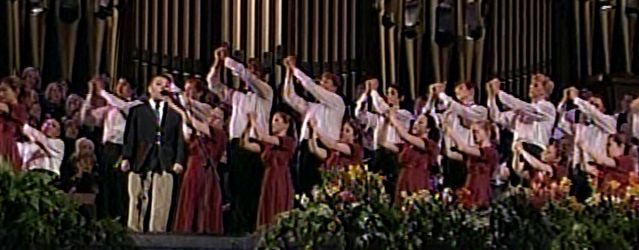
#3999
- Sweet Peace English Folk Song; arr. Mack Wilberg
- Be Still, My Soul Jean Sibelius; arr. Mack Wilberg
- Morning Mood from Peer Gynt Edvard Grieg; transcription by Clay Christiansen
- In Dreams from Lord of the Rings Fran Walsh and Howard Shore
- Prayer of the Children Kurt Bestor
- Spoken Word Lloyd D. Newell
"The Hope of the Children"
Nearly every day we see portrayed in the media innocent children suffering the violence of war, the ravages of nature, and the pain of disability. We see little ones wide-eyed with fear or glassy-eyed from hunger, clinging to desperate parents or crying alone. The world can be so cruel to those who deserve kindness the most.
But the faith of children is not easily shaken, so they pray to a loving God, who is aware of the trouble they face. He hears their prayers over the blast of a car bomb and above the din of street fighting. Whether they are kneeling in supplication or pleading silently in their hearts, children seem to know intuitively that God will hear them. There is no disability, no man-made uproar, no natural disaster that can hinder the heartfelt plea of a child.
The answer to such prayers comes in the form of humble hope. Like the first hint of dawn following a long night, there comes the sweet assurance that things will be better, that all is not lost, that the future holds a promise of peace and joy. The darkness of conflict can give way to a brilliant gleam of trust in the victory of good over evil and right over wrong.
This hope must find a place in the heart of each of our precious children. Whatever their station in life, despite the troubles that surround them, they need to believe that somewhere there is room for them to grow and to feel the love of Divine Providence. Surely somewhere we can find a place—a place of safety, a place of peace, a place of love for each child who prays for hope.
- Somewhere from West Side Story Leonard Bernstein; arr. Arthur Harris
#3998
- Christ the Lord Is Risen Today Melody from Lyra Davidica; arr. John Rutter
- Easter from Five Mystical Songs Ralph Vaughan Williams
- Amazing Grace! How Sweet the Sound George Shearing on the tune New Britain
- Easter Morning Paul Christiansen
- I Know That My Redeemer Lives, Lewis D. Edwards
- Spoken Word Lloyd D. Newell
"An Appointment with April" [Easter]
In the early spring of 1912, students crowded into a Harvard classroom for the final lecture of renowned philosopher and poet George Santayana. Near the end of his remarks, the students hanging on his every word, Professor Santayana glanced out the window. His eyes caught sight of a forsythia blossoming in a patch of lingering snow. At once, he quit speaking, picked up his gloves, hat, and walking stick, and strode to the door. He turned to the startled assembly and said calmly, "I shall not be able to finish that sentence. I have just discovered that I have an appointment with April."1
He left his books, his associates, and the hallowed halls of scholarship and walked outside into the garden.
What was it about spring that drew him? Was it the beauty? The contrast of white snow and bright golden petals? Did this philosopher see lessons for the soul in the plant's ability to tolerate harsh conditions and city life? Or did he find hope and inspiration in springtime's promise of new life after the long, lonesome winter?
Santayana later wrote, "I like to walk about amidst the beautiful things that adorn the world."2 If we are willing to drop what we are doing and truly see these beauties, we too can be renewed by spring's wonders flowering around us. The diversity of color in the landscape can paint a picture of remarkable splendor, but too often we simply pass by, and it all becomes merely a backdrop to our busy lives.
If we could just take a moment today, whether it's rainy or sunny, windy or still, to walk amidst the grandeur we call nature—all of us should have "an appointment with April" and, hopefully, keep and hold those precious moments close to our hearts.
1 Clifton Fadiman, ed., The Little, Brown Book of Anecdotes (1985), 487.
2 In John Bartlett, comp., Familiar Quotations, 16th ed. (1992), 588.
- The Savior Is Risen Indeed Robert Galbraith
- He Is Risen Joachim Neander; arr. Mack Wilberg
#3997
- All Glory, Laud and Honor Alexander Schreiner; based on a melody by Melchior Teschner
- Introit and Kyrie from Requiem Maurice Duruflé
- The Good Shepherd Dale Wood
- Spoken Word Lloyd D. Newell
"A Shepherd's Care"
The good shepherd has long been a symbol of God's love and watchful care. The shepherd knows his sheep and calls each one by name. The sheep are defenseless against the wolves of the desert. They need constant care. So night and day, the shepherd protects his sheep and guides them to green pastures and still waters.1
Several years ago, a man traveling in a North African desert came upon a roadside accident. The king's automobile had struck a young lamb, and an old shepherd, with his small flock, listened as the driver explained how he could be compensated. By law, a shepherd whose sheep had been injured by the king's vehicle could receive 100 times the value of the sheep. However, the same law dictated that the injured sheep must be slain and its meat divided among the people.
The traveler watched as the shepherd rejected the offer, carefully picked up the injured lamb, wrapped it in his flowing robe, and walked away. He led his flock back into the desert, gently stroking the little lamb and repeating its name, over and over.
Amazed, the traveler wondered why the shepherd had refused the money. The reason is clear: because he loves his sheep.
Just as the shepherd nurtures and protects his flock, so the Lord will watch over us, guide us, and shelter us from danger.
The Lord my pasture will prepare
And feed me with a shepherd's care.
His presence will my want supply
And guard me with a watchful eye.
My noonday walks he will attend
And all my silent midnight hours defend.31 See Psalm 23.
2 See John R. Lasater, in Conference Report, Apr. 1988, 86–87; or Ensign, May 1988, 74.
3 "The Lord My Pasture Will Prepare," Hymns, no. 109.
- The Lord My Pasture Will Prepare Dmitri Bortniansky; arr. Mack Wilberg
- O My Father James McGranahan; arr. Crawford Gates
#3996
- Guide Us, O Thou Great Jehovah John Hughes; arr. Mack Wilberg
- I Will Sing with the Spirit John Rutter
- Crossing the Bar Henry Holden Huss; edited by Richard P. Condie
- True to the Faith Evan Stephens; arranged by Clay Christiansen
- God of Our Fathers, Known of Old Leroy J. Robertson
- Spoken Word Lloyd D. Newell
"Lest We Forget"
When all is well and life is good, we tend to forget those who have made our present comforts possible: the teachers, parents, ancestors, and others who've sacrificed in our behalf. We drive on roads we didn't build, or we eat food we didn't grow—we all enjoy benefits and blessing that have come from the work of others. How often do we pause to acknowledge this? Do we sometimes enjoy the peace without remembering the peacemakers? Do we seize opportunities without giving thought to those who provided them?
We appreciate our blessings more deeply when we choose to remember those who have made these blessings possible. How fully can we appreciate a beautiful performance of music without considering the hours, even years, of practice behind it? How sincerely can we enjoy the gifts of nature—the starlit skies, the flowering fields, the panoramic sunsets—without remembering the God of creation?
Before the children of Israel entered the promised land, Moses reviewed with them the laws and blessings they had been given while in the wilderness. He understood that their prosperity in the land would only be as good as their memory of how they got there: the guidance they received, the lessons they learned, the daily sustenance they were given. Moses counseled, "Take heed to thyself, and keep thy soul diligently, lest thou forget the things which thine eyes have seen, and lest they depart from thy heart all the days of thy life."1
If the Giver of all good is always close to our hearts, our lives will be enriched by the reverent memory and acknowledgment of our every blessing.
1 Deuteronomy 4:9.
- Faith of Our Fathers, Living Still Henri F. Hemy; arr. John Longhurst
- Faith in Every Footstep K. Newell Dayley
#3995
- The Brotherhood Of Man, Wilbur Chenoweth
- Trumpet Voluntary Henry Heron
- O Lord Most Holy Cesar Franck; arr. Leroy J. Robertson and Alexander Scheriner
- Spoken Word Lloyd D. Newell
"Loss and Gain"
The life of beloved poet Henry Wadsworth Longfellow is proof that good can come from sorrow and difficulty. He received great honors for his many successes, but—like all of us—he also knew his share of heartbreak and grief, including the tragic death of his wife.
From the losses he suffered, however, Longfellow gained insight and strength that found voice in his poems. Longfellow's poetry lives on today not only for its rhyme and rhythm but because it expresses courage and optimism, even in the face of disappointment.
In his poem "Loss and Gain" Longfellow writes of regret, of longing, of the wisdom born of humility, and of the hope that can come when we have faith in the future.
When I compare
What I have lost with what I have gained,
What I have missed with what attained,
Little room do I find for pride.I am aware
How many days have been idly spent;
How like an arrow the good intent
Has fallen short or been turned aside.But who shall dare
To measure loss and gain in this wise?
Defeat may be victory in disguise;
The lowest ebb is the turn of the tide.1Life is full of wins and losses. But no loss will be in vain if we do our best to learn from it and then forge ahead with all the courage and optimism we can muster. We'll often find that life's inevitable stumbling blocks can become our greatest stepping stones.
1 The Complete Poetical Works of Longfellow (1893), 359.
- Because I Have Benn Given Much Phillip Landgrave
- Old Time Religion Traditional; arr. Moses Hogan; adapted by Benjamin Harlan
- Praise God! Fred Bock; based on "Old Hundredth" by Louis Bourgeois
#3994
- Come, Ye Children of the Lord Old Spanish Melody; setting by A. Laurence Lyon
- Agnus Dei (Transcribed from "Adagio for Strings" Op. 11) Samuel Barber
- Trumpet Tune in C Alice Jordan
- Spoken Word Lloyd D. Newell
"Time and the Things of Greatest Worth"
How we choose to spend our time says a lot about us. It's true that sometimes we don't have any say over how our minutes, hours, and days are spent. No one really chooses to wait in long grocery lines, catch the flu, or get stuck in traffic. But what we do with the time we have reflects our commitments, interests, and values.
A beloved hymn reminds us:
Time flies on wings of lightning;
We cannot call it back.
It comes, then passes forward
Along its onward track.But suppose you were allowed to "call back" a day or even an hour and relive that small portion of your life. What would you do differently? Would you spend more time with children? with grandparents? with neighbors and friends? Would you take the opportunity to apologize? to forgive? or simply to listen?
When we think back on our lives, most of us don't wish we had watched more television or held more grudges. In the same way, possessions, power, and prestige are all but forgotten when life comes to an end. But things of the heart endure and even grow sweeter with time's passage. Opportunities to help, to love, to learn, and to cultivate relationships are among life's greatest gifts. Since we all have some life left to live, let's pause to consider whether we're spending our time on things that matter the most.
Then should we not endeavor
Each day some point to gain,
That we may here be useful
And ev'ry wrong disdain?11 "Improve the Shining Moments," Hymns, no. 226
- Improve the Shining Moments Robert B. Baird
- Sunrise, Sunset from "Fiddler on the Roof" Jerry Bock; arr. Arthur Harris
- Of the Father's Love Begotten Wilbur Chenoweth; based on "Diminum Mysterium"
#3993
- Ten Thousand Times Ten Thousand John B. Dykes; arr. Arthur Harris
- Pilgrim's Hymn Stephen Paulus
- Choral prelude on "Slane"
- Let Us with a Gladsome Mind Alan Ridout
- Jesu, the Very Thought of Thee Paul Halley
- Spoken Word Lloyd D. Newell
"The 10-Dollar Fine"
How we treat others says much about who we really are. Civility, mercy, sacrifice, and integrity hold our society together. Yet such qualities often seem in short supply. Too often, arrogance and indifference isolate us from one another and harden our hearts.
So taught Fiorello LaGuardia, mayor of New York City at the time of the Great Depression. One winter day as he presided at police court, an officer brought in a shabbily dressed man charged with stealing a loaf of bread. The defendant explained tearfully that his family was starving.
"I have got to punish you," LaGuardia stated. "I can do nothing but sentence you for breaking the law. The fine will be 10 dollars."
But as he spoke, the mayor reached into his pocket: "Here's the 10 dollars to pay your fine." Then, looking around the courtroom, he continued, "I'm going to fine everybody here 50 cents for living in a town where a man has to steal bread to eat." He ordered the bailiff to collect from everyone and give the money to the defendant.
The stunned man left the courtroom with $47.50—not much by today's standards, but the mayor was not just asking for money; he was asking for compassion and encouragement for one of God's children.1
That's something we can all give. We can lift and bless with a smile, a handshake, a compliment, or kindness. We can be generous with our time, treat others like they matter, be sensitive to their feelings and their needs. In doing this, we do more than alleviate the suffering of a single soul—we help bring greater unity to our society.
1 See Clifton Fadiman, ed., The Little Brown Book of Anecdotes, ed. [name of editor or compiler] (1985), 339.
- There But For You Go I from "Brigadoon" Frederick Loewe; arr. Arthur Harris
- All Creatures of Our God and King German Hymn Tune; arr. Mack Wilberg
#3992
- Rejoice, the Lord Is King Malcolm Archer; orch. Nathan Hofheins
- Lift Thine Eyes from "Elijah" Felix Mendelssohn
- He Watching Over Israel from "Elijah'" Felix Mendelssohn
- The Prince of Denmark's March Jeremiah Clarke; arr. John Longhurst
- All Through the Night Welsh Melody; arr. Mack Wilberg
- Spoken Word Lloyd D. Newell
"What E'er Thou Art, Act Well Thy Part"
We all have moments in life that can change us forever. Somehow we're never quite the same after certain experiences. And more often than not, such pivotal moments can be relatively simple and small.
In the late 19th century, a young American of Scottish descent traveled to Scotland to live and work for a number of years. The work was difficult, the hours long, the discouragements frequent. During his time in Scotland, far away from his beloved home and family, he had occasion to spend a day touring the magnificent Stirling Castle in the countryside near Glasgow.
Later that evening, he happened to notice an inscription chiseled in the stone arch over the front door of a house: "What E'er Thou Art, Act Well Thy Part." The message penetrated the young man's heart. Invigorated and renewed, he determined to "act well his part." 1
He later returned to America and went on to become a great leader, revered by all who knew him. His discovery of an old Scottish proverb was a turning point in his life. The simple message, "What E'er Thou Art, Act Well Thy Part," became his personal motto. He never forgot its challenge to always do his best, whatever the task.
We all have such pivotal moments, if we just recognize them. They often come unexpectedly, when we're struggling or discouraged, when we need them most. We suddenly notice something we haven't seen before. It sparks a new insight that inspires us and motivates us. We discover a new resolve to do better and to be better. We change forever in that moment. And for the rest of our lives we look back to that moment for strength and inspiration.
1 See Francis M. Gibbons, David O. McKay: Apostle to the World, Prophet of God (1986), 44–45.
- Highland Cathedral Traditional; arr. Chad Steffey
- Rejoice and Be Merry Traditional English Tune; arr. Mack Wilberg
#3991
- Hallelujah Chorus from "Christ on the Mount of Olives" Ludwig van Beethoven
- We Hasten to Thee from the Cantata "Jesu, du meine Seele" Johann Sebastian Bach
- Glory to God in the Highest Sergei Rachmaninoff
- Norwegian Rustic March Edvard Grieg
- The Impossible Dream Mitch Leigh; arr. Arthur Harris
- Spoken Word Lloyd D. Newell
"Believing in Worthy Dreams"
Since the revival of the Olympic Games in 1896, thousands of athletes have dreamed about representing their country and becoming Olympic champions.
During the 1912 games, a new horse-and-rider event called dressage was introduced. It was a competition in which only commissioned military officers—all of them men—were allowed to compete. It stayed that way for 40 years, until the 1952 games in Helsinki, Finland, where, for the first time, the event was opened to all.
During that competition, the world became captivated with a woman rider from Denmark, Lis Hartel. In a sport dominated by men, Lis stunned the crowd with a magnificent performance and was awarded the silver medal.
But there is more to the story. At the awards ceremony, when Lis Hartel's name was announced, the gold-medal winner stepped down from the medals platform to help her climb the steps to her place on the podium. Lis was unable to climb them herself because eight years earlier she had contracted polio and had been paralyzed from the waist down.
When her condition was first diagnosed, most believed that her riding days were over, but Lis refused to abandon her dream, no matter how impossible it seemed. After years of rehabilitation, she regained enough muscle control to ride a horse. She began to train. And eventually her determination led her to the medals platform in Helsinki.
The Olympic motto is Citius, Altius, Fortius: Swifter, Higher, Stronger. But for most of us, the great challenges of life do not require that we sprint faster or jump higher than someone else.
The example of Lis Hartel reminds us that the greatest champions are those who never stop believing in their worthy dreams no matter how great the obstacles that confront them.
Perhaps there is no better definition of a champion.
- Call of the Champions John Williams
#3990
- Glory to God on High Felice de Giardini; arr. John Longhurst
- When I Survey the Wondrous Cross Gilbert M. Martin; based on the tune by Lowell Mason
- Down to the River to Pray
- The Dying Soldier American Folk Song; arr. Mack Wilberg
- Spoken Word Lloyd D. Newell
"Understanding Brings Peace"
People who travel to foreign lands usually go hoping to see exotic scenery and famous places. They thrill at the wonderful new sights, sounds, and smells. But if they are perceptive and sensitive, they also grow to understand other peoples in other cultures. They realize, as the poet Maya Angelou said, that "all people cry, laugh, eat, worry, and die. . . . If we try to understand each other, we may even become friends."
Not everyone can be a world traveler, but we can all learn to appreciate others. We can avail ourselves of books, documentaries, and music that help us learn about and respect other cultures. Better yet, we can get to know people of various backgrounds in our own neighborhoods.
Reaching out to other cultures, and learning all we can about them, is a path to peace. When we identify with the hearts of people around the world, we are far less likely to make rash assumptions about them, far less likely to embrace stereotypes.
Recently, a group of women from various backgrounds attended an interfaith women's luncheon. They soon discovered that their religious differences paled in comparison to the things they had in common. All of the women were striving to raise good families, improve as individuals, and be good neighbors. And, as one Hindu woman said with a chuckle, "We all want to understand our husbands."
If peace is ever to come to this world, it will come because we realize that we are all brothers and sisters, fellow citizens of the same planet. We may wear different clothing and eat different foods, but every one of us hopes, dreams, and struggles against adversity. Every one of us wants to be loved and wants to make a difference in the world. These basic similarities far outshine our differences and give us hope that we can live together in peace.
- Make Me an Instrument of Thy Peace Mary McDonald
- I'm Runnin' On African-American Spiritual; arr. Mack Wilberg
#3989
- Rise! Up! Arise! From "Saint Paul" Felix Mendelssohn
- Love Bade Me Welcome Ralph Vaughan Williams
- Wondrous Love Traditional; arr. Alice Parker and Robert Shaw
- Our Savior's Love Crawford Gates, arr. John Longhurst
- Spoken Word Lloyd D. Newell
"More Than a Paper Heart"
Everyone wants to love, and everyone wants to be loved. From our earliest years, we look for love. Some people travel far and wide in search of it, and others may not know love when they've found it.
In days past, children left little paper hearts or small boxes of candy on the doorsteps of friends. Sometimes the children would ring the doorbell and run. Usually they included a note that read, "I love you."
Yet even at a young age, children seem to understand that "love is more than a paper heart. Love is of the very essence of life," as a wise religious leader once taught. "Love is the security for which children weep, the yearning of youth, the adhesive that binds marriage, and the lubricant that prevents devastating friction in the home; it is the peace of old age, the sunlight of hope shining through death.
". . . Love, like faith, is a gift of God."1
But love has many counterfeits. If we're not careful, we may mistake love for one of its impersonators. True love is never manipulative, domineering, or selfish. It doesn't require loyalty tests or paybacks.
Real love is freely given. It liberates and empowers. It enlarges the heart and makes room for others. Love withholds judgment and is patient. Love manifests itself in kindness, respect, and compassion. Love overlooks differences and extends mercy. Love is an abundant, generous feeling that changes the way we see the world, the way we live in the world.
Those who have received genuine love, and those who have given it, know that it is truly God's greatest gift to His children.
1 Teachings of Gordon B. Hinckley [1997], 317.
- Where Is Love? from "Oliver" Lionel Bart; arr. Michael Davis
- Love Divine, All Loves Excelling Rowland Hugh Prichard; arr. Mack Wilberg
#3988
- Morning Has Broken Traditional Gaelic Melody; arr. Mack Wilberg
- The Pasture Z. Randall Stroope
- All Beautiful the March of Days English Melody; arr. Mack Wilberg
- Come Ye Disconsolate Samuel Webb; arr. Dale Wood
- Lord, I Would Follow Thee K. Newell Dayley
- Spoken Word Lloyd D. Newell
"Life Is Not Fair"
Parents often tell their children that life isn't fair. The harshness of this reality is somehow softened when it comes from loving parents. It's usually not until children become adults that they realize how right their parents were and how painful some of life's injustices can be. Life really can be unfair. But that doesn't mean that life can't be good.
Some of the happiest people are those who endure more than their share of injustices. How is this possible? Perhaps it's because they stop competing with those around them; they simply do their best with what they have. They look forward instead of backward and stop thinking about what could have been. They understand that "why me?" questions can't really be answered here and now, so they don't ask them. They've felt deeply of life's sorrows, so they actively look for and cultivate the joys. And somewhere deep in their hearts, they know they can trust in a loving God who is perfectly merciful and ultimately fair.
Recently, some children were playing a board game, and one of the players was disappointed with the cards he'd been dealt. Everyone else seemed to have good cards, but he got most of the bad ones. As the game went on, instead of complaining, he decided to bring some humor into the game. The mood lightened, and before long the children agreed: "The game is a lot more fun if we don't keep score."
And so is life. When we stop keeping score, when we stop itemizing slights and holding on to grievances, we start recognizing blessings. We realize that life may not be fair, but it can be good—in fact, better than we ever thought possible.
- Lord, I Would Follow Thee K. Newell Dayley
- Come Dwell in Solomon's Walls Z. Randall Stroope
- Arise, O God, and Shine John Darwell; arr. Mack Wilberg
#3987
- Holy, Holy, Holy John B. Dykes; arr. Arthur Harris
- God So Loved the World Carl J. Nygard, Jr.
- Festival Toccato on "St. Anne"
- Abide with Me: 'Tis Eventide Harrison Millard; arr. Crawford Gates
- The Lord Is My Shepherd Thomas Matthews
- Spoken Word Lloyd D. Newell
"God Be With You"
Saying good-bye has never been easy—especially when we have concerns about where loved ones are going or how long they'll be gone. But knowing that good-bye is really a pronouncement of the blessing "God be with you" can make the separation more bearable.
The word good-bye was formed from the longer phrase "God be with you" during the 16th century. For all who seek to bless family, friends, and associates with divine help, this unsaid meaning of good-bye can remain the same—go with a prayer for heaven's blessing from those who care.
When the former president of Howard University, Jeremiah Rankin, learned the history of the word good-bye, he wrote the hymn "God Be with You."2 It soon became a favorite of congregations everywhere and has been sung at many heartfelt farewells over the decades.
For example, at the end of World War II, a Christian missionary prepared to leave New Guinea after serving there for eight years. She had been imprisoned during the war, her husband had died, and she was now returning home a 28-year-old widow without a single possession. She wondered if her mission had been worthwhile and struggled with feelings of bitterness. As the boat set sail, she heard Indonesian voices singing, "God be with you till we meet again." The words sank deep into her heart and set in motion a healing of her soul.2
Such loving farewells comfort those who leave as well as those who stay behind. For many years at the conclusion of this broadcast we have sung to our live audiences—and today we sing to each of you—"God be with you till we meet again."
1 See Robert J. Morgan, Then Sings My Soul: 150 of the World's Greatest Hymn Stories (2003), 205.
2 See Morgan, Then Sings My Soul, 205.
- God Be with You Till We Meet Again William G. Tomer; arr. Mack Wilberg
#3986
- How Firm a Foundation Attributed to J. Ellis; arr. Mack Wilberg
- There Is Sunshine in My Soul Today John R. Sweney; arr. Mack Wilberg
- What Wondrous Love Is This Wondrous Love from "The Southern Harmony," 1835; arr. John Longhurst
- Jesus, The Very Thought of Thee John B. Dykes, arr. Mack Wilberg
- Spoken Word Lloyd D. Newell
"The Lord Bless and Keep You"
We've all heard the expressions "Bless your heart" and "All the best" and so many others. With these words we extend good wishes to those around us. Such expressions are like a prayer calling down heaven's blessings upon those we care about. And we all need blessings.
There are those who may say that these are meaningless clichés. But when someone offers to another a heartfelt wish for a blessing, it is never trite, never tired or inappropriate.
Expressing the sincere hope that one will be blessed and watched over is a practice as old as time. For example, centuries ago the Lord gave to Moses a blessing that he was to impart upon his people. Its words have been recited by ministers of various faiths for generations, and they have been set to music and sung by choirs around the world. The supplication is for the Lord to watch over His children, to pour out His promised blessings upon true followers, to give peace. The words are:
The Lord bless you, and keep you:
The Lord make his face to shine upon you, and be gracious unto you:
The Lord lift up the light of his countenance upon you, and give you peace.1
In our day, many families have a simple expression of blessing that has become a beloved tradition. Every night as they retire to bed, they express to one another the same hope, the same desire: "Sweet dreams." For them, it's just another way of saying, "The Lord bless you and keep you until morning." We all hope that our loved ones will be blessed, will be protected, will have peace and joy in their hearts and homes.
1 See Numbers 6:24–26
- The Lord Bless You and Keep You Peter Lutkin
#3985
- High On the Mountain Top Ebenezer Beesley; arr. Mack Wilberg
- I Know that My Redeemer Lives Lewis D. Edwards; arr. Robert Cundick
- In Christ There Is No East or West Spiritual adapted by Harry T. Burleigh; arr. Dale Wood
- Nearer, My God, to thee Lowell Mason; arr. Arthur Harris
- I Will Sing with the Spirit John Rutter
- Did You Think to Pray? William O. Perkins; arr. Mack Wilberg
- Spoken Word Lloyd D. Newell
"Don't Forget to Pray"
"Did you think to pray?" This simple question from a 19th-century hymn reminds us to offer thanks and seek divine guidance, comfort, and peace each day. Is there anyone who does not need such divine intervention?
"Oh, how praying rests the weary," the familiar hymn continues. "Prayer will change the night to day."1 These are powerful promises in our challenging world. Each of us faces situations we cannot handle alone, problems we cannot solve alone, weaknesses we cannot overcome alone.
Abraham Lincoln, wearied by the division of our nation at the time of the Civil War, humbly spoke these words: "I have been driven many times to my knees by the overwhelming conviction that I had nowhere else to go. My own wisdom, and that of all around me, seemed insufficient for the day."2
Prayer can be our lifeline. When tragedy strikes a community, citizens gather in churches, synagogues, mosques, and homes to pray and draw strength from God. Family prayer brings parents and children together. One 15-year-old whose turn it was to say the family prayer paused and looked from one face to another. He then asked quietly, "Does anyone need anything?" What an immeasurable gift we give when we pray in behalf of another.
Humble prayer can prompt in us a desire to be better—to be a little kinder, more generous with others, more patient and forgiving. Whether spoken aloud or carried silently in our souls, each sincere prayer reaches to heaven. It draws down from heaven the strength to press on, the ability to see beyond today, and the willingness to trust God's answers and His will in our behalf.
"So, when life gets dark and dreary, don't forget to pray."3
1. Mary A. Pepper Kidder, "Did You Think to Pray?"
2. In The New Dictionary of Thoughts: A Cyclopedia of Quotations, comp. Tryon Edwards, rev. ed. (1959), 540.
3. Mary A. Pepper Kidder, "Did You Think to Pray?"
- The Lord's Prayer Albert Hay Malotte; arr. Carl Deis
#3984
- Redeemer of Israel Freeman Lewis; arr. Mack Wilberg
- Lead, Kindly Light John B. Dykes; arr. Mack Wilberg
- How Excellent Thy Name George Frideric Handel
- Come, Let Us Anew Attributed to James Lucas; Improvisation by Clay Christiansen
- Spoken Word Lloyd D. Newell
"A Time of Resolution"
At the beginning of each new year we feel a sense of renewal and a chance to start over. We put more energy into accomplishing some of the things we have been putting off. We call this a time of resolution.
Resolutions are promises to ourselves. Unfortunately, sometimes even our most heartfelt resolutions go unfulfilled. But this need not be so. Maybe we just need a little more patience.
On May 12, 2005, Ed Viesturs stood on the snowy summit of a towering Himalayan mountain peak. It was one of the happiest days of his life. After 16 years of diligent preparation, failed attempts, and hard work, he had successfully climbed all of the world's mountains above 26,000 feet high, including Mt. Everest. Perseverance had seen him through extreme physical and emotional challenges and allowed him to realize his dream.
This remarkable accomplishment is a vivid reminder that some resolutions take many years to complete. Resolutions of enduring value usually require patient determination and are realized one step at a time.
Our challenges may not be made of rock and snow, but like the mountain climber, we can carefully plan out a route to our chosen peak of achievement and then work our way to the summit by putting one foot in front of the other. As we continue in our resolve, our reward will be a gratifying view from the heights of our potential.
And when we become discouraged along the way, we can pause to catch our breath and then dig deep within ourselves to find the determination to move ahead. Even the highest obstacles will yield to the power of dedicated resolution.
- Come, Let Us Anew "Attributed to James Lucas; arr. Mack Wilberg
- The Spirit of God Anonymous; arr. Mack Wilberg
#3974
Rebroadcast of program #3974 "Dreams of Courage"
#3983
- Hark! The Herald Angels Sing Felix Mendelssohn; arr. Mack Wilberg
- For Unto Us a Child Is Born Georg Frederic Handel
- Joseph Dearest, Joseph Mine Old German Tune; arr. Mack Wilberg
- Bring a Torch, Jeanette Isabella Keith Chapman
- Baby, What You Goin' to Be? Natalie Sleeth
- Spoken Word Lloyd D. Newell"Joy to the World"
"Good tidings of great joy"1 is the message of Christmas. Whenever we love and serve, whenever we forget ourselves and lift others, we feel that joy. "Real joy comes not from ease or riches or from the praise of men, but from doing something worthwhile."2 Real joy is the blessed reward of selfless living.
Over a thousand years ago, the good King Wenceslas of Bohemia felt the joy of helping others. Taught by his grandmother that faith should be put into action, King Wenceslas became known for his kind and generous care of the poor. He found great joy in sharing his bounty. Legend recounts that one cold December night, the king looked out his window to see a man searching for firewood. The king decided to leave the warmth of his castle to comfort the man and his poor family. He and his page traveled through deep drifts of snow and wind carrying wood for the family's dying fire and food for their scant table.
When the page, exhausted and chilled in the extreme weather, felt he could go no further, the good king reassured him:
Mark my footsteps, my good page, tread thou in them boldly,
Thou shalt find the winter's rage, freeze thy blood less coldly.3Walking in his master's footsteps, the page was able to finish the journey and find joy in serving the needy family.
And so it goes for each of us. As we walk in the Master's footsteps, as we bring good tidings to those around us, we feel the great joy of Christmas, the lasting joy that warms our hearts—and the hearts of those we serve—the whole year through.
1. Luke 2:10.
2. Wilfred T. Grenfell, in The Treasure Chest, ed. Charles L. Wallis (1965), 153.
3. John Mason Neale, "Good King Wenceslas," in Jean Richardson, Stephen's Feast (1991), inside front cover.
- Joy to the World "Antioch" by Lowell Mason; arr. Mack Wilberg
#3982
- Carol of the Bells Mykola Leontovych; arr. Barlow Bradford
- The First Noel Traditional English Carol; arr. Mack Wilberg
- Masters In This Hall arr. Thomas M. Waldron
- Do You Hear What I Hear? Noel Regney & Gloria Shayne; arr. Arthur Harris
- God Rest Ye Merry, Gentlemen
- Once In Royal David's City Henry J. Gauntlett
- Spoken Word Lloyd D. Newell"Wise Men"
Of all the stories associated with Christmas, the story of the Wise Men is among the most intriguing, mostly because we really don't know that much about them. Who were these Wise Men? How did they know what the new star signified? Had they read ancient prophecies foretelling the signs of Jesus's birth? Or did angels announce it to them as they had to the lowly shepherds?
Whatever the source of their knowledge, "when they saw the star, they rejoiced with exceeding great joy,"1 and they were willing to follow that star far from the comforts of home.
Their complete story is told in only 12 verses in the Bible, and then the Wise Men disappear.
We are left to wonder about these strangers who seemed to have understood Jesus's holy mission, perhaps better than many of His own countrymen. Their gifts for the Christ child may suggest that they knew He was to be more than just another earthly king, for their gifts had both monetary value and symbolic meaning. And so it was—gold, the metal of kings, proclaimed Jesus the King of Kings. Frankincense, burned on the temple altar as a symbol of prayers ascending to God, suggested Jesus was a link between heaven and earth. And myrrh, an ointment used for embalming, was perhaps a poignant foreshadowing of His death and burial.
Though much of their story still remains a mystery, what we do know about the Wise Men must win our admiration and increase our appreciation for the King they came to worship. We learn from them that the birth of Christ holds significance beyond Bethlehem and that to find and worship the King of Kings is still the noblest pursuit for wise men and women throughout the world.
1 Matthew 2:10
- O Come, All Ye Faithful Attr. John F. Wade; arr. Mack Wilberg
Guests: Bells on Temple Square, Thomas M. Waldron, conductor
#3981
- Gloria In Excelsis Deo (A Christmas Processional) Mack Wilberg
- Joy to the World "Antioch" by Lowell Mason; arr. Mack Wilberg
- What Child Is This? Traditional Melody; arr. Mack Wilberg
- Lo, How a Rose E'er Blooming Traditional; arr. Mack Wilberg
- Spoken Word Claire Bloom"On Earth Peace, Good Will toward Men"
And it came to pass in those days, that there went out a decree from Caesar Augustus, that all the world should be taxed.
And all went to be taxed, every one into his own city.
And Joseph also went up from Galilee, out of the city of Nazareth, into Judea, unto the city of David, which is called Bethlehem…
To be taxed with Mary his espoused wife, being great with child.
And so it was, that, while they were there, the days were accomplished that she should be delivered.
And she brought forth her first-born son, and wrapped him in swaddling clothes, and laid him in a manger; because there was no room for them in the inn.
And there were in the same country shepherds abiding in the field, keeping watch over their flock by night.
And, lo, the angel of the Lord came upon them, and the glory of the Lord shone round about them: and they were sore afraid.
And the angel said unto them, Fear not, for, behold, I bring you good tidings of great joy, which shall be to all people.
For unto you is born this day in the city of David a Saviour, which is Christ the Lord.
And this shall be a sign unto you; Ye shall find the babe wrapped in swaddling clothes, lying in a manger.
And suddenly there was with the angel a multitude of the heavenly host praising God, and saying,
Glory to God in the highest, and on earth peace, good will toward men.
1 Luke 2:1, 3-14
- Angels, From the Realms of Glory French Carol; arr. Mack Wilberg
- Hallelujah from "Messiah" George Frideric Handel
Guests: Renée Fleming, soprano; Claire Bloom, narrator; Edward Fleming, guest conductor; Bells on Temple Square, Dancers
#3980
- O Come, Emmanuel Traditional; arr. Arthur Harris
- One December, Bright and Clear Caralonian Carol; arr. Mack Wilberg
- Little Jesus Mark & Charlene A. Newell; arr. Andrea C. Brett
- This Little Babe from "A Ceremony of Carols" Benjamin Britten; arr. Julius Harrison
- Carol of the Birds Traditional French Carol; arr. Raymond Haan
- How Far Is It to Bethlehem? English Carol; arr. Mack Wilberg
- Spoken Word Lloyd D. Newell"Bethlehem"
Long ago, in the dusty village of Bethlehem, a new life came into the world—a world that would be changed forever. On that silent night more than two thousand years ago, the light of a new star shone on the fields, the walkways, and stables of Bethlehem. Not everyone knew or recognized this radiant fulfillment of ancient prophecy. But then, as well as now, those who truly looked heavenward, were led to the Light of the World.
And they found him in Bethlehem. Once the birthplace of King David, Bethlehem was no longer home to royalty, and by all worldly standards, it was humble. And yet, the King of Kings was born there.
So, Mary, "great with child,"1 and Joseph, traveled 90 long, uncomfortable miles from Nazareth to their ancestral home of Bethlehem where they were to be taxed. By the time they arrived, there was no room for them in the inns. So, in a stable for animals, Mary "brought forth her firstborn son, and wrapped him in swaddling clothes, and laid him in a manger."2 Emmanuel, meaning "God with us,"3 was born in what would otherwise be considered an insignificant Judean town. But Bethlehem in Hebrew means "house of bread", and so Jesus came as the Bread of Life to a hungry world. He came as Living Water to quench the thirst of all honest seekers. He came to lift souls and spread joy, as the Prince of Peace. And today, as then, he reigns in the hearts of all who truly know Him.
The life and love, mercy and hope brought into the world by the babe of Bethlehem will live forever.
1 Luke 2:5
2 Luke 2:7
3 Matthew 1:23
- O Little Town of Bethlehem Lewis H. Redner; arr. Leroy Robertson
- The First Noel Traditional; arr. Andrea C. Brett
Guests: The Brett Family Singers
#3979
- Now Thank We All Our God from Cantata 79 Johann Sebastian Bach
- The Lord's Prayer Albert Hay Malotte; arr. Carl Deis
- For the Beauty of the Earth John Rutter
- Prayer of Thanksgiving Improvisation by Clay Christiansen
- Count Your Blessings Instead of Sheep from "White Christmas" Irving Berlin; arr. Michael Davis
- Thanks Be to God Stanley Dickson;arr. Noble Cain
- Spoken Word Lloyd D. Newell"We Have Cause to Give Thanks"
We don't miss what we've never known. But when people or things are an important part of our lives, we miss them dearly when they're no longer with us. Yet, all too often, we take them for granted until they are taken away. For example, we often don't appreciate health until we lose it; food, until it's scarce; safety, unless it's in doubt; peace, until it's threatened.
Ironically, that which we most prize is often what we most take for granted: the love of home and family, liberty and harmony, health and happiness. We often don't even think about the many commonplace but precious blessings in our lives, like the air around us. Think for a moment of harvest and home, of warm memories and loving associations, of meaningful work and wholesome leisure, of the beauties of nature and the wonders of living. Even our heartaches can become, in time, a source of gratitude and wisdom.
Some five decades ago on this broadcast, Richard L. Evans expressed a universal theme of thanksgiving: "Whether we think we have much or little, we have cause to give thanks for everything that is ours—for the food we eat, for friends and freedom, for the warmth we feel from the sun, for the companionship of people, for the leaves that fall and again come forth, for the rain that filters through the soil, for the beauty and providence of the earth—for the very air we breathe; for the very life we live."i
All good things are gifts from a loving God. Wait not until such rich blessings go away to appreciate them more fully.
i The Everlasting Things (1957), 33–34.
- Come, Ye Thankful People, Come George J. Elvey; arr. Mack Wilberg
"America The Beautiful"
#3978
- Due to the choir's performance in Denver on November 19,
this broadcast was recorded the week before.
- This Land Is Your Land Woody Guthrie; arr. Percy Faith and Michael Davis
- America, the Dream Goes On John Williams; arr. Michael Davis
- Shenandoah Traditional; arr. Mack Wilberg
- God Bless America Irving Berling; arr. Roy Ringwald
- Spoken Word Lloyd D. Newell"The America We Call Home"
All these beauties make up the land we love. America the beautiful, we so proudly call you home.
1. Katharine Lee Bates, notes. Available at http://www.fuzzylu.com/falmouth/bates/america.html.
- America the Beautiful Samuel A. Ward; arr. Mack Wilberg
- The Star-Spangled Banner John Stafford Smith; arr. Robert Russell Bennett
#3977
- Guests: Synergy Brass Quintet
- From All that Dwell Below the Skies John Hatton; arr. Mack Wilberg
- Sleepers Wake! For Night Is Flying from Cantata 140 Johann Sebastian Bach
- When In Our Music God Is Glorified "Sine Nomine" arranged with additional music by Emily Crocker; Brass arrangement by John Moss
- Now Thank We All Our God Sigfrid Karg-Elert
- Home, Sweet Home Henry K. Bishop; edited by Donald H. Ripplinger
- Spoken Word Lloyd D. Newell"The Path to Home"
It may be that we have more expressions about "home" than anything else. We've all heard "home is where the heart is," "there's no place like home," and "home sweet home"—simple sayings that ring with truth and bear repeating.
The hallmark of a happy home is not its size or location, but what goes on inside its walls. Small homes can be filled to overflowing with joy and contentment, and homes on "the other side of the tracks" can be grounded in goodness and decency. No matter the landscape, the path to home is always paved with love and kindness. And no matter how far we travel, we always come back—even if only in our memories—to such happy homes.
Many decades ago, Edgar A. Guest explained why in a poem titled "The Path to Home":
There's the mother at the doorway, and the children at the gate,
And the little parlor windows with the curtains white and straight.
There are shaggy asters blooming in the bed that lines the fence,
And the simplest of the blossoms seems of mighty consequence.
Oh, there isn't any mansion underneath God's starry dome
That can rest a weary pilgrim like the little place called home.Men have sought for gold and silver; men have dreamed at night of fame;
In the heat of youth they've struggled for achievement's honored name;
But the selfish crowns are tinsel, and their shining jewels paste,
And the wine of pomp and glory soon grows bitter to the taste.
For there's never any laughter howsoever far you roam,
Like the laughter of the loved ones in the happiness of home.- Home, Sweet Home Henry K. Bishop; edited by Donald H. Ripplinger
- Earl of Oxford's Mask William Byrd
- Joy in the Morning Natalie Sleeth
#3976
- God of Our Fathers, Whose Almighty Hand George W. Warren; arr. Mack Wilberg
- Dirge for Two Veterans from "Dona Nobis Pacem" Ralph Vaughan Williams
- Spoken Word Lloyd D. Newell"Their Finest Hour"
In 1940, as the thunder and lightning of armed conflict erupted across Europe, Winston Churchill stood at the head of a nation faced with the horrible reality of a calamitous war. "I have nothing to offer," he told his countrymen, "but blood, toil, tears and sweat."i
In spite of the arduous road, Churchill was firm in his resolve. "We shall go on to the end," he declared. "We shall never surrender."ii
He urged his people to "so bear [themselves] that, if the British Empire and its Commonwealth last for a thousand years, men will still say, ‘This was their finest hour.' "iii
Churchill's courage and optimism bolstered the confidence of his countrymen. "These are not dark days," he told them. "These are great days—the greatest days our country has ever lived."iv
In our day we sometimes find ourselves overwhelmed by fear, worry, and distress. We each must face our share of life's hazards and sorrows. During our own hours of darkness, the unfailing voice of this lion of England can give us the strength to "never give in, never give in, never, never, never, never." v
Even if our days seem dark, we can make them our greatest days because of how we choose to face them. In the end, it may be our courage during our own times of crisis and trial that causes others to say of us, "This was their finest hour."
i "Blood, Toil, Tears and Sweat," first speech as prime minister, House of Commons, May 13, 1940, in Never Give In! The Best of Winston Churchill's Speeches, sel. Winston S. Churchill (2003), 206.
ii "Wars Are Not Won by Evacuations," House of Commons, June 4, 1940, in Never Give In! 218.
iii "This Was Their Finest Hour," House of Commons, June 18, 1940, in Never Give In! 229.
iv "Never Give In!" Harrow School, October 29, 1941, in Never Give In! 308.
v Winston Churchill, "Never Give In!" in Never Give In! 307.
- Nation Shall Not Lift Up Sword Against Nation from "Dona Nobis Pacem" Ralph Vaughan Williams
Courage To Believe
#3975
- Guest: Maureen McGovern
- O Come Ye Nations of the Earth Composer Ellacombe; Arranger Mack Wilberg
- O Holy Jesus Jonathan Willcocks; orchestration by Mack Wilberg
- Help Is on the Way (David Friedman; arr. Jeffrey D. Harris)
- Take Time to be Holy Traditional; arr. John Longhurst
- Though Deepening Trials (George Careless)
- Spoken Word Lloyd D. Newell"Courage to Believe"
Sometimes it takes courage to believe. When we mourn the loss of a loved one, when hopes vanish or dreams dissolve, whenever hearts deeply ache, it takes more than willpower to keep going. It takes faith to believe that life has meaning beyond the present pain. It requires humble submission to a greater good and abiding trust that someday wrongs will be righted.
At first, when a loss shocks our souls, we may feel as if the wind were knocked out of us. We're never quite the same, but we go on. In the course of time, the loss we endure starts to give newness to life. We notice the way a toddler giggles. We listen more intently to a bird's song. The change of seasons comforts us. We remember details about our lives before the loss, and we cherish the memories.
In the classic novel Little Women by Louisa May Alcott, the strong-willed older sister Jo mourns the untimely death of her younger sister Beth. She consoles herself:
My great loss becomes my gain.
For the touch of grief will render
My wild nature more serene,
Give to life new aspirations—
A new trust in the unseen.1
Jo's faith, having been tested, carves depth into her soul that was not realized until she lost her sister. She becomes more patient, more disciplined, more motivated to use her writing talent, more trusting in God's will.
The same is true for us. When we have the courage to hold on to faith, pain and grief can give us wisdom and a greater capacity to love. They can bestow quiet confidence in divine purposes and a deeper appreciation for life.
1 (1932), 403.
- Days of Plenty from "Little Women" (Jason Howland)
- Amazing Grace Traditional; arr. Renzi
#3974
- Guest: Ronan Tynan, Irish Tenor
- Praise Ye the Lord John Rutter
- Isle of Hope, Isle of Tears Brendan Graham; arr. David Cullen
- Homeward Bound Marta Keen Thompson; arr. Mack Wilberg
- Spoken Word Lloyd D. Newell"Put Courage in Your Dreams"
1. In Paul Zollo, "Ronan Tynan: Songs for a World Class Voice," Playback, spring 2005, 30.
- Passing Through Bryan Byrne
- Thou Gracious God, Whose Mercy Lends, Oliver W. Holmes; Traditional, arr: Mack Wilberg
#3973
- O Clap Your Hands John Rutter
- The Lord Is My Shepherd John Rutter
- Fugue in C Major ("Jig") Dietrich Buxtehude; adapted by Mack Wilberg
- Count Your Blessings Instead of Sheep from "White Christmas" Irving Berlin; arr. Michael Davis
- Spoken Word Lloyd D. Newell
“Hearts to Match Our Dreams”
From the timeless tale of the puppet brought to life comes the classic ballad “When You Wish upon a Star.” The little wooden Pinocchio, painstakingly carved by Gepetto, wished to be a real boy. He could move his arms and legs, he could sing and dance, but to achieve his ultimate dream he had to become truthful, courageous, and unselfish. He had to develop strength of character.
Though a fantasy originally written more than a century ago, the story has application for each one of us. As Pinocchio learned when he succumbed to the temptations and amusements all around him, entertainment in our “feel-good world” can dull our senses and distract us from noble purposes. Sometimes we feel like Pinocchio did in the belly of the whale—we too face overwhelming problems at work, at home, and in relationships that can consume our lives. With courage and ingenuity, Pinocchio overcame his follies and obstacles and proved himself worthy of his goal, and so can we.
Developing real character is the noblest pursuit of life. No matter who you are—a puppet or a wood carver, an adult or a child—the fact is, acquiring truth, courage, and unselfishness are lifelong quests that require might, commitment, and consistency. Such quests call for pure hearts to match our lofty dreams.
Pinocchio’s journey from a puppet to a real boy reminds us of the inherent potential and goodness within each of us. If we wish it with all our hearts, we, like Pinocchio, can become our best and true selves.
- When You Wish Upon a Star arr. Michael Davis
- Antiphon from "Five Mystical Songs" Ralph Vaughan Williams
#3972
- Let the People Praise Thee, O God William Mathias
- He Shall Feed His Flock John Ness Beck
- Praise Thou the Lord Richard Warner
- Processional William Mathias
- Love Is Spoken Here Janice Kapp Perry
- Spoken Word Lloyd D. Newell
“To Live a Balanced Life”
One of the great opportunities in life is to gain a variety of experiences. It is important that we fill our days with a balance of meaningful events and activities that will stretch our minds and strengthen our relationships. Even everyday duties can provide a chance for us to improve our skills and share our love.
Each experience adds a new dimension in the development of our character. Just like a multi-faceted jewel, we are polished here and refined there until we are complete. The end result of a life lived in this way is a balanced personality, well-rounded and whole.
Too much of any one thing makes that balance harder to achieve. Too much work, and the playful part of our nature may go undeveloped. Too much play, and important work may be left undone. Too much focus on material things, and we find ourselves lacking in spiritual sensitivity. In life, variety and balance can be just as important as talent and expertise.
Audiences have long been thrilled by the amazing balancing act of the tightrope walker. Perched alone and far above the ground, the brave performer carefully maneuvers the high wire, armed with nothing but a simple balancing pole. Shifting with the demands of gravity, the pole helps the entertainer keep his balance until he has safely completed his walk over the wire.
Like a tightrope walker with a pole, we can shift our activities, vary our experiences, and keep ourselves balanced on the path of life. Then, when our days are finished, our living will have been complete.
- Improve the Shining Moments Robert B. Baird
- The King of Love My Shepherd Is Harry Rowe Shelley; arr. C. Albert Scholin
#3971
- Let Zion in Her Beauty Rise Anonymous; arr. James C. Kasen
- I Know that My Redeemer Lives Lewis D. Edwards; arr. Richard Elliott
- How Firm a Foundation Attributed to J. Ellis; arr. Richard Elliott
- Spoken Word Lloyd D. Newell
“Now Let Us Rejoice”
It’s one thing to write a song about rejoicing when all is well and the future looks bright. It’s quite another to sing of rejoicing while enduring violence and persecution—as did William W. Phelps in Missouri in 1833. He wrote “Now Let Us Rejoice” against a backdrop of “defeat, frustration, homelessness, suffering, privation, [and] hunger.”1
At a time when others may have had difficulty finding any good at all, William W. Phelps declared, “Good tidings are sounding to us and each nation.”2 Like William Phelps and so many others, we too can refuse to be defeated by our circumstances. Even in the worst of times, we can look with faith to the future; we can hold on to the hope of a coming day of peace and joy.
Indeed, the trials we endure can be the very reason we recognize the good around us. Most often our sorrows make possible our rejoicings. If we never experience sadness, we never can know happiness. If we never feel pain, we cannot know relief. If we never face heartache, we cannot know a fullness of joy.
In a heart furrowed by sorrow and suffering, seeds of faith can grow into spiritual maturity. As Isaiah taught so long ago, the Lord will help us through the hard times: “When thou passest through the waters, I will be with thee; and through the rivers, they shall not overflow thee: when thou walkest through the fire, thou shalt not be burned. . . . Fear not: for I am with thee.”3 Knowing this gives us reason to rejoice. If we patiently look to the Lord for succor and strength, “the hour of redemption will come.”4
1. George D. Pyper, in Karen Lynn Davidson, Our Latter-day Hymns: The Stories and the Messages (1988), 32.
2. “Now Let Us Rejoice,” Hymns, no.3.
3. Isaiah 43:2, 5.
4. “Now Let Us Rejoice”; italics added.
- Now let Us Rejoice Henry Tucker
- God Is Love Thomas C. Griggs
- The Spirit of God Anonymous; arr. Mack Wilberg
#3970
- I Sing the Greatness of Our God Fred Bock
- The Lord My Pasture will Prepare Dmitri Bortniansky; arr. Mack Wilberg
- The Heavens Declare the Glory of God (Psalm 19) Benedetto Marcello
- Be Still, My Soul Jean Sibelius
- Spoken Word Lloyd D. Newell"Meditation"
Throughout history, men and women have drawn strength from stepping away from the crowd to quietly commune with their Maker. Isaac of old "went out to meditate in the field at the eventide,"1 as did David2 and Jesus3 and so many others in the scriptures. In more recent history, the story is told of General Charles Gordon, who, during a wartime campaign in Africa, began each day in private meditation. Every morning while he pondered and prayed, a white handkerchief lay outside his tent door, signaling to his troops that he was not to be disturbed. No matter the emergency, General Gordon knew he could better meet the challenges of the day if he took time to meditate.4
Some may think meditation is a waste of time. Perhaps they're too busy or too tired or too set in their ways. It may not be easy to justify a time for sitting still and thinking deeply. But as suggested in Proverbs, there is wisdom in pondering "the path of thy feet."5 Rather than aimlessly hurrying through life, stop to consider where you've been and where you want to be. Stop to ask yourself questions that don't have ready answers. Pause to consider why you feel the way you do.
Something about closing ourselves off from worldly distractions and really pondering gives us some perspective and helps us feel better about life. When we look heavenward for guidance, our problems become less troublesome, our worries less taxing, and our heartaches less overwhelming. The more sincerely we meditate, the more inner strength we receive. Our convictions deepen, our lives become more purposeful, and our love is more abiding when we take time to meditate.
1. Genesis 24:63.
2. See Psalm 143:5.
3. See Matthew 14:23.
4. See Gordon B. Hinckley, Discourses of President Gordon B. Hinckley, 2 vols. (2005), 1:269.
5. Proverbs 4:26.
- Be Still, My Soul Jean Sibelius; arr. Mack Wilberg
- All My Trials Spiritual; arr. Albert McNeil
- I was glad when they said unto me C. Hubert H. Parry
#3969
- Sing and Rejoice Will James
- The Lord Is My Shepherd Thomas Matthews
- Hyfrydol Ralph Vaughan Williams
- What a Wonderful World George David Weiss & Bob Thiele; arr. David Cullen
- Spoken Word Lloyd D. Newell"It Couldn't Be Done"
During the first half of the past century, Edgar A. Guest became well-known as the "people's poet." Celebrated for his homespun, sentimental verse, he penned some 10,000 poems during his life, which were syndicated in hundreds of newspapers across the country and reprinted in several books, such as A Heap O' Livin' and Just Folks. One of his most popular poems, "It Couldn't Be Done," reflects his optimistic outlook on life:
Somebody said that it couldn't be done,
But he with a chuckle replied
That "maybe it couldn't," but he would be one
Who wouldn't say so till he'd tried.
So he buckled right in with the trace of a grin
On his face. If he worried he hid it.
He started to sing as he tackled the thing
That couldn't be done, and he did it.Somebody scoffed: "Oh, you'll never do that;
At least no one ever has done it";
But he took off his coat and he took off his hat,
And the first thing we knew he'd begun it.
With a lift of his chin and a bit of a grin,
Without any doubting or quiddit,
He started to sing as he tackled the thing
That couldn't be done, and he did it.There are thousands to tell you it cannot be done,
There are thousands to prophesy failure;
There are thousands to point out to you, one by one,
The dangers that wait to assail you.
But just buckle in with a bit of a grin,
just take off your coat and go to it;
Just start to sing as you tackle the thing
That "cannot be done," and you'll do it.–"It Couldn't Be Done," by Edgar Albert Guest (1881–1959)
- Come, Let Us Anew Attributed to James Lucas; arr. Mack Wilberg
- Sing Unto God from "Judas Maccabaeus" George Frideric Handel; edited by Richard P. Condie
#3968
- Arise, Thy Light Has Come David Danner
- No Man Is an Island Joan Whtney and Alex Kramer; arr. Michael Davis
- He's Got the Whole World In His Hands Spiritual; arr. Thomas M. Waldron
- Who Are the Brave Joseph M. Martin
- Spoken Word Lloyd D. Newell"Fanfare for the Common Man"
John F. Kennedy reminded us nearly half a century ago, "A nation reveals itself not only by the men it produces but also by the men it honors, the men it remembers."1
Most of us honor and remember those close to us who have made an imprint on our lives. Who heads the list of those you admire? Ask a young boy, and he will probably mention his dad or granddad. His admiration reflects not the positions they held in society but the attention they gave him, like time spent together at a fishing hole or on a ball field, sitting on the porch, or even cleaning the garage. We hold in our hearts those special moments long after they are gone, and our memories speak volumes about the men and women who stand by us day after day.
Some may label these men and women as common. But is anyone really common? Regardless of our stations in life, we all must be brave and have courage, most often with little acclaim. We strive to honor our commitments and our standards; to face the challenges of making a living; to accept losses, loneliness, and disappointment. At the same time we attempt to help others facing the same challenges. Society is better because each of us has a unique goodness in us, ready to come forth in times of need.
Put simply, we honor men and women who fight the fires of life—their own and those of others. In remembering them, we honor the best in all of us. If such heroes can be called "common" men and women, then we stand in very good company.
1 Remarks given at the dedication of the Robert Frost Library, Amherst College, Amherst, Massachusetts, October 26, 1963. Available at www.jfklibrary.org/j102663.htm.
- Fanfare for the Common Man Aaron Copland
- A Song of Peace Based on "Finlandia" by Jean Sibelius; arr. Dale Wood
#3967
- Almighty God of Our Fathers Will James
- I Will Lift Up Mine Eyes Leo Sowerby
- Beautiful Zion, Built Above Joseph G. Fones; arr. Linda Margetts
- Did You Think to Pray? William O. Perkins; arr. Mack Wilberg
- Spoken Word Lloyd D. Newell"There Is a Balm in Gilead"
"Is there no balm in Gilead . . . ?"1 asked the prophet Jeremiah. Anciently, an ointment known for its power to heal and soothe came from Gilead, near the Jordan River. Made from the gum of a tree, the balm was in high demand as a trade commodity at the time. Today we talk of the symbolic power of the balm of Gilead to "make the wounded whole."2
Recently, a wise physician told his patient, "There is no cure for what you have, but there is healing." The physician understood that sometimes the healing we need does not come from medical treatment. Healing of the soul comes from unselfish concern for others, from integrity and goodness, from repentance and forgiveness. Every time we reach past personal concerns to encourage and lift others, we can experience a healing of the heart. When we feel anguish or animosity, we can find healing by letting go of anger and blame. When we feel troubled and afraid, we can find peace in the words of scriptures and hymns. When we feel like we can't face another day, we can find courage in sweet assurances and the quiet confidence of family and friends.
Humility and meekness are the balm of Gilead. Kindness and empathy are healing ointments. Sincere prayer and meditation soothe the worried soul. Even the beauties of nature can lift our spirits and help us look to a higher source for healing.
The Lord's promise is sure: "I have heard thy prayer, I have seen thy tears: behold, I will heal thee."3
1. Jeremiah 8:22.
2. In Boyd K. Packer, in Conference Report, Oct. 1987, 17; or Ensign, Nov. 1987, 16.
3. 2 Kings 20:5.
- There Is a Balm in Gilead William L. Dawson
- Somewhere Out There (Over the Rainbow) James Horner, Barry Mann, Cynthia Weil; (Harold Arlen); arr. Michael Davis
#3966
- All People That On Earth Do Dwell Louis Bourgeois, arr. Florence Jolley
- The Grateful Concert Round Mack Wilberg
- Savior, Again to Thy Dear Name Edward J. Hopkins; arr. Robet Hebble
- Coronation Oliver Holden
- Spoken Word Lloyd D. Newell